


测绘学报 ›› 2024, Vol. 53 ›› Issue (10): 1993-2006.doi: 10.11947/j.AGCS.2024.20230220.
孙猛1,2,( ), 汪云甲1,2(), 王潜心1,2, 陈国良1,2, 李增科1,2
收稿日期:2023-06-20
出版日期:2024-11-26
发布日期:2024-11-26
通讯作者:
汪云甲
E-mail:msun@cumt.edu.cn;wyjc411@163.com
作者简介:孙猛(1995—),男,博士,讲师,主要研究方向为室内定位与导航。E-mail:msun@cumt.edu.cn
基金资助:
Meng SUN1,2,(), Yunjia WANG1,2(), Qianxin WANG1,2, Guoliang CHEN1,2, Zengke LI1,2
Received:2023-06-20
Online:2024-11-26
Published:2024-11-26
Contact:
Yunjia WANG
E-mail:msun@cumt.edu.cn;wyjc411@163.com
About author:SUN Meng (1995—), male, PhD, lecturer, majors in indoor positioning and navigation. E-mail: msun@cumt.edu.cn
Supported by:摘要:
基于精细时间测量协议(FTM)的Wi-Fi RTT定位是目前领域内的研究热点,但其定位算法性能的评估手段较为单一且缺乏理论基础,Wi-Fi接入点(AP)布局对于定位精度的影响也尚未深入研究。本文以智能手机Wi-Fi FTM为研究对象,推导了基于Wi-Fi RTT/RSS混合定位方法的克拉美罗下界(CRLB),阐明了单一定位与混合定位方法CRLB的理论关系,为算法性能评估确立了理论依据;研究了Wi-Fi AP布局对RTT/RSS混合定位精度的影响,以增强遗传算法(EGA)和CRLB为基础,设计了Wi-Fi RTT/RSS混合定位的最优节点布局方案。研究表明,Wi-Fi RSS/RTT混合定位可作为高效的FTM定位方法,提出的基于EGA和CRLB的最优节点布局方法能快速给出定位区域内的最优AP布局方案。试验结果表明,在最优节点布局下(7个Wi-Fi节点),Wi-Fi RSS、RTT和RSS/RTT混合定位在本文试验环境的理论精度分别为0.92、1.07和0.61 m。研究结果可为Wi-Fi FTM定位算法性能评估提供理论支持,也能为合理布设Wi-Fi节点、减少定位成本投入提供可行方案。
中图分类号:
孙猛, 汪云甲, 王潜心, 陈国良, 李增科. Wi-Fi RTT/RSS混合定位CRLB推导与最优节点布局设计[J]. 测绘学报, 2024, 53(10): 1993-2006.
Meng SUN, Yunjia WANG, Qianxin WANG, Guoliang CHEN, Zengke LI. Wi-Fi RTT/RSS fusion localization CRLB derivation and optimal access points layout design[J]. Acta Geodaetica et Cartographica Sinica, 2024, 53(10): 1993-2006.
表1
Wi-Fi FTM定位方法对比"
| 定位方法 | NLoS/LoS识别 | 测距补偿 | 测试场景 | 定位精度 |
|---|---|---|---|---|
| Wi-Fi FTM+地图[ | 否 | 无 | 试验室办公环境(>1000 m2) | <2 m (90%) |
| Wi-Fi FTM+GPS+里程计[ | 否 | 有/多径补偿 | 市区街道/住宅区/郊区环境 | 1.3 m/2.1 m/0.8 m |
| Wi-Fi FTM+RSS测距[ | 否 | 有/钟差补偿 | 室内房间(16.7 m×12.14 m) | 1.44 m |
| Wi-Fi FTM+RSS测距+PDR[ | 否 | 有/RSS测距 | 建筑楼/办公室 | 0.58 m(50%) |
| Wi-Fi RSS测距+FTM+PDR[ | 否 | 有/RSS测距 | 2层试验室环境(33 m×9 m) | <1.1 m(67.5%) |
| Wi-Fi RSS测距+FTM+PDR[ | 无 | 有/RSS测距 | 室内办公环境(约126 m2) | 0.39 m |
| 时空约束的Wi-Fi FTM定位[ | 无 | 无 | 办公室环境 | <1 m (80%) |
| 基于高斯模型的Wi-Fi FTM定位[ | 是 | 无 | 试验室办公环境(20 m×8 m) | <1 m |
| 基于高斯过程回归的Wi-Fi FTM定位[ | 是 | 有/NLOS误差补偿 | 试验室办公环境(20 m×8 m) | <1 m |
| Wi-Fi FTM+PDR[ | 是 | 有/测距误差补偿 | 试验室办公环境(20 m×8 m) | 0.98 m |
| Wi-Fi FTM+Encoder+INS[ | 否 | 无 | LoS/NLoS环境 | 0.54 m/0.77 m |
| Wi-Fi FTM+地图+MEMS[ | 是 | 无 | 2层试验室环境 | <1 m (94%) |
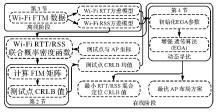
图1
Wi-Fi RSS/RTT定位最优AP布局方法框架"
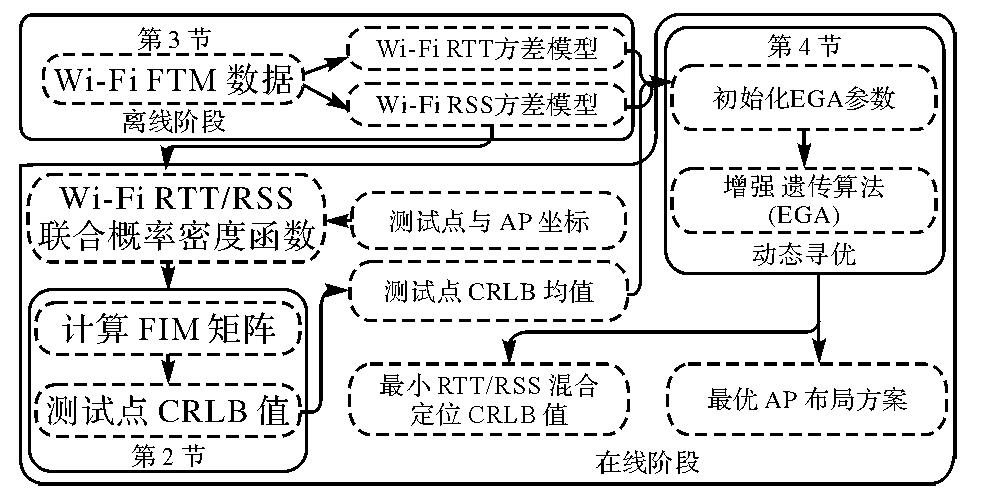
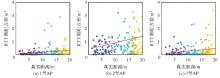
图2
不同的Wi-Fi AP在不同距离下RTT测距时的误差方差分布"
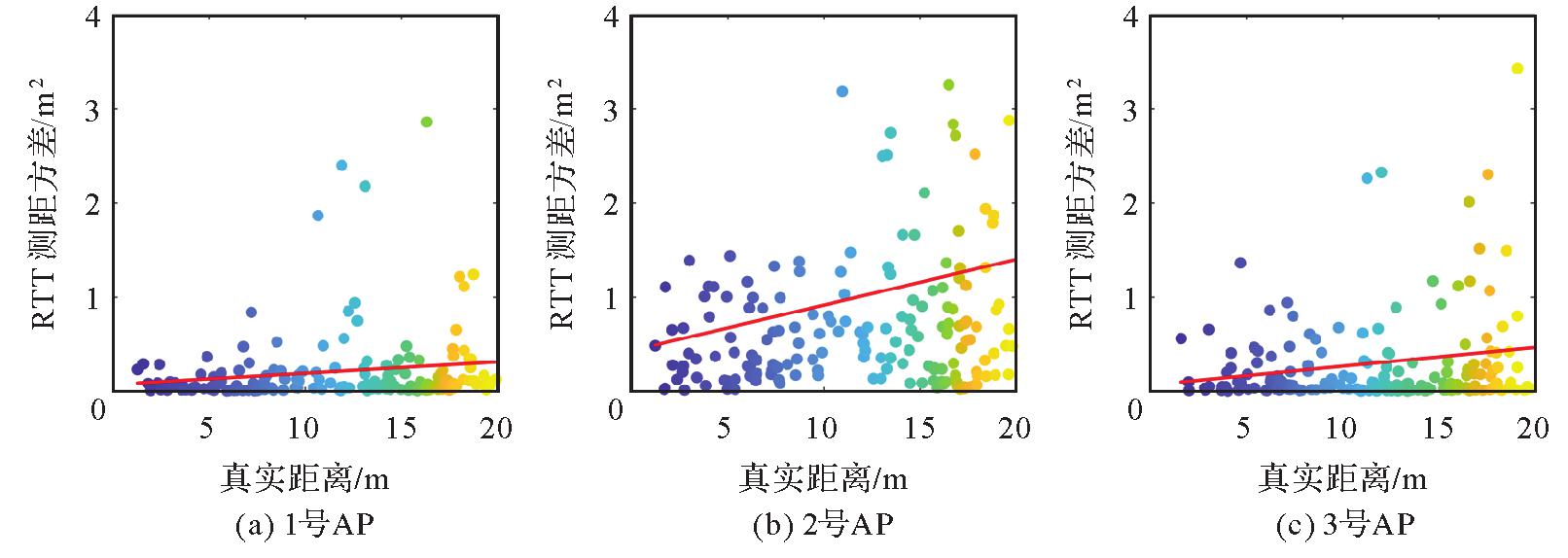
图3
不同的Wi-Fi AP在不同距离下RSS测量时的方差分布"
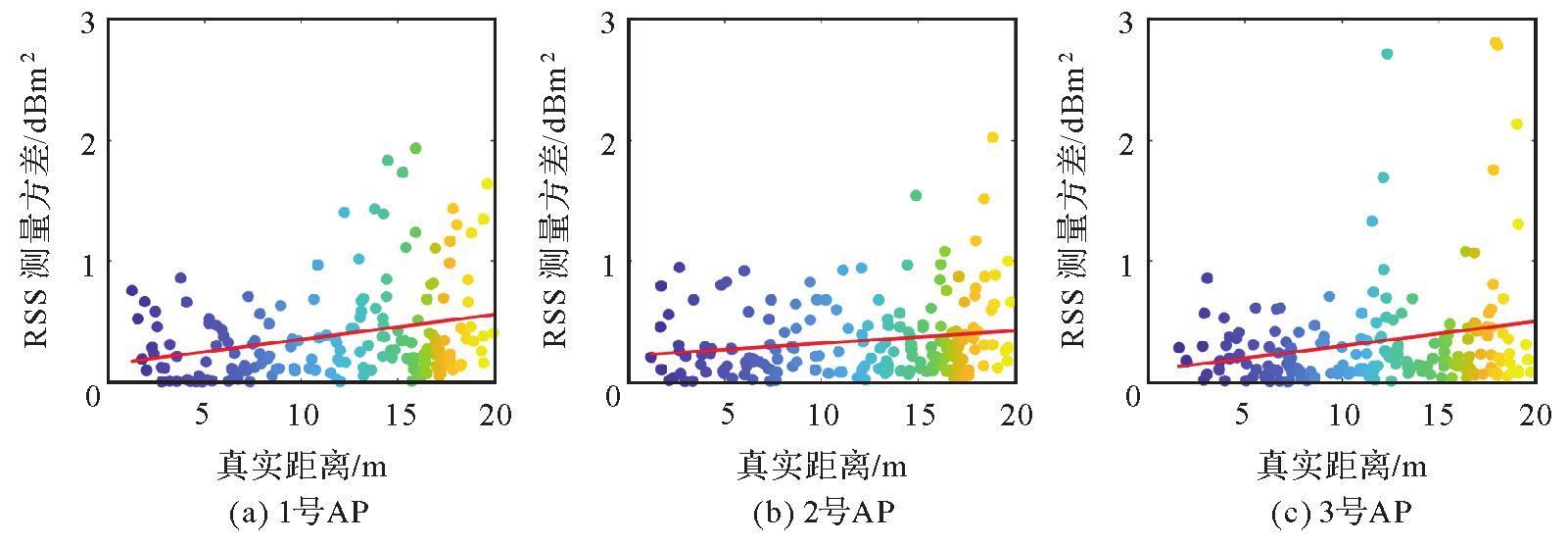
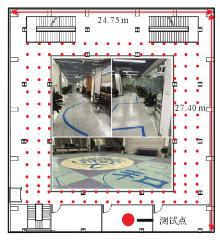
图4
试验场景及设置"
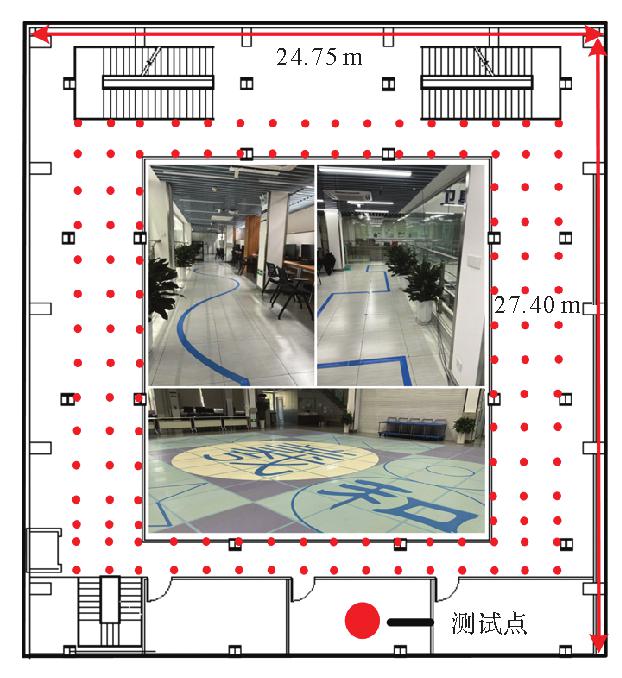
图5
不同定位方法的PEB分布"
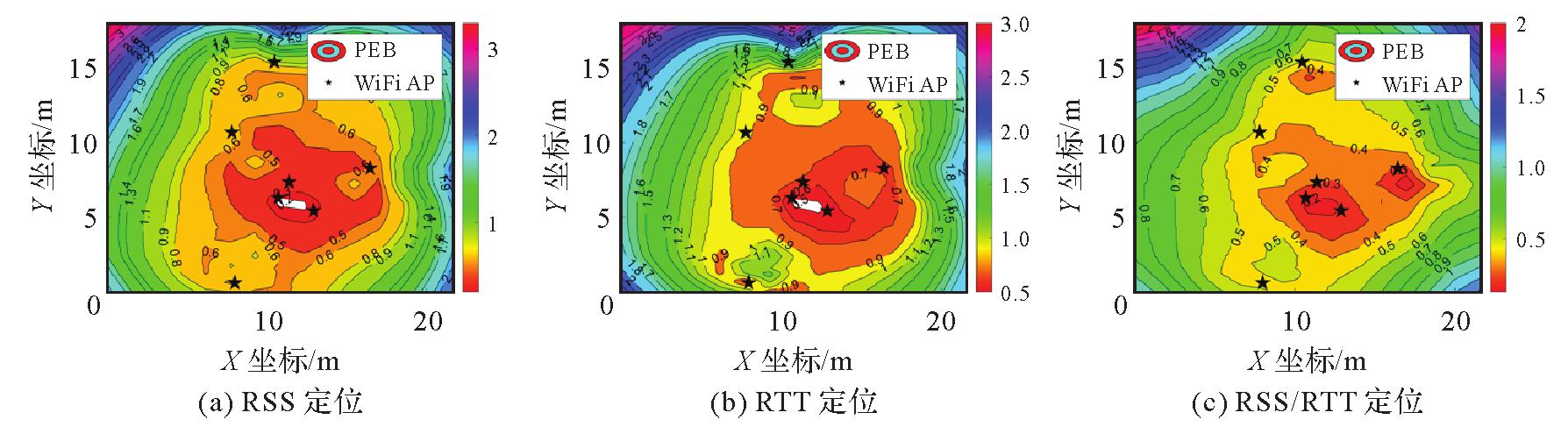
表2
不同定位方法的PEB值"
| 定位方法 | 最小值 | 最大值 | 平均值 | 75 th | 90 th |
|---|---|---|---|---|---|
| RSS | 0.16 | 3.42 | 1.16 | 1.56 | 2.06 |
| RTT | 0.47 | 3.08 | 1.35 | 1.76 | 2.11 |
| RSS/RTT | 0.10 | 2.12 | 0.74 | 0.93 | 1.20 |
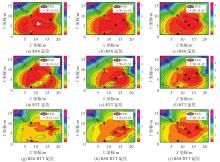
图6
不同AP数量条件下不同定位方法的PEB分布对比"
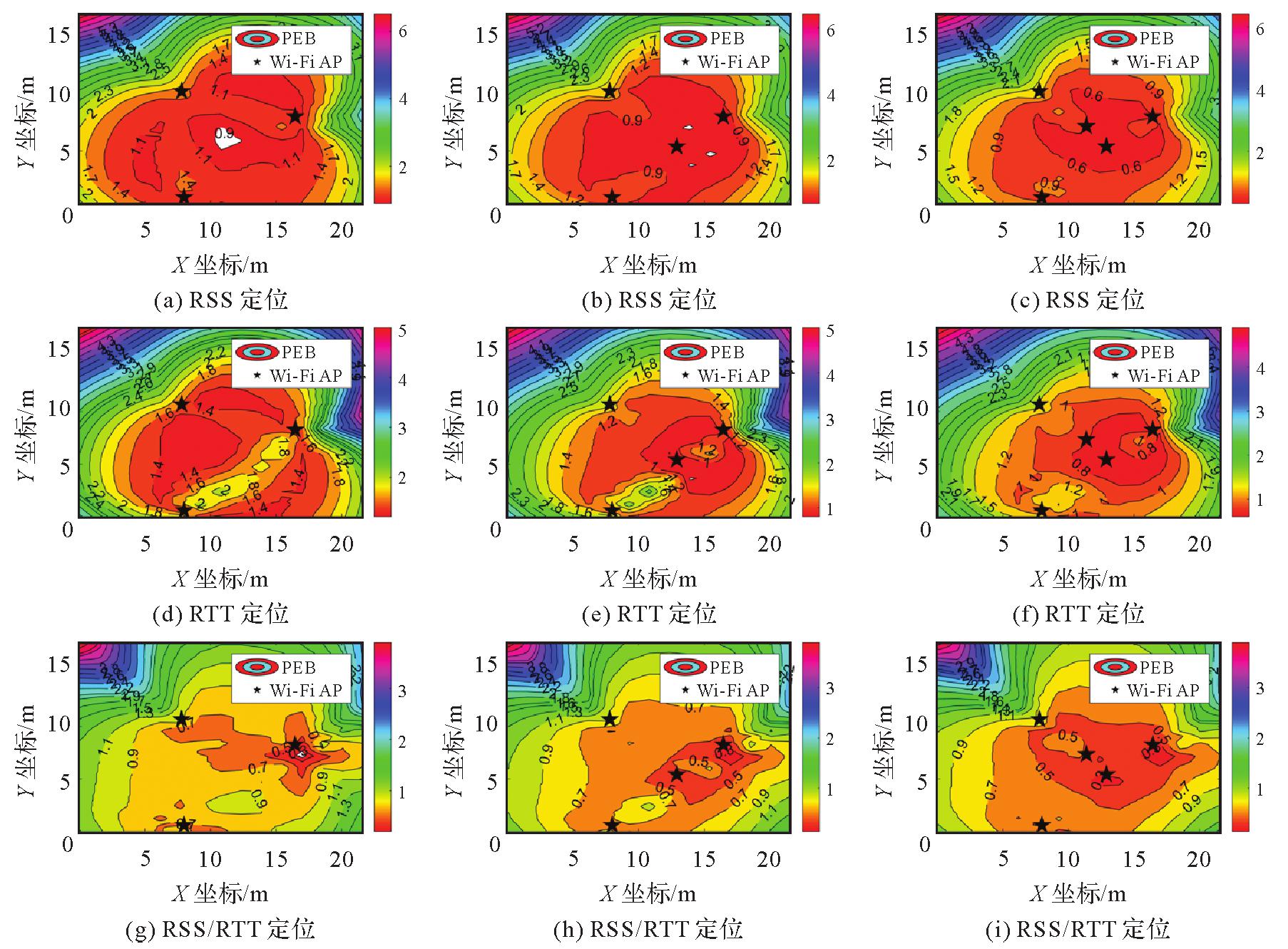
表3
利用不同数量AP时不同定位方法的PEB值"
| AP数量 | 统计量 | RSS/m | RTT/m | RSS/RTT/m |
|---|---|---|---|---|
| 3 | 均值 | 2.05 | 2.32 | 1.20 |
| 75 th | 2.52 | 2.87 | 1.37 | |
| 90 th | 3.61 | 3.78 | 2.03 | |
| 4 | 均值 | 1.88 | 2.13 | 1.09 |
| 75 th | 2.42 | 2.80 | 1.25 | |
| 90 th | 3.51 | 3.71 | 1.94 | |
| 5 | 均值 | 1.78 | 1.97 | 1.00 |
| 75 th | 2.35 | 2.62 | 1.19 | |
| 90 th | 3.46 | 3.55 | 1.78 |
表4
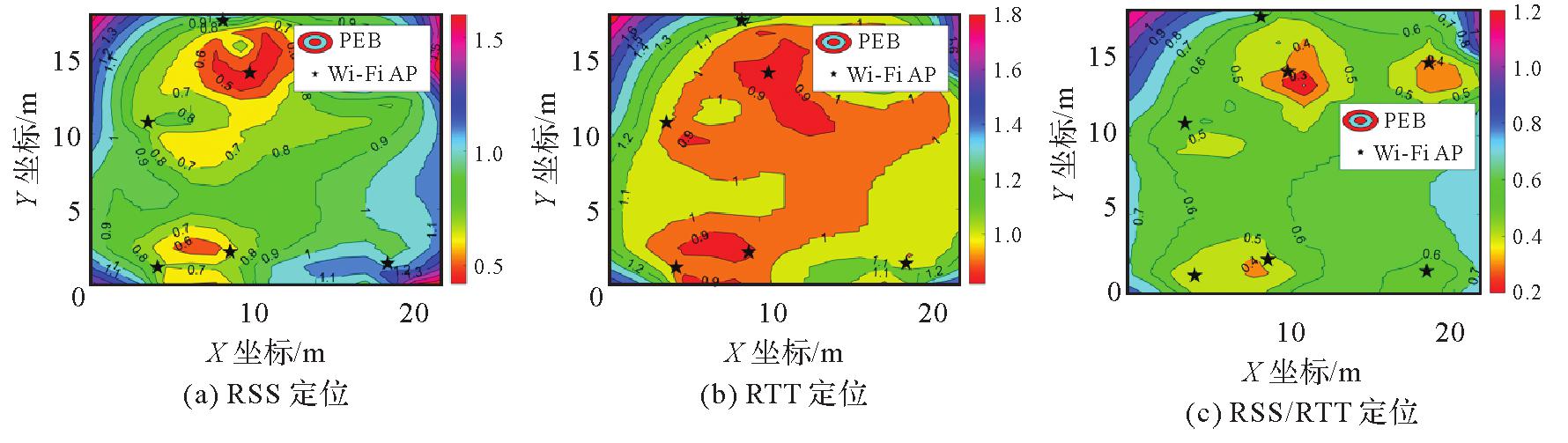
最优AP布局下不同定位方法的PEB值"
| 定位方法 | 最小值 | 最大值 | 平均值 | 75 th | 90 th |
|---|---|---|---|---|---|
| RSS | 0.41 | 1.72 | 0.92 | 1.05 | 1.18 |
| RTT | 0.75 | 1.89 | 1.07 | 1.13 | 1.35 |
| RSS/RTT | 0.17 | 1.23 | 0.61 | 0.68 | 0.77 |
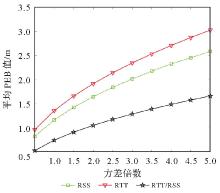
图7
不同方差条件下不同定位方法的PEB均值对比"
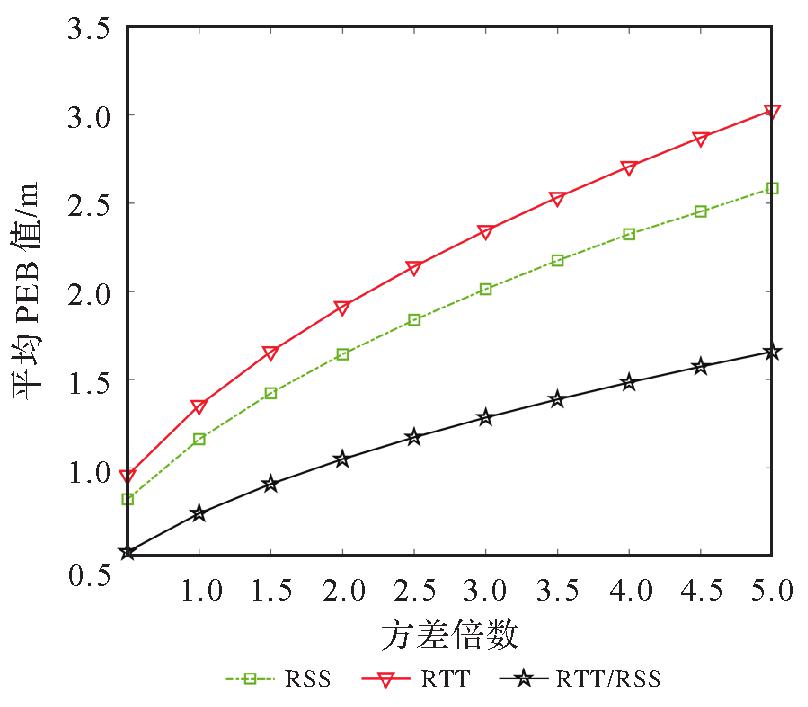
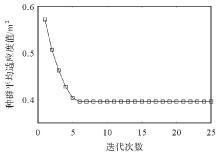
图8
EGA算法的收敛曲线"
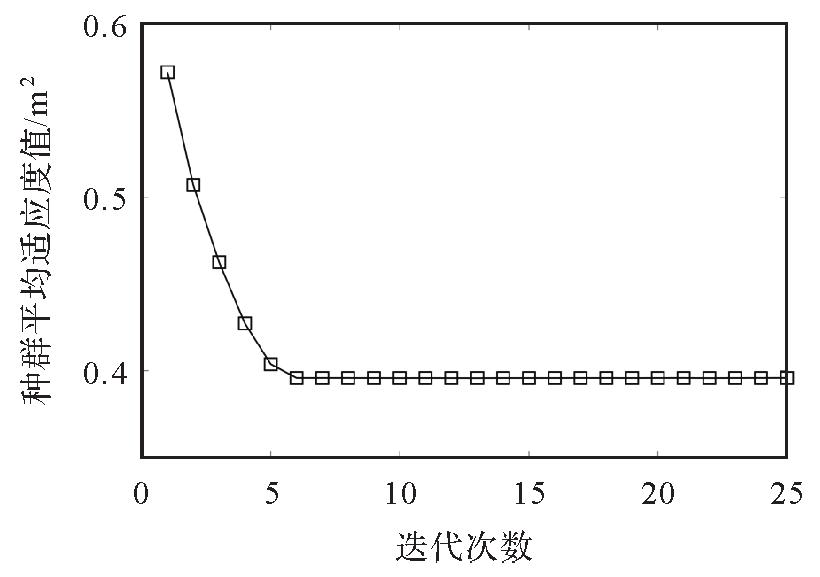
图9
最优AP布局下不同定位方法的PEB分布对比"
| [1] | YANG Yuanxi. Resilient PNT concept frame[J]. Journal of Geodesy and Geoinformation Science, 2019, 2(3):1-7. |
| [2] |
陈锐志, 陈亮. 基于智能手机的室内定位技术的发展现状和挑战[J]. 测绘学报, 2017, 46(10):1316-1326. DOI:.
doi: 10.11947/j.AGCS.2017.20170383 |
|
CHEN Ruizhi, CHEN Liang. Indoor positioning with smartphones: the state-of-the-art and the challenges[J]. Acta Geodaetica et Cartographica Sinica, 2017, 46(10):1316-1326. DOI:.
doi: 10.11947/j.AGCS.2017.20170383 |
|
| [3] |
陈锐志, 郭光毅, 叶锋, 等. 智能手机音频信号与MEMS传感器的紧耦合室内定位方法[J]. 测绘学报, 2021, 50(2):143-152. DOI:.
doi: 10.11947/j.AGCS.2021.20200551 |
|
CHEN Ruizhi, GUO Guangyi, YE Feng, et al. Tightly-coupled integration of acoustic signal and MEMS sensors on smartphones for indoor positioning[J]. Acta Geodaetica et Cartographica Sinica, 2021, 50(2):143-152. DOI:.
doi: 10.11947/j.AGCS.2021.20200551 |
|
| [4] | IEEE Standard Association. IEEE standard for information technology—telecommunications and information exchange between systems local and metropolitan area networks-specific requirements—Part 11: wireless LAN medium access control (MAC) and physical layer (PHY) specifications[S]. [S.l.]: IEEE, 2016. |
| [5] | ANDROID Developers. Wi-Fi location: ranging with RTT[EB/OL]. [2024-02-08]. https://developer.android.com/develop/connectivity/wifi/wifi-rtt. |
| [6] | BANIN L, SCHATZBERG U, AMIZUR Y. WiFi FTM and map information fusion for accurate positioning[C]//Proceedings of 2016 International Conference on Indoor Positioning and Indoor Navigation. Alcalá de Henares: IEEE, 2016. |
| [7] | BANIN L, BAR-SHALOM O, DVORECKI N, et al. Scalable Wi-Fi client self-positioning using cooperative FTM-sensors[J]. IEEE Transactions on Instrumentation and Measurement, 2019, 68(10):3686-3698. |
| [8] | DVORECKI N, BAR-SHALOM O, BANIN L, et al. A machine learning approach for Wi-Fi RTT ranging[C]//Proceedings of 2019 International Technical Meeting of the Institute of Navigation. Reston: Institute of Navigation, 2019. |
| [9] | IBRAHIM M, LIU Hansi, JAWAHAR M, et al. Verification: accuracy evaluation of WiFi fine time measurements on an open platform[C]//Proceedings of the 24th Annual International Conference on Mobile Computing and Networking. New Delhi: ACM Press, 2018. |
| [10] | IBRAHIM M, ROSTAMI A, YU Bo, et al. Wi-Go: accurate and scalable vehicle positioning using WiFi fine timing measurement[C]//Proceedings of the 18th International Conference on Mobile Systems, Applications, and Services. Toronto: ACM Press, 2020. |
| [11] | JIOKENG K, JAKLLARI G, TCHANA A, et al. When FTM discovered MUSIC: accurate WiFi-based ranging in the presence of multipath[C]//Proceedings of 2020 IEEE Conference on Computer Communications. Toronto: IEEE, 2020: 1857-1866. |
| [12] | CHAN Haowei, LAI A I C, WU R B. Transfer learning of Wi-Fi FTM responder positioning with NLOS identification[C]//Proceedings of 2021 IEEE Topical Conference on Wireless Sensors and Sensor Networks. San Diego: IEEE, 2021: 23-26. |
| [13] | DONG Yinhuan, ARSLAN T, YANG Yunjie. Real-time NLOS/LOS identification for smartphone-based indoor positioning systems using WiFi RTT and RSS[J]. IEEE Sensors Journal, 2022, 22(6):5199-5209. |
| [14] | YU Yue, CHEN Ruizhi, CHEN Liang, et al. A robust dead reckoning algorithm based on Wi-Fi FTM and multiple sensors[J]. Remote Sensing, 2019, 11(5):504. |
| [15] | GUO Guangyi, CHEN Ruizhi, YE Feng, et al. Indoor smartphone localization: a hybrid WiFi RTT-RSS ranging approach[J]. IEEE Access, 2019, 7:176767-176781. |
| [16] | GUO Guangyi, CHEN Ruizhi, YE Feng, et al. Arobust integration platform of Wi-Fi RTT, RSS signal, and MEMS-IMU for locating commercial smartphone indoors[J]. IEEE Internet of Things Journal, 2022, 9(17):16322-16331. |
| [17] | YU Yue, CHEN Ruizhi, CHEN Liang, et al. Precise 3D indoor localization based on Wi-Fi FTM and built-in sensors[J]. IEEE Internet of Things Journal, 2020, 7(12):11753-11765. |
| [18] | GUO Guangyi, CHEN Ruizhi, NIU Xiaoguang, et al. Factor graph framework for smartphone indoor localization: integrating data-driven PDR and Wi-Fi RTT/RSS ranging[J]. IEEE Sensors Journal, 2023, 23(11):12346-12354. |
| [19] | SHAO Wenhua, LUO Haiyong, ZHAO Fang, et al. Accurate indoor positioning using temporal-spatial constraints based on Wi-Fi fine time measurements[J]. IEEE Internet of Things Journal, 2020, 7(11):11006-11019. |
| [20] | 阎硕. 基于Wi-Fi精细时间测量的测距定位算法研究[D]. 北京: 北京邮电大学, 2020. |
| YAN Shuo. The research of Wi-Fi fine time measurement based indoor positioning[D]. Beijing: Beijing University of Posts and Telecommunications, 2020. | |
| [21] | 邵文华. 室内移动位置感知关键技术研究[D]. 北京: 北京邮电大学, 2019. |
| SHAO Wenhua. Research on key technologies of indoor mobile location awareness[D]. Beijing: Beijing University of Posts and Telecommunications, 2019. | |
| [22] | SI Minghao, WANG Yunjia, XU Shenglei, et al. A Wi-Fi FTM-based indoor positioning method with LOS/NLOS identification[J]. Applied Sciences, 2020, 10(3):956. |
| [23] | CAO Hongji, WANG Yunjia, BI Jingxue, et al. Indoor positioning method using WiFi RTT based on LOS identification and range calibration[J]. ISPRS International Journal of Geo-Information, 2020, 9(11):627. |
| [24] | SUN Meng, WANG Yunjia, XU Shenglei, et al. Indoor positioning tightly coupled Wi-Fi FTM ranging and PDR based on the extended Kalman filter for smartphones[J]. IEEE Access, 2020, 8:49671-49684. |
| [25] | ZHOU Baoding, WU Zhiqian, CHEN Zhipeng, et al. Wi-Fi RTT/encoder/INS-based robot indoor localization using smartphones[J]. IEEE Transactions on Vehicular Technology, 2023, 72(5):6683-6694. |
| [26] | HUANG Lu, YU Baoguo, LI Hongsheng, et al. HPIPS: a high-precision indoor pedestrian positioning system fusing WiFi-RTT, MEMS, and map information[J]. Sensors, 2020, 20(23):6795. |
| [27] | KAY S M. Fundamentals of statistical signal processing[M]. Englewood Cliffs: Prentice-Hall PTR, 1993. |
| [28] | PLETS D, JOSEPH W, VANHECKE K, et al. Coverage prediction and optimization algorithms for indoor environments[J]. EURASIP Journal on Wireless Communications and Networking, 2012, 2012(1):123. |
| [29] | SUN Meng, WANG Yunjia, XU Shenglei, et al. Indoor geomagnetic positioning using the enhanced genetic algorithm-based extreme learning machine[J]. IEEE Transactions on Instrumentation and Measurement, 2021, 70:1-11. |
| [1] | 祝程程, 李真, 郭金运, 周茂盛, 李婉秋. 基于限定区域的纬度做差法解算宽刈幅测高数据交叉点位置[J]. 测绘学报, 2026, 55(4): 673-683. |
| [2] | 杨小磊, 肖云, 杨丽清, 洪晓东, 郭恩泽, 王翰. 时变重力场反演的改进基线法[J]. 测绘学报, 2026, 55(4): 708-720. |
| [3] | 李洋, 黄海军, 刘素兰, 吴晓辉, 刘琦, 庞琪沛, 吴云龙. 鄱阳湖流域未来百年陆地水储量异常预测及干旱风险评估:基于CMIP6驱动的Transformer-GRU模型[J]. 测绘学报, 2026, 55(4): 721-738. |
| [4] | 杨先圣. 高可用可见光智能定位技术研究[J]. 测绘学报, 2026, 55(4): 753-753. |
| [5] | 耿继军. 基于智能手机多传感器融合的行人室内外定位研究[J]. 测绘学报, 2026, 55(4): 754-754. |
| [6] | 马宏阳. 对流层模型增强的PPP-AR理论方法及在机载导航中的应用研究[J]. 测绘学报, 2026, 55(4): 756-756. |
| [7] | 刘航. 联合地基GNSS和星载GNSS-R的低纬电离层闪烁监测及预报方法研究[J]. 测绘学报, 2026, 55(4): 758-758. |
| [8] | 刘海锋. 基于GNSS无线电掩星的电离层突发E层时空分布研究[J]. 测绘学报, 2026, 55(4): 759-759. |
| [9] | 王家耀, 陈琳, 程士源, 王利军, 熊思奇. 人工智能赋能地图科学数智化[J]. 测绘学报, 2026, 55(3): 381-389. |
| [10] | 吴汤婷, 罗馨语, 卢立果, 刘站科, 超能芳. 基于GNSS和GRACE/GRACE-FO的陕甘宁地区水资源与水文干旱特征时空变化评价[J]. 测绘学报, 2026, 55(3): 439-450. |
| [11] | 马中民, 张双成, 周昕, 刘奇, 刘宁, 王恒利. 顾及地表反射率不确定性的风云三号GNSS-R洪涝监测方法:以8·2广东极端暴雨灾害为例[J]. 测绘学报, 2026, 55(3): 451-464. |
| [12] | 周瑞, 朱锋, 张小红. 基于先验位姿与运动编排的相机惯导外参标定方法[J]. 测绘学报, 2026, 55(3): 465-476. |
| [13] | 刘婧璇, 刘学习, 张克非, 杨超, 吴素芹, 朱守庆, 郭福东. 基于LSTM模型与加权最小二乘组合的日长变化预测方法[J]. 测绘学报, 2026, 55(3): 477-489. |
| [14] | 侯文韬, 肖云, 曹杰, 王宇康, 曹春婷, 王翰. 基于特征加权CatBoost模型的重力卫星反演地下水储量变化降尺度方法[J]. 测绘学报, 2026, 55(3): 490-501. |
| [15] | 徐磊. GNSS区域电离层精细化建模理论与方法研究[J]. 测绘学报, 2026, 55(3): 565-565. |
| 阅读次数 | ||||||
|
全文 |
|
|||||
|
摘要 |
|
|||||
