

Acta Geodaetica et Cartographica Sinica ›› 2026, Vol. 55 ›› Issue (3): 404-414.doi: 10.11947/j.AGCS.2026.20250352
• New Theories and Methods of Cartography in the Digital and Intelligent Era • Previous Articles Next Articles
Min YANG1( ), Hongran MA1, Bo KONG1(), Pengcheng LIU2,3, Tinghua AI1
Received:2025-08-26
Revised:2026-03-17
Online:2026-04-16
Published:2026-04-16
Contact:
Bo KONG
E-mail:yangmin2003@whu.edu.cn;bokong@whu.edu.cn
About author:YANG Min (1985—), male, professor, majors in geospatial deep learning and intelligent cartography. E-mail: yangmin2003@whu.edu.cn
Supported by:CLC Number:
Min YANG, Hongran MA, Bo KONG, Pengcheng LIU, Tinghua AI. A pre-trained model-based method for discriminating morphological patterns of vector-based coastlines[J]. Acta Geodaetica et Cartographica Sinica, 2026, 55(3): 404-414.
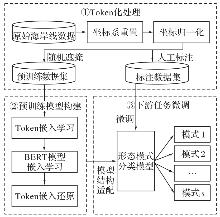
Fig. 1
A pre-trained model-based method for discriminating the morphological patterns of vector-based coastlines"
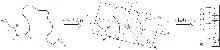
Fig. 2
Tokenization process of a vector-based coastline"
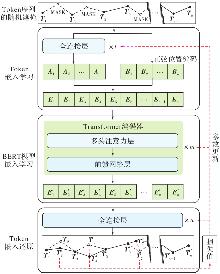
Fig. 3
A pre-trained model for learning coastline geometric features"
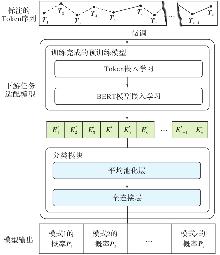
Fig. 4
Fine-tuning module for coastline morphological pattern discrimination"
Fig. 5
Coastlines with different morphological patterns"
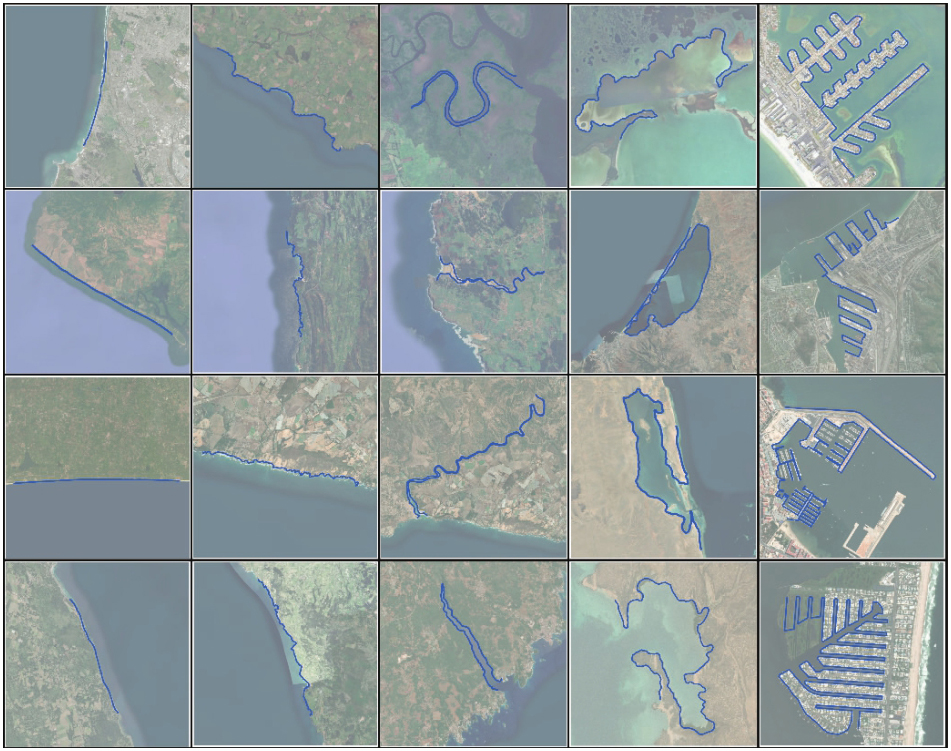
Fig. 6
Changes of model losses during the pre-training process"
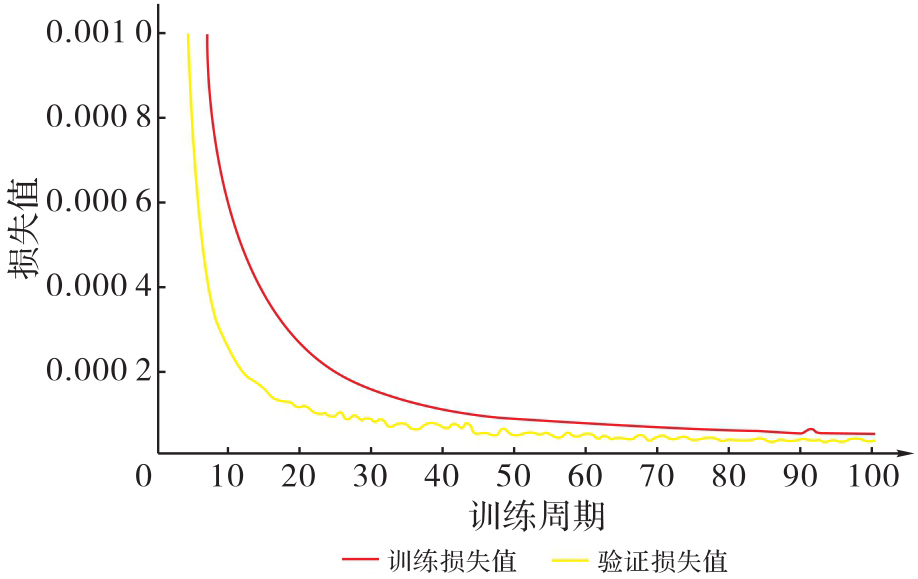
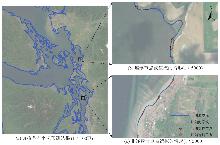
Fig. 7
Coordinate prediction results for masked nodes by the pre-trained model"

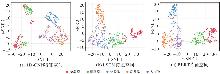
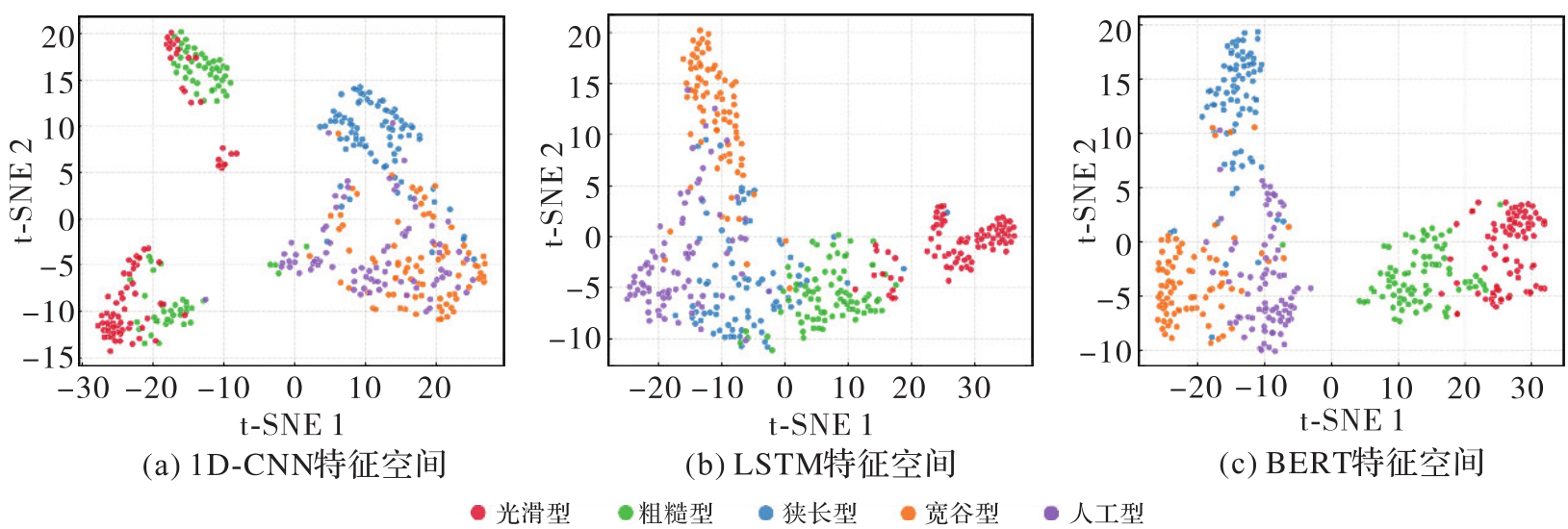
Fig. 8
Two-dimensional visualization results of coastline embedding vectors learned by three methods"
Tab. 1
Precision, recall, and F1 score of the morphology pattern discrimination on the test dataset using three methods"
| 方法 | 精准率 | 召回率 | F1值 |
|---|---|---|---|
| 1D-CNN | 81.76 | 81.50 | 81.34 |
| LSTM | 83.81 | 83.25 | 83.41 |
| BERT | 90.83 | 90.75 | 90.72 |

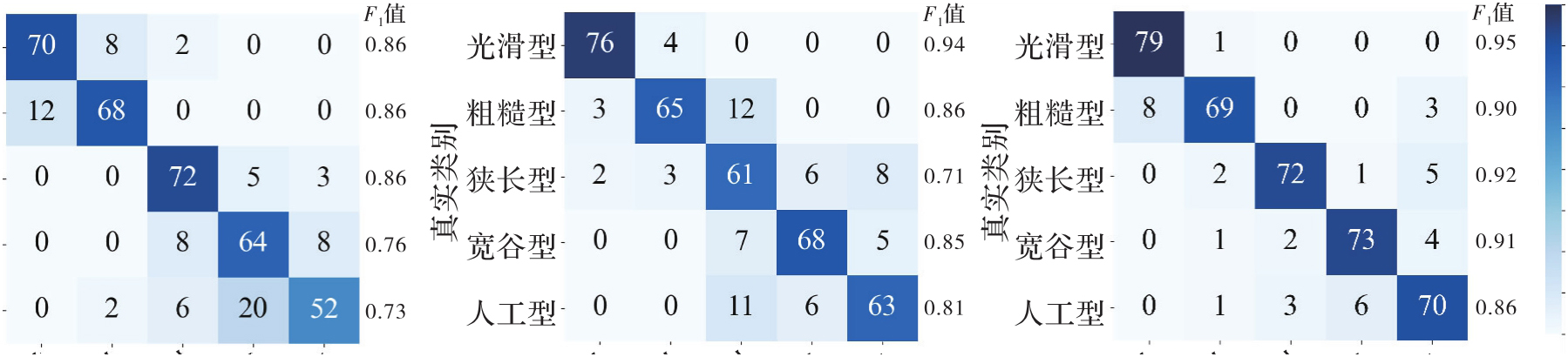
Fig. 9
Confusion matrices of coastline morphological pattern discrimination on the test dataset using three methods"
Tab. 2
Typical cases of coastline morphological pattern discrimination"
| 案例 | 海岸线形态 | 方法 | 判别概率 | ||||
|---|---|---|---|---|---|---|---|
| 光滑型 | 粗糙型 | 狭长型 | 宽谷型 | 人工型 | |||
| 案例1(狭长型) | 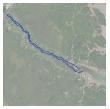 | 1D-CNN | 0.00 | 44.07 | 55.93 | 0.00 | 0.00 |
| LSTM | 2.19 | 63.31 | 34.38 | 0.00 | 0.12 | ||
| BERT | 0.00 | 13.24 | 86.76 | 0.00 | 0.00 | ||
| 案例2(宽谷型) | 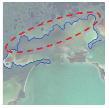 | 1D-CNN | 0.00 | 57.04 | 0.22 | 41.05 | 1.69 |
| LSTM | 2.48 | 33.19 | 1.30 | 61.05 | 1.98 | ||
| BERT | 0.00 | 17.00 | 0.00 | 79.13 | 3.87 | ||
| 案例3(人工型) | 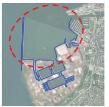 | 1D-CNN | 0.00 | 0.00 | 10.27 | 56.09 | 33.64 |
| LSTM | 0.00 | 2.20 | 0.30 | 22.14 | 75.36 | ||
| BERT | 0.00 | 1.66 | 0.17 | 0.00 | 98.17 | ||
Tab. 3
Typical cases of coastline morphological pattern misclassification using the proposed approach"
| 案例 | 海岸线形态 | 方法 | 判别概率 | ||||
|---|---|---|---|---|---|---|---|
| 光滑型 | 粗糙型 | 狭长型 | 宽谷型 | 人工型 | |||
| 案例1(狭长型) | 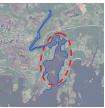 | 1D-CNN | 0.00 | 9.46 | 15.72 | 68.31 | 6.51 |
| LSTM | 0.00 | 7.22 | 28.25 | 64.53 | 0.00 | ||
| BERT | 0.00 | 16.34 | 35.92 | 47.74 | 0.00 | ||
| 案例2(人工型) | 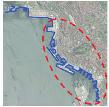 | 1D-CNN | 3.21 | 73.13 | 0.25 | 10.40 | 13.01 |
| LSTM | 0.79 | 63.56 | 2.06 | 20.93 | 12.66 | ||
| BERT | 0.00 | 84.04 | 0.00 | 0.00 | 15.96 | ||
| [1] | 骆永明. 中国海岸带可持续发展中的生态环境问题与海岸科学发展[J]. 中国科学院院刊, 2016, 31(10): 1133-1142. |
| LUO Yongming. Sustainability associated coastal eco-environmental problems and coastal science development in China[J]. Bulletin of the Chinese Academy of Sciences, 2016, 31(10): 1133-1142. | |
| [2] | JOHNSON D W. Shore processes and shoreline development[M]. New York: Wiley, 1919: 159-190. |
| [3] | 修淳, 霍素霞, 姚海燕, 等. 注重新形势下自然岸线管控的海岸线分类体系探讨[J]. 地理科学, 2022, 42(2): 333-342. |
| XIU Chun, HUO Suxia, YAO Haiyan, et al. Coastline classification for strictly controlling natural coastline in the new era[J]. Scientia Geographica Sinica, 2022, 42(2): 333-342. | |
| [4] | 贾建军, 蔡廷禄, 刘毅飞, 等. 考虑人类活动的海岸线分类体系:近期浙江省海岸线调查的实践与思考[J]. 海洋科学, 2019, 43(10): 13-23. |
| JIA Jianjun, CAI Tinglu, LIU Yifei, et al. A classification of coastline considering the impacts of human activities: remarks on latest practices on coastline survey in Zhejiang province[J]. Marine Sciences, 2019, 43(10): 13-23. | |
| [5] | AI Tinghua, ZHOU Qi, ZHANG Xiang, et al. A simplification of ria coastline with geomorphologic characteristics preserved[J]. Marine Geodesy, 2014, 37(2): 167-186. |
| [6] |
杜佳威, 武芳, 李靖涵, 等. 一种河口湾海岸线渐进化简方法[J]. 测绘学报, 2018, 47(4): 547-556. DOI: .
doi: 10.11947/j.AGCS.2018.20170440 |
|
DU Jiawei, WU Fang, LI Jinghan, et al. A progressive simplification method for the estuary coastline[J]. Acta Geodaetica et Cartographica Sinica, 2018, 47(4): 547-556. DOI: .
doi: 10.11947/j.AGCS.2018.20170440 |
|
| [7] | 刘鹏程, 杨琴. 贝叶斯模型下面向地图表达的海岸线分段模型[J]. 计算机工程与应用, 2016, 52(22): 174-179. |
| LIU Pengcheng, YANG Qin. Coastline segment model research for map generalization based on Bayesian method[J]. Computer Engineering and Applications, 2016, 52(22): 174-179. | |
| [8] | MANDELBROT B. How long is the coast of Britain statistical self-similarity and fractional dimension[J]. Science, 1967, 156(3775): 636-638. |
| [9] |
艾廷华. 深度学习赋能地图制图的若干思考[J]. 测绘学报, 2021, 50(9): 1170-1182. DOI: .
doi: 10.11947/j.AGCS.2021.20210091 |
|
AI Tinghua. Some thoughts on deep learning enabling cartography[J]. Acta Geodaetica et Cartograpgica Sinica, 2021, 50(9): 1170-1182. DOI: .
doi: 10.11947/j.AGCS.2021.20210091 |
|
| [10] |
刘鹏程, 黄欣, 马宏然, 等. 建筑物多边形高精度识别的傅里叶形状描述子神经网络方法[J]. 测绘学报, 2022, 51(9): 1969-1976. DOI: .
doi: 10.11947/j.AGCS.2022.20210730 |
|
LIU Pengcheng, HUANG Xin, MA Hongran, et al. Fourier descriptor-based neural network method for high-precision shape recognition of building polygon[J]. Acta Geodaetica et Cartograpgica Sinica, 2022, 51(9): 1969-1976. DOI: .
doi: 10.11947/j.AGCS.2022.20210730 |
|
| [11] |
晏雄锋, 袁拓, 杨敏, 等. 建筑物形状特征分析表达与自适应化简方法[J]. 测绘学报, 2022, 51(2): 269-278. DOI: .
doi: 10.11947/j.AGCS.2022.20210302 |
|
YAN Xiongfeng, YUAN Tuo, YANG Min, et al. An adaptive building simplification approach based on shape analysis and representation[J]. Acta Geodaetica et Cartograpgica Sinica, 2022, 51(2): 269-278. DOI: .
doi: 10.11947/j.AGCS.2022.20210302 |
|
| [12] |
于洋洋, 贺康杰, 武芳, 等. 面状居民地形状分类的图卷积神经网络方法[J]. 测绘学报, 2022, 51(11): 2390-2402. DOI: .
doi: 10.11947/j.AGCS.2022.20210134 |
|
YU Yangyang, HE Kangjie, WU Fang, et al. Graph convolution neural network method for shape classification of areal settlements[J]. Acta Geodaetica et Cartograpgica Sinica, 2022, 51(11): 2390-2402. DOI: .
doi: 10.11947/j.AGCS.2022.20210134 |
|
| [13] |
张付兵, 孙群, 马京振, 等. 融合全局和局部特征的建筑物形状智能分类方法[J]. 测绘学报, 2024, 53(9): 1842-1852. DOI: .
doi: 10.11947/j.AGCS.2024.20240040 |
|
ZHANG Fubing, SUN Qun, MA Jingzheng, et al. An intelligent classification method for building shape based on fusion of global and local features[J]. Acta Geodaetica et Cartograpgica Sinica, 2024, 53(9): 1842-1852. DOI: .
doi: 10.11947/j.AGCS.2024.20240040 |
|
| [14] | YANG Min, JIANG Chenjun, YAN Xiongfeng, et al. Detecting interchanges in road networks using a graph convolutional network approach[J]. International Journal of Geographical Information Science, 2022, 36(6): 1119-1139. |
| [15] |
何海威, 钱海忠, 谢丽敏, 等. 立交桥识别的CNN卷积神经网络法[J]. 测绘学报, 2018, 47(3): 385-395. DOI: .
doi: 10.11947/j.AGCS.2018.20170265 |
|
HE Haiwei, QIAN Haizhong, XIE Limin, et al. Interchange recognition method based on CNN[J]. Acta Geodaetica et Cartograpgica Sinica, 2018, 47(3): 385-395. DOI: .
doi: 10.11947/j.AGCS.2018.20170265 |
|
| [16] | YU Huafei, AI Tinghua, Yang Min, et al. A recognition method for drainage patterns using a graph convolutional network[J]. International Journal of Applied Earth Observation and Geoinformation, 2022, 107: 102696. |
| [17] |
余华飞, 邱天奇, 周哲, 等. 图Transformer支持下的河网模式识别[J]. 测绘学报, 2024, 53(11): 2075-2085. DOI: .
doi: 10.11947/j.AGCS.2024.20230582 |
|
YU Huafei, QIU Tianqi, ZHOU Zhe, et al. Drainage pattern recognition supported by graph Transformer[J]. Acta Geodaetica et Cartograpgica Sinica, 2024, 53(11): 2075-2085. DOI: .
doi: 10.11947/j.AGCS.2024.20230582 |
|
| [18] |
孔博, 艾廷华, 杨敏, 等. 等高线形态知识与图神经网络联合作用下的黄土地貌类型识别[J]. 测绘学报, 2024, 53(6): 1154-1164. DOI: .
doi: 10.11947/j.AGCS.2024.20230445 |
|
KONG Bo, AI Tinghua, YANG Min, et al. Identification of loess landform types jointly affected by contour morphological knowledge and the graph neural network[J]. Acta Geodaeticaet Cartograpgica Sinica, 2024, 53(6): 1154-1164. DOI: .
doi: 10.11947/j.AGCS.2024.20230445 |
|
| [19] | GAO Aji, AI Tinghua, YU Huafei, et al. A vector-based coastline shape classification approach using sequential deep learning model[J]. International Journal of Applied Earth Observation and Geoinformation, 2024, 129: 103810. |
| [20] |
杨敏, 陈果, 李连营, 等. 序列卷积神经网络支持下线状地图目标的分段方法[J]. 测绘学报, 2023, 52(1): 108-116. DOI: .
doi: 10.11947/j.AGCS.2023.20210317 |
|
YANG Min, CHEN Guo, LI Lianying, et al. Segmentation of linear map objects using sequential convolutional neural network[J]. Acta Geodaetica et Cartograpgica Sinica, 2023, 52(1): 108-116. DOI: .
doi: 10.11947/j.AGCS.2023.20210317 |
|
| [21] | PATWARDHAN N, MARRONE S, SANSONE C. Transformers in the real world: a survey on NLP applications[J]. Information, 2023, 14(4): 242. |
| [22] | SCHMIRLER R, HEINZINGER M, ROST B. Fine-tuning protein language models boosts predictions across diverse tasks[J]. Nature Communications, 2024, 15(1): 7407. |
| [23] | DEVLIN J, CHANG M-W, LEE K, et al. Bert: pre-training of deep bidirectional transformers for language understanding[C]//Proceedings of 2019 Conference of the North American Chapter of the Association for Computational Linguistics: Human Language Technologies. Minnesota: Association for Computational Linguistics, 2019: 4171-4186. |
| [24] | YAN Xiongfeng, YANG Min, AI Tinghua. Deep learning in automatic map generalization: achievements and challenges[J]. Geo-spatial Information Science, 2025, 28(6): 2905-2926. |
| [25] | MIKOLOV T, SUTSKEVER I, CHEN K, et al. Distributed representations of words and phrases and their compositionality[C]//Proceedings of the 27th Annual Conference on Neural Information Processing Systems. Red Hook: Curran Associates Inc., 2013: 3111-3119. |
| [26] | VASWANI A, SHAZEER N, PARMAR N, et al. Attention is all you need[C]//Proceedings of the 31st International Conference on Neural Information Processing Systems. Red Hook: Curran Associates Inc., 2017: 6000-6010. |
| [27] | LECUN Y, BOTTOU L, BENGIO Y, et al. Gradient-based learning applied to document recognition[J]. Proceedings of the IEEE, 1998, 86(11): 2278-2324. |
| [28] | HOCHREITER S, SCHMIDHUBER J. Long short-term memory[J]. Neural Computation, 1997, 9(8): 1735-1780. |
| [29] | VAN DER MAATEN L. Accelerating t-SNE using tree-based algorithms[J]. The Journal of Machine Learning Research, 2014, 15(1): 3221-3245. |
| [30] | HUBERT L, ARABIE P. Comparing partitions[J]. Journal of Classification, 1985, 2(1): 193-218. |
| [31] | VINH N X, EPPS J, BAILEY J. Information theoretic measures for clusterings comparison: variants, properties, normalization and correction for chance[J]. Journal of Machine Learning Research, 2010(11): 2837-2854. |
| [32] | STEINLEY D. Properties of the hubert-arabie adjusted rand index[J]. Psychological Methods, 2004, 9(3): 386-396. |
| [33] | 刘鹏程, 艾廷华, 杨敏. 基于傅里叶级数的等高线网络渐进式传输模型[J]. 测绘学报, 2012, 41(2): 284-290. |
| LIU Pengcheng, AI Tinghua, YANG Min. The internet progressive transmission model for contour based on Fourier series[J]. Acta Geodaetica et Cartographica Sinica, 2012, 41(2): 284-290. |
| [1] | Mingguang WU, Ziming CHENG. Color generation method for green maps considering use contexts [J]. Acta Geodaetica et Cartographica Sinica, 2026, 55(3): 390-403. |
| [2] | Wenhao YU, Ziyi ZENG, Yifan ZHANG, Haizhong QIAN. Road network grid pattern analysis using a pre-trained model fusing spatial and topological information [J]. Acta Geodaetica et Cartographica Sinica, 2026, 55(3): 415-424. |
| [3] | Xiaomin LU, Zhiyi ZHANG, Haowen YAN, Yi HE, Xiaoning SU. A recognition method for building group pattern integrating deep graph infomax and multilayer perceptron [J]. Acta Geodaetica et Cartographica Sinica, 2026, 55(3): 425-438. |
| [4] | Xiaoqiang CHENG, Jiawei ZHAO, Pengcheng LIU. Spatial interaction visualization based on the distance-similarity metaphor [J]. Acta Geodaetica et Cartographica Sinica, 2026, 55(3): 536-547. |
| [5] | Zejiao WANG, Longgang XIANG, Meng WANG, Xingjuan WANG, Qing LIU. Hierarchical feature and diversified attention fusion network for collaborative extraction of road surface and centerline [J]. Acta Geodaetica et Cartographica Sinica, 2026, 55(3): 548-563. |
| [6] | Zhibang XU. Hierarchical boundary identification, pattern analysis and expansion simulation of physical cities [J]. Acta Geodaetica et Cartographica Sinica, 2026, 55(3): 566-566. |
| [7] | Yunbo RAN, Xue YANG, Wenhao ZHOU, Chengen WU, Baoding ZHOU, Luliang TANG, Qingquan LI. Pedestrian path planning driven by preference-enhanced adversarial deep reinforcement learning [J]. Acta Geodaetica et Cartographica Sinica, 2026, 55(2): 191-205. |
| [8] | Lizeng WANG, Shifen CHENG, Yitao YANG, Peixiao WANG, Feng LU. LGA-EL: a spatio-temporal adaptive ensemble method with local-global awareness for traffic prediction [J]. Acta Geodaetica et Cartographica Sinica, 2026, 55(2): 206-221. |
| [9] | Shaohua WANG, Haojian LIANG, Cheng SU, Dachuan XU, Liang ZHOU, Kun QIN. Advances and prospects in urban facility allocation optimization through coupling spatio-temporal big data and artificial intelligence [J]. Acta Geodaetica et Cartographica Sinica, 2026, 55(2): 222-235. |
| [10] | Xiao FU, Sirui ZHU, Xudong LI, Guonian LÜ. An optimization method for the layout of urban vertiports in long-distance commuting scenarios [J]. Acta Geodaetica et Cartographica Sinica, 2026, 55(2): 236-248. |
| [11] | Junhao GUO, Mingzhi WU, Peixiao WANG, Hengcai ZHANG. A dual-threshold stay point detection method based on adaptive extended density peak clustering for sparse fixed-point trajectories [J]. Acta Geodaetica et Cartographica Sinica, 2026, 55(2): 249-260. |
| [12] | Guannan LI. Method for automatic construction of three dimensional real scene model of the road [J]. Acta Geodaetica et Cartographica Sinica, 2026, 55(2): 378-378. |
| [13] | Pengcheng LIU, Xiaoqiang CHENG, Tianyuan XIAO, Min YANG, Tinghua AI. A Transformer model for building polygon simplification in map generalization [J]. Acta Geodaetica et Cartographica Sinica, 2026, 55(1): 124-137. |
| [14] | Biao HE, Haojia LIN, Renzhong GUO, Xi KUAI, Ding MA, Chen ZHANG. Visual perception-based quantitative calculation of 3D spatial similarity relations [J]. Acta Geodaetica et Cartographica Sinica, 2026, 55(1): 138-153. |
| [15] | Weilian LI, Qingqing RAN, Pei DANG, Jun ZHU, Qing ZHU, Heng ZHANG. A coupled LLMs-KG method for cascading flood vulnerability analysis of underground station facilities [J]. Acta Geodaetica et Cartographica Sinica, 2026, 55(1): 154-168. |
| Viewed | ||||||
|
Full text |
|
|||||
|
Abstract |
|
|||||
