


测绘学报 ›› 2025, Vol. 54 ›› Issue (7): 1206-1214.doi: 10.11947/j.AGCS.2025.20240406
胡辉雯1,2( ), 沈聪1,2, 柳林涛1(), 王国成1
收稿日期:2024-10-11
修回日期:2025-06-20
出版日期:2025-08-18
发布日期:2025-08-18
通讯作者:
柳林涛
E-mail:huhuiwen@apm.ac.cn;llt@asch.whigg.ac.cn
作者简介:胡辉雯(1997—),男,博士,研究方向为时延估计、阵列信号处理、麦克风阵列定向。E-mail:huhuiwen@apm.ac.cn
基金资助:
Huiwen HU1,2(), Cong SHEN1,2, Lintao LIU1(), Guocheng WANG1
Received:2024-10-11
Revised:2025-06-20
Online:2025-08-18
Published:2025-08-18
Contact:
Lintao LIU
E-mail:huhuiwen@apm.ac.cn;llt@asch.whigg.ac.cn
About author:HU Huiwen (1997—), male, PhD, majors in time delay estimation, array signal processing, and microphone array orientation. E-mail: huhuiwen@apm.ac.cn
Supported by:摘要:
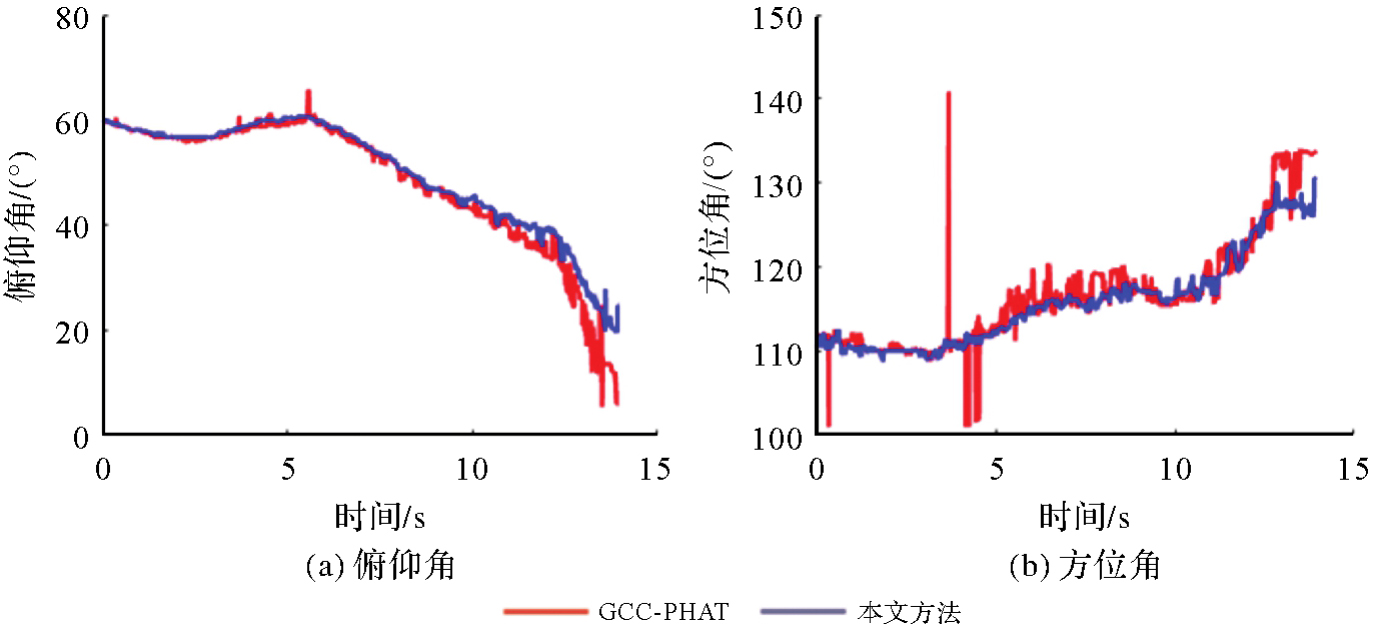
针对广义互相关-PHAT(generalized cross correlation-PHAT,GCC-PHAT)中不能合理反映两信号的相关性、存在边缘效应问题,导致在目标被动定向中时延估计扭曲、精度低、有时无法定向目标等现象,本文提出了一种基于皮尔逊相关系数的时延估计方法。该方法利用皮尔逊相关系数合理地、精确地测量两个信号的相关性,并利用平移观测信号与参考信号求滑动皮尔逊相关系数,通过绝对值的峰值所在位置来估计时延。仿真试验表明,与GCC-PHAT相比,本文方法在时延估计的有效值比例上提高了14.67个百分点,在时延估计的精度上提高了92.67个百分点,在目标定向的精度上提高了88.24个百分点。将本文方法应用于麦克风阵列定向无人机试验,试验结果进一步验证了本文方法在时延估计和目标定向上的高稳健性和高精确性,并且在目标方向的稳定点比例上较GCC-PHAT提高了28.66个百分点。
中图分类号:
胡辉雯, 沈聪, 柳林涛, 王国成. 皮尔逊相关系数时延估计在声学定向上的应用[J]. 测绘学报, 2025, 54(7): 1206-1214.
Huiwen HU, Cong SHEN, Lintao LIU, Guocheng WANG. Pearson correlation coefficient time delay estimation applied in acoustic orientation[J]. Acta Geodaetica et Cartographica Sinica, 2025, 54(7): 1206-1214.
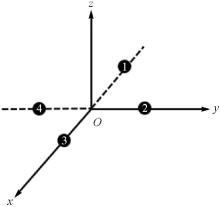
图1
四元十字型阵列"

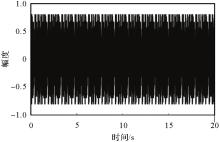
图2
目标发出的信号"
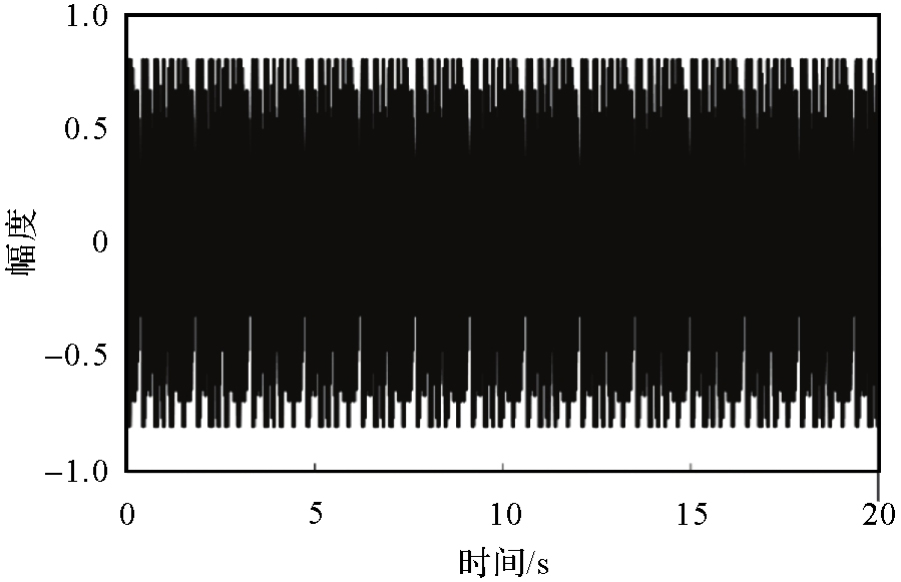
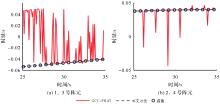
图3
两个阵元间不同方法估计的时延和真时延"

表1
时延估计的统计值"
| 阵元序号 | 异常值个数的比例/(%) | 去异常值后均方根误差/(°) | ||
|---|---|---|---|---|
| GCC-PHAT | 本文方法 | GCC-PHAT | 本文方法 | |
| 1、2 | 14.00 | 0.00 | 1.5×10⁻⁴ | 1.1×10⁻⁵ |
| 1、3 | 48.00 | 0.00 | 2.2×10⁻⁴ | 2.9×10⁻⁴ |
| 1、4 | 0.00 | 0.00 | 2.1×10⁻⁵ | 1.5×10⁻⁵ |
| 2、3 | 3.00 | 0.00 | 1.6×10⁻⁵ | 1.3×10⁻⁵ |
| 2、4 | 8.00 | 0.00 | 7.7×10⁻⁵ | 7.8×10⁻⁶ |
| 3、4 | 15.00 | 0.00 | 1.0×10⁻⁵ | 1.0×10⁻⁵ |
表2
目标定向的统计值"
| 目标方向 | 方法 | 定向方程组有解的比例/(%) | 异常值个数的比例/(%) | 去异常值后均方根误差/(°) |
|---|---|---|---|---|
| 俯仰角 | GCC-PHAT | 71.00 | 28.17 | 0.54 |
| 本文方法 | 100.00 | 0.00 | 0.13 | |
| 方位角 | GCC-PHAT | 71.00 | 21.13 | 0.85 |
| 本文方法 | 100.00 | 0.00 | 0.10 |
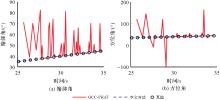
图4
目标方向"

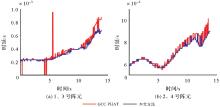
图5
两个阵元间GCC-PHAT和本文方法估计的时延"
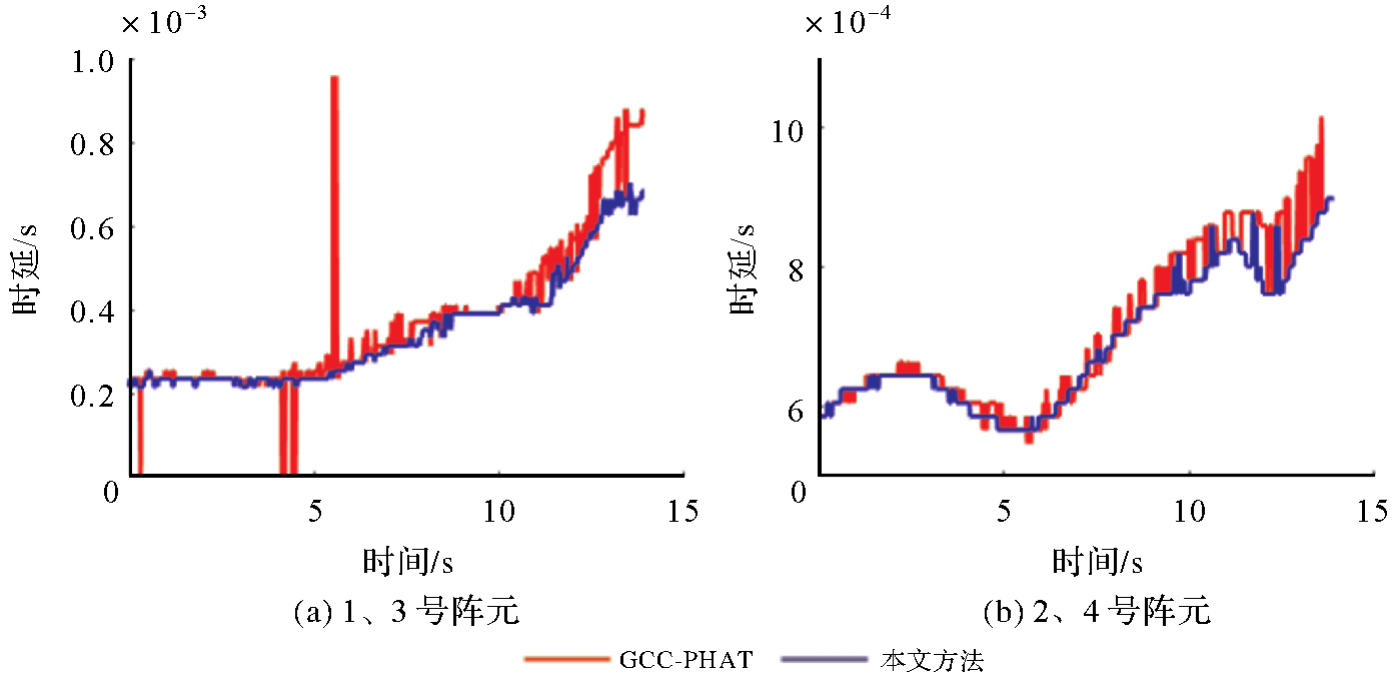
表3
无人机定向的统计值"
| 方法 | 定向方程组有解的比例 | 在俯仰角稳定性上占优比例 | 在方位角稳定性上占优比例 |
|---|---|---|---|
| GCC-PHAT | 98.22 | 35.67 | 39.89 |
| 本文方法 | 100.00 | 64.33 | 60.11 |
图6
无人机方向"
| [1] | LI Fu, VACCARO R J. Unified analysis for DOA estimation algorithms in array signal processing[J]. Signal Processing, 1991, 25(2): 147-169. |
| [2] | LIAO Bin, MADANAYAKE A, AGATHOKLIS P. Array signal processing and systems[J]. Multidimensional Systems and Signal Processing, 2018, 29(2): 467-473. |
| [3] | 蒋德军, 胡涛. 时延估计技术及其在多途环境中的应用[J]. 声学学报, 2001, 26(1): 34-40. |
| JIANG Dejun, HU Tao. Time-delay estimation and its application in multipath environment[J]. Acta Acustica, 2001, 26(1): 34-40. | |
| [4] | DA ROSA ZANATTA M, LÓPES DE MENDONÇA F L, ANTREICH F, et al. Tensor-based time-delay estimation for second and third generation global positioning system[J]. Digital Signal Processing, 2019, 92: 1-19. |
| [5] | AZARIA M, HERTZ D. Time delay estimation by generalized cross correlation methods[J]. IEEE Transactions on Acoustics, Speech, and Signal Processing, 1984, 32(2): 280-285. |
| [6] | 张传义, 卢晓. 基于广义互功率谱相位法的声源定位技术[J]. 东北大学学报(自然科学版), 2018, 39(8): 1075-1079. |
| ZHANG Chuanyi, LU Xiao. Sound source localization technology based on generalized cross-power spectrum phase[J]. Journal of Northeastern University (Natural Science), 2018, 39(8): 1075-1079. | |
| [7] | GAO Y, BRENNAN M J, JOSEPH P F. A comparison of time delay estimators for the detection of leak noise signals in plastic water distribution pipes[J]. Journal of Sound and Vibration, 2006, 292(3-5): 552-570. |
| [8] | ZHANG Cheng, SHEN Shihui, HUANG Hai, et al. Estimation of the vehicle speed using cross-correlation algorithms and MEMS wireless sensors[J]. Sensors, 2021, 21(5): 1721. |
| [9] | COBOS M, ANTONACCI F, COMANDUCCI L, et al. Frequency-sliding generalized cross-correlation: a sub-band time delay estimation approach[J]. IEEE/ACM Transactions on Audio, Speech, and Language Processing, 2020, 28: 1270-1281. |
| [10] | 李皖婷, 李登峰, 张修靖, 等. 指数形式的二次相关GCC-PHAT-β时延估计算法[J]. 科学技术与工程, 2022, 22(33): 14779-14785. |
| LI Wanting, LI Dengfeng, ZHANG Xiujing, et al. Exponential quadratic correlation GCC-PHAT-β delay estimation algorithm[J]. Science Technology and Engineering, 2022, 22(33): 14779-14785. | |
| [11] | 梁宇, 马良, 纳霞, 等. 基于广义互相关算法的时延估计[J]. 计算机科学, 2011, 38(): 454-456. |
| LIANG Yu, MA Liang, NA Xia, et al. Research of time delay estimation based on GCC algorithm[J]. Computer Science, 2011, 38(): 454-456. | |
| [12] | 邢毓华, 郑琦. 广义互相关在混沌扩频时延估计中的研究与应用[J]. 激光与光电子学进展, 2021, 58(23): 1907001. |
| XING Yuhua, ZHENG Qi. Research and application of generalized cross correlation in chaotic spread spectrum time delay estimation[J]. Laser & Optoelectronics Progress, 2021, 58(23): 1907001. | |
| [13] | NIKIAS C L, PAN R. Time delay estimation in unknown Gaussian spatially correlated noise[J]. IEEE Transactions on Acoustics, Speech, and Signal Processing, 1988, 36(11): 1706-1714. |
| [14] | TUGNAIT J K. Time delay estimation with unknown spatially correlated Gaussian noise[C]//Proceedings of 1991 International Conference on Acoustics, Speech, and Signal Processing. Toronto: IEEE, 1991: 1265-1268. |
| [15] | LIU Qing, HAN Shuangwang, MA Xiaoshu. Research of time delay estimation based on higher order statistics[J]. Applied Mechanics and Materials, 2014, 530-531. |
| [16] | ARULAMPALAM M S, MASKELL S, GORDON N, et al. A tutorial on particle filters for online nonlinear/non-Gaussian Bayesian tracking[J]. IEEE Transactions on Signal Processing, 2002, 50(2): 174-188. |
| [17] | HAYES E E, THORP S, MANDEL K S, et al. Gaussn: Bayesian time-delay estimation for strongly lensed supernovae[J]. Monthly Notices of the Royal Astronomical Society, 2024, 530(4): 3942-3963. |
| [18] | CHAN K L, WANG Zhuoru, DING Aijun, et al. MAX-DOAS and OMI measurements of tropospheric NO2 and HCHO over Eastern China[J]. Journal of Geodesy and Geoinformation Science, 2020, 3(4): 1-13. |
| [19] | REN Dong, WANG Yong, WANG Guocheng, et al. Rising trends of global precipitable water vapor and its correlation with flood frequency[J]. Geodesy and Geodynamics, 2023, 14(4): 355-367. |
| [20] | RUSAKOV D A. A misadventure of the correlation coefficient[J]. Trends in Neurosciences, 2023, 46(2): 94-96. |
| [21] | CHEN Kai, CHEN Li, XIAO Jiaqi, et al. Speckle reduction in digital holography with non-local means filter based on the Pearson correlation coefficient and Butterworth filter[J]. Optics Letters, 2022, 47(2): 397-400. |
| [22] | 路晓妹, 寇文珍, 段渭军. 基于EMD分解重构的互相关时延估计方法[J]. 测控技术, 2013, 32(7): 45-48, 56. |
| LU Xiaomei, KOU Wenzhen, DUAN Weijun. Cross-correlation delay estimation method based on EMD decomposition and reconstruction algorithm[J]. Measurement & Control Technology, 2013, 32(7): 45-48, 56. | |
| [23] | CHEN Lai, KANG Chaogui, YANG Chao. Understanding citizens' emotion states under the urban livability environment through social media data: a case study of Wuhan[J]. Journal of Geodesy and Geoinformation Science, 2022, 5(2): 49-59. |
| [24] |
张春森, 张萌萌, 郭丙轩. 影像信息驱动的三角网格模型优化方法[J]. 测绘学报, 2018, 47(7): 959-967. DOI: .
doi: 10.11947/j.AGCS.2018.20170733 |
|
ZHANG Chunsen, ZHANG Mengmeng, GUO Bingxuan. Refinement of the 3D mesh model driven by the image information[J]. Acta Geodaetica et Cartographica Sinica, 2018, 47(7): 959-967. DOI: .
doi: 10.11947/j.AGCS.2018.20170733 |
|
| [25] | 王兆瑞, 张杰. 一种基于小波变换的波达方向估计方法[J]. 测绘学报, 2011, 40(): 111-114. |
| WANG Zhaorui, ZHANG Jie. A method of DOA estimation based on wavelet transform[J]. Acta Geodaetica et Cartographica Sinica, 2011, 40(): 111-114. | |
| [26] | YANG Xu, XING Hongyan, YAN Yan. A data complementary method for sound source localization based on four-element microphone array groups[J]. Measurement Science and Technology, 2021, 32(9): 095015. |
| [27] | LI Yang, ZOU Xihua, LIU Puyu, et al. Four-element array for GNSS attitude determination using IRLS: an improved rounding of long-short baseline approach[J]. IEEE Transactions on Vehicular Technology, 2020, 69(5): 4920-4934. |
| [1] | 祝程程, 李真, 郭金运, 周茂盛, 李婉秋. 基于限定区域的纬度做差法解算宽刈幅测高数据交叉点位置[J]. 测绘学报, 2026, 55(4): 673-683. |
| [2] | 杨小磊, 肖云, 杨丽清, 洪晓东, 郭恩泽, 王翰. 时变重力场反演的改进基线法[J]. 测绘学报, 2026, 55(4): 708-720. |
| [3] | 李洋, 黄海军, 刘素兰, 吴晓辉, 刘琦, 庞琪沛, 吴云龙. 鄱阳湖流域未来百年陆地水储量异常预测及干旱风险评估:基于CMIP6驱动的Transformer-GRU模型[J]. 测绘学报, 2026, 55(4): 721-738. |
| [4] | 杨先圣. 高可用可见光智能定位技术研究[J]. 测绘学报, 2026, 55(4): 753-753. |
| [5] | 耿继军. 基于智能手机多传感器融合的行人室内外定位研究[J]. 测绘学报, 2026, 55(4): 754-754. |
| [6] | 马宏阳. 对流层模型增强的PPP-AR理论方法及在机载导航中的应用研究[J]. 测绘学报, 2026, 55(4): 756-756. |
| [7] | 刘航. 联合地基GNSS和星载GNSS-R的低纬电离层闪烁监测及预报方法研究[J]. 测绘学报, 2026, 55(4): 758-758. |
| [8] | 刘海锋. 基于GNSS无线电掩星的电离层突发E层时空分布研究[J]. 测绘学报, 2026, 55(4): 759-759. |
| [9] | 王家耀, 陈琳, 程士源, 王利军, 熊思奇. 人工智能赋能地图科学数智化[J]. 测绘学报, 2026, 55(3): 381-389. |
| [10] | 吴汤婷, 罗馨语, 卢立果, 刘站科, 超能芳. 基于GNSS和GRACE/GRACE-FO的陕甘宁地区水资源与水文干旱特征时空变化评价[J]. 测绘学报, 2026, 55(3): 439-450. |
| [11] | 马中民, 张双成, 周昕, 刘奇, 刘宁, 王恒利. 顾及地表反射率不确定性的风云三号GNSS-R洪涝监测方法:以8·2广东极端暴雨灾害为例[J]. 测绘学报, 2026, 55(3): 451-464. |
| [12] | 周瑞, 朱锋, 张小红. 基于先验位姿与运动编排的相机惯导外参标定方法[J]. 测绘学报, 2026, 55(3): 465-476. |
| [13] | 刘婧璇, 刘学习, 张克非, 杨超, 吴素芹, 朱守庆, 郭福东. 基于LSTM模型与加权最小二乘组合的日长变化预测方法[J]. 测绘学报, 2026, 55(3): 477-489. |
| [14] | 侯文韬, 肖云, 曹杰, 王宇康, 曹春婷, 王翰. 基于特征加权CatBoost模型的重力卫星反演地下水储量变化降尺度方法[J]. 测绘学报, 2026, 55(3): 490-501. |
| [15] | 徐磊. GNSS区域电离层精细化建模理论与方法研究[J]. 测绘学报, 2026, 55(3): 565-565. |
| 阅读次数 | ||||||
|
全文 |
|
|||||
|
摘要 |
|
|||||
