

Acta Geodaetica et Cartographica Sinica ›› 2025, Vol. 54 ›› Issue (9): 1537-1560.doi: 10.11947/j.AGCS.2025.20250274
• Review • Next Articles
Jiancheng LI1( ), Yunlong WU2(), Yibing YAO3, Zhicai LUO4
Received:2025-07-08
Revised:2025-09-15
Online:2025-10-10
Published:2025-10-10
Contact:
Yunlong WU
E-mail:jcli@whu.edu.cn;wuyunlong@cug.edu.cn
About author:LI Jiancheng (1964—), male, professor, academician of Chinese Academy of Engineering, majors in satellite geodesy and physical geodesy. E-mail: jcli@whu.edu.cn
Supported by:CLC Number:
Jiancheng LI, Yunlong WU, Yibing YAO, Zhicai LUO. Satellite gravity technology oriented towards data-scenario-model driven approach: developments, challenges and outlook[J]. Acta Geodaetica et Cartographica Sinica, 2025, 54(9): 1537-1560.

Fig. 1
Development of gravity satellite missions"

Tab. 1
GRACE science products"
| 数据处理级别 | 数据产品/工具名 | 平台名 | 发布源 |
|---|---|---|---|
| L3 | Land Water-Equivalent-Thickness/Ocean Bottom Pressure | PODAAC | |
| L3 | Mascon | PODAAC | |
| L4 | Antarctica/Greenland/Ocean Mass Anomaly | PODAAC | |
| L4 | GRACE(-FO)Data Analysis Tool | JPL | |
| L3 | Mascon | CSR | |
| L3 | Mascon | GSFC | |
| L4 | Trend | GSFC | |
| L4 | Mascon Visualization Tool | CCAR | |
| L4 | 3D Visualisation | ICGEM | |
| L3/L4 | Terrestrial Water Storage/Groundwater Storage/Ocean Bottom Pressure | GravIS | |
| L4 | The COST-G Plotter | COST-G |
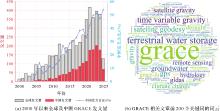
Fig. 2
GRACE-related publications and keyword cloud (top 200 keywords) in the world and China since 2000 (Note: Data retrieved from Web of Science using the keywords “GRACE/GRACE-FO” and “Satellite”)"


Fig. 3
Spatial coverage of GRACE satellite ground tracks over periods ranging from one day to one month[166]"


Fig. 4
GRACE gravity satellite and its primary detection targets: ocean mass changes, glacier melting, terrestrial water storage variations, and solid Earth mass redistribution such as large earthquakes[179]"

Tab. 2
Precision requirements for gravity field inversion in different geophysical disciplines[181]"
| 应用领域 | 大地水准面/cm | 重力异常/mGal | 空间分辨率(半波长)/km | |
|---|---|---|---|---|
| 大地测量学 | GPS水准 | ~1 | 100~1000 | |
| 统一高程水准 | <5 | 50~100 | ||
| 惯性导航系统 | 1~5 | 100~1000 | ||
| 精密定轨 | 1~3 | 100~1000 | ||
| 固体地球物理学 | 地质构造移动 | 1~2 | 100~500 | |
| 地震灾害 | ~1 | 100~1000 | ||
| 海洋学 | 小尺度 | 1~2 | 60~250 | |
| 洋盆尺度 | <1 | 1000 | ||
| 冰川学 | 冰川的垂直运动 | ~2 | 1~5 | 50~200 |
| 水资源学 | 地表水/地下水 | 0.5~1 | 100~500 | |
| [1] | BAKER R M L. Orbit determination from range and range rate data[C]//Proceedings of 1960 Semi-Annual Meeting of the American Rocket Society. Los Angeles: ARS Preprint. 1960: 1220-1260. |
| [2] | WOLFF M. Direct measurements of the Earth's gravitational potential using a satellite pair[J]. Journal of Geophysical Research (1896—1977), 1969, 74(22): 5295-300. |
| [3] | EL-BAZ F, WARNER D M. Apollo-Soyuz test project: astronomy, Earth atmosphere and gravity field, life sciences, and materials processing[R]. [S.l.]: Scientific and Technical Information Office, National Aeronautics and Space Administration, 1977. |
| [4] | REIGBER C, LÜHR H, SCHWINTZER P. CHAMP mission status[J]. Advances in Space Research, 2002, 30(2): 129-134. |
| [5] | FLOBERGHAGEN R, FEHRINGER M, LAMARRE D, et al. Mission design, operation and exploitation of the gravity field and steady-state ocean circulation explorer mission[J]. Journal of Geodesy, 2011, 85(11): 749-758. |
| [6] | 罗子人, 张敏, 靳刚, 等. 中国空间引力波探测“太极计划”及“太极1号”在轨测试[J]. 深空探测学报, 2020, 7(1): 3-10. |
| LUO Ziren, ZHANG Min, JIN Gang, et al. Introduction of Chinese space-borne gravitational wave detection program “Taiji” and “Taiji-1” satellite mission[J]. Journal of Deep Space Exploration, 2020, 7(1): 3-10. | |
| [7] | 罗俊, 艾凌皓, 艾艳丽, 等. 天琴计划简介[J]. 中山大学学报(自然科学版), 2021, 60(1): 1-19. |
| LUO Jun, AI Linghao, AI Yanli, et al. A brief introduction to the TianQin Project[J]. Acta Scientiarum Naturalium Universitatis Sunyatseni, 2021, 60(1): 1-19. | |
| [8] | 肖云, 杨元喜, 潘宗鹏, 等. 中国卫星跟踪卫星重力测量系统性能与应用[J]. 科学通报, 2023, 68(20): 2655-2664. |
| XIAO Yun, YANG Yuanxi, PAN Zongpeng, et al. Performance and application of the Chinese satellite-to-satellite tracking gravimetry system[J]. Chinese Science Bulletin, 2023, 68(20): 2655-2664. | |
| [9] | DARAS I, MARCH G, PAIL R, et al. Mass-change and Geosciences International Constellation (MAGIC) expected impact on science and applications[J]. Geophysical Journal International, 2024, 236(3): 1288-1308. |
| [10] | BENDER P L, CONKLIN J W, WIESE D N. Short-period mass variations and the next generation gravity mission[J]. Journal of Geophysical Research: Solid Earth, 2025, 130: e2024JB030290. |
| [11] | LEMOINE J M, MANDEA M. The MARVEL gravity and reference frame mission proposal[C]//Proceedings of 2020 EGU General Assembly Conference Abstracts. [S.l.]: IEEE, 2020: 13359. |
| [12] | LÉVÈQUE T, FALLET C, MANDEA M, et al. Gravity field mapping using laser-coupled quantum accelerometers in space[J]. Journal of Geodesy, 2021, 95(1): 15. |
| [13] | MIGLIACCIO F, REGUZZONI M, BATSUKH K, et al. MOCASS: a satellite mission concept using cold atom interferometry for measuring the Earth gravity field[J]. Surveys in Geophysics, 2019, 40(5): 1029-1053. |
| [14] | LUTHCKE S B, SAIF B, FISHER K, et al. Atom interferometer gravity gradiometer (AIGG) instrument technology development readiness, flight implementation, and expected performance[R]. Washington, D. C: NASA's CORE 2.0 Report, 2021. |
| [15] | PIE N, BETTADPUR S V, TAMISIEA M, et al. “Time variable earth gravity field models from the first spaceborne laser ranging interferometer”[J]. Journal of Geophysical Research Solid Earth, 2021, 126(12): e2021JB022392. |
| [16] | 尹恒, 朱紫彤, 闫易浩, 等. GRACE-FO重力卫星激光干涉测距原始数据预处理[J]. 地球物理学报, 2025, 68(5): 1615-1632. |
| YIN Heng, ZHU Zitong, YAN Yihao, et al. Raw data processing of laser ranging interferometer for GRACE-FO gravity satellite[J]. Chinese Journal of Geophysics, 2025, 68(5): 1615-1632. | |
| [17] | STRAY B, LAMB A, KAUSHIK A, et al. Quantum sensing for gravity cartography[J]. Nature, 2022, 602(7898): 590-594. |
| [18] | STRAY B, BOSCH-LLUIS X, THOMPSON R, et al. Quantum gravity gradiometry for future mass change science[J]. EPJ Quantum Technology, 2025, 12(1): 35. |
| [19] | CHRISTOPHE B, BOULANGER D, FOULON B, et al. A new generation of ultra-sensitive electrostatic accelerometers for GRACE Follow-on and towards the next generation gravity missions[J]. Acta Astronautica, 2015, 117: 1-7. |
| [20] | RUMMEL R, YI Weiyong, STUMMER C. GOCE gravitational gradiometry[J]. Journal of Geodesy, 2011, 85(11): 777-790. |
| [21] | FROMMKNECHT B. Integrated sensor analysis of the GRACE mission[D]. München: Technische Universität MüNchen, 2007. |
| [22] | STUMMER C, SIEMES C, PAIL R, et al. Upgrade of the GOCE level 1b gradiometer processor[J]. Advances in Space Research, 2012, 49(4): 739-752. |
| [23] | PAIL R. A parametric study on the impact of satellite attitude errors on GOCE gravity field recovery[J]. Journal of Geodesy, 2005, 79(4): 231-241. |
| [24] | RISPENS S, BOUMAN J. External calibration of GOCE accelerations to improve derived gravitational gradients[J]. Journal of Geodetic Science, 2011, 1(2): 114-126. |
| [25] | SIEMES C, REXER M, HAAGMANS R. GOCE star tracker attitude quaternion calibration and combination[J]. Advances in Space Research, 2019, 63(3): 1133-1146. |
| [26] | 吴云龙, 郭泽华, 肖云, 等. 卫星重力梯度观测数据L1级构建方法[J]. 地球物理学报, 2021, 64(12): 4437-4448. |
| WU Yunlong, GUO Zehua, XIAO Yun, et al. L1 level construction method of satellite gravity gradiometry observations[J]. Chinese Journal of Geophysics, 2021, 64(12): 4437-4448. | |
| [27] | 郭泽华. 重力梯度测量卫星0-1级数据预处理研究[D]. 武汉: 中国地震局地震研究所, 2021. |
| GUO Zehua. Research on preprocessing of Level 0-1 data from gravity gradient measurement satellites[D]. Wuhan: Institute of Seismology, China Earthquake Administration, 2021. | |
| [28] |
胡丹怡, 吴云龙, 肖云, 等. 顾及温度效应改正的多星敏感器角速度重建方法[J]. 测绘学报, 2024, 53(9): 1748-1760. DOI: .
doi: 10.11947/j.AGCS.2024.20240093 |
|
HU Danyi, WU Yunlong, XIAO Yun, et al. Multi-star tracker angular velocity reconstruction method considering temperature effect correction[J]. Acta Geodaetica et Cartographica Sinica, 2024, 53(9): 1748-1760. DOI: .
doi: 10.11947/j.AGCS.2024.20240093 |
|
| [29] | TAPLEY B D, BETTADPUR S, WATKINS M, et al. The gravity recovery and climate experiment: mission overview and early results[J]. Geophysical Research Letters, 2004, 31(9): L09607. |
| [30] | 潘宗鹏, 肖云, 刘晓刚, 等. 重力卫星加速度计数据预处理研究[J]. 地球物理学报, 2024, 67(10): 3697-3706. |
| PAN Zongpeng, XIAO Yun, LIU Xiaogang, et al. Research on preprocessing of gravity satellite accelerometer data[J]. Chinese Journal of Geophysics, 2024, 67(10): 3697-3706. | |
| [31] | FLURY J, BETTADPUR S, TAPLEY B D. Precise accelerometry onboard the GRACE gravity field satellite mission[J]. Advances in Space Research, 2008, 42(8): 1414-1423. |
| [32] | PETERSEIM N. TWANGS-high-frequency disturbing signals in the 10 Hz accelerometer data of the GRACE satellites[D]. München: Technische Universität MüNchen, 2014. |
| [33] | MCGIRR R, TREGONING P, ALLGEYER S, et al. Mitigation of thermal noise in GRACE accelerometer observations[J]. Advances in Space Research, 2022, 69(1): 386-401. |
| [34] | MEYER U, JÄGGI A, BEUTLER G. Monthly gravity field solutions based on GRACE observations generated with the Celestial Mechanics Approach[J]. Earth and Planetary Science Letters, 2012, 345: 72-80. |
| [35] | YANG Fan, LIANG Lei, WANG Changqing, et al. Attitude determination for GRACE-FO: reprocessing the level-1A SC and IMU data[J]. Remote Sensing, 2022, 14(1): 126. |
| [36] | BANDIKOVA T, MCCULLOUGH C, KRUIZINGA G L, et al. GRACE accelerometer data transplant[J]. Advances in Space Research, 2019, 64(3): 623-644. |
| [37] | SCHLICHT A. GRACE accelerometers sensitive to ionosphere plasma waves: similarities between twangs and whistlers[J]. Geosciences, 2022, 12(6): 228. |
| [38] | BROCKMANN J M, SCHUBERT T, MAYER-GÜRR T, et al. The Earth's gravity field as seen by the GOCE satellite: an improved sixth release derived with the time-wise approach (GO_CONS_GCF_2_TIM_R6)[DB/OL]. Potsdam: GFZ Data Services, 2019[2025-08-29]. https://doi.org/10.5880/ICGEM.2019.003. |
| [39] | 罗志才, 钟波, 宁津生, 等. 卫星重力梯度测量确定地球重力场的理论与方法[M]. 武汉: 武汉大学出版社, 2015. |
| LUO Zhicai, ZHONG Bo, NING Jinsheng, et al. Theory and method for determining the Earth's gravity field from satellite gravity gradiometry[M]. Wuhan: Wuhan University Press, 2015. | |
| [40] | KVAS A, BROCKMANN J M, KRAUSS S, et al. GOCO06s-a satellite-only global gravity field model[J]. Earth System Science Data, 2021, 13(1): 99-118. |
| [41] | FÖRSTE C, BRUINSMA S, RUDENKO S, et al. EIGEN-6S4: a time-variable satellite-only gravity field model to d/o 300 based on LAGEOS, GRACE and GOCE data from the collaboration of GFZ Potsdam and GRGS Toulouse[C]//Proceedings of the 26th IUGG General Assembly. Prague: IEEE, 2015. |
| [42] | RIES J, BETTADPUR S, EANES R, et al. The combined gravity model GGM05C[DB/OL]. Potsdam: GFZ Data Services, 2016[2025-08-29]. https://doi.org/10.5880/icgem.2016.002. |
| [43] | 苏勇, 范东明, 谷延超. 利用能量守恒法和GOCE卫星轨道数据反演地球重力场模型[J]. 武汉大学学报(信息科学版), 2014, 39(9): 1043-1046. |
| SU Yong, FAN Dongming, GU Yanchao. Gravity field modeling using energy conservation approach and GOCE orbits[J]. Geomatics and Information Science of Wuhan University, 2014, 39(9): 1043-1046. | |
| [44] | LU Biao, LUO Zhicai, ZHONG Bo, et al. The gravity field model IGGT_R1 based on the second invariant of the GOCE gravitational gradient tensor[J]. Journal of Geodesy, 2018, 92(5): 561-572. |
| [45] | ZHOU Hao, LUO Zhicai, ZHOU Zebing, et al. HUST-Grace2016s: a new GRACE static gravity field model derived from a modified dynamic approach over a 13-year observation period[J]. Advances in Space Research, 2017, 60(3): 597-611. |
| [46] | 肖云, 夏哲仁, 孙中苗, 等. 基线法在卫星重力数据处理中的应用[J]. 武汉大学学报(信息科学版), 2011, 36(3): 280-284. |
| XIAO Yun, XIA Zheren, SUN Zhongmiao, et al. Application of an improved dynamic method baseline method to satellite gravtimetry data processing[J]. Geomatics and Information Science of Wuhan University, 2011, 36(3): 280-284. | |
| [47] |
沈云中et al.. 动力学法的卫星重力反演算法特点与改进设想[J]. 测绘学报, 2017, 46(10): 1308-1315. DOI: .
doi: 10.11947/j.AGCS.2017.20170380 |
|
SHEN Yunzhonget al.. Algorithm characteristics of dynamic approach-based satellite gravimetry and its improvement proposals[J]. Acta Geodaetica et Cartographica Sinica, 2017, 46(10): 1308-1315. DOI: .
doi: 10.11947/j.AGCS.2017.20170380 |
|
| [48] | VISSER P N A M. Gravity field determination with GOCE and GRACE[J]. Advances in Space Research, 1999, 23(4): 771-776. |
| [49] | CHEN J, ZHANG X, CHEN Q, et al. Static gravity field recovery and accuracy analysis based on reprocessed GOCE level 1b gravity gradient observations//[C]Proceedings of 2022 EGU general assembly conference abstracts. [S.l.]: IEEE, 2022. |
| [50] | HAO Y Q, LI J C, XU X Y, et al. WHU-SWPU-GOGR2022S: a combined gravity model of GOCE and GRACE[DB/OL]. Potsdam: GFZ Data Services, 2023[2025-08-29]. https://doi.org/10.5880/icgem.2023.003. |
| [51] | 罗志才, 钟波, 周浩, 等. 利用卫星重力测量确定地球重力场模型的进展[J]. 武汉大学学报(信息科学版), 2022, 47(10): 1713-1727. |
| LUO Zhicai, ZHONG Bo, ZHOU Hao, et al. Progress in determining the Earth's gravity field model by satellite gravimetry[J]. Geomatics and Information Science of Wuhan University, 2022, 47(10): 1713-1727. | |
| [52] | 游为, 范东明, 黄强. 卫星重力反演的短弧长积分法研究[J]. 地球物理学报, 2011, 54(11): 2745-2752. |
| YOU Wei, FAN Dongming, HUANG Qiang. Analysis of short-arc integral approach to recover the Earth's gravitational field[J]. Chinese Journal of Geophysics, 2011, 54(11): 2745-2752. | |
| [53] | ZHAO Qile, GUO Jing, HU Zhigang, et al. GRACE gravity field modeling with an investigation on correlation between nuisance parameters and gravity field coefficients[J]. Advances in Space Research, 2011, 47(10): 1833-1850. |
| [54] | ZHOU Hao, ZHENG Lijun, LI Yaozong, et al. Hust-Grace2024: a new grace-only gravity field time series based on more than 20 years of satellite geodesy data and a hybrid processing chain[J]. Earth System Science Data, 2024, 16: 3261-3281. |
| [55] | GUO X, ZHAO Q, DITMAR P, et al. A new time-series of GRACE monthly gravity field solutions obtained by accounting for the colored noise in the K-Band range-rate measurements[DB/OL]. Potsdam: GFZ Data Services, 2017[2025-08-29]. https://doi.org/10.5880/icgem.2017.004. |
| [56] | 苏勇, 范东明. 利用短弧积分法和GOCE轨道数据确定地球重力场模型[J]. 地球物理学进展, 2014, 29(5): 2072-2076. |
| SU Yong, FAN Dongming. Gravity field modeling by using the short-arc integral approach and GOCE orbits[J]. Progress in Geophysics, 2014, 29(5): 2072-2076. | |
| [57] | CHEN Qiujie, SHEN Yunzhong, CHEN Wu, et al. An optimized short-arc approach: methodology and application to develop refined time series of Tongji-Grace 2018 GRACE monthly solutions[J]. Journal of Geophysical Research (Solid Earth), 2019, 124(6): 6010-6038. |
| [58] | 游为. 应用低轨卫星数据反演地球重力场模型的理论和方法[D]. 成都: 西南交通大学, 2011. |
| YOU Wei. Theory and methodology of Earth's gravitational field model recovery by LEO data[D]. Chengdu: Southwest Jiaotong University, 2011. | |
| [59] |
陈秋杰et al.. 基于改进短弧积分法的GRACE重力反演理论、方法及应用[J]. 测绘学报, 2017, 46(1): 130. DOI: .
doi: 10.11947/j.AGCS.2017.20160470 |
|
CHEN Qiujieet al.. Theory, methodology and application of GRACE gravity recovery using modified short arc approach[J]. Acta Geodaetica et Cartographica Sinica, 2017, 46(1): 130. DOI: .
doi: 10.11947/j.AGCS.2017.20160470 |
|
| [60] | 沈云中, 许厚泽, 吴斌. 星间加速度解算模式的模拟与分析[J]. 地球物理学报, 2005, 48(4): 807-811. |
| SHEN Yunzhong, XU Houze, WU Bin. Simulation of recovery of the geopotential model based on intersatellite acceleration data in the low-low satellite to satellite tracking gravity mission[J]. Chinese Journal of Geophysics (in Chinese), 2005, 48(4): 807-811. | |
| [61] | 徐天河. 利用CHAMP卫星轨道和加速度计数据推求地球重力场模型[J]. 测绘学报, 2005, 34(4): 371. |
| XU Tianhe. Gravity field recovery from CHAMP orbits and accelerometer data[J]. Acta Geodaetica et Cartographic Sinica, 2005, 34(4): 371. | |
| [62] | LIU X, DITMAR P, SIEMES C, et al. DEOS mass transport model (DMT-1) based on GRACE satellite data: methodology and validation[J]. Geophysical Journal International, 2010, 181(2): 769-788. |
| [63] | HAN S C, SHUM C K, JEKELI C. Precise estimation of in situ geopotential differences from GRACE low-low satellite-to-satellite tracking and accelerometer data[J]. Journal of Geophysical Research: Solid Earth, 2006, 111(B4): 2005JB003719. |
| [64] | SHANG Kun, GUO Junyi, SHUM C K, et al. GRACE time-variable gravity field recovery using an improved energy balance approach[J]. Geophysical Journal International, 2015, 203(3): 1773-1786. |
| [65] | ZHONG Bo, LI Qiong, CHEN Jianli, et al. Improved estimation of regional surface mass variations from GRACE intersatellite geopotential differences using a priori constraints[J]. Remote Sensing, 2020, 12(16): 2553. |
| [66] | MEYER U, JEAN Y, KVAS A, et al. Combination of GRACE monthly gravity fields on the normal equation level[J]. Journal of Geodesy, 2019, 93(9): 1645-1658. |
| [67] | LANDERER F W, SWENSON S C. Accuracy of scaled GRACE terrestrial water storage estimates[J]. Water Resources Research, 2012, 48(4): W04531. |
| [68] | LANDERER F. TELLUS_GRAC_L3_CSR_RL06_LND_v04. Ver. RL06 v04[DB/OL]. PO. DAAC, 2021[2025-08-29]. https://doi.org/10.5067/TELND-3AC64. |
| [69] | WATKINS M M, WIESE D N, YUAN D N, et al. Improved methods for observing Earth's time variable mass distribution with GRACE using spherical cap mascons[J]. Journal of Geophysical Research (Solid Earth), 2015, 120(4): 2648-2671. |
| [70] | SAVE H, BETTADPUR S, TAPLEY B D. High-resolution CSR grace RL05 mascons[J]. Journal of Geophysical Research: Solid Earth, 2016, 121(10): 7547-7569. |
| [71] | LOOMIS B D, LUTHCKE S B, SABAKA T J. Regularization and error characterization of GRACE mascons[J]. Journal of Geodesy, 2019, 93(9): 1381-1398. |
| [72] | LOOMIS B D, FELIKSON D, SABAKA T J, et al. High-spatial-resolution mass rates from GRACE and GRACE-FO: global and ice sheet analyses[J]. Journal of Geophysical Research: Solid Earth, 2021, 126(12): e2021JB023024. |
| [73] | DAHLE C, BOERGENS E, SASGEN I, et al. Gravis: mass anomaly products from satellite gravimetry[J]. Earth System Science Data, 2025, 17: 611-631. |
| [74] | 王正涛, 李建成, 姜卫平, 等. 基于GRACE卫星重力数据确定地球重力场模型WHU-GM-05[J]. 地球物理学报, 2008, 51(5): 1364-1371. |
| WANG Zhengtao, LI Jiancheng, JIANG Weiping, et al. Determination of earth gravity field model WHU-GM-05 using GRACE gravity data[J]. Chinese Journal of Geophysics, 2008, 51(5): 1364-1371. | |
| [75] | CHEN Qiujie, SHEN Yunzhong, FRANCIS O, et al. Tongji-Grace02s and Tongji-Grace02k: high-precision static GRACE-only global earth's gravity field models derived by refined data processing strategies[J]. Journal of Geophysical Research: Solid Earth, 2018, 123(7): 6111-6137. |
| [76] | LEMOINE J M, BIANCALE R, REINQUIN F, et al. CNES/GRGS RL04 Earth gravity field models, from GRACE and SLR data[DB/OL]. Potsdam: GFZ Data Services, 2019[2025-08-29]. https://doi.org/10.5880/ICGEM.2019.010. |
| [77] | KOCH I, FLURY J, NAEIMI M, et al. LUH-GRACE2018: a new time series of monthly gravity field solutions from GRACE[C]//Proceedings of 2020 IAG General Assembly. Montreal: Springer, 2020: 67-75. |
| [78] | ZHOU Hao, ZHOU Zebing, LUO Zhicai. A new hybrid processing strategy to improve temporal gravity field solution[J]. Journal of Geophysical Research: Solid Earth, 2019, 124(8): 9415-9432. |
| [79] | CHEN Qiujie, SHEN Yunzhong, KUSCHE J, et al. High-resolution GRACE monthly spherical harmonic solutions[J]. Journal of Geophysical Research (Solid Earth), 2021, 126(1): e2019JB018892. |
| [80] | HAN Jiancheng, CHEN Shi, LU Hongyan, et al. A high-resolution time-variable terrestrial gravity field model of continental North China[J]. Communications Earth and Environment, 2024, 5(1): 44. |
| [81] |
党亚民, 郭春喜, 蒋涛, 等. 2020珠峰测量与高程确定[J]. 测绘学报, 2021, 50(4): 556-561. DOI: .
doi: 10.11947/j.AGCS.2021.20210034 |
|
DANG Yamin, GUO Chunxi, JIANG Tao, et al. 2020 height measurement and determination of Mount Qomolangma[J]. Acta Geodaetica et Cartographica Sinica, 2021, 50(4): 556-561. DOI: .
doi: 10.11947/j.AGCS.2021.20210034 |
|
| [82] |
李建成, 褚永海, 徐新禹et al.. 区域与全球高程基准差异的确定[J]. 测绘学报, 2017, 46(10): 1262-1273. DOI: .
doi: 10.11947/j.AGCS.2017.20170538 |
|
LI Jiancheng, CHU Yonghai, XU Xinyuet al.. Determination of vertical datum offset between the regional and the global height datum[J]. Acta Geodaetica et Cartographica Sinica, 2017, 46(10): 1262-1273. DOI: .
doi: 10.11947/j.AGCS.2017.20170538 |
|
| [83] | 李建成. 最新中国陆地数字高程基准模型:重力似大地水准面CNGG2011[J]. 测绘学报, 2012, 41(5): 651-660, 669. |
| LI Jiancheng. The recent Chinese terrestrial digital height datum model: gravimetric quasi-geoid CNGG2011[J]. Acta Geodaetica et Cartographica Sinica, 2012, 41(5): 651-660, 669. | |
| [84] | DANG Yamin, JIANG Tao, GUO Chunxi, et al. Determining the new height of mount Qomolangma based on the international height reference system[J]. Geo-spatial Information Science, 2024, 27(4): 1182-1191. |
| [85] | 赫林, 褚永海, 徐新禹, 等. GRACE/GOCE扩展重力场模型确定我国1985高程基准重力位的精度分析[J]. 地球物理学报, 2019, 62(6): 2016-2026. |
| HE Lin, CHU Yonghai, XU Xinyu, et al. Evaluation of the GRACE/GOCE global geopotential model on estimation of the geopotential value for the China vertical datum of 1985[J]. Chinese Journal of Geophysics, 2019, 62(6): 2016-2026. | |
| [86] | WANG Hansheng, JIA Lulu, STEFFEN H, et al. Increased water storage in North America and Scandinavia from GRACE gravity data[J]. Nature Geoscience, 2013, 6(1): 38-42. |
| [87] | FENG Wei, ZHONG Min, LEMOINE J M, et al. Evaluation of groundwater depletion in North China using the Gravity Recovery and Climate Experiment (GRACE) data and ground-based measurements[J]. Water Resources Research, 2013, 49(4): 2110-2118. |
| [88] | HUANG Zhiyong, PAN Yun, GONG Huili, et al. Subregional-scale groundwater depletion detected by GRACE for both shallow and deep aquifers in North China Plain[J]. Geophysical Research Letters, 2015, 42(6): 1791-1799. |
| [89] | XIANG Longwei, WANG Hansheng, STEFFEN H, et al. Groundwater storage changes in the Tibetan Plateau and adjacent areas revealed from GRACE satellite gravity data[J]. Earth and Planetary Science Letters, 2016, 449: 228-239. |
| [90] | LONG Di, YANG Yuting, WADA Y, et al. Deriving scaling factors using a global hydrological model to restore GRACE total water storage changes for China's Yangtze River Basin[J]. Remote Sensing of Environment, 2015, 168: 177-193. |
| [91] | LI Xueying, LONG Di, SCANLON B R, et al. Climate change threatens terrestrial water storage over the Tibetan Plateau[J]. Nature Climate Change, 2022, 12(9): 801-807. |
| [92] | YANG Fan, FOROOTAN E, LIU Shuhao, et al. A Monte Carlo propagation of the full variance-covariance of GRACE-like level-2 data with applications in hydrological data assimilation and sea-level budget studies[J]. Water Resources Research, 2024, 60(9): e2023WR036764. |
| [93] | BAI Hongbing, ZHONG Yulong, MA Ning, et al. Changes and drivers of long-term land evapotranspiration in the Yangtze River Basin: a water balance perspective[J]. Journal of Hydrology, 2025, 653: 132763. |
| [94] | FOK H S, CHEN Yutong, WANG Lei, et al. Improved Mekong basin runoff estimate and its error characteristics using pure remotely sensed data products[J]. Remote Sensing, 2021, 13(5): 996. |
| [95] | ZHONG Yulong, BAI Hongbing, FENG Wei, et al. Separating the precipitation- and non-precipitation- driven water storage trends in China[J]. Water Resources Research, 2023, 59(3): e2022WR033261. |
| [96] | YI Shuang, SONG Chunqiao, WANG Qiuyu, et al. The potential of GRACE gravimetry to detect the heavy rainfall-induced impoundment of a small reservoir in the upper Yellow River[J]. Water Resources Research, 2017, 53(8): 6562-6578. |
| [97] | ZHANG Gangqiang, XU Tongren, YIN Wenjie, et al. A machine learning downscaling framework based on a physically constrained sliding window technique for improving resolution of global water storage anomaly[J]. Remote Sensing of Environment, 2024, 313: 114359. |
| [98] | XIAO Cuiyu, ZHONG Yulong, FENG Wei, et al. Monitoring the catastrophic flood with GRACE-FO and near-real-time precipitation data in northern Henan Province of China in July 2021[J]. IEEE Journal of Selected Topics in Applied Earth Observations and Remote Sensing, 2023, 16: 89-101. |
| [99] | YI Shuang, SNEEUW N. Filling the data gaps within GRACE missions using singular spectrum analysis[J]. Journal of Geophysical Research: Solid Earth, 2021, 126(5): e2020JB021227. |
| [100] | ZHONG Bo, LI Xianpao, CHEN Jianli, et al. Estimation of terrestrial water storage changes in Brazil from the joint inversion of GRACE-based geopotential difference and GNSS vertical displacement data[J]. Water Resources Research, 2024, 60(11): e2024WR037538. |
| [101] | HU Jiyuan, ZHOU Zheng, WANG Jiabei, et al. Enhancing the groundwater storage estimates by integrating MT-InSAR, GRACE/GRACE-FO, and hydraulic head measurements in Henan Plain (China)[J]. International Journal of Applied Earth Observation and Geoinformation, 2024, 131: 103993. |
| [102] | CHEN J L, WILSON C R, BLANKENSHIP D D, et al. Antarctic mass rates from GRACE[J]. Geophysical Research Letters, 2006, 33(11): 2006GL026369. |
| [103] | VELICOGNA I, WAHR J. Measurements of time-variable gravity show mass loss in Antarctica[J]. Science, 2006, 311(5768): 1754-1756. |
| [104] | YI Shuang, SUN Wenke. Evaluation of glacier changes in high-mountain Asia based on 10 year GRACE RL05 models[J]. Journal of Geophysical Research: Solid Earth, 2014, 119(3): 2504-2517. |
| [105] | WANG Qiuyu, YI Shuang, SUN Wenke. Continuous estimates of glacier mass balance in high Mountain Asia based on ICESat-1, 2 and GRACE/GRACE follow-on data[J]. Geophysical Research Letters, 2021, 48(2): e2020GL090954. |
| [106] | ZHANG Bao, YAO Yibin, LIU Lin, et al. Interannual ice mass variations over the Antarctic ice sheet from 2003 to 2017 were linked to El Niño-Southern Oscillation[J]. Earth and Planetary Science Letters, 2021, 560: 116796. |
| [107] | RAN Jiangjun, DITMAR P, LIU Lin, et al. Analysis and mitigation of biases in Greenland ice sheet mass balance trend estimates from GRACE mascon products[J]. Journal of Geophysical Research: Solid Earth, 2021, 126(7): e2020JB020880. |
| [108] | RAN Jiangjun, DITMAR P, VAN DEN BROEKE M R, et al. Vertical bedrock shifts reveal summer water storage in Greenland ice sheet[J]. Nature, 2024, 635(8037): 108-113. |
| [109] | LIU Bingshi, ZOU Xiancai, YI Shuang, et al. Reconstructing GRACE-like time series of high mountain glacier mass anomalies[J]. Remote Sensing of Environment, 2022, 280: 113177. |
| [110] | ZHANG Bao, YAO Yibin, HE Yulin. Bridging the data gap between GRACE and GRACE-FO using artificial neural network in Greenland[J]. Journal of Hydrology, 2022, 608: 127614. |
| [111] | LI Zhen, CHAO B F, WANG H S, et al. Antarctica ice-mass variations on interannual timescale: Coastal Dipole and propagating transports[J]. Earth and Planetary Science Letters, 2022, 595: 117789. |
| [112] | 张子占, 陆洋. GRACE卫星资料确定的稳态海面地形及其谱特征[J]. 中国科学(D辑), 2005(2): 176-183. |
| ZHANG Zizhan, LU Yang. Steady-state sea surface topography determined by GRACE satellite data and its spectral characteristics[J]. Science in China (Series D), 2005(2): 176-183. | |
| [113] | JIN T Y, LI J C, WANG Z T, et al. Global ocean mass variations in recent four years and its spatial and temporal characteristics[J]. Chinese Journal of Geophysics, 2010, 53(1): 26-34. |
| [114] | YI Shuang, SUN Wenke, HEKI K, et al. An increase in the rate of global mean sea level rise since 2010[J]. Geophysical Research Letters, 2015, 42(10): 3998-4006. |
| [115] | 冯伟, 钟敏, 许厚泽. 联合卫星重力、卫星测高和海洋资料研究中国南海海平面变化[J]. 中国科学:地球科学, 2012, 42(3): 313-319. |
| FENG Wei, ZHONG Min, XU Houze. Study on sea level change in South China Sea of China by combining satellite gravity, satellite altimetry and ocean data[J]. Scientia Sinica (Terrae), 2012, 42(3): 313-319. | |
| [116] | FENG W, LEMOINE J M, ZHONG M, et al. Mass-induced sea level variations in the Red Sea from GRACE, steric-corrected altimetry, in situ bottom pressure records, and hydrographic observations[J]. Journal of Geodynamics, 2014, 78: 1-7. |
| [117] | MU Dapeng, XU Tianhe, XU Guochang. Detecting coastal ocean mass variations with GRACE mascons[J]. Geophysical Journal International, 2019, 217(3): 2071-2080. |
| [118] | MU Dapeng, XU Tianhe, XU Guochang. Improved Arctic Ocean mass variability inferred from time-variable gravity with constraints and dual leakage correction[J]. Marine Geodesy, 2020, 43(3): 269-284. |
| [119] | MU Dapeng, XU Tianhe, GUAN Meiqian. Sea level instantaneous budget for 2003—2015[J]. Geophysical Journal International, 2022, 229(2): 828-837. |
| [120] | HUANG Jun, FENG Wei, YANG Yuanyuan, et al. Significant impact of non-tidal oceanic and atmospheric mass variations on regional ocean mass budgets: a comparative analysis across 19 representative regions[J]. Journal of Geophysical Research: Oceans, 2025, 130(4): e2024JC021477. |
| [121] | CHEN Qiujie, WANG Fengwei, SHEN Yunzhong, et al. Monthly gravity field solutions from early LEO satellites' observations contribute to global ocean mass change estimates over 1993—2004[J]. Geophysical Research Letters, 2022, 49(21): e2022GL099917. |
| [122] | CHANG Le, TANG He, YI Shuang, et al. The trend and seasonal change of sediment in the East China Sea detected by GRACE[J]. Geophysical Research Letters, 2019, 46(3): 1250-1258. |
| [123] | MU Dapeng, XU Tianhe, XU Guochang. An investigation of mass changes in the Bohai Sea observed by GRACE[J]. Journal of Geodesy, 2020, 94(9): 79. |
| [124] | RUNCORN S K. Flow in the mantle inferred from the low degree harmonics of the geopotential[J]. Geophysical Journal of the Royal Astronomical Society, 2010, 14(1/2/3/4): 375-384. |
| [125] | LIU Hanshou. Mantle convection pattern and subcrustal stress field under Asia[J]. Physics of the Earth and Planetary Interiors, 1978, 16(3): 247-256. |
| [126] | 武继峰, 杨志强, 胡洋, 等. 利用卫星重力数据计算地幔对流应力场[J]. 测绘科学, 2016, 41(5): 29-32. |
| WU Jifeng, YANG Zhiqiang, HU Yang, et al. Calculate the mantle convection stress field using satellite gravity data[J]. Science of Surveying and Mapping, 2016, 41(5): 29-32. | |
| [127] | YI Shuang, FREYMUELLER J T, SUN Wenke. How fast is the middle-lower crust flowing in eastern Tibet? A constraint from geodetic observations[J]. Journal of Geophysical Research: Solid Earth, 2016, 121(9): 6903-6915. |
| [128] | CAMBIOTTI G, DOUCH K, CESARE S, et al. On earthquake detectability by the next-generation gravity mission[J]. Surveys in Geophysics, 2020, 41(5): 1049-1074. |
| [129] | 杨荣祥, 王万银, 蔡梦轲, 等. 基于卫星重力异常的渤海盆地秦南凹陷及邻区构造格局研究[J]. 物探与化探, 2023, 47(3): 584-596. |
| YANG Rongxiang, WANG Wanyin, CAI Mengke, et al. A study of tectonic framework of the Qinnan sag in Bohai Basin and its adjacent areas based on satellite gravity anomalies[J]. Geophysical and Geochemical Exploration, 2023, 47(3): 584-596. | |
| [130] | SWENSON S, WAHR J. Methods for inferring regional surface-mass anomalies from Gravity Recovery and Climate Experiment (GRACE) measurements of time-variable gravity[J]. Journal of Geophysical Research: Solid Earth, 2002, 107(B9): ETG3-1-ETG3-13. |
| [131] | FULLEA J, FERNÀNDEZ M, ZEYEN H. FA2BOUG: a FORTRAN 90 code to compute bouguer gravity anomalies from gridded free-air anomalies: application to the Atlantic-Mediterranean transition zone[J]. Computers & Geosciences, 2008, 34(12): 1665-1681. |
| [132] | 王谦身, 滕吉文, 王光杰, 等. 应用卫星重力信息对横断山系地区布格重力异常特异分布的纠正[J]. 地球物理学进展, 2007, 22(2): 345-352. |
| WANG Qianshen, TENG Jiwen, WANG Guangjie, et al. The correction for special pattern of Bouguer gravity anomaly in Heng Duan Mts area by using satellite gravity[J]. Progress in Geophysics, 2007, 22(2): 345-352. | |
| [133] | 陈石, 王谦身. 蒙古及周边地区重力异常和地壳不均匀体分布[J]. 地球物理学报, 2015, 58(1): 79-91. |
| CHEN Shi, WANG Qianshen. Gravity anomalies and the distributions of inhomogeneous masses in the crust of Mongolia and its surrounding regions[J]. Chinese Journal of Geophysics, 2015, 58(1): 79-91. | |
| [134] | 曾昭发, 赵雪宇, 李忠雄, 等. 龙木错—双湖—澜沧江缝合带中段双湖地区地球物理特征[J]. 地球物理学报, 2016, 59(12): 4594-4602. |
| ZENG Zhaofa, ZHAO Xueyu, LI Zhongxiong, et al. Geophysical characteristics of the Shuanghu District in the Lungmu Co-Shuanghu-Lancang river suture zone[J]. Chinese Journal of Geophysics, 2016, 59(12): 4594-4602. | |
| [135] | YI Shuang, WANG Qiuyu, SUN Wenke. Basin mass dynamic changes in China from GRACE based on a multibasin inversion method[J]. Journal of Geophysical Research: Solid Earth, 2016, 121(5): 3782-3803. |
| [136] | DENG Haijun, CHEN Yaning. Influences of recent climate change and human activities on water storage variations in Central Asia[J]. Journal of Hydrology, 2017, 544: 46-57. |
| [137] | MENG Fanchong, SU Fengge, LI Ying, et al. Changes in terrestrial water storage during 2003—2014 and possible causes in Tibetan Plateau[J]. Journal of Geophysical Research: Atmospheres, 2019, 124(6): 2909-2931. |
| [138] | ZHONG Yulong, TIAN Baoming, VISHWAKARMA B D, et al. Reinterpreting global GRACE trends based on century-long GRACE-REC data[J]. Water Resources Research, 2023, 59(12): e2023WR035817. |
| [139] | NI Shengnan, CHEN Jianli, WILSON C R, et al. Global terrestrial water storage changes and connections to ENSO events[J]. Surveys in Geophysics, 2018, 39(1): 1-22. |
| [140] | 陈威, 钟敏, 冯伟, 等. 2005—2017年两次强ENSO事件对中国区域陆地水储量变化影响的卫星重力观测[J]. 地球物理学报, 2020, 63(1): 141-154. |
| CHEN Wei, ZHONG Min, FENG Wei, et al. Effects of two strong ENSO events on terrestrial water storage anomalies in China from GRACE during 2005—2017[J]. Chinese Journal of Geophysics, 2020, 63(1): 141-154. | |
| [141] | ZHONG Y, TIAN B, VISHWAKARMA B D, et al. Reinterpreting global GRACE trends based on century-long GRACE-REC data[J]. Water Resources Research, 2023, 59(12): e2023WR035817. |
| [142] | ZHU Jinyu, YIN Dongqin, LI Xiang. Future terrestrial water reserves are projected to undergo stronger interannual variability[J]. Journal of Hydrology, 2024, 640: 131690. |
| [143] | CHAO Nengfang, WANG Zhengtao, JIANG Weiping, et al. A quantitative approach for hydrological drought characterization in southwestern China using GRACE[J]. Hydrogeology Journal, 2016, 24(4): 893-903. |
| [144] | ZHANG Zizhan, CHAO B F, CHEN Jianli, et al. Terrestrial water storage anomalies of Yangtze River Basin droughts observed by GRACE and connections with ENSO[J]. Global and Planetary Change, 2015, 126: 35-45. |
| [145] | WANG Linsong, PENG Zhenran, MA Xian, et al. Multiscale gravity measurements to characterize 2020 flood events and their spatio-temporal evolution in Yangtze River of China[J]. Journal of Hydrology, 2021, 603: 127176. |
| [146] | XU Guodong, WU Yunlong, LIU Sulan, et al. How 2022 extreme drought influences the spatiotemporal variations of terrestrial water storage in the Yangtze River Catchment: insights from GRACE-based drought severity index and in situ measurements[J]. Journal of Hydrology, 2023, 626: 130245. |
| [147] | YI Hang, WEN Lianxing. Satellite gravity measurement monitoring terrestrial water storage change and drought in the continental United States[J]. Scientific Reports, 2016, 6: 19909. |
| [148] | ZHONG Yulong, HU E, WU Yunlong, et al. Reconstructing a long-term water storage-based drought index in the Yangtze River Basin[J]. Science of The Total Environment, 2023, 883: 163403. |
| [149] | LI Bailing, RODELL M, KUMAR S, et al. Global GRACE data assimilation for groundwater and drought monitoring: advances and challenges[J]. Water Resources Research, 2019, 55(9): 7564-7586. |
| [150] | HAN Zhiming, HUANG Shengzhi, PENG Jian, et al. GRACE-based dynamic assessment of hydrological drought trigger thresholds induced by meteorological drought and possible driving mechanisms[J]. Remote Sensing of Environment, 2023, 298: 113831. |
| [151] | WANG Fei, WANG Zongmin, YANG Haibo, et al. Utilizing GRACE-based groundwater drought index for drought characterization and teleconnection factors analysis in the North China Plain[J]. Journal of Hydrology, 2020, 585: 124849. |
| [152] | REAGER J T, FAMIGLIETTI J S. Global terrestrial water storage capacity and flood potential using GRACE[J]. Geophysical Research Letters, 2009, 36(23): 2009GL040826. |
| [153] | XIONG Jinghua, YIN Jiabo, GUO Shenglian, et al. Integrated flood potential index for flood monitoring in the GRACE era[J]. Journal of Hydrology, 2021, 603: 127115. |
| [154] | GROSS R S, CHAO B F. The gravitational signature of earthquakes[C]//Proceedings of 2002 Gravity, Geoid and Geodynamics. Berlin: Springer, 2002, 205-210. |
| [155] | SUN Wenke, OKUBO S. Coseismic deformations detectable by satellite gravity missions: a case study of Alaska (1964, 2002) and Hokkaido (2003) earthquakes in the spectral domain[J]. Journal of Geophysical Research (Solid Earth), 2004, 109(B4): B04405. |
| [156] | HAN S C, SHUM C K, BEVIS M, et al. Crustal dilatation observed by GRACE after the 2004 Sumatra-Andaman earthquake[J]. Science, 2006, 313(5787): 658-662. |
| [157] | 王武星, 石耀霖, 顾国华, 等. GRACE卫星观测到的与汶川Ms 8.0地震有关的重力变化[J]. 地球物理学报, 2010, 53(8): 1767-1777. |
| WANG Wuxing, SHI Yaolin, GU Guohua, et al. Gravity changes associated with the Ms 8.0 Wenchuan earthquake detected by GRACE[J]. Chinese Journal of Geophysics, 2010, 53(8): 1767-1777. | |
| [158] | HAN S C, SAUBER J, LUTHCKE S. Regional gravity decrease after the 2010 Maule (Chile) earthquake indicates large-scale mass redistribution[J]. Geophysical Research Letters, 2010, 37(23): 2010GL045449. |
| [159] | MATSUO K, HEKI K. Coseismic gravity changes of the 2011 Tohoku-Oki earthquake from satellite gravimetry[J]. Geophysical Research Letters, 2011, 38: L00G12. |
| [160] | TANAKA Y. Coseismic gravity changes and crustal deformation induced by the 2018 Fiji deep-focus earthquake observed by GRACE and GRACE-FO satellites[J]. Remote Sensing, 2023, 15(2): 495. |
| [161] | XU Ming, WAN Xiaoyun, CHEN Runjing, et al. Evaluation of GRACE/GRACE follow-on time-variable gravity field models for earthquake detection above Mw8.0s in spectral domain[J]. Remote Sensing, 2021, 13(16): 3075. |
| [162] | WANG Lei, SHUM C K, SIMONS F J, et al. Coseismic and postseismic deformation of the 2011 Tohoku-Oki earthquake constrained by GRACE gravimetry[J]. Geophysical Research Letters, 2012, 39(7): 2012GL051104. |
| [163] | WANG Lei, SHUM C K, SIMONS F J, et al. Coseismic slip of the 2010 Mw 8.8 Great Maule, Chile, earthquake quantified by the inversion of GRACE observations[J]. Earth and Planetary Science Letters, 2012, 335: 167-179. |
| [164] | 瞿伟, 安东东, 薛康, 等. GRACE卫星观测到的尼泊尔8.1级地震前后的重力变化[J]. 大地测量与地球动力学, 2017, 37(12): 1214-1218. |
| QU Wei, AN Dongdong, XUE Kang, et al. Gravity variations before and after the M8.1 Nepal earthquake observed by the GRACE[J]. Journal of Geodesy and Geodynamics, 2017, 37(12): 1214-1218. | |
| [165] | HAN S C, SAUBER J, POLLITZ F. Postseismic gravity change after the 2006—2007 great earthquake doublet and constraints on the asthenosphere structure in the central Kuril Islands[J]. Geophysical Research Letters, 2016, 43(7): 3169-3177. |
| [166] | SCHMIDT R, FLECHTNER F, MEYER U, et al. Hydrological signals observed by the GRACE satellites[J]. Surveys in Geophysics, 2008, 29(4): 319-334. |
| [167] | LI Haosi, YI Shuang, LUO Ziren, et al. Revealing high-temporal-resolution flood evolution with low latency using GRACE follow-on ranging data[J]. Water Resources Research, 2024, 60(6): e2023WR036332. |
| [168] | ZHANG Jianxin, LIU Kai, WANG Ming. Flood detection using Gravity Recovery and Climate Experiment (GRACE) terrestrial water storage and extreme precipitation data[J]. Earth System Science Data, 2023, 15(2): 521-540. |
| [169] | XIE Jingkai, XU Yueping, YU Hongjie, et al. Monitoring the extreme flood events in the Yangtze River basin based on GRACE and GRACE-FO satellite data[J]. Hydrology and Earth System Sciences, 2022, 26(22): 5933-5954. |
| [170] | CHEN J L, WILSON C R, FAMIGLIETTI J S, et al. Spatial sensitivity of the Gravity Recovery and Climate Experiment (GRACE) time-variable gravity observations[J]. Journal of Geophysical Research: Solid Earth, 2005, 110(B8): 2004JB003536. |
| [171] | CHEN J L, WILSON C R, TAPLEY B D. Contribution of ice sheet and mountain glacier melt to recent sea level rise[J]. Nature Geoscience, 2013, 6(7): 549-552. |
| [172] | JACOB T, WAHR J, PFEFFER W T, et al. Recent contributions of glaciers and ice caps to sea level rise[J]. Nature, 2012, 482(7386): 514-518. |
| [173] | WANG Qiuyu, YI Shuang, SUN Wenke. The changing pattern of lake and its contribution to increased mass in the Tibetan Plateau derived from GRACE and ICESat data Free[J]. Geophysical Journal International, 2016, 207(1): 528-541. |
| [174] | 王洁, 张建梅, 宁少尉, 等. 基于GRACE重力卫星云南陆地水储量变化的降尺度分析[J]. 水电能源科学, 2018, 36(10): 1-5. |
| WANG Jie, ZHANG Jianmei, NING Shaowei, et al. Downscaling analysis of GRACE terrestrial water storage changes in Yunnan province[J]. Water Resources and Power, 2018, 36(10): 1-5. | |
| [175] | ZHANG Jianxin, LIU Kai, WANG Ming. Downscaling groundwater storage data in China to a 1-km resolution using machine learning methods[J]. Remote Sensing, 2021, 13(3): 523. |
| [176] | LI Xianpao, ZHONG Bo, CHEN Jianli, et al. Investigation of 2020—2022 extreme floods and droughts in Sichuan province of China based on joint inversion of GNSS and GRACE/GFO data[J]. Journal of Hydrology, 2024, 632: 130868. |
| [177] | LI Bailing, RODELL M, ZAITCHIK B F, et al. Assimilation of GRACE terrestrial water storage into a land surface model: evaluation and potential value for drought monitoring in western and central Europe[J]. Journal of Hydrology, 2012, 446: 103-115. |
| [178] | SCHMIDT R, SCHWINTZER P, FLECHTNER F, et al. GRACE observations of changes in continental water storage[J]. Global and Planetary Change, 2006, 50(1/2): 112-126. |
| [179] | CAZENAVE A, LE COZANNET G. Sea level rise and its coastal impacts[J]. Earth's Future, 2014, 2(2): 15-34. |
| [180] | 高春春, 陆洋, 史红岭, 等. 联合GRACE和ICESat数据分离南极冰川均衡调整(GIA)信号[J]. 地球物理学报, 2016, 59(11): 4007-4021. |
| GAO Chunchun, LU Yang, SHI Hongling, et al. Combination of GRACE and ICESat data sets to estimate Antarctica glacial isostatic adjustment (GIA)[J]. Chinese Journal of Geophysics, 2016, 59(11): 4007-4021. | |
| [181] | 郑伟. 基于卫星重力测量恢复地球重力场的理论和方法[D]. 武汉: 华中科技大学, 2007. |
| ZHENG Wei. Theory and methodology of Earth's gravitational field recovery based on satellite gravity measurement[D]. Wuhan: Huazhong University of Science and Technology, 2007. |
| [1] | Zhibin XING, Shanshan LI, Miao TIAN, Yao MENG, Na YANG, Qian LI, Pinyao CHANG. FFT block-diagonal least square method for constructing spherical harmonic model of earth topography with degree 10 800 [J]. Acta Geodaetica et Cartographica Sinica, 2026, 55(1): 36-45. |
| [2] | Kuangchao WU. Research on the determination of geopotential and orthometric height by GNSS time-frequency signal transfer [J]. Acta Geodaetica et Cartographica Sinica, 2025, 54(11): 2106-2106. |
| [3] | Xuli TAN, Shanshan LI, Zhiyong HUANG, Zongpeng PAN, Diao FAN, Hongfa WAN, Xianyong PEI, Zhenbang XU. Construction and analysis of the static gravity field model based on ChiGaM satellite [J]. Acta Geodaetica et Cartographica Sinica, 2025, 54(10): 1798-1811. |
| [4] | Hongjuan YU. The study on geocentre motion and variation of the Earth's oblateness using SLR data [J]. Acta Geodaetica et Cartographica Sinica, 2025, 54(10): 1907-1907. |
| [5] | Daocheng YU. Optimal gravity field recovery in the South China Sea from multiple altimeter missions [J]. Acta Geodaetica et Cartographica Sinica, 2025, 54(10): 1908-1908. |
| [6] | Chuanyin ZHANG, Tao JIANG, Baogui KE. Theoretical foundation of gravity field and improvement of classical concepts for geodetic height datum unified in the terrestrial reference system [J]. Acta Geodaetica et Cartographica Sinica, 2025, 54(9): 1561-1571. |
| [7] | Zhen LI, Zhenghang HE, Chuang SHI. A high-degree gravitational potential and gradient calculation method without singularities [J]. Acta Geodaetica et Cartographica Sinica, 2025, 54(9): 1572-1582. |
| [8] | Shaoshuai YA, Xin LIU, Ruichen ZHOU, Zhen LI, Shaofeng BIAN, Jinyun GUO. High accuracy vertical gradient of gravity anomaly model determined from SWOT/KaRIn altimetry data during scientific phase [J]. Acta Geodaetica et Cartographica Sinica, 2025, 54(9): 1583-1595. |
| [9] | Han WANG, Yun XIAO, Huaikui GUAN, Weixuan SUN. An improved Butterworth gravity downward continuation method driven by entropy-PSO dual optimization [J]. Acta Geodaetica et Cartographica Sinica, 2025, 54(9): 1620-1632. |
| [10] | Shaobin HU, Qiujie CHEN, Yunzhong SHEN, Xingfu ZHANG. An efficient discretization approach for the short-arc integral equation based on Adams and KSG integrators [J]. Acta Geodaetica et Cartographica Sinica, 2025, 54(8): 1416-1426. |
| [11] | Chuanyin ZHANG, Wei WANG, Tao JIANG. Monitoring method of Earth's center of mass, figure pole and various rotational dynamics parameters [J]. Acta Geodaetica et Cartographica Sinica, 2025, 54(7): 1157-1169. |
| [12] | Jia LIU. Study on spatio-temporal variations and influencing factors of landslides in High Asia under climate change—a case study in the northern mountainous area of China-Pakistan Economic Corridor [J]. Acta Geodaetica et Cartographica Sinica, 2025, 54(6): 1155-1155. |
| [13] | Mingtao ZHU, Yi ZHANG, Xian MA, Linsong WANG. Simulation and verification of regional hydrological gravity effect considering undulating terrain: a case study of the head region of Three Gorges Reservoir [J]. Acta Geodaetica et Cartographica Sinica, 2025, 54(5): 819-830. |
| [14] | Zhenhe ZHAI, Zhongmiao SUN, Jian MA, Bin GUAN, He HUANG, Mingda OUYANG, Lingyong HUANG, Zhiyong HUANG, Xingchen PAN, Shigeng YUAN, Shengli LIU, Sen LIU. Gravity field inversion from China ocean altimetry tandem satellites data and performance analysis [J]. Acta Geodaetica et Cartographica Sinica, 2025, 54(4): 714-724. |
| [15] | Zhiyong HUANG. Research on theory and method of on-orbit calibration of GRACE-type gravity satellite payloads [J]. Acta Geodaetica et Cartographica Sinica, 2025, 54(3): 583-583. |
| Viewed | ||||||
|
Full text |
|
|||||
|
Abstract |
|
|||||
