

Acta Geodaetica et Cartographica Sinica ›› 2025, Vol. 54 ›› Issue (2): 345-355.doi: 10.11947/j.AGCS.2025.20230369
• Cartography and Geoinformation • Previous Articles Next Articles
Shanshan WANG1( ), Junfu FAN2(), Zhikun ZHANG2,3, Jianyun HAN1
Received:2023-08-28
Online:2025-03-11
Published:2025-03-11
Contact:
Junfu FAN
E-mail:wangss1028@126.com;fanjf@sdut.edu.cn
About author:WANG Shanshan (1985—), female, PhD, senior engineer, majors in remote sensing geology and spatial analysis. E-mail: wangss1028@126.com
Supported by:CLC Number:
Shanshan WANG, Junfu FAN, Zhikun ZHANG, Jianyun HAN. CPU-GPU hybrid parallel overlay analysis method for GIS vector polygons based on improved Vatti algorithm using even-odd sorting[J]. Acta Geodaetica et Cartographica Sinica, 2025, 54(2): 345-355.
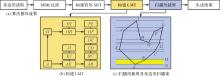
Fig. 1
Flowchart of Vatti algorithm"
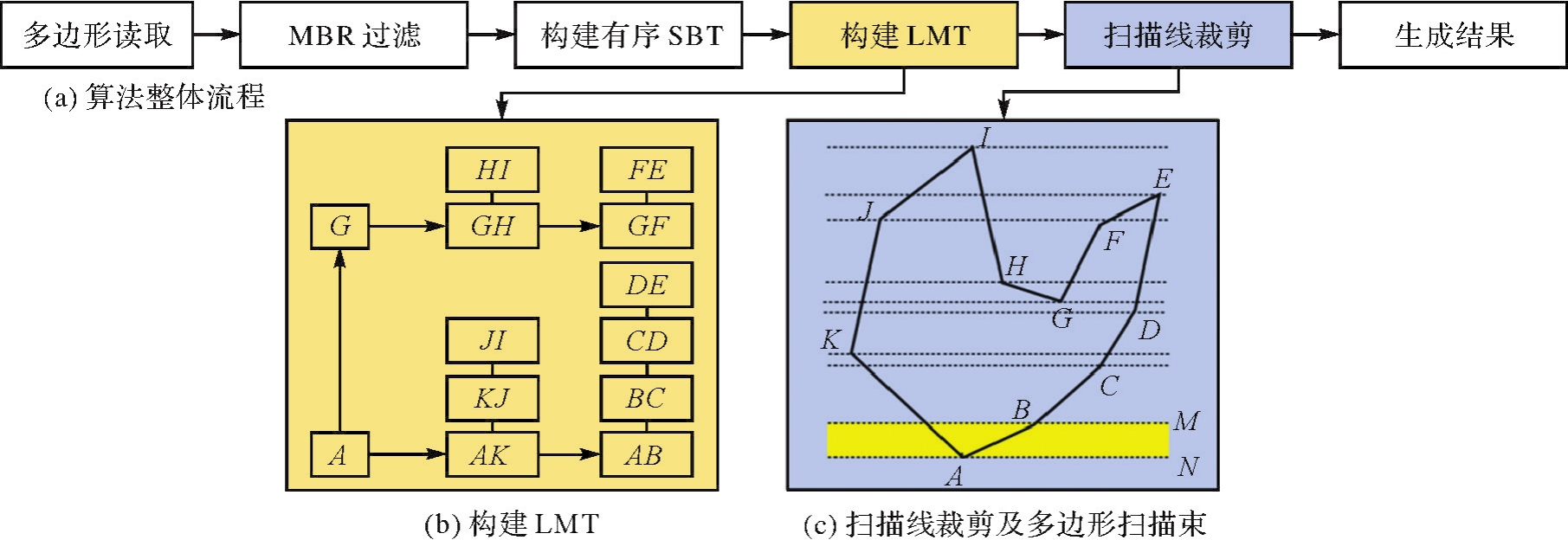
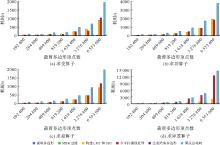
Fig. 2
Time consuming in each stage of serial Vatti algorithm"
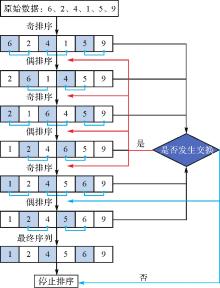
Fig. 3
Odd-even sort process"
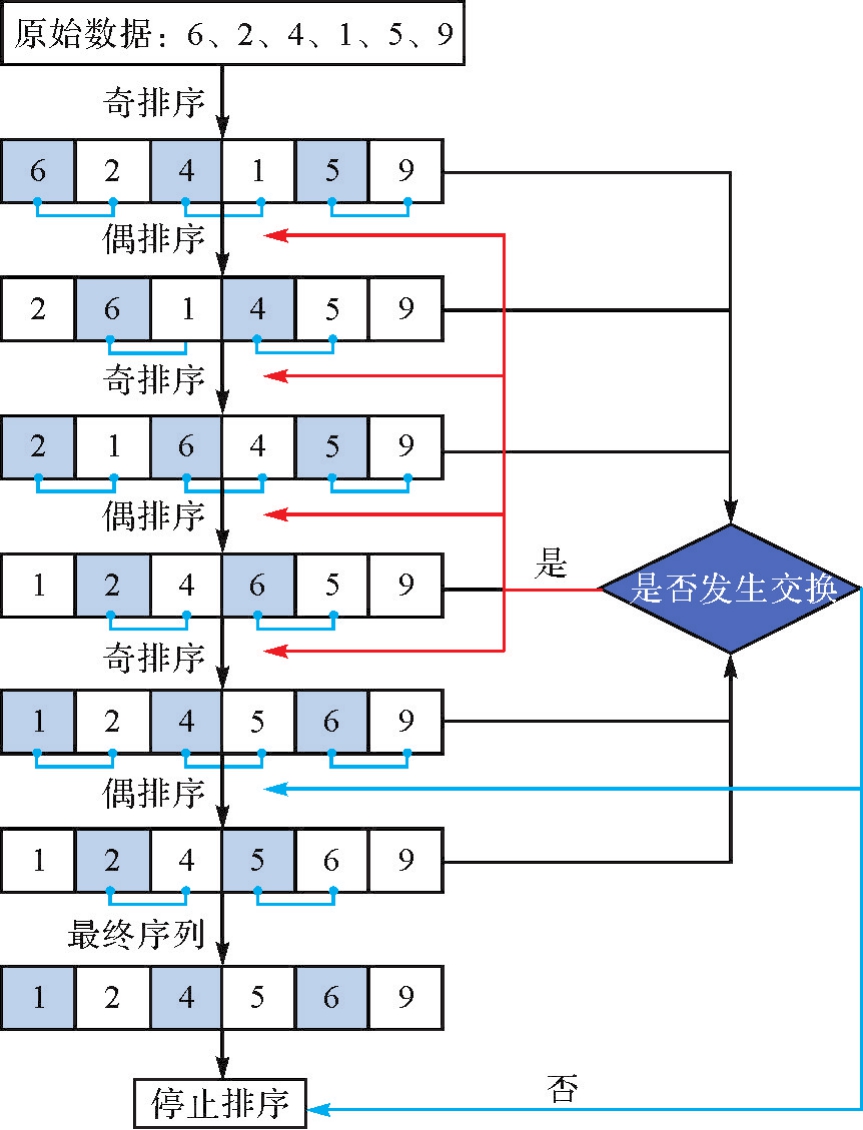
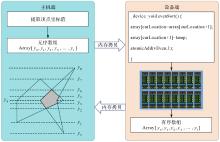
Fig. 4
Parallel optimization process of Vatti algorithm"
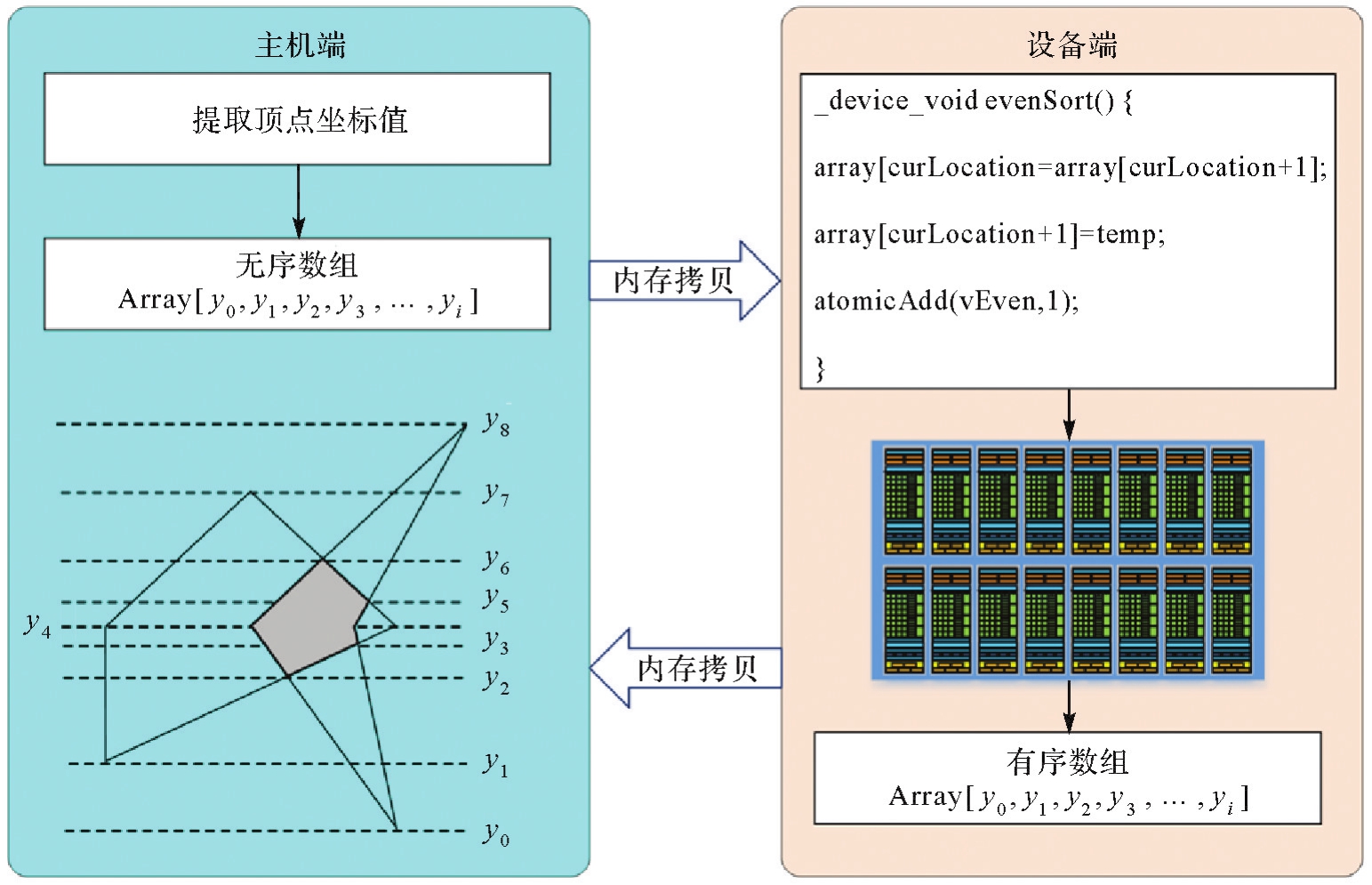
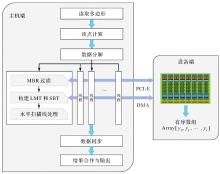
Fig. 5
VSHP optimization method calculation process"
Tab. 1
Basic information of the experimental platform"
| 软硬件环境 | 配置情况 |
|---|---|
| 处理器(CPU) | Intel i7-10700F |
| 核心及线程数量 | 8核16线程 |
| CPU主频/GHz | 2.9 |
| 系统内存/GB | 32.0 |
| 硬盘容量/TB | 5.0 |
| GPU | NVIDIA RTX 3070 |
| GPU显存/GB | 8.0 |
| 显存带宽/(GB/s) | 448 |
| CUDA核心数 | 5888 |
| 操作系统 | Windows 10 |
| 计算平台 | CUDA 11.2 |
| 开发工具 | Visual Studio 2019 |
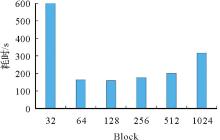
Fig. 6
Time consumption of parallel sorting for blocks of different sizes"
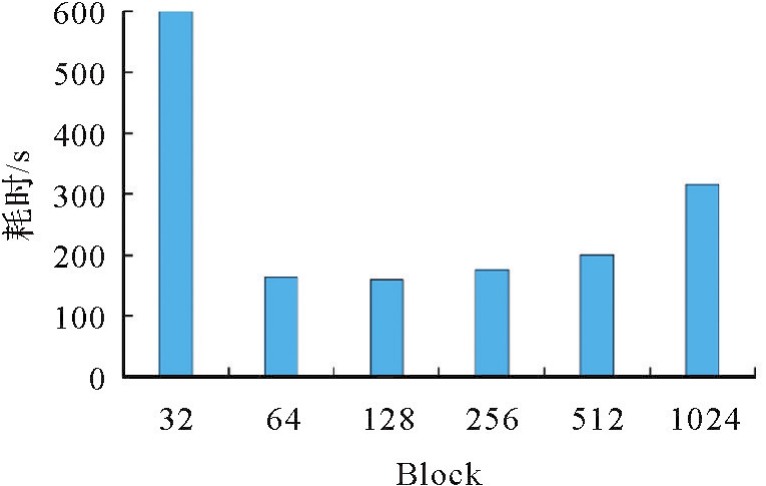
Fig. 7
The acceleration ratio of parallelized odd-even sort on the construction of LMT and SBT"
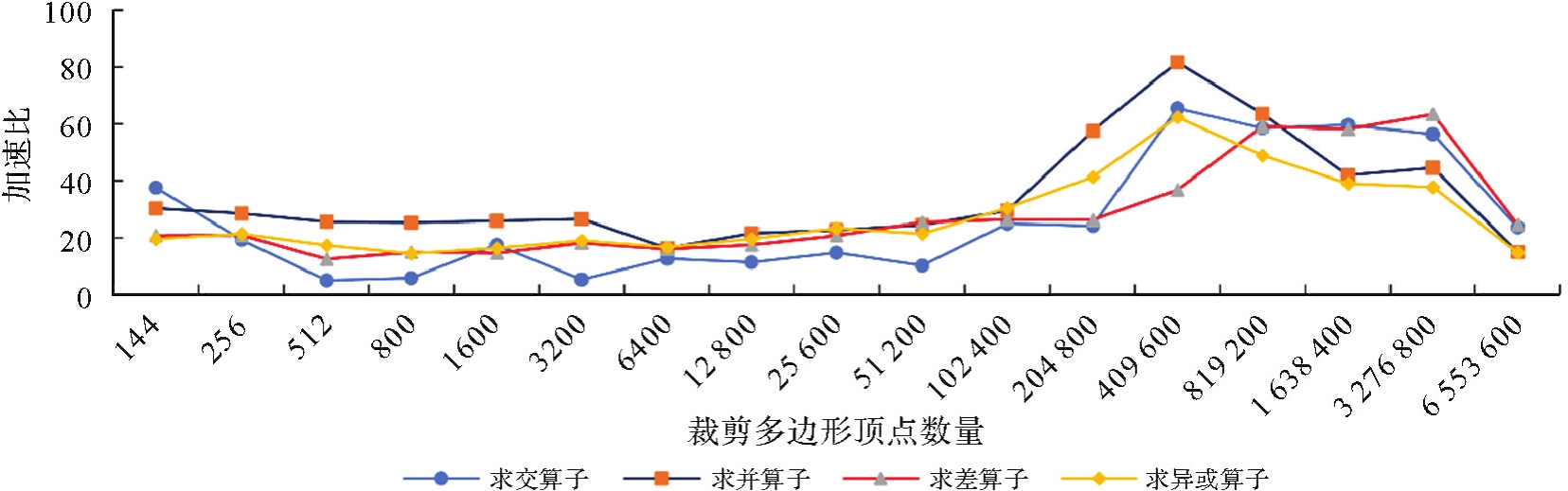
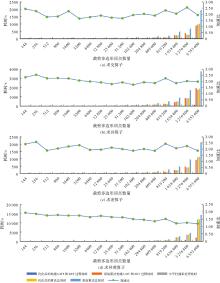
Fig. 8
Optimization of parallelized odd-even sorting for overlay algorithms"

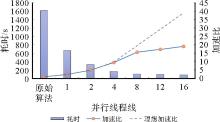
Fig. 9
Comparison of optimization effects for different CPU parallel threads"
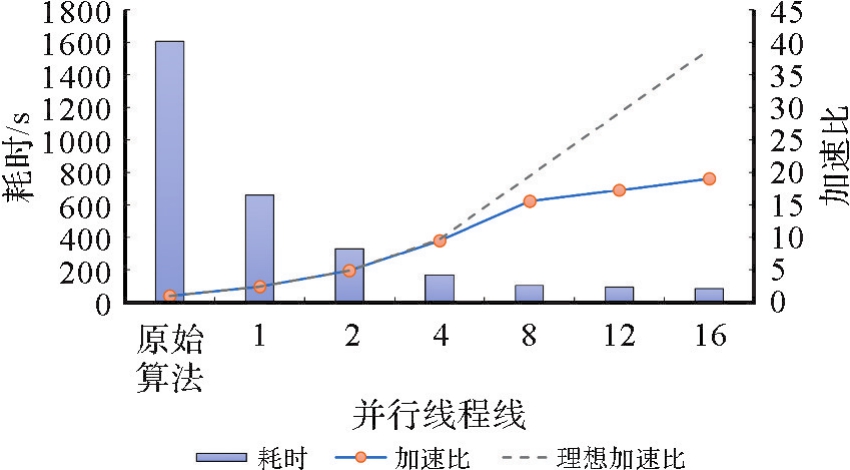
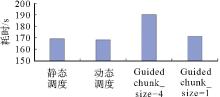
Fig. 10
Optimization comparison of different scheduling strategies"

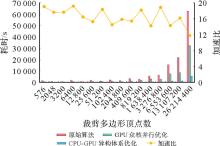
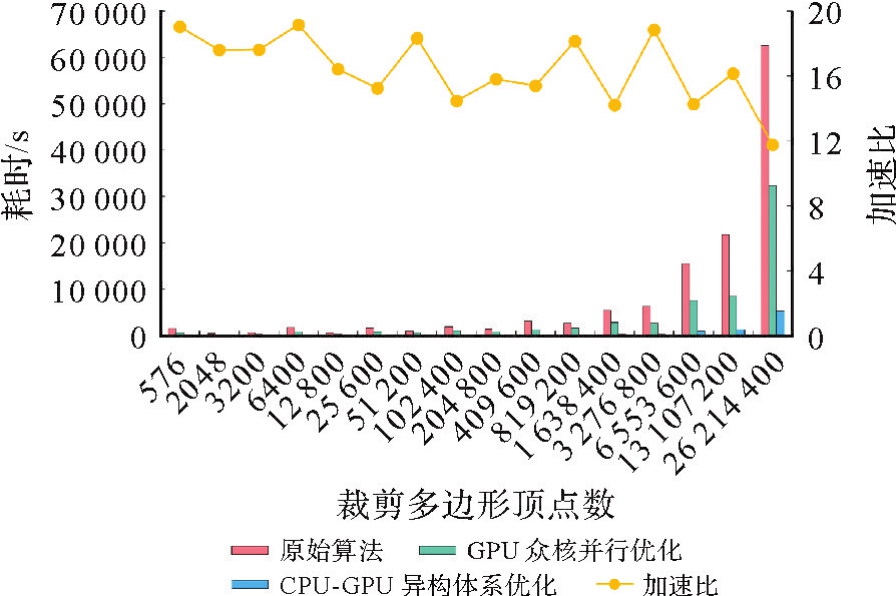
Fig. 11
Optimization and acceleration of data of different scale data under VSHP optimization method"
| [1] | 李德仁. 论时空大数据的智能处理与服务[J]. 地球信息科学学报, 2019, 21(12): 1825-1831. |
| LI Deren. The intelligent processing and service of spatiotemporal big data[J]. Journal of Geo-information Science, 2019, 21(12): 1825-1831. | |
| [2] | 王结臣, 王豹, 胡玮, 等. 并行空间分析算法研究进展及评述[J]. 地理与地理信息科学, 2011, 27(6): 1-5. |
| WANG Jiechen, WANG Bao, HU Wei, et al. Review on parallel spatial analysis algorithms[J]. Geography and Geo-Information Science, 2011, 27(6): 1-5. | |
| [3] |
范俊甫. 并行化矢量多边形叠加算法研究[J]. 测绘学报, 2016, 45(4): 502. DOI:.
doi: 10.11947/j.AGCS.2016.20150495 |
|
FAN Junfu. Parallel algorithms for polygon overlapping[J]. Acta Geodaetica et Cartographica Sinica, 2016, 45(4): 502. DOI:.
doi: 10.11947/j.AGCS.2016.20150495 |
|
| [4] | SUTHERLAND I E, HODGMAN G W. Reentrant polygon clipping[J]. Communications of the ACM, 1974, 17(1): 32-42. |
| [5] | WEILER K, ATHERTON P, WEILER K, et al. Hidden surface removal using polygon area sorting[C]//Proceedings of the 4th Annual Conference on Computer Graphics and Interactive Techniques. San Jose: ACM Press, 1977: 214-222. |
| [6] | VATTI B R. A generic solution to polygon clipping[J]. Communications of the ACM, 1992, 35(7): 56-63. |
| [7] | RUSHMEIER H, GREINER G, HORMANN K. Efficient clipping of arbitrary polygons[J]. ACM Transactions on Graphics, 1998, 17(2): 71-83. |
| [8] | 刘勇奎, 高云, 黄有群. 一个有效的多边形裁剪算法[J]. 软件学报, 2003, 14(4): 845-856. |
| LIU Yongkui, GAO Yun, HUANG Youqun. An efficient algorithm for polygon clipping[J]. Journal of Software, 2003, 14(4): 845-856. | |
| [9] | 张志锟, 范俊甫, 徐少波, 等. 多边形叠加Vatti算法的VCS优化方法与GPU并行化[J]. 地球信息科学学报, 2022, 24(3): 437-447. |
| ZHANG Zhikun, FAN Junfu, XU Shaobo, et al. VCS optimization method of Vatti algorithm for polygon overlay and parallelization using GPU[J]. Journal of Geo-information Science, 2022, 24(3): 437-447. | |
| [10] | ZHOU Yuke, WANG Shaohua, GUAN Yong. An efficient parallel algorithm for polygons overlay analysis[J]. Applied Sciences, 2019, 9(22): 4857. |
| [11] | 苏诚, 韩俊刚. Sutherland-Hodgman裁剪算法的改进[J]. 西安邮电大学学报, 2013, 18(3): 80-82. |
| SU Cheng, HAN Jungang. An advanced Sutherland-Hodgman algorithm[J]. Journal of Xi'an University of Posts and Telecommunications, 2013, 18(3): 80-82. | |
| [12] | 赵斯思, 周成虎. GPU加速的多边形叠加分析[J]. 地理科学进展, 2013, 32(1): 7. |
| ZHAO Sisi, ZHOU Chenghu. Accelerating polygon overlay analysis by GPU[J]. Progress in Geography, 2013, 32(1): 7. | |
| [13] | 蒋元义, 金宝轩, 赵康, 等. 叠置计算中多边形形状复杂度的度量研究[J]. 测绘科学, 2020, 45(11): 177-184. |
| JIANG Yuanyi, JIN Baoxuan, ZHAO Kang, et al. Research on measurement of polygon shape complexity in overlay calculation[J]. Science of Surveying and Mapping, 2020, 45(11): 177-184. | |
| [14] | HUANG Fang, TIE Bo, TAO Jian, et al. Methodology and optimization for implementing cluster-based parallel geospatial algorithms with a case study[J]. Cluster Computing, 2020, 23(2): 673-704. |
| [15] | ZHOU Chen, LI Manchun. A systematic parallel strategy for generating contours from large-scale DEM data using collaborative CPUs and GPUs[J]. Cartography and Geographic Information Science, 2021, 48(3): 187-209. |
| [16] | ZHOU Chen, LI Manchun. Performance evaluation of spatial indexing to identify polygon intersection[J]. Geocarto International, 2020, 35(16): 1850-1872. |
| [17] | ZHAO Kang, JIN Baoxuan, FAN Hong, et al. A data allocation strategy for geocomputation based on shape complexity in a cloud environment using parallel overlay analysis of polygons as an example[J]. IEEE Access, 2020, 8: 185981-185991. |
| [18] |
范俊甫, 孔维华, 马廷, 等. RaPC:一种基于栅格化思想的多边形裁剪算法及其误差分析[J]. 测绘学报, 2015, 44(3): 338-345. DOI:.
doi: 10.11947/j.AGCS.2015.20140017 |
|
FAN Junfu, KONG Weihua, MA Ting, et al. RaPC: a rasterization-based polygon clipping algorithm and its error analysis[J]. Acta Geodaetica et Cartographica Sinica, 2015, 44(3): 338-345. DOI:.
doi: 10.11947/j.AGCS.2015.20140017 |
|
| [19] | FAN Junfu, HE Huixin, HU Taoying, et al. Rasterization computing-based parallel vector polygon overlay analysis algorithms using OpenMP and MPI[J]. IEEE Access, 2018, 6: 21427-21441. |
| [20] | 卢风顺, 宋君强, 银福康, 等. CPU/GPU协同并行计算研究综述[J]. 计算机科学, 2011, 38(3): 5-9. |
| LU Fengshun, SONG Junqiang, YIN Fukang, et al. Survey of CPU/GPU synergetic parallel computing[J]. Computer Science, 2011, 38(3): 5-9. | |
| [21] | MITTAL S, VETTER J S. A survey of CPU-GPU heterogeneous computing techniques[J]. ACM Computing Surveys, 2015, 47(4): 1-35. |
| [22] | 方留杨, 王密, 李德仁. CPU和GPU协同处理的光学卫星遥感影像正射校正方法[J]. 测绘学报, 2013, 42(5): 668-675. |
| FANG Liuyang, WANG Mi, LI Deren. A CPU-GPU co-processing orthographic rectification approach for optical satellite imagery[J]. Acta Geodaetica et Cartographica Sinica, 2013, 42(5): 668-675. | |
| [23] | VESTIAS M, NETO H. Trends of CPU, GPU and FPGA for high-performance computing[C]//Proceedings of 2014 International Conference on Field Programmable Logic and Applications. Munich: IEEE, 2014: 1-6. |
| [24] | 徐云耘, 周琛, 李满春. CPU+GPU异构环境下数据密集型矢量多边形地理大数据并行框架[J]. 测绘通报, 2022(5): 110-119. |
| XU Yunyun, ZHOU Chen, LI Manchun. A parallel framework for data-intensive geospatial analysis on large-scale vector polygons over hybrid CPUs and GPUs[J]. Bulletin of Surveying and Mapping, 2022(5): 110-119. | |
| [25] | ZHANG Peng, FAN Junfu, ZHANG Panpan, et al. Comparative study on the effect of shape complexity on the efficiency of different overlay analysis algorithms[J]. IEEE Access, 2021, 9: 144179-144194. |
| [1] | Biao HE, Haojia LIN, Renzhong GUO, Xi KUAI, Ding MA, Chen ZHANG. Visual perception-based quantitative calculation of 3D spatial similarity relations [J]. Acta Geodaetica et Cartographica Sinica, 2026, 55(1): 138-153. |
| [2] | Biao HE, Renzhong GUO, Hai XU, Xi KUAI, Haojia LIN, Zhigang ZHAO. Concept and technical system of smart city operating system [J]. Acta Geodaetica et Cartographica Sinica, 2025, 54(5): 785-794. |
| [3] | Huayi WU, Zhangxiao SHEN, Shuyang HOU, Jianyuan LIANG, Anqi ZHAO, Haoyue JIAO, Zhipeng GUI, Xuefeng GUAN. Large language model-driven GIS analysis: methods, applications, and prospects [J]. Acta Geodaetica et Cartographica Sinica, 2025, 54(4): 621-635. |
| [4] | Xing ZHANG, Zhanpeng HUANG, Qingquan LI, Baoding ZHOU, Qipei LI. 3D tunnel mapping method combining registration compensation and spatial constraint [J]. Acta Geodaetica et Cartographica Sinica, 2025, 54(2): 297-307. |
| [5] | Yongjun ZHANG, Changjun ZHU, Siyuan ZOU, Xinyi LIU, Qingzhou MAO, Yi WAN. Registration of aerial images and LiDAR point clouds based on distance field and plane constraints [J]. Acta Geodaetica et Cartographica Sinica, 2025, 54(1): 64-74. |
| [6] | XIANG Deliang, DING Huaiyue, GUAN Dongdong, CHENG Jianda, SUN Xiaokun. PolSAR image registration combining polarization whitening filtering and SimSD-CapsuleNet [J]. Acta Geodaetica et Cartographica Sinica, 2024, 53(3): 450-462. |
| [7] | CHEN Shuai, MIAO Zelang, WU Lixin. Probabilistic seismic landslide hazard mapping with consideration of slope occurrence environment [J]. Acta Geodaetica et Cartographica Sinica, 2023, 52(9): 1548-1561. |
| [8] | Lü Kefeng, ZHANG Yongsheng, YU Ying, MIN Jie. Instance object localization based on semantic information and geo-registration [J]. Acta Geodaetica et Cartographica Sinica, 2023, 52(8): 1375-1386. |
| [9] | SHAN Jianchen, LI Shanshan, FAN Diao, LI Xinxing, HUANG Yan, XING Zhibin. Design and implementation of ultra-high-degree spherical harmonic model of earth topography [J]. Acta Geodaetica et Cartographica Sinica, 2023, 52(5): 748-759. |
| [10] | ZHANG Guangyun, HAN Yi, ZHANG Rongting, LI Mingfeng, JI Wenlai. A spatial consistency-based point cloud registration method for the same platform [J]. Acta Geodaetica et Cartographica Sinica, 2023, 52(5): 789-797. |
| [11] | LI Haoran, MEI Tiancan, GAO Zhi. 3D face reconstruction based on global ICP and improved Poisson [J]. Acta Geodaetica et Cartographica Sinica, 2023, 52(3): 454-463. |
| [12] | ZHANG Yongxian, MA Guorui, ZI Shuanjin, MEN Hang. Multi-source remote sensing image bidirectional consistent registration based on learning feature [J]. Acta Geodaetica et Cartographica Sinica, 2023, 52(11): 1906-1916. |
| [13] | LI Jiayuan, ZHANG Yongjun, AI Mingyao, HU Qingwu. Scale-adaptive Cauchy robust estimation based on progressive optimization and its applications [J]. Acta Geodaetica et Cartographica Sinica, 2023, 52(1): 61-70. |
| [14] | ZHANG Ning, JIN Shaohua, BIAN Gang, XIAO Fumin. An iterative and adaptive registration method for multi-beam and side-scan sonar images [J]. Acta Geodaetica et Cartographica Sinica, 2022, 51(9): 1951-1958. |
| [15] | LI Pei, JIANG Gang, MA Qianli, XUE Wanfeng, YANG Weihua. A hybrid model combining tensor and mutual information for multi-modal image registration [J]. Acta Geodaetica et Cartographica Sinica, 2021, 50(7): 916-929. |
| Viewed | ||||||
|
Full text |
|
|||||
|
Abstract |
|
|||||
