

Acta Geodaetica et Cartographica Sinica ›› 2026, Vol. 55 ›› Issue (8): 1414-1424.doi: 10.11947/j.AGCS.2026.20260064
• Photogrammetry and Remote Sensing • Previous Articles
Xijiang Chen1( ), Minkun Zeng1, Wei Xuan2(), Jingui Zou3, Xianghong Hua3
Received:2025-11-24
Revised:2026-07-23
Published:2026-09-09
Contact:
Wei Xuan
E-mail:chenxijiang@whu.edu.cn;xuanwei1988@whut.edu.cn
About author:Chen Xijiang (1984—), male, PhD, associate professor, majors in point cloud data analysis research. E-mail: chenxijiang@whu.edu.cn
Supported by:CLC Number:
Xijiang Chen, Minkun Zeng, Wei Xuan, Jingui Zou, Xianghong Hua. Multi-scale supervoxel feature aggregation network for three-dimensional point cloud semantic segmentation[J]. Acta Geodaetica et Cartographica Sinica, 2026, 55(8): 1414-1424.
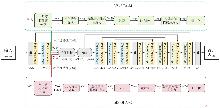
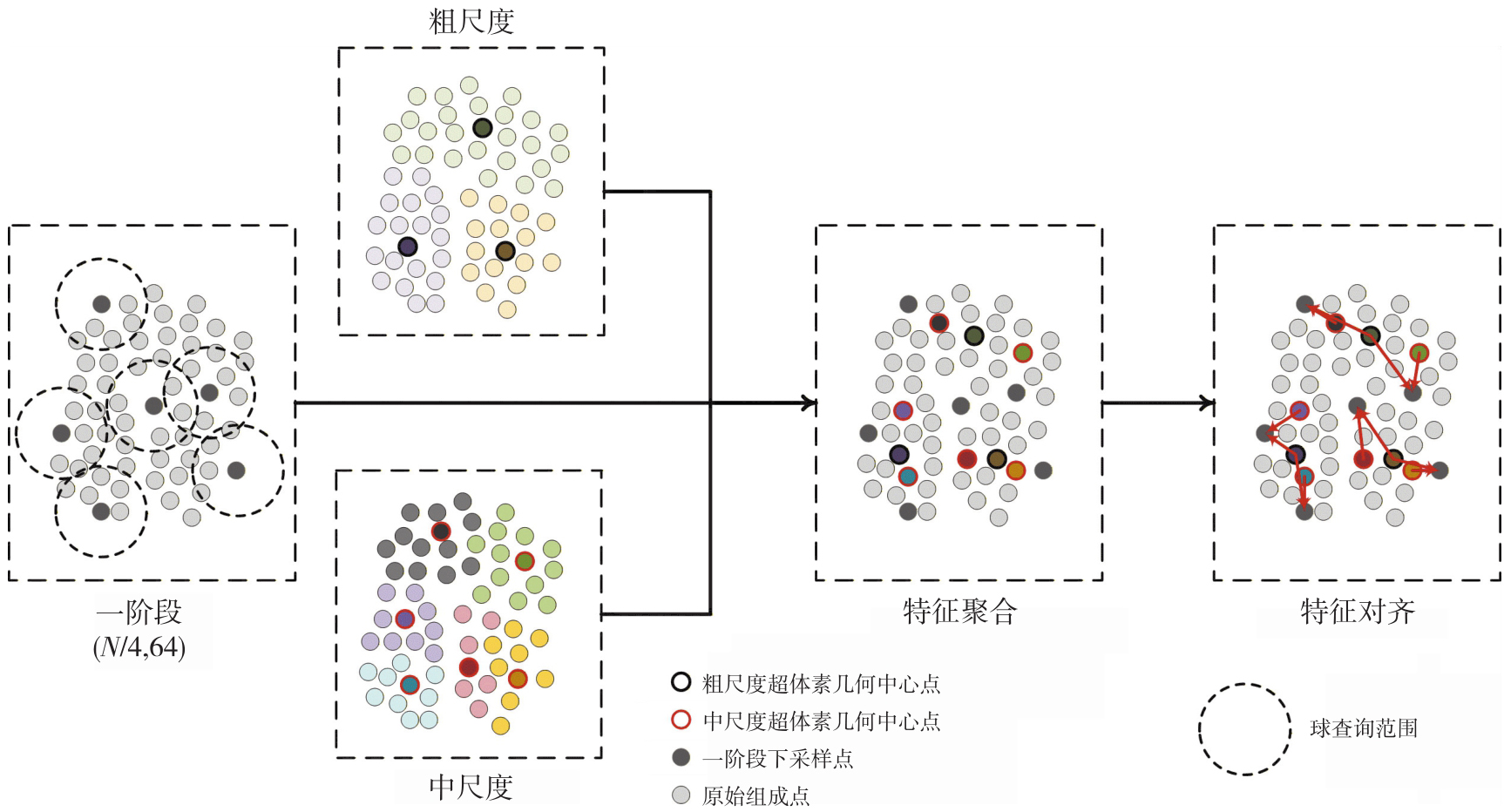
Fig. 1
The overall architecture of the proposed mult-iscale supervoxel feature aggregation network(MS-SFA-Net)"

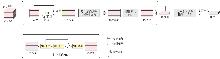
Fig. 2
MS-SFA module"
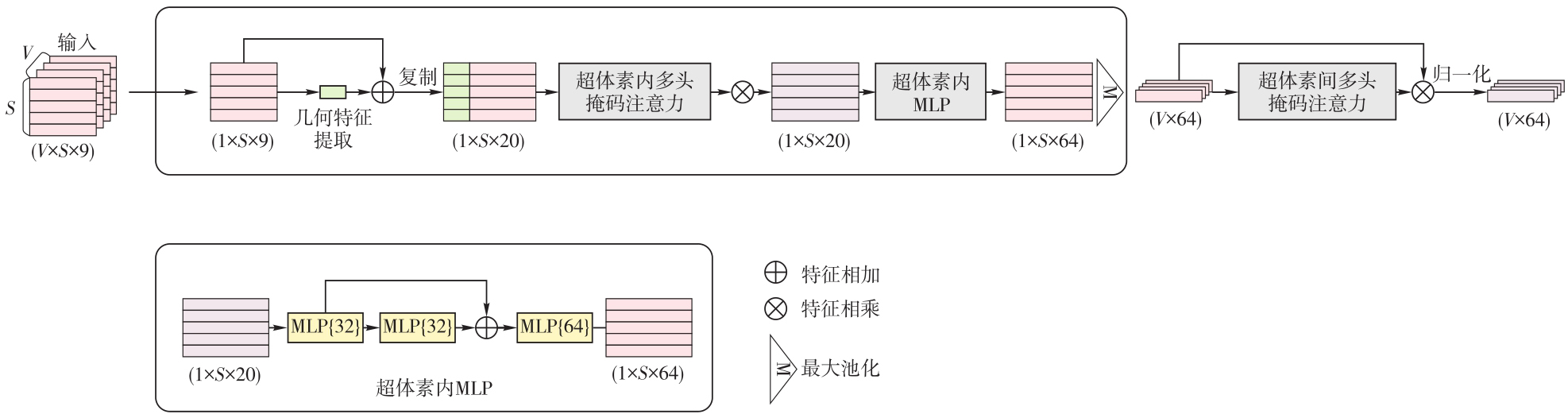
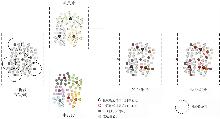
Fig. 3
Illustration of the multi-scale supervoxel-to-point feature alignment"
Tab. 1
Semantic segmentation results (mIoU) on ScanNet v2 validation set"
| 方法 | 方法类别 | 验证 | 测试 |
|---|---|---|---|
| PointNet++[ | 点 | 53.5 | 55.7 |
| 3DMV[ | 点 | - | 48.4 |
| PanopticFusion[ | 点 | - | 52.9 |
| PointCNN[ | 点 | - | 45.8 |
| PointConv[ | 点 | 61.0 | 66.6 |
| JointPointBased[ | 点 | 69.2 | 63.4 |
| PointASNL[ | 点 | 63.5 | 66.6 |
| SegGCN[ | 点 | - | 58.9 |
| RandLA-Net[ | 点 | - | 64.5 |
| KPConv[ | 点 | - | 68.4 |
| SparseConvNet[ | 体素 | 69.3 | 72.5 |
| MinkowskiNet[ | 体素 | 72.2 | 73.6 |
| PTv3[ | 点 | 76.8 | 73.6 |
| PointNet+++MS-SFA | 点+超体素 | 64.3 | 67.5 |
| PTv3+MS-SFA | 点+超体素 | 78.0 | 74.1 |
Tab. 2
Per-class IoU on ScanNet v2 validation set"
| 方法 | 墙 | 地板 | 柜子 | 床 | 椅子 | 沙发 | 桌子 | 门 | 窗 | 书架 | 画板 | 内阁 | 书桌 | 窗帘 | 冰箱 | 浴帘 | 马桶 | 水池 | 浴缸 | 其他 |
|---|---|---|---|---|---|---|---|---|---|---|---|---|---|---|---|---|---|---|---|---|
| PTv3[ | 87.4 | 95.8 | 71.7 | 83.2 | 92.4 | 82.3 | 77.5 | 74.7 | 72.8 | 82.6 | 41.8 | 69.3 | 70.8 | 77.3 | 68.3 | 71.8 | 93.3 | 70.4 | 89.0 | 63.2 |
| PTv3+MS-SFA | 87.8 | 95.9 | 71.5 | 84.2 | 92.4 | 84.9 | 80.2 | 75.0 | 74.6 | 81.6 | 41.4 | 70.9 | 74.2 | 78.9 | 71.0 | 75.3 | 94.6 | 69.8 | 89.3 | 66.7 |
Tab. 3
Per-class IoU on ScanNet v2 test set"
| 方法 | 浴缸 | 床 | 书架 | 柜子 | 椅子 | 内阁 | 窗帘 | 书桌 | 门 | 地板 | 其他 | 画 | 冰箱 | 浴帘 | 水池 | 沙发 | 桌子 | 马桶 | 墙 | 窗 |
|---|---|---|---|---|---|---|---|---|---|---|---|---|---|---|---|---|---|---|---|---|
| PointNet++[ | 73.5 | 66.1 | 68.6 | 49.1 | 74.4 | 39.2 | 53.9 | 45.1 | 37.5 | 94.6 | 37.6 | 20.5 | 40.3 | 35.6 | 55.3 | 64.3 | 49.7 | 82.4 | 75.6 | 51.5 |
| 3DMV[ | 48.4 | 53.8 | 64.3 | 42.4 | 60.6 | 31.0 | 57.4 | 43.3 | 37.8 | 79.6 | 30.1 | 21.4 | 53.7 | 20.8 | 47.2 | 50.7 | 41.3 | 69.3 | 60.2 | 53.9 |
| PanopticFusion[ | 49.1 | 68.8 | 60.4 | 38.6 | 63.2 | 22.5 | 70.5 | 43.4 | 29.3 | 81.5 | 34.8 | 24.1 | 49.9 | 66.9 | 50.7 | 64.9 | 44.2 | 79.6 | 60.2 | 56.1 |
| PointCNN[ | 57.7 | 61.1 | 35.6 | 32.1 | 71.5 | 29.9 | 37.6 | 32.8 | 31.9 | 94.4 | 28.5 | 16.4 | 21.6 | 22.9 | 48.4 | 54.5 | 45.6 | 75.5 | 70.9 | 47.5 |
| PointConv[ | 78.1 | 75.9 | 69.9 | 64.4 | 82.2 | 47.5 | 77.9 | 56.4 | 50.4 | 95.3 | 42.8 | 20.3 | 58.6 | 75.4 | 66.1 | 75.3 | 58.8 | 90.2 | 81.3 | 64.2 |
| JointPointBased[ | 61.4 | 77.8 | 66.7 | 63.3 | 82.5 | 42.0 | 80.4 | 46.7 | 56.1 | 95.1 | 49.4 | 29.1 | 56.6 | 45.8 | 57.9 | 76.4 | 55.9 | 83.8 | 81.4 | 59.8 |
| PointASNL[ | 70.3 | 78.1 | 75.1 | 65.5 | 83.0 | 47.1 | 76.9 | 47.4 | 53.7 | 95.1 | 47.5 | 27.9 | 63.5 | 69.8 | 67.5 | 75.1 | 55.3 | 81.6 | 80.6 | 70.3 |
| SegGCN[ | 83.3 | 73.1 | 53.9 | 51.4 | 78.9 | 44.8 | 46.7 | 57.3 | 48.4 | 93.6 | 39.6 | 6.1 | 50.1 | 50.7 | 59.4 | 70.0 | 56.3 | 87.4 | 77.1 | 49.3 |
| RandLA-Net[ | 77.8 | 73.1 | 69.9 | 57.7 | 82.9 | 44.6 | 73.6 | 47.7 | 52.3 | 94.5 | 45.4 | 26.9 | 48.4 | 74.9 | 61.8 | 73.8 | 59.9 | 82.7 | 79.2 | 62.1 |
| KPConv[ | 84.7 | 75.8 | 78.4 | 64.7 | 81.4 | 47.3 | 77.2 | 60.5 | 59.4 | 93.5 | 45.0 | 18.1 | 58.7 | 80.5 | 69.0 | 78.5 | 61.4 | 88.2 | 81.9 | 63.2 |
| SparseConvNet[ | 64.7 | 82.1 | 84.6 | 72.1 | 86.9 | 53.3 | 75.4 | 60.3 | 61.4 | 95.5 | 57.2 | 32.5 | 71.0 | 87.0 | 72.4 | 82.3 | 62.8 | 93.4 | 86.5 | 68.3 |
| MinkowskiNet[ | 85.9 | 81.8 | 83.2 | 70.9 | 84.0 | 52.1 | 85.3 | 66.0 | 64.3 | 95.1 | 54.4 | 28.6 | 73.1 | 89.3 | 67.5 | 77.2 | 68.3 | 87.4 | 85.2 | 72.7 |
| PTv3[ | 75.1 | 80.9 | 82.7 | 71.4 | 84.7 | 54.2 | 87.1 | 59.3 | 68.7 | 96.0 | 53.9 | 35.0 | 76.7 | 65.6 | 76.7 | 78.0 | 63.5 | 93.8 | 88.2 | 79.5 |
| PTv3+MS-SFA | 73.6 | 81.6 | 84.5 | 73.6 | 83.6 | 52.6 | 90.4 | 65.9 | 66.7 | 95.7 | 53.7 | 33.2 | 77.4 | 68.4 | 76.7 | 79.6 | 70.1 | 89.7 | 87.7 | 76.5 |
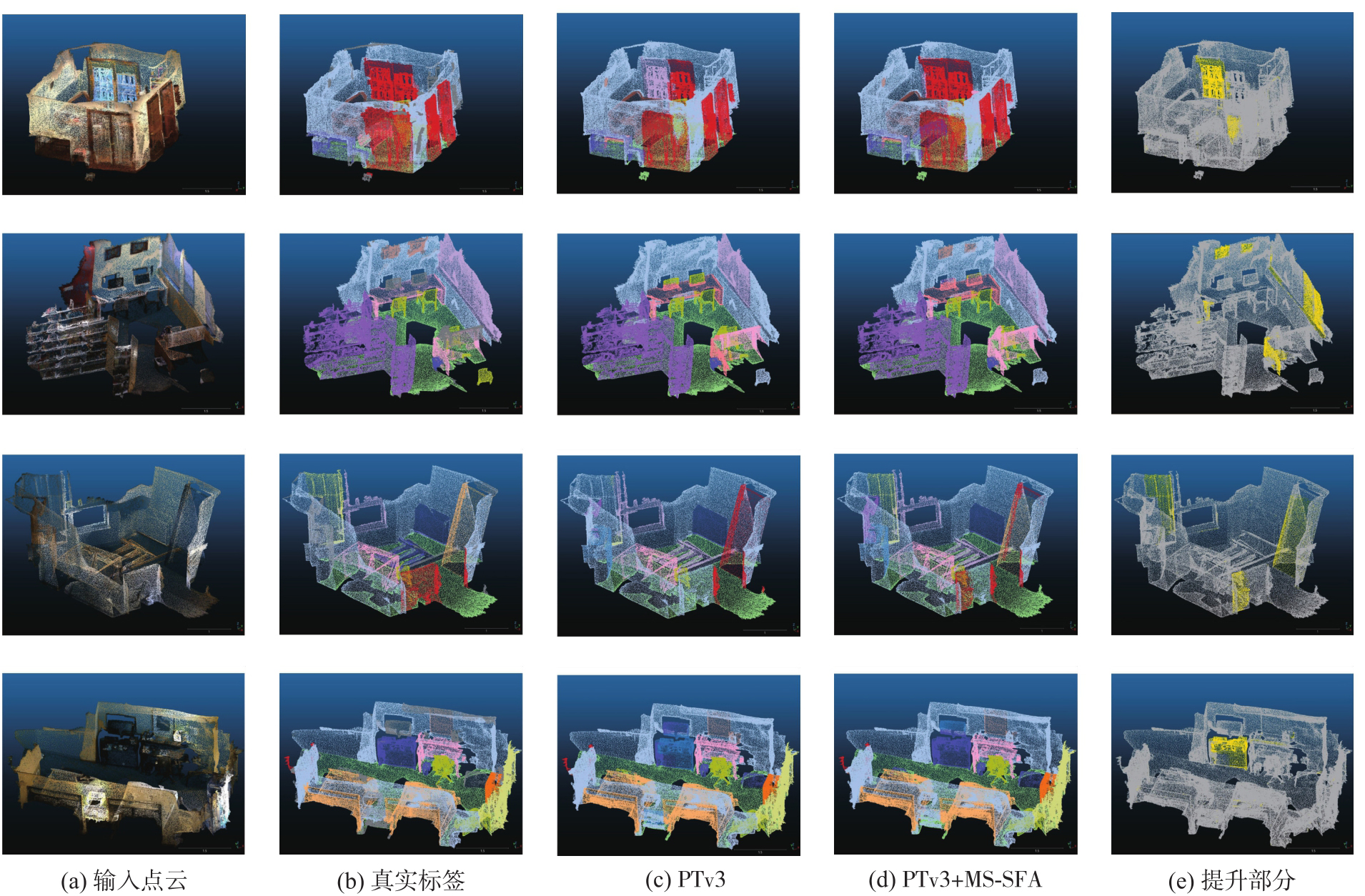
Fig. 4
Visualization of segmentation results on the ScanNet v2 validation set"
Tab. 4
Per-class IoU on Semantic KITTI validation set"
| 模型 | mIoU | IoU | ||||||||||||||||||
|---|---|---|---|---|---|---|---|---|---|---|---|---|---|---|---|---|---|---|---|---|
| 汽车 | 自行车 | 摩托车 | 卡车 | 其他车辆 | 行人 | 骑自行车 | 骑摩托车 | 道路 | 停车区 | 人行道 | 其他路面 | 建筑物 | 围栏 | 植被 | 树干 | 地形 | 杆子 | 标志 | ||
| PTv3[ | 65.5 | 96.6 | 52.6 | 71.5 | 85.3 | 63.5 | 77.5 | 88.6 | 0 | 95.3 | 59.2 | 84.3 | 0.5 | 79.4 | 57.1 | 84.9 | 65.8 | 73.0 | 64.1 | 45.3 |
| PTv3+MS-SFA | 66.7 | 96.0 | 53.7 | 78.0 | 92.1 | 59.0 | 78.1 | 89.2 | 0.1 | 95.1 | 59.4 | 84.6 | 0.1 | 80.0 | 59.2 | 84.5 | 68.4 | 72.0 | 64.6 | 48.1 |
Tab. 5
Semantic segmentation results on Semantic KITTI test set"
| 方法 | 方法类别 | mIoU/(%) |
|---|---|---|
| PointNet++[ | 点 | 20.1 |
| TangentConv[ | 点 | 40.9 |
| RandLA-Net[ | 点 | 55.9 |
| KPConv[ | 点 | 58.8 |
| SPVNAS[ | 体素 | 67.0 |
| PTv3[ | 点 | 66.6 |
| PTv3+MS-SFA | 点+超体素 | 67.7 |
Tab. 6
Per-class IoU on Semantic KITTI test set"
| 模型 | 汽车 | 自行车 | 摩托车 | 卡车 | 其他车辆 | 行人 | 骑自行车 | 骑摩托车 | 道路 | 停车区 | 人行道 | 其他路面 | 建筑物 | 围栏 | 植被 | 树干 | 地形 | 杆子 | 标志 |
|---|---|---|---|---|---|---|---|---|---|---|---|---|---|---|---|---|---|---|---|
| PointNet++[ | 53.7 | 1.9 | 0.2 | 0.9 | 0.2 | 0.9 | 1.0 | 0 | 72.0 | 18.7 | 41.8 | 5.6 | 62.3 | 16.9 | 46.5 | 13.8 | 30.0 | 6.0 | 8.9 |
| TangentConv[ | 90.8 | 2.7 | 16.5 | 15.2 | 12.1 | 23.0 | 28.4 | 8.1 | 83.9 | 33.4 | 63.9 | 15.4 | 83.4 | 49.0 | 79.5 | 49.3 | 58.1 | 35.8 | 28.5 |
| RandLA-Net[ | 94.2 | 29.8 | 32.2 | 43.9 | 39.1 | 48.4 | 47.4 | 9.4 | 90.5 | 61.8 | 74.0 | 24.5 | 89.7 | 60.4 | 83.8 | 63.6 | 68.6 | 51.0 | 50.7 |
| KPConv[ | 95.0 | 30.2 | 42.5 | 33.4 | 44.3 | 61.5 | 61.6 | 11.8 | 90.3 | 61.3 | 72.7 | 31.5 | 90.5 | 64.2 | 84.8 | 69.2 | 69.1 | 56.4 | 47.4 |
| SPVNAS[ | 97.2 | 67.1 | 50.3 | 56.6 | 58.0 | 67.4 | 67.1 | 50.3 | 90.2 | 67.6 | 75.4 | 21.8 | 91.6 | 66.9 | 86.7 | 56.6 | 71.0 | 64.3 | 67.3 |
| PTv3[ | 96.0 | 47.4 | 50.9 | 53.0 | 54.4 | 62.5 | 70.3 | 63.9 | 91.3 | 70.1 | 76.9 | 25.3 | 86.4 | 66.5 | 82.1 | 70.2 | 70.1 | 62.9 | 64.8 |
| PTv3+MS-SFA | 96.1 | 48.4 | 49.2 | 53.2 | 53.0 | 70.4 | 74.8 | 70.2 | 91.3 | 69.7 | 77.2 | 35.4 | 86.8 | 67.4 | 80.7 | 70.7 | 68.0 | 62.8 | 61.5 |
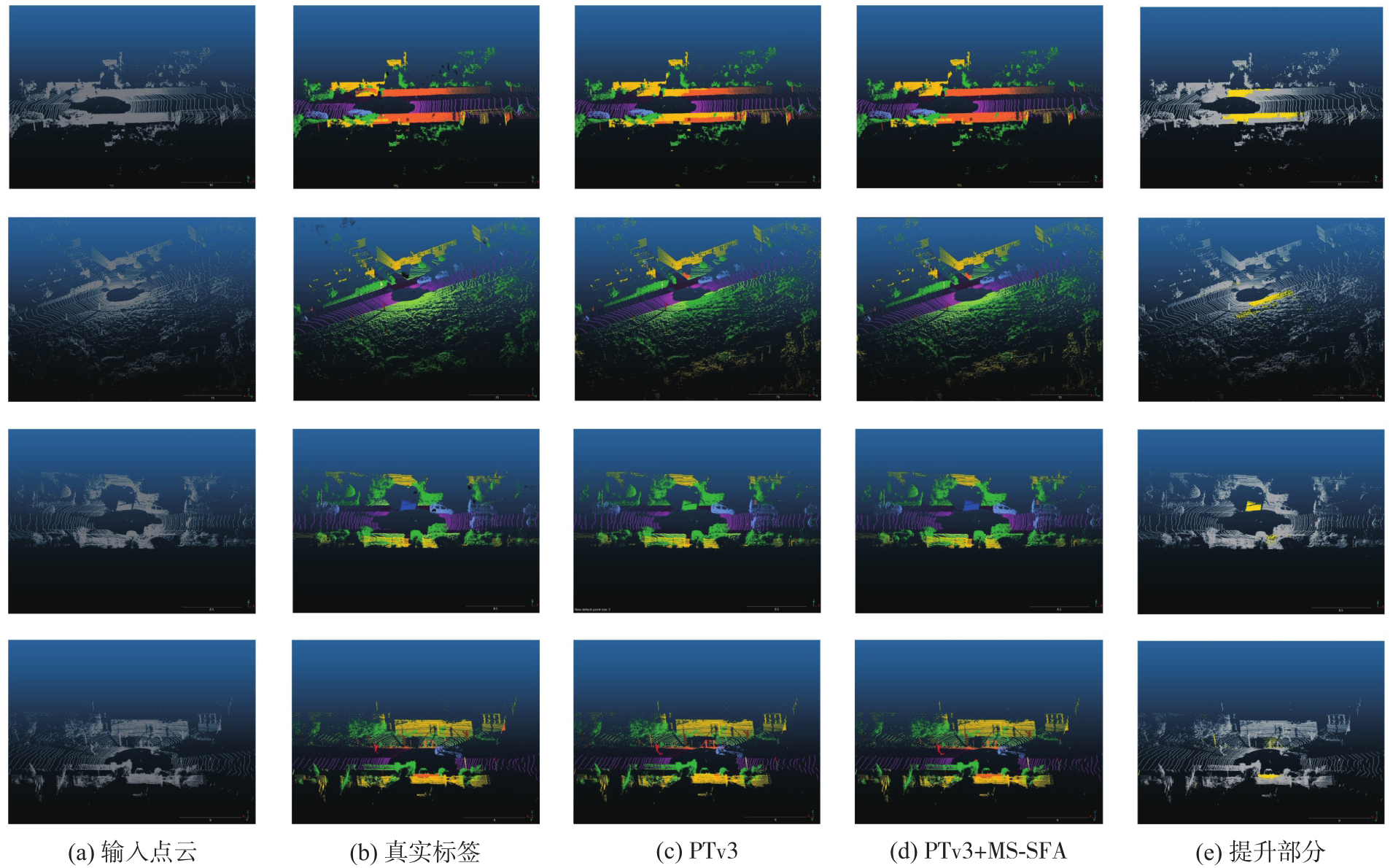
Fig. 5
Visualization of segmentation results on the Semantic KITTI validation set"
Tab. 7
Boundary segmentation accuracy (B-mIoU) under different boundary tolerance thresholds k"
| 数据集 | 模型 | k=5 | k=7 | k=9 | k=11 | k=13 | k=15 | k=17 | k=19 | k=21 |
|---|---|---|---|---|---|---|---|---|---|---|
| ScanNet v2 | PTv3 | 59.43 | 60.53 | 61.35 | 62.04 | 62.66 | 63.20 | 63.64 | 64.07 | 64.45 |
| PTv3+MS-SFA | 60.15 | 61.28 | 62.13 | 62.49 | 63.49 | 64.04 | 64.50 | 64.95 | 65.34 | |
| Semantic KITTI | PTv3 | 32.62 | 34.02 | 35.02 | 35.83 | 36.41 | 36.90 | 37.30 | 37.62 | 37.88 |
| PTv3+MS-SFA | 33.35 | 34.79 | 35.75 | 36.52 | 37.09 | 37.54 | 37.92 | 38.21 | 38.44 |
Tab. 8
Ablation experiments on ScanNet v2 validation set"
| 模型 | 多尺度 | 几何特征 | 外部注意力 | 内部注意力 | mIoU/(%) |
|---|---|---|---|---|---|
| PTv3 | × | × | × | × | 76.64 |
| 变体A | × | √ | × | × | 76.92 |
| 变体B | √ | √ | × | × | 77.15 |
| 变体C | × | √ | √ | √ | 77.01 |
| 变体D | √ | √ | √ | × | 77.49 |
| MS-SFA-Net | √ | √ | √ | √ | 77.82 |
| [1] |
杨必胜, 董震. 点云智能研究进展与趋势[J]. 测绘学报, 2019, 48(12): 1575-1585. DOI: .
doi: 10.11947/j.AGCS.2019.20190465 |
|
Yang Bisheng, Dong Zhen. Progress and perspective of point cloud intelligence[J]. Acta Geodaetica et Cartographica Sinica, 2019, 48(12): 1575-1585. DOI: .
doi: 10.11947/j.AGCS.2019.20190465 |
|
| [2] | Li Jie, Liu Zhao, Li Li, et al. Multi-view convolutional vision transformer for 3D object recognition[J]. Journal of Visual Communication and Image Representation, 2023, 95: 103906. |
| [3] | Feng Yifan, Zhang Zizhao, Zhao Xibin, et al. GVCNN: group-view convolutional neural networks for 3D shape recognition[C]//Proceedings of 2018 IEEE/CVF Conference on Computer Vision and Pattern Recognition. Salt Lake City: IEEE, 2018: 264-272. |
| [4] |
徐涛, 杨元维, 高贤君, 等. 融合图卷积与多尺度特征的接触网点云语义分割[J]. 测绘学报, 2024, 53(8): 1624-1633. DOI: .
doi: 10.11947/j.AGCS.2024.20230198 |
|
Xu Tao, Yang Yuanwei, Gao Xianjun, et al. Integrated graph convolution and multi-scale features for the overhead catenary system point cloud semantic segmentation[J]. Acta Geodaetica et Cartographica Sinica, 2024, 53(8): 1624-1633. DOI: .
doi: 10.11947/j.AGCS.2024.20230198 |
|
| [5] | Wu Z, Song S, Khosla A, et al. 3D ShapeNets: a deep representation for volumetric shapes[C]//Proceedings of 2015 IEEE Conference on Computer Vision and Pattern Recognition. Boston: IEEE, 2015: 1912-1920. |
| [6] | Meng H Y, Gao L, Lai Y, et al. VV-Net: voxel VAE net with group convolutions for point cloud segmentation[C]//Proceedings of 2019 IEEE/CVF International Conference on Computer Vision. Seoul: IEEE, 2019: 8499-8507. |
| [7] | Qi C R, Su H, Mo K, et al. PointNet: deep learning on point sets for 3D classification and segmentation[C]//Proceedings of 2017 IEEE Conference on Computer Vision and Pattern Recognition. Honolulu: IEEE, 2017: 77-85. |
| [8] | Qi C R, Yi L, Su H, et al. PointNet++: deep hierarchical feature learning on point sets in a metric space[C]//Proceedings of 2017 Advances in Neural Information Processing Systems. Red Hook: Curran Associates Inc., 2017: 5105-5114. |
| [9] | Jiang Mingyang, Wu Yiran, Zhao Tianqi, et al. PointSIFT: a SIFT-like network module for 3D point cloud semantic segmentation[PP/OL]. V2. arXiv (2018-11-24) [2026-01-02]. https://doi.org/10.48550/arXiv.1807.00652. |
| [10] | Zhao H, Jiang L, Fu C W, et al. PointWeb: enhancing local neighborhood features for point cloud processing[C]//Proceedings of 2019 IEEE/CVF Conference on Computer Vision and Pattern Recognition. Long Beach: IEEE, 2019: 5560-5568. |
| [11] | 张蕊, 包丰璞, 黄官龙, 等. 联合多尺度扩展融合与动态残差的街景点云语义分割[J/OL]. 计算机工程与应用, 2025-09-19. https://link.cnki.net/urlid/11.2127.tp.20250918.1853.004. |
| Zhang Rui, Bao Fengpu, Huang Guanlong, et al. Semantic segmentation of street scene point clouds by combining multi-scale extended fusionand dynamic residual[J/OL]. China Industrial Economics, 2025-09-19. https://link.cnki.net/urlid/11.2127.tp.20250918.1853.004. | |
| [12] | Vaswani A, Shazeer N, Parmar N, et al. Attention is all you need[C]//Proceedings of 2017 Advances in Neural Information Processing Systems: Red Hook: Curran Associates Inc., 2017: 5998-6008. |
| [13] | 库闵凡, 张良, 邓继伟, 等. LAE-Transformer:融合局部感知增强的机载LiDAR点云分割网络[J]. 遥感学报, 2025, 29(11): 3363-3377. |
| Ku Minfan, Zhang Liang, Deng Jiwei, et al. LAE-Transformer: an airborne LiDAR point cloud segmentation network incorporating local-aware enhancement[J]. National Remote Sensing Bulletin, 2025, 29(11): 3363-3377. | |
| [14] | Guo Menghao, Cai Junxiong, Liu Zhengning, et al. PCT: point cloud transformer[J]. Computational Visual Media, 2021, 7(2): 187-199. |
| [15] | Zhao Hengshuang, Jiang Li, Jia Jiaya, et al. Point transformer[C]//Proceedings of 2021 IEEE/CVF International Conference on Computer Vision. Montreal: IEEE, 2021: 16239-16248. |
| [16] | Liu Zheng, Zhou Weijie, Guo Chuchen, et al. PyramidPCD: a novel pyramid network for point cloud denoising[J]. Pattern Recognition, 2025, 161: 111228. |
| [17] | Lai Xin, Liu Jianhui, Jiang Li, et al. Stratified transformer for 3D point cloud segmentation[C]//Proceedings of 2022 IEEE/CVF Conference on Computer Vision and Pattern Recognition. New Orleans: IEEE, 2022: 8490-8499. |
| [18] | Zhou Wei, Zhao Yiheng, Xiao Yi, et al. TNPC: Transformer-based network for point cloud classification[J]. Expert Systems with Applications, 2024, 239: 122438. |
| [19] | Jiang Chenru, Huang Kaizhu, Wu Junwei, et al. PointGS: bridging and fusing geometric and semantic space for 3D point cloud analysis[J]. Information Fusion, 2023, 91: 316-326. |
| [20] | Wu Junwei, Sun Mingjie, Jiang Chenru, et al. Context-based local-global fusion network for 3D point cloud classification and segmentation[J]. Expert Systems with Applications, 2024, 251: 124023. |
| [21] | Cheng Haozhe, Zhu Jihua, Lu Jian, et al. EDGCNet: joint dynamic hyperbolic graph convolution and dual squeeze-and-attention for 3D point cloud segmentation[J]. Expert Systems with Applications, 2024, 237: 121551. |
| [22] | Yu Xumin, Tang Lulu, Rao Yongming, et al. Point-BERT: pre-training 3D point cloud transformers with masked point modeling[C]//Proceedings of 2022 IEEE/CVF Conference on Computer Vision and Pattern Recognition. New Orleans: IEEE, 2022: 19291-19300. |
| [23] | Pang Y, Wang W, Tay F E H, et al. Masked autoencoders forPoint cloud self-supervised learning[C]//Proceedings of 2022 European Conference on Computer Vision. Cham: Springer, 2022: 604-621. |
| [24] | Min Chen, Xiao Liang, Zhao Dawei, et al. Occupancy-MAE: self-supervised pre-training large-scale LiDAR point clouds with masked occupancy autoencoders[J]. IEEE Transactions on Intelligent Vehicles, 2024, 9(7): 5150-5162. |
| [25] | Hu Qingyong, Yang Bo, Xie Linhai, et al. RandLA-Net: efficient semantic segmentation of large-scale point clouds[C]//Proceedings of 2020 IEEE/CVF Conference on Computer Vision and Pattern Recognition. Seattle: IEEE, 2020: 11105-11114. |
| [26] | Landrieu L, Simonovsky M. Large-scale point cloud semantic segmentation with superpoint graphs[C]//Proceedings of 2018 IEEE/CVF Conference on Computer Vision and Pattern Recognition. Salt Lake City: IEEE, 2018: 4558-4567. |
| [27] | Papon J, Abramov A, Schoeler M, et al. Voxel cloud connectivity segmentation-supervoxels for point clouds[C]//Proceedings of 2013 IEEE Conference on Computer Vision and Pattern Recognition. Portland: IEEE, 2013: 2027-2034. |
| [28] | Dai A, Chang A X, Savva M, et al. ScanNet: richly-annotated 3D reconstructions of indoor scenes[C]//Proceedings of 2017 IEEE Conference on Computer Vision and Pattern Recognition. Honolulu: IEEE, 2017: 2432-2443. |
| [29] | Behley J, Garbade M, Milioto A, et al. SemanticKITTI: a dataset for semantic scene understanding of LiDAR sequences[C]//Proceedings of 2019 IEEE/CVF International Conference on Computer Vision. Seoul: IEEE, 2019: 9296-9306. |
| [30] | Wu Xiaoyang, Jiang Li, Wang Pengshuai, et al. Point transformer V3: simpler, faster, stronger[C]//Proceedings of 2024 IEEE/CVF Conference on Computer Vision and Pattern Recognition. Seattle: IEEE, 2024: 4840-4851. |
| [31] | Dai A, Nießner M. 3DMV: joint 3D-multi-view prediction for 3D semantic scene segmentation[C]//Proceedings of Computer Vision-ECCV2018. Cham: Springer, 2018: 458-474. |
| [32] | Song Hamin, Cho J, Ha Jinsu, et al. Panoptic-FusionNet: camera-LiDAR fusion-based point cloud panoptic segmentation for autonomous driving[J]. Expert Systems with Applications, 2024, 251: 123950. |
| [33] | Li Yangyan, Bu Rui, Sun Mingchao, et al. PointCNN: convolution on X-transformed points[PP/OL]. V5. arXiv (2018-11-05) [2026-01-02]. https://arxiv.org/pdf/1801.07791. |
| [34] | Wu Wenxuan, Qi Zhongang, Li Fuxin. PointConv: deep convolutional networks on 3D point clouds[C]//Proceedings of 2019 IEEE/CVF Conference on Computer Vision and Pattern Recognition. Long Beach: IEEE, 2019: 9613-9622. |
| [35] | Zhao Lin, Tao Wenbing. JSNet: joint instance and semantic segmentation of 3D point clouds[C]//Proceedings of the 34th AAAI Conference on Artificial Intelligence/the 32nd Innovative Applications of Artificial Intelligence Conference/the 10th AAAI Symposium on Educational Advances in Artificial Intelligence New York: [s.n.], 2020: 12951-12958. |
| [36] | Yan Xu, Zheng Chaoda, Li Zhen, et al. PointASNL: robust point clouds processing using nonlocal neural networks with adaptive sampling[C]//Proceedings of 2020 IEEE/CVF Conference on Computer Vision and Pattern Recognition. Seattle: IEEE, 2020: 5588-5597. |
| [37] | Lei H, Akhtar N, Mian A. SegGCN: efficient 3D point cloud segmentation with fuzzy spherical kernel[C]//Proceedings of 2020 IEEE/CVF Conference on Computer Vision and Pattern Recognition. Seattle: IEEE, 2020: 11608-11617. |
| [38] | Thomas H, Qi C R, Deschaud J E, et al. KPConv: flexible and deformable convolution for point clouds[C]//Proceedings of 2019 IEEE/CVF International Conference on Computer Vision. Seoul: IEEE, 2019: 6410-6419. |
| [39] | Graham B, Engelcke M, van der Maaten L. 3D semantic segmentation with submanifold sparse convolutional networks[C]//Proceedings of 2018 IEEE/CVF Conference on Computer Vision and Pattern Recognition. Salt Lake City: IEEE, 2018: 9224-9232. |
| [40] | Choy C, Gwak J, Savarese S. 4D spatio-temporal ConvNets: Minkowski convolutional neural networks[C]//Proceedings of 2019 IEEE/CVF Conference on Computer Vision and Pattern Recognition. Long Beach: IEEE, 2019: 3070-3079. |
| [41] | Tatarchenko M, Park J, Koltun V, et al. Tangent convolutions for dense prediction in 3D[C]//Proceedings of 2018 IEEE/CVF Conference on Computer Vision and Pattern Recognition. Salt Lake City: IEEE, 2018: 3887-3896. |
| [42] | Tang Haotian, Liu Zhijian, Zhao Shengyu, et al. Searching efficient 3D architectures with sparse point-voxel convolution[C]//Proceedings of Computer Vision-ECCV2020. Cham: Springer, 2020: 685-702. |
| [1] | Tengfeng Tang, Renyuan Liu, Chang Liu, Yangang Zhao, Dan Pan, Yuanxin Ye. Multi-modal image matching based on modality reconstruction and feature perturbation learning [J]. Acta Geodaetica et Cartographica Sinica, 2026, 55(8): 1343-1356. |
| [2] | He Li, Kejie Chen, Wenfeng Cui, Haishan Chai, Rongxin Fang, Chaoyong Peng, Li Sun. Rapid magnitude estimation based on BDS-3 PPP-B2b coseismic displacement and deep learning: a case study of the 2025 Tingri Mw 7.1 and Mandalay Mw 7.7 earthquakes [J]. Acta Geodaetica et Cartographica Sinica, 2026, 55(7): 1171-1182. |
| [3] | Xi Zhao, Qiangqiang Yuan, Jiadan Xu. A sample generation and enhancement method for side-scan sonar targets in complex marine environments [J]. Acta Geodaetica et Cartographica Sinica, 2026, 55(7): 1229-1239. |
| [4] | Lubing Zeng, Jiansheng Li, Ancheng Wang, Zidi Yang, Yuning Gao, Jiajie Zhang. A visual SLAM method fusing lightweight illumination enhancement network in complex illumination environments [J]. Acta Geodaetica et Cartographica Sinica, 2026, 55(7): 1278-1292. |
| [5] | Ze YOU, Liying WANG, Yiwei YU, Zhiwei QIN, Chunxi XIE, Yimo GENG, Xinao LI. A segment joint multi-measure interaction index for shield tunnel recognition in RMLS point clouds [J]. Acta Geodaetica et Cartographica Sinica, 2026, 55(6): 1101-1115. |
| [6] | Pengcheng WEI, Guiyu JIANG, Hangyi SHEN, Haifeng HUANG, Rongling ZHANG. Millimeter-level surface deformation detection method based on high-precision laser point cloud registration [J]. Acta Geodaetica et Cartographica Sinica, 2026, 55(5): 866-880. |
| [7] | Tiandong SHI, Ling ZHAO, Wenhao ZHAO, Ji QI, Hao CUI, Chengli PENG, Xinchang ZHANG. Controllable generation of high-resolution optical remote sensing image explicitly guided by spatio-temporal information [J]. Acta Geodaetica et Cartographica Sinica, 2026, 55(5): 894-908. |
| [8] | Zhengwen WANG, Juntao YANG, Zhizhong KANG, Yutao ZHANG, Xuzhe WANG, Xue ZHANG. A semantic-assisted method for constructing multi-floor indoor spatial topology models from 3D point clouds [J]. Acta Geodaetica et Cartographica Sinica, 2026, 55(5): 909-926. |
| [9] | Jiayao WANG, Lin CHEN, Shiyuan CHENG, Lijun WANG, Siqi XIONG. Artificial intelligence empowering the digital-intelligent transformation of cartographic science [J]. Acta Geodaetica et Cartographica Sinica, 2026, 55(3): 381-389. |
| [10] | Xiaomin LU, Zhiyi ZHANG, Haowen YAN, Yi HE, Xiaoning SU. A recognition method for building group pattern integrating deep graph infomax and multilayer perceptron [J]. Acta Geodaetica et Cartographica Sinica, 2026, 55(3): 425-438. |
| [11] | Zejiao WANG, Longgang XIANG, Meng WANG, Xingjuan WANG, Qing LIU. Hierarchical feature and diversified attention fusion network for collaborative extraction of road surface and centerline [J]. Acta Geodaetica et Cartographica Sinica, 2026, 55(3): 548-563. |
| [12] | Haopeng HU, Hangbin WU, Shihao ZHAN, Zaihao WEN, Chun LIU. Road pole-like object change detection supported by visual point cloud quality optimization [J]. Acta Geodaetica et Cartographica Sinica, 2026, 55(2): 344-358. |
| [13] | Shunping JI, Jin LIU, Jian GAO, Jianya GONG. An intelligent 3D reconstruction framework via deep learning based multi-view image matching [J]. Acta Geodaetica et Cartographica Sinica, 2025, 54(9): 1633-1646. |
| [14] | Jixian ZHANG, Haiyan GU, Huan NI, Haitao LI, Yi YANG, Shaopeng DING, Songman SUI. Deep learning methods for remote sensing intelligent change detection: evolution and development [J]. Acta Geodaetica et Cartographica Sinica, 2025, 54(8): 1347-1370. |
| [15] | Shuai FANG, Jiaen LIU, Jing ZHANG. Spatio-temporal fusion algorithm based on adaptive reference feature incorporation and multi-scale feature aggregation [J]. Acta Geodaetica et Cartographica Sinica, 2025, 54(8): 1476-1488. |
| Viewed | ||||||
|
Full text |
|
|||||
|
Abstract |
|
|||||
