

Acta Geodaetica et Cartographica Sinica ›› 2026, Vol. 55 ›› Issue (6): 1047-1057.doi: 10.11947/j.AGCS.2026.20250404
• Geodesy and Navigation • Previous Articles
Jingzhu ZHAO1,2( ), Chuang SHI2,3, Lei FAN2,3(), Shiwei GUO2,3, Tao ZHANG1,2
Received:2025-09-28
Revised:2026-06-01
Published:2026-07-28
Contact:
Lei FAN
E-mail:jingzhu@buaa.edu.cn;bhflei@buaa.edu.cn
About author:ZHAO Jingzhu (2000—), female, PhD candidate, majors in GNSS precise data processing. E-mail: jingzhu@buaa.edu.cn
Supported by:CLC Number:
Jingzhu ZHAO, Chuang SHI, Lei FAN, Shiwei GUO, Tao ZHANG. Unified estimation and correction method for multi-form code bias using BDS-3 data[J]. Acta Geodaetica et Cartographica Sinica, 2026, 55(6): 1047-1057.
Tab. 1
Coefficients of and corresponding constraints under different forms of code bias representation"
| 码偏差 |  | 约束 |   |
|---|---|---|---|
| OSB | 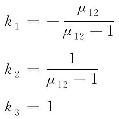 | 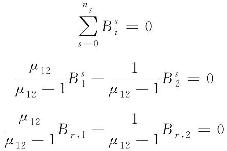 |  |
| DCB | 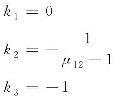 |  |  |
| IFCB |  |  |  |
Tab. 2
Satellite clock error correction methods under different forms of code bias representation"
| 码偏差 |  |
|---|---|
| OSB | 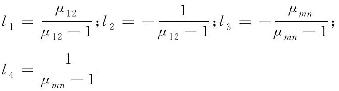 |
| DCB |  |
| IFCB |  |
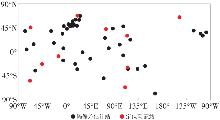
Fig. 1
Global distribution of the selected MGEX stations"
Tab. 3
Data processing strategies for code bias estimation"
| 项目 | 内容 |
|---|---|
| 观测值 | C2I、C6I、C1X、C5X原始观测值 |
| 卫星个数 | BDS-3 23颗MEO卫星和3颗IGSO卫星 |
| 截止高度角 | 7° |
| 处理弧长 | 24 h |
| 处理间隔 | 300 s |
| 天线相位中心误差 | 采用IGS提供的ANTEX(antenna exchange format)文件(igs20.atx)进行卫星和接收机天线相位中心误差改正 |
| 卫星轨道钟差 | 通过WHU发布的精密产品改正 |
| 站坐标 | 估计为常数并由IGS天解紧约束 |
| 接收机钟差 | 估计为随机游走噪声 |
| 对流层延迟 | 使用Vienna Mapping Functions 1(VMF1)映射函数[35];对流层梯度估计为24 h内常数;对流层湿延迟估计为1 h内常数并估计为随机游走噪声 |
| 模糊度 | 估计为弧段内浮点常数 |
| 电离层延迟 | 使用电离层单层映射函数;使用CODE发布的GIM产品改正的同时将改正残余量估计为白噪声 |
| 卫星码偏差 | 估计为24 h内常数;采用所有可用卫星的零均值约束;根据估计码偏差类型不同分别加入对应约束 |
| 接收机码偏差 | 估计为24 h内常数 |
| 参数估计器 | 加权最小二乘估计,原始伪距与相位观测值先验精度分别设置为0.2 m和0.002 m,采用高度角e相关的加权策略,即当e≥30°时采用等权,否则权重设为2sine |
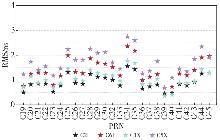
Fig. 2
RMS of BDS-3 satellite OSB estimation differences compared with CAS OSB product"
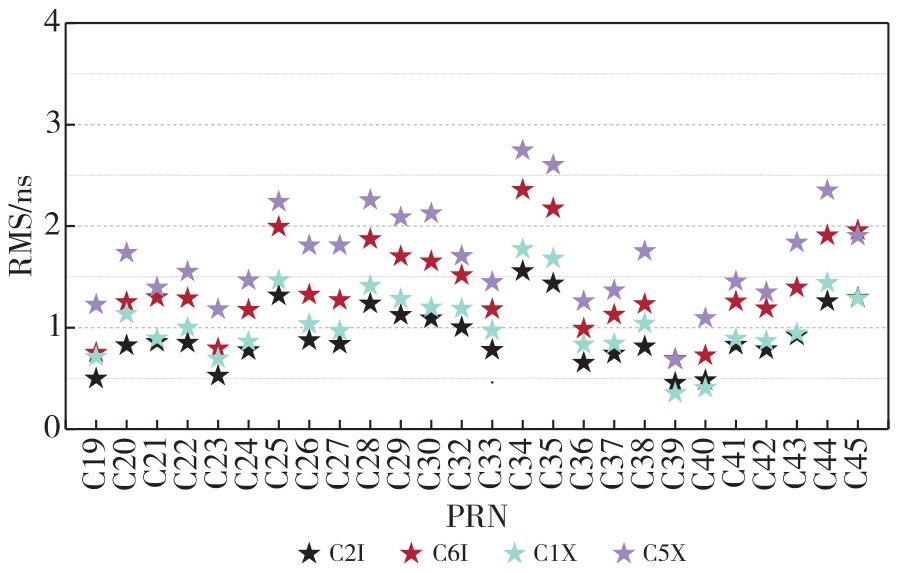
Fig. 3
RMS of BDS-3 satellite OSB estimation differences compared with WHU OSB product"
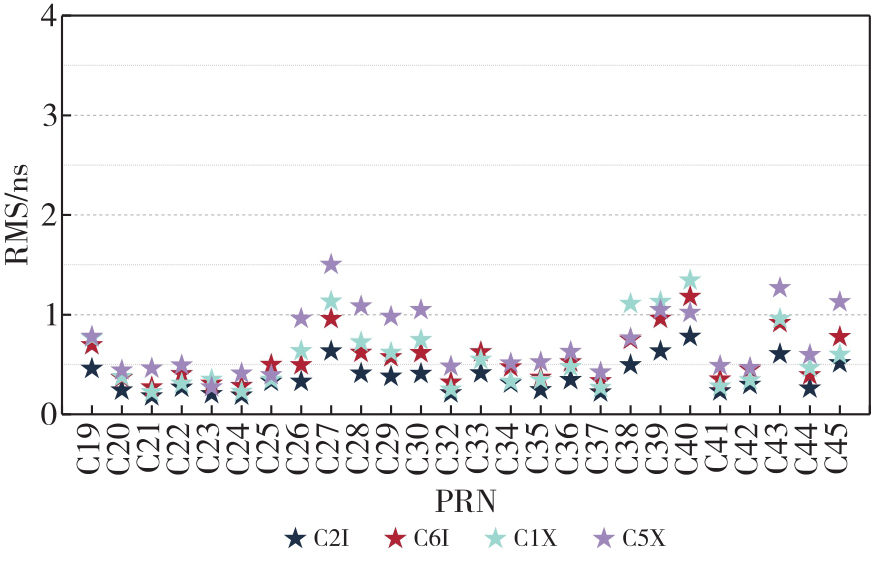
Fig. 4
RMS of differences between DCB converted from OSB estimates and DCB estimated directly"
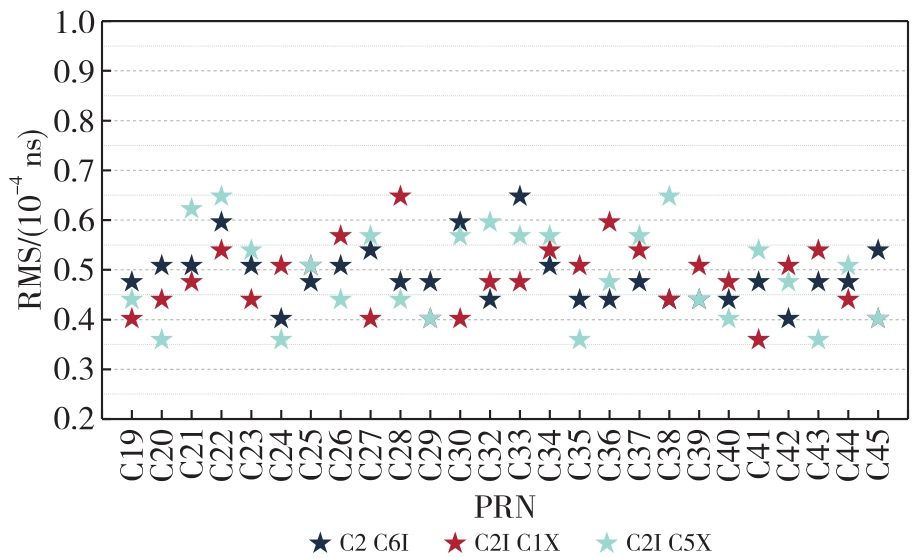
Fig. 5
RMS of differences between IFCB converted from OSB estimates and IFCB estimated directly"
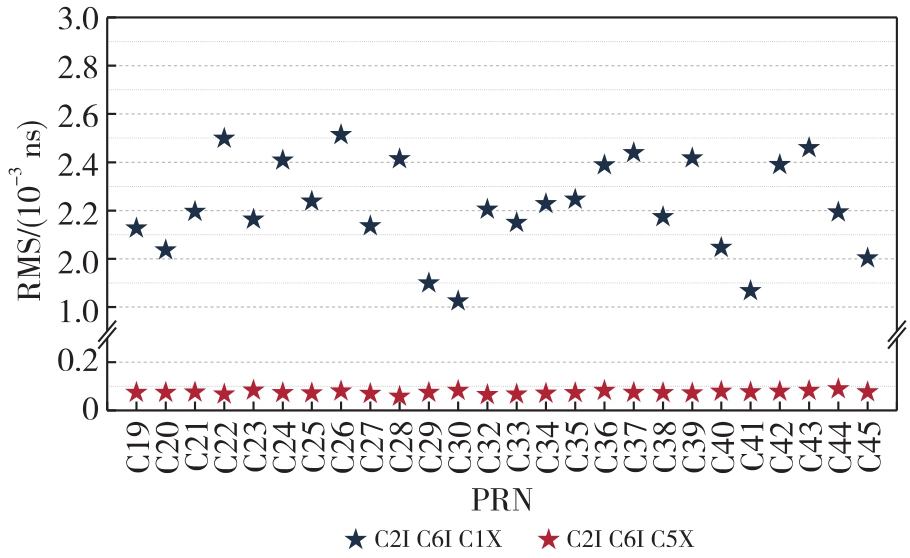
Fig. 6
The time series of RMS of kinematic PPP positioning errors"
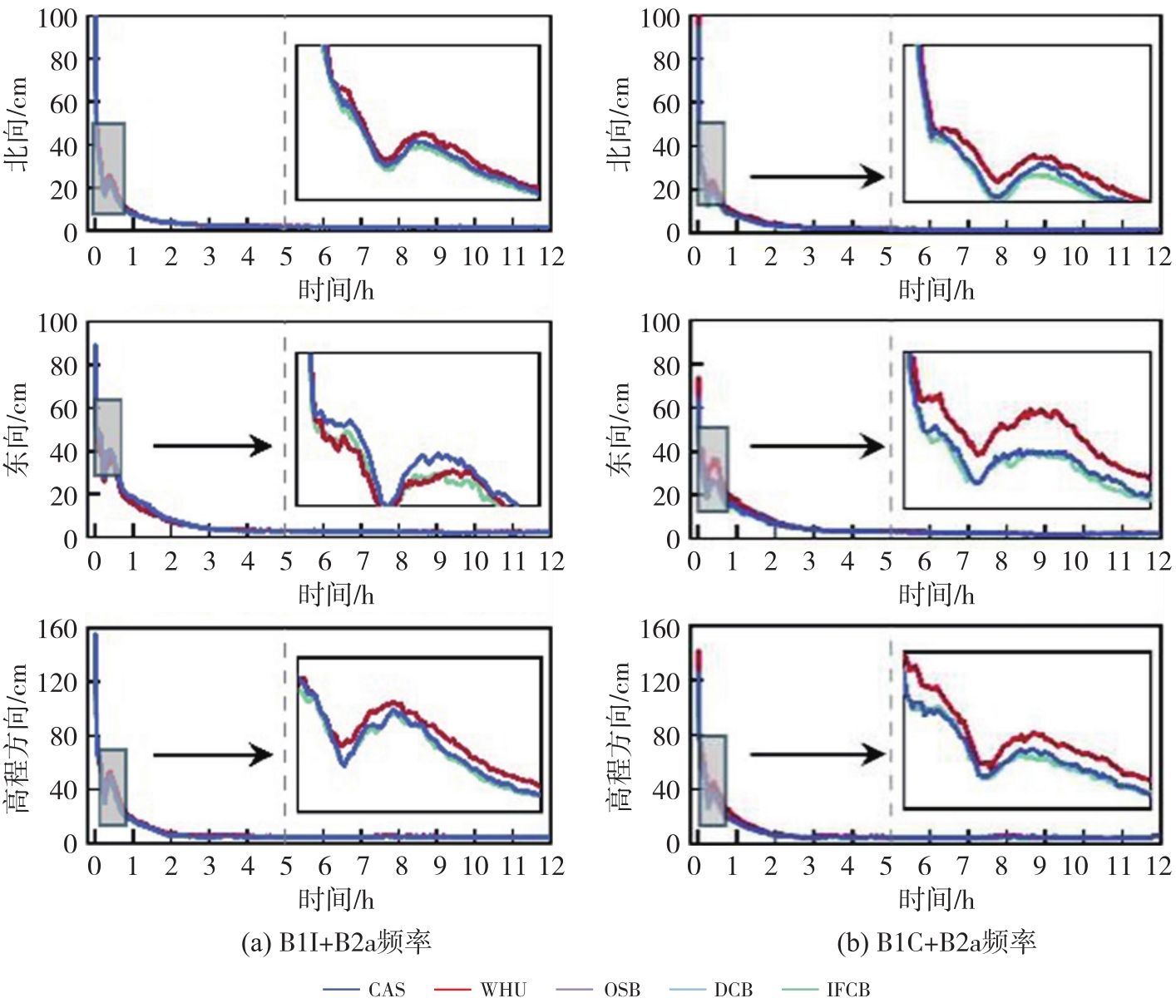
Tab. 4
The average RMS PPP errors during convergence (over the first 5 h)"
| 频率 | 方向 | CAS | WHU | OSB | DCB | IFCB |
|---|---|---|---|---|---|---|
| B1I+B2a | 北向 | 6.81 | 6.46 | 6.22 | 6.22 | 6.22 |
| 东向 | 10.43 | 11.37 | 10.63 | 10.63 | 10.63 | |
| 高程 | 13.94 | 12.88 | 12.59 | 12.59 | 12.59 | |
| 3D | 18.70 | 18.36 | 17.62 | 17.62 | 17.62 | |
| B1C+B2a | 北向 | 5.82 | 6.66 | 5.62 | 5.62 | 5.62 |
| 东向 | 8.95 | 10.60 | 8.62 | 8.62 | 8.62 | |
| 高程 | 11.53 | 13.43 | 11.41 | 11.41 | 11.41 | |
| 3D | 15.71 | 18.36 | 15.36 | 15.36 | 15.36 |
Tab. 5
The average RMS PPP errors after convergence"
| 频率 | 方向 | CAS | WHU | OSB | DCB | IFCB |
|---|---|---|---|---|---|---|
| B1I+B2a | 北向 | 1.78 | 1.70 | 1.70 | 1.70 | 1.70 |
| 东向 | 2.37 | 2.27 | 2.27 | 2.27 | 2.27 | |
| 高程 | 4.74 | 4.48 | 4.49 | 4.49 | 4.49 | |
| 3D | 5.59 | 5.31 | 5.31 | 5.31 | 5.31 | |
| B1C+B2a | 北向 | 1.67 | 1.75 | 1.67 | 1.67 | 1.67 |
| 东向 | 2.23 | 2.34 | 2.19 | 2.19 | 2.19 | |
| 高程 | 4.47 | 4.72 | 4.49 | 4.49 | 4.49 | |
| 3D | 5.27 | 5.55 | 5.26 | 5.26 | 5.26 |
| [1] | MONTENBRUCK O, HAUSCHILD A. Code biases in multi-GNSS point positioning[C]//Proceedings of 2013 International Technical Meeting of the Institute of Navigation. San Diego: ION, 2013: 616-628. |
| [2] | MONTENBRUCK O, STEIGENBERGER P, PRANGE L, et al. The multi-GNSS experiment (MGEX) of the International GNSS Service (IGS)-achievements, prospects and challenges[J]. Advances in Space Research, 2017, 59(7): 1671-1697. |
| [3] | 胡倬铭, 袁海军, 何秀凤, 等. MGEX差分码偏差产品对BDS-3伪距单点定位的影响研究[J]. 武汉大学学报(信息科学版), 2024, 49(5): 756-764. |
| HU Zhuoming, YUAN Haijun, HE Xiufeng, et al. Influence of MGEX differential code bias products on BDS-3 pseudorange single point positioning[J]. Geomatics and Information Science of Wuhan University, 2024, 49(5): 756-764. | |
| [4] | 汪奇生. 一种差分码偏差估计的简化模型及其评估分析[J]. 大地测量与地球动力学, 2022, 42(8): 840-845. |
| WANG Qisheng. A simplified model for DCB estimation and its assessment analysis[J]. Journal of Geodesy and Geodynamics, 2022, 42(8): 840-845. | |
| [5] | SARDÓN E, RIUS A, ZARRAOA N. Estimation of the transmitter and receiver differential biases and the ionospheric total electron content from global positioning system observations[J]. Radio Science, 1994, 29(3): 577-586. |
| [6] |
汪奇生. 多模多频GNSS差分码偏差估计及电离层建模研究[J]. 测绘学报, 2023, 52(6): 1040. DOI: .
doi: 10.11947/j.AGCS.2023.20210624 |
|
WANG Qisheng. Study of differential code bias estimation and ionosphere modeling using multi-mode and multi-frequency GNSS observations[J]. Acta Geodaetica et Cartographica Sinica, 2023, 52(6): 1040. DOI: .
doi: 10.11947/j.AGCS.2023.20210624 |
|
| [7] |
王宁波. GNSS差分码偏差处理方法及全球广播电离层模型研究[J]. 测绘学报, 2017, 46(8): 1069. DOI: .
doi: 10.11947/j.AGCS.2017.20160387 |
|
WANG Ningbo. Study on GNSS differential code biases and global broadcast ionospheric models of GPS, Galileo and BDS[J]. Acta Geodaetica et Cartographica Sinica, 2017, 46(8): 1069. DOI: .
doi: 10.11947/j.AGCS.2017.20160387 |
|
| [8] | 李子申, 王宁波, 袁运斌. 多模多频卫星导航系统码偏差统一定义与处理方法[J]. 导航定位与授时, 2020, 7(5): 10-20. |
| LI Zishen, WANG Ningbo, YUAN Yunbin. A unified definition and processing method of observable-specific signal biases for multi-mode and multi-frequency global navigation satellite system[J]. Navigation Positioning and Timing, 2020, 7(5): 10-20. | |
| [9] | FAN Lei, WANG Cheng, GUO Shiwei, et al. GNSS satellite inter-frequency clock bias estimation and correction based on IGS clock datum: a unified model and result validation using BDS-2 and BDS-3multi-frequency data[J]. Journal of Geodesy, 2021, 95(12): 135. |
| [10] | VILLIGER A, SCHAER S, DACH R, et al. Determination of GNSS pseudo-absolute code biases and their long-term combination[J]. Journal of Geodesy, 2019, 93(9): 1487-1500. |
| [11] | WANG Ningbo, YUAN Yunbin, LI Zishen, et al. Determination of differential code biases with multi-GNSS observations[J]. Journal of Geodesy, 2015, 90(3): 209-228. |
| [12] | WANG Ningbo, LI Zishen, DUAN Bingbing, et al. GPS and GLONASS observable-specific code bias estimation: comparison of solutions from the IGS and MGEX networks[J]. Journal of Geodesy, 2020, 94: 74. |
| [13] | GENG Jianghui, ZHANG Qiyuan, LI Guangcai, et al. Observable-specific phase biases of Wuhan multi-GNSS experiment analysis center's rapid satellite products[J]. Satellite Navigation, 2022, 3: 23. |
| [14] | ZHANG Qiang, ZHAO Qile. Global ionosphere mapping and differential code bias estimation during low and high solar activity periods with GIMAS software[J]. Remote Sensing, 2018, 10: 705. |
| [15] |
姚宜斌, 刘磊, 孔建, 等. GIM和不同约束条件相结合的BDS差分码偏差估计[J]. 测绘学报, 2017, 46(2): 135-143. DOI: .
doi: 10.11947/j.AGCS.2017.20160375 |
|
YAO Yibin, LIU Lei, KONG Jian, et al. Estimation of BDS DCB combining GIM and different zero-mean constraints[J]. Acta Geodaetica et Cartographica Sinica, 2017, 46(2): 135-143. DOI: .
doi: 10.11947/j.AGCS.2017.20160375 |
|
| [16] | MONTENBRUCK O, HAUSCHILD A, STEIGENBERGER P. Differential code bias estimation using multi-GNSS observations and global ionosphere maps[J]. Navigation, 2014, 61(3): 191-201. |
| [17] |
李阳, 王宁波, 李子申, 等. 顾及卫星PCO改正的BDS-3卫星差分码偏差精确估计[J]. 测绘学报, 2023, 52(9): 1460-1468. DOI: .
doi: 10.11947/j.AGCS.2023.20220444 |
|
LI Yang, WANG Ningbo, LI Zishen, et al. BDS-3 satellite difference code bias estimation with satellite phase center offset correction applied[J]. Acta Geodaetica et Cartographica Sinica, 2023, 52(9): 1460-1468. DOI: .
doi: 10.11947/j.AGCS.2023.20220444 |
|
| [18] |
邓远帆, 郭斐, 张小红, 等. 北斗三号卫星多频多通道差分码偏差估计与分析[J]. 测绘学报, 2021, 50(4): 448-456. DOI: .
doi: 10.11947/j.AGCS.2021.20200504 |
|
DENG Yuanfan, GUO Fei, ZHANG Xiaohong, et al. Estimation and analysis of the multi-frequency and multi-channel DCB for BDS-3[J]. Acta Geodaetica et Cartographica Sinica, 2021, 50(4): 448-456. DOI: .
doi: 10.11947/j.AGCS.2021.20200504 |
|
| [19] | 张宝成, 欧吉坤, 袁运斌, 等. 利用非组合精密单点定位技术确定斜向电离层总电子含量和站星差分码偏差[J]. 测绘学报, 2011, 40(4): 447-453. |
| ZHANG Baocheng, OU Jikun, YUAN Yunbin, et al. Calibration of slant total electron content and satellite-receiver's differential code biases with uncombined precise point positioning technique[J]. Acta Geodaetica et Cartographica Sinica, 2011, 40(4): 447-453. | |
| [20] | PAN Lin, ZHANG Xiaohong, LI Xingxing, et al. Characteristics of inter-frequency clock bias for Block IIF satellites and its effect on triple-frequency GPS precise point positioning[J]. GPS Solutions, 2016, 21(2): 811-822. |
| [21] | SCHÖNEMANN E, BECKER M, SPRINGER T. A new approach for GNSS analysis in a multi-GNSS and multi-signal environment[J]. Journal of Geodetic Science, 2011, 1(3): 204-214. |
| [22] | HOU Pengyu, CHE Delu, LIU Teng, et al. Status of undifferenced and uncombined GNSS data processing activities in China[J]. Journal of Geodesy and Geoinformation Science, 2023, 6(3): 135-144. |
| [23] | LIU Teng, ZHANG Baocheng, YUAN Yunbin, et al. Multi-GNSS triple-frequency differential code bias (DCB) determination with precise point positioning (PPP)[J]. Journal of Geodesy, 2018, 93(5): 765-784. |
| [24] | FAN Lei, SHI Chuang, WANG Cheng, et al. Impact of satellite clock offset on differential code biases estimation using undifferenced GPS triple-frequency observations[J]. GPS Solutions, 2020, 24(1): 32. |
| [25] | LIU Teng, ZHANG Baocheng. Estimation of code observation-specific biases (OSBs) for the modernized multi-frequency and multi-GNSS signals: an undifferenced and uncombined approach[J]. Journal of Geodesy, 2021, 95(8): 97. |
| [26] | LI Zishen, WANG Ningbo, LIU Ang, et al. Progress of geodesy related ionosphere from Chinese scientists in the period of 2019—2023[J]. Journal of Geodesy and Geoinformation Science, 2023, 6(3): 115-123. |
| [27] | ZHAO Jingzhu, FAN Lei, GUO Shiwei, et al. Satellite's differential code bias conversion model between different IGS clock products using uncombined BDS-3 multi-frequency data[J]. Journal of Geodesy, 2024, 98(10): 88. |
| [28] | ROMA-DOLLASE D, HERNÁNDEZ-PAJARES M, KRANKOWSKI A, et al. Consistency of seven different GNSS global ionospheric mapping techniques during one solar cycle[J]. Journal of Geodesy, 2017, 92(6): 691-706. |
| [29] | LI Zishen, WANG Ningbo, HERNÁNDEZ-PAJARES M, et al. IGS real-time service for global ionospheric total electron content modeling[J]. Journal of Geodesy, 2020, 94(3): 32. |
| [30] | SHI Chuang, GUO Shiwei, FAN Lei, et al. GSTAR: an innovative software platform for processing space geodetic data at the observation level[J]. Satellite Navigation, 2023, 4(1): 18. |
| [31] |
郭仕伟, 施闯, 范磊, 等. 北斗三号地心运动反演方法与结果[J]. 测绘学报, 2023, 52(12): 2054-2065. DOI: .
doi: 10.11947/j.AGCS.2023.20220518 |
|
GUO Shiwei, SHI Chuang, FAN Lei, et al. Estimation and analysis of geocenter motion using BDS-3 data[J]. Acta Geodaetica et Cartographica Sinica, 2023, 52(12): 2054-2065. DOI: .
doi: 10.11947/j.AGCS.2023.20220518 |
|
| [32] | JIANG Weiping, ZHAO Qile, LI Min, et al. The progress of IGS Analysis Center at Wuhan University[J]. Journal of Geodesy and Geoinformation Science, 2023, 6(3): 46-57. |
| [33] | FELTENS J, SCHAER S. IGS products for the ionosphere[C]//Proceedings of 1998 IGS Analysis Centers Workshop. Darmstadt: ESOC, 1998: 225-232. |
| [34] | LAGLER K, SCHINDELEGGER M, BOHM J, et al. GPT2: empirical slant delay model for radio space geodetic techniques[J]. Geophysical Research Letters, 2013, 40(6): 1069-1073. |
| [35] | HERNÁNDEZ-PAJARES M, JUAN J M, SANZ J, et al. The IGS VTEC maps: a reliable source of ionospheric information since 1998[J]. Journal of Geodesy, 2009, 83(3/4): 263-275. |
| [1] | Xiong PAN, Longjie ZHANG, Qingsong AI, Lihong JIN, Mao CAI. Improved ABC algorithm for optimizing BP neural network in short-term clock bias prediction and application [J]. Acta Geodaetica et Cartographica Sinica, 2025, 54(8): 1404-1415. |
| [2] | Jian CHEN, Jiahui WANG, Xingwang ZHAO, Chao LIU, Chunyang LIU, Xuexiang YU. Single-epoch RTK positioning optimization method based on BDS-3/Galileo multi-frequency ionosphere-reduced combinations [J]. Acta Geodaetica et Cartographica Sinica, 2025, 54(12): 2153-2167. |
| [3] | Tian HE, Guojie MENG, Weiwei WU, Xiaoning SU, Guoqiang ZHAO, Congmin WEI, Zhihua DONG. Preliminary analysis to positioning precision and crustal movement of BDS-3 data recorded by the China seismic experiment site [J]. Acta Geodaetica et Cartographica Sinica, 2024, 53(4): 653-665. |
| [4] | HU Chao, WANG Qianxin. GNSS ultra-rapid orbit and clock offset estimation method with the aid of the constraint of BDS-3 onboard clock [J]. Acta Geodaetica et Cartographica Sinica, 2024, 53(3): 413-424. |
| [5] | Chao HU, Qianxin WANG. BDS-3/GNSS satellite ultra-rapid clock offsets estimation model with the aid of onboard clock states solution [J]. Acta Geodaetica et Cartographica Sinica, 2024, 53(12): 2268-2281. |
| [6] | ZHA Jiuping, ZHANG Baocheng, LIU Teng, ZHANG Xiao, HOU Pengyu, YUAN Yunbin, LI Zishen. Undifferenced and uncombined PPP-RTK aided by BDS-3 PPP-B2b precise orbits [J]. Acta Geodaetica et Cartographica Sinica, 2023, 52(9): 1449-1459. |
| [7] | LI Yang, WANG Ningbo, LI Zishen, WANG Liang, LI Zongyi. BDS-3 satellite difference code bias estimation with satellite phase center offset correction applied [J]. Acta Geodaetica et Cartographica Sinica, 2023, 52(9): 1460-1468. |
| [8] | WANG Qianxin, HU Chao, WANG Zejie. Single station velocity determination of BDS-3 carrier phase observations with the constraints of heading angle [J]. Acta Geodaetica et Cartographica Sinica, 2023, 52(6): 871-883. |
| [9] | ZENG Huiyan, AI Lun, CHENG Jie, GENG Pengfei, ZHANG Ruwei, CHEN Mohan, SUN Shujie, LI Mingzhe. Analysis and solution of pseudorange layering between BDS-2 and BDS-3 systems [J]. Acta Geodaetica et Cartographica Sinica, 2023, 52(4): 596-604. |
| [10] | GUO Shiwei, SHI Chuang, FAN Lei, WEI Na, ZHANG Tao, FANG Xinqi, ZHOU Linghao. Estimation and analysis of geocenter motion using BDS-3 data [J]. Acta Geodaetica et Cartographica Sinica, 2023, 52(12): 2054-2065. |
| [11] | RUAN Rengui, JIA Xiaolin, FENG Laiping, WANG Long, ZHANG Fen. Modeling non-conservative forces for BDS-3 MEO satellites [J]. Acta Geodaetica et Cartographica Sinica, 2022, 51(9): 1862-1869. |
| [12] | LI Xingxing, LI Jie, YUAN Yongqiang, ZHENG Hongjie, HUANG Shi, LIU Chengbo, ZHANG Keke. Assessment and improvement of the empirical solar radiation pressure models for BDS-3 satellites [J]. Acta Geodaetica et Cartographica Sinica, 2022, 51(8): 1680-1689. |
| [13] | ZHANG Baocheng, KE Cheng, ZHA Jiuping, HOU Pengyu, LIU Teng, YUAN Yunbin, LI Zishen. Undifferenced and uncombined PPP-RTK:algorithmic models,prototype terminals and field-test results [J]. Acta Geodaetica et Cartographica Sinica, 2022, 51(8): 1725-1735. |
| [14] | YUAN Yunbin, HOU Pengyu, ZHANG Baocheng. GNSS undifferenced and uncombined data processing and PPP-RTK high-precision positioning [J]. Acta Geodaetica et Cartographica Sinica, 2022, 51(7): 1225-1238. |
| [15] | LI Bofeng, QIN Yuanyang, CHEN Guang'e. BDS-3 cycle slip and data gap repair based on the geometry-free ionosphere-filter model [J]. Acta Geodaetica et Cartographica Sinica, 2022, 51(4): 501-510. |
| Viewed | ||||||
|
Full text |
|
|||||
|
Abstract |
|
|||||
