

Acta Geodaetica et Cartographica Sinica ›› 2026, Vol. 55 ›› Issue (7): 1278-1292.doi: 10.11947/j.AGCS.2026.20250514
• Photogrammetry and Remote Sensing • Previous Articles
Lubing Zeng1( ), Jiansheng Li1,2,3(), Ancheng Wang1,2,3,4, Zidi Yang1, Yuning Gao1, Jiajie Zhang1
Received:2025-12-05
Revised:2026-07-18
Published:2026-08-18
Contact:
Jiansheng Li
E-mail:zlb17275600401@163.com;ljs2021@vip.henu.edu.cn
About author:Zeng Lubing (2002—), male, postgraduate, majors in computer vision and multi-source fusion navigation. E-mail: zlb17275600401@163.com
Supported by:CLC Number:
Lubing Zeng, Jiansheng Li, Ancheng Wang, Zidi Yang, Yuning Gao, Jiajie Zhang. A visual SLAM method fusing lightweight illumination enhancement network in complex illumination environments[J]. Acta Geodaetica et Cartographica Sinica, 2026, 55(7): 1278-1292.
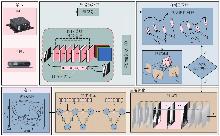
Fig. 1
The framework of the proposed method"

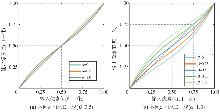
Fig. 2
The IE curve"
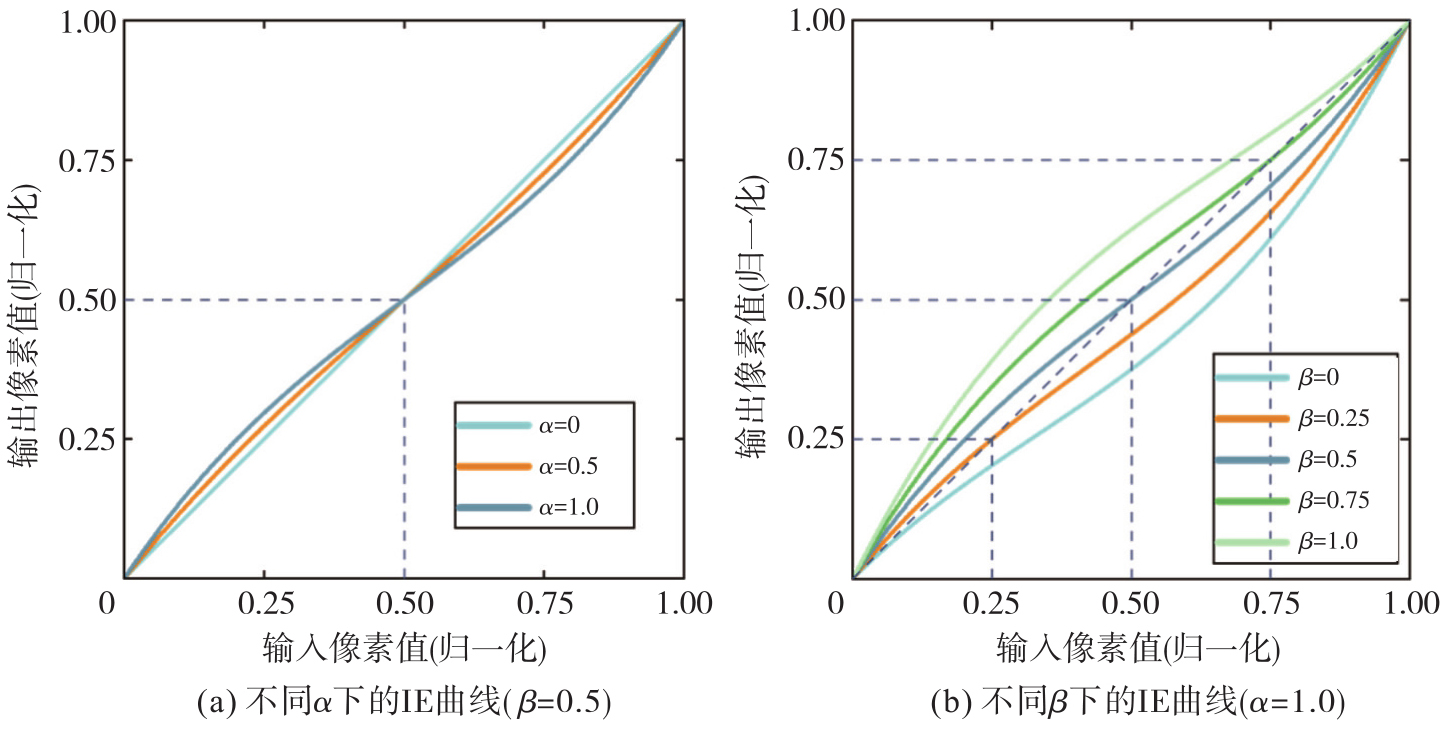
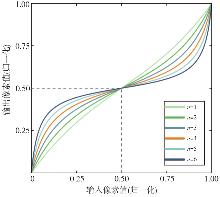
Fig. 3
The IE curves at different iteration counts"
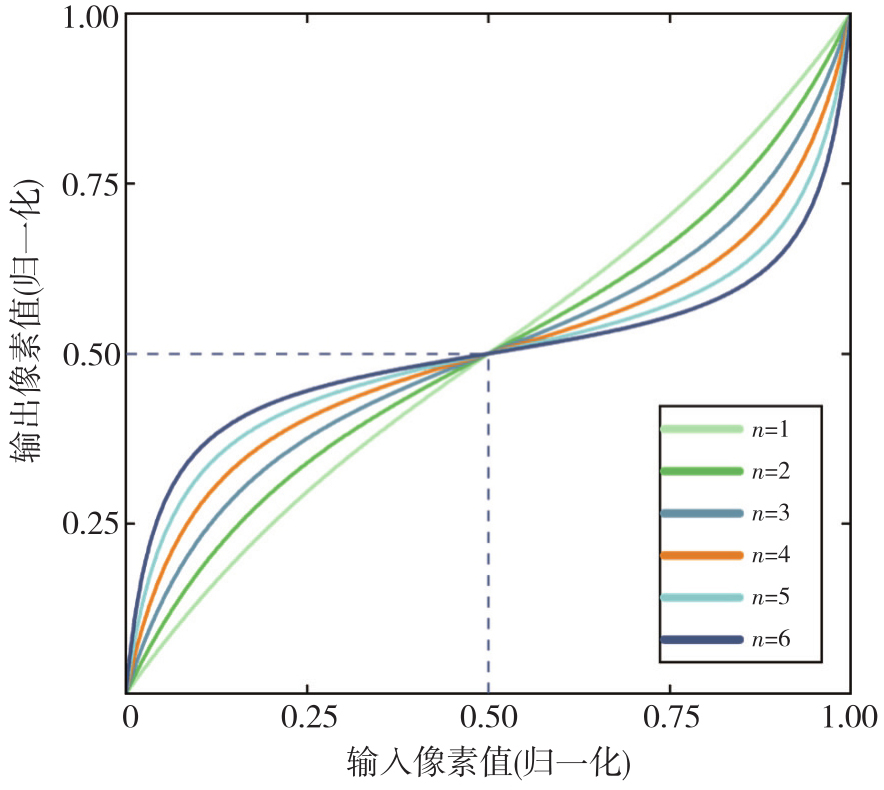
Fig. 4
The flowchart of iterative IE curve"
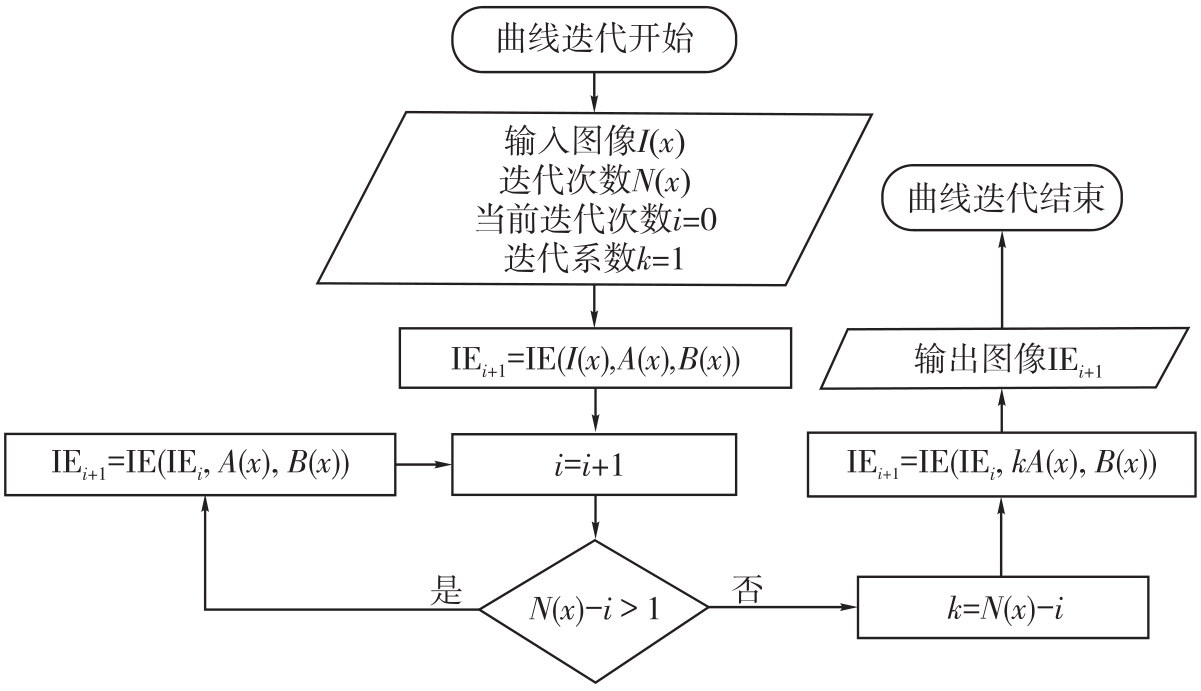
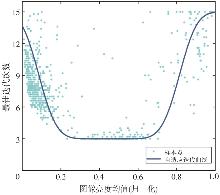
Fig. 5
The fitting results of the adaptive iterative curve"
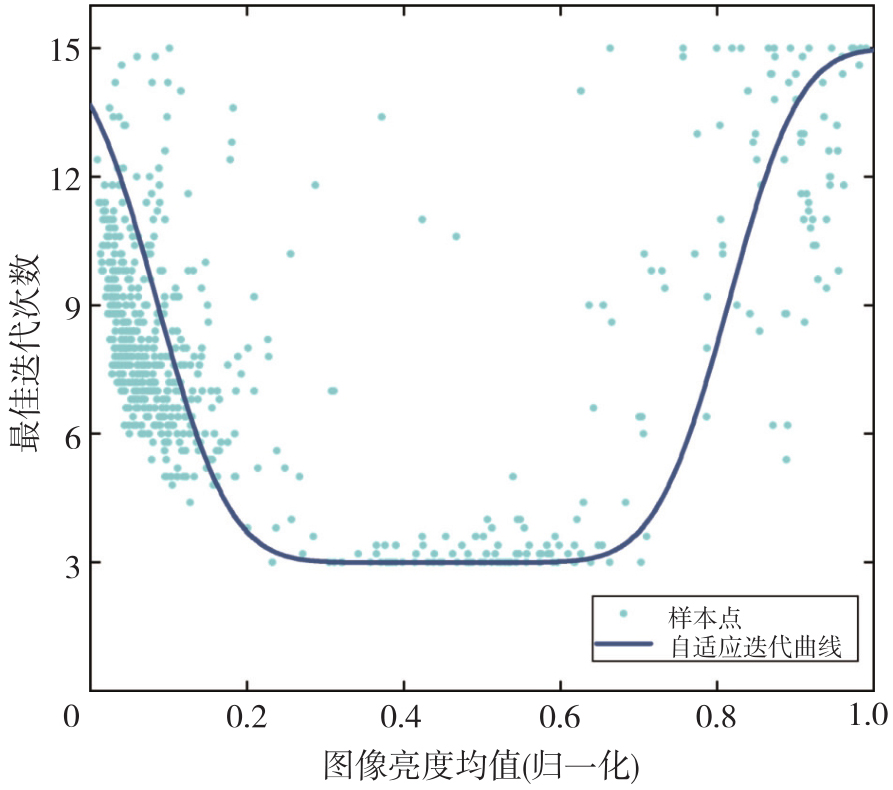
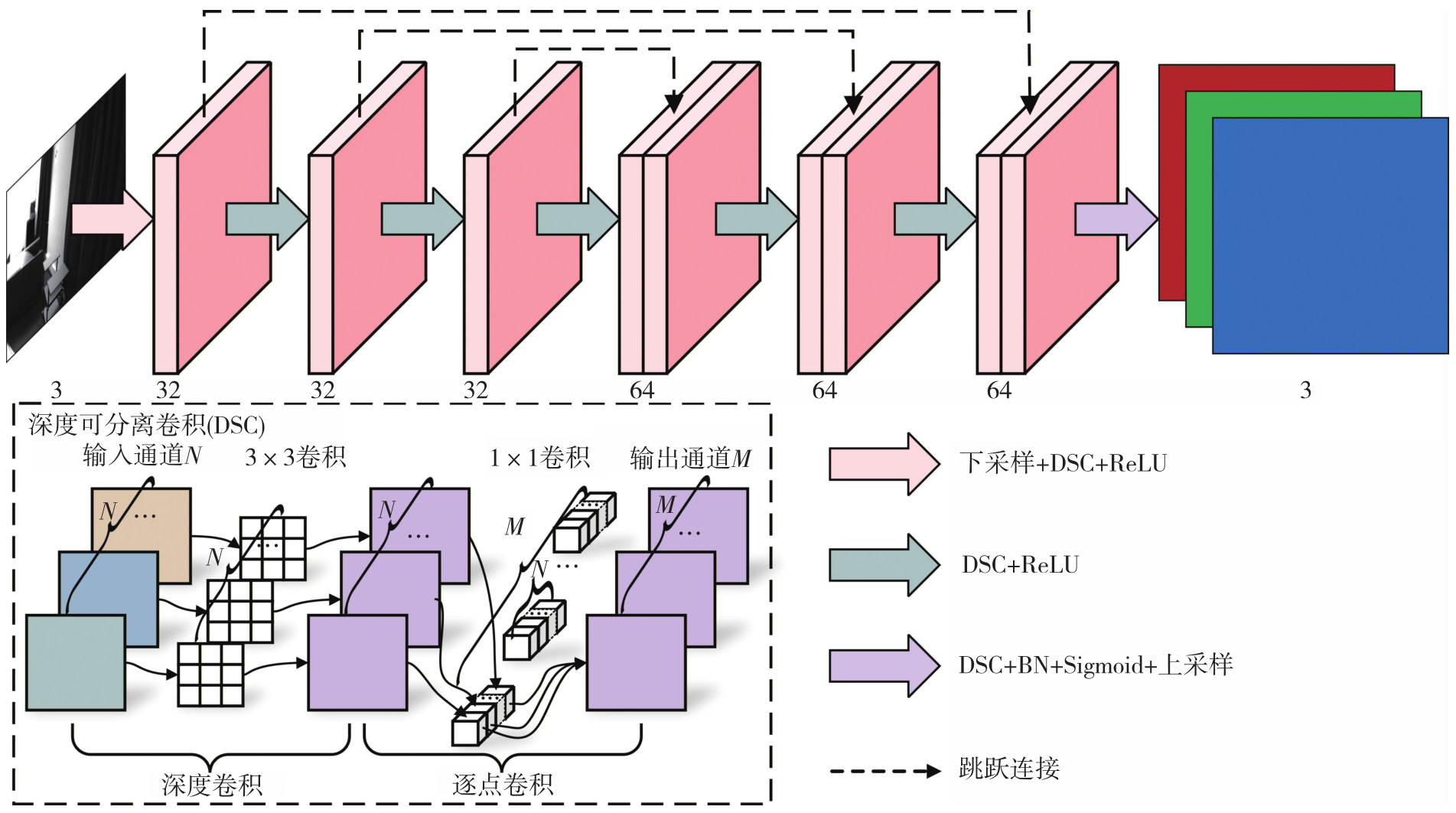
Fig. 6
The network architecture"
Tab. 1
The layer-wise network configuration"
| 层名 | 结构 |
|---|---|
| layer1 | 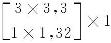 |
| layer2-4 | 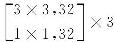 |
| layer5-6 | 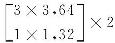 |
| layer7 | 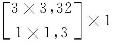 |
Tab. 2
The comparison of model efficiency metrics"
| 方法 | FLOPs | 模型参数量 | 处理时间/ms | 计算平台 |
|---|---|---|---|---|
| CLAHE | — | — | 0.971 | CPU |
| MSRCR | — | — | 1 336.574 | CPU |
| Zero-DCE | 20 761 804 800 | 79 416 | 175.437 | CPU |
| 4.257 | GPU | |||
| Zero-DCE++ | 49 917 952 | 10 561 | 9.704 | CPU |
| 1.830 | GPU | |||
| CIDNet | 32 531 742 720 | 1 973 496 | 947.859 | CPU |
| 41.738 | GPU | |||
| 本文方法 | 49 967 104 | 10 567 | 12.679 | CPU |
| 1.453 | GPU |
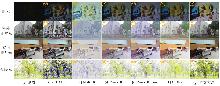
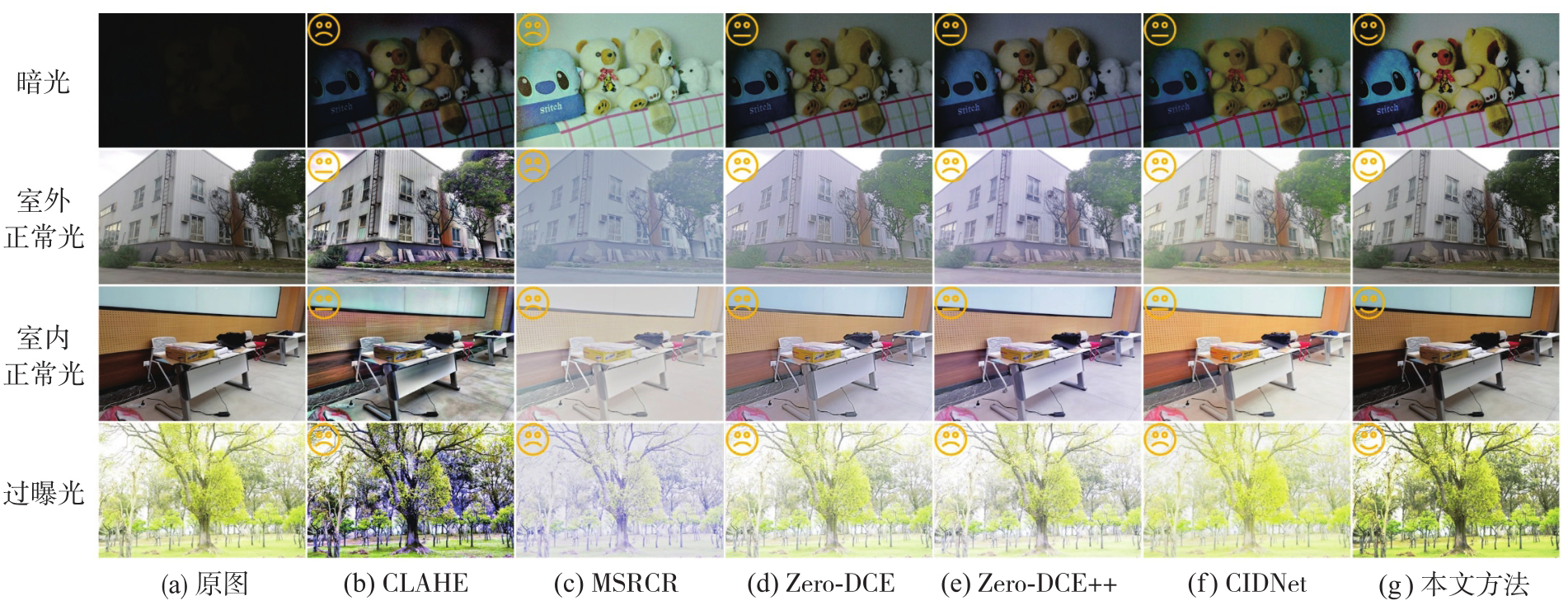
Fig. 7
The image enhancement results of different algorithms"
Tab. 3
The objective metrics comparison on low-light image"
| 图像 | 均值 | 标准差 | 平均梯度 | 信息熵 | NIQE |
|---|---|---|---|---|---|
| 原始图像 | 14.338 1 | 8.022 5 | 5.182 0 | 4.897 1 | 7.207 5 |
| CLAHE结果 | 35.542 8 | 19.216 1 | 14.078 6 | 6.082 5 | 7.729 9 |
| MSRCR结果 | 165.257 6 | 37.994 8 | 28.678 1 | 6.908 2 | 7.977 6 |
| Zero-DCE结果 | 75.921 2 | 34.795 3 | 23.097 5 | 6.695 5 | 8.021 4 |
| Zero-DCE++结果 | 77.276 0 | 34.536 5 | 23.194 1 | 6.704 8 | 8.218 9 |
| CIDNet结果 | 68.344 6 | 40.698 7 | 21.632 7 | 6.493 9 | 6.409 4 |
| 本文方法结果 | 119.783 9 | 60.017 8 | 31.589 6 | 6.003 9 | 6.710 2 |
Tab. 4
The objective metrics comparison on outdoor normal-light image"
| 图像 | 均值 | 标准差 | 平均梯度 | 信息熵 | NIQE |
|---|---|---|---|---|---|
| 原始图像 | 124.830 3 | 60.627 8 | 31.971 9 | 7.474 5 | 3.788 9 |
| CLAHE结果 | 136.767 1 | 63.630 5 | 53.221 3 | 7.647 8 | 4.066 9 |
| MSRCR结果 | 174.830 5 | 19.451 1 | 21.402 6 | 6.244 7 | 4.029 6 |
| Zero-DCE结果 | 170.069 2 | 39.685 8 | 32.786 1 | 7.051 0 | 3.960 5 |
| Zero-DCE++结果 | 177.933 8 | 37.298 8 | 32.818 3 | 6.994 8 | 4.024 0 |
| CIDNet结果 | 178.311 7 | 44.844 0 | 29.506 4 | 7.229 7 | 4.089 8 |
| 本文方法结果 | 125.197 7 | 59.427 4 | 31.439 9 | 7.447 3 | 3.769 6 |
Tab. 5
The objective metrics comparison on indoor normal-light image"
| 图像 | 均值 | 标准差 | 平均梯度 | 信息熵 | NIQE |
|---|---|---|---|---|---|
| 原始图像 | 134.376 7 | 65.374 0 | 22.437 3 | 7.690 9 | 3.870 4 |
| CLAHE结果 | 141.493 1 | 62.546 3 | 32.603 4 | 7.756 7 | 3.216 4 |
| MSRCR结果 | 205.829 7 | 22.048 6 | 13.681 0 | 5.769 1 | 3.960 9 |
| Zero-DCE结果 | 173.656 3 | 44.543 9 | 24.447 5 | 7.318 9 | 3.642 2 |
| Zero-DCE++结果 | 179.398 9 | 44.409 1 | 24.519 7 | 7.296 8 | 3.671 7 |
| CIDNet结果 | 187.037 6 | 54.634 6 | 22.166 5 | 7.143 2 | 3.606 7 |
| 本文方法结果 | 132.241 2 | 64.060 3 | 22.185 7 | 7.685 3 | 3.859 7 |
Tab. 6
The objective metrics comparison on overexposed image"
| 图像 | 均值 | 标准差 | 平均梯度 | 信息熵 | NIQE |
|---|---|---|---|---|---|
| 原始图像 | 202.709 7 | 45.871 7 | 57.450 5 | 7.099 7 | 2.976 1 |
| CLAHE结果 | 169.854 7 | 62.755 1 | 101.586 7 | 7.635 1 | 4.211 1 |
| MSRCR结果 | 220.877 6 | 18.824 5 | 38.561 8 | 5.834 6 | 2.863 2 |
| Zero-DCE结果 | 220.220 8 | 30.939 0 | 44.316 4 | 6.547 2 | 2.852 2 |
| Zero-DCE++结果 | 220.815 7 | 30.356 7 | 45.868 2 | 6.519 0 | 2.869 0 |
| CIDNet结果 | 216.408 5 | 34.584 2 | 34.282 6 | 6.544 7 | 3.100 8 |
| 本文方法结果 | 140.392 7 | 69.858 5 | 104.129 0 | 7.375 0 | 2.750 4 |
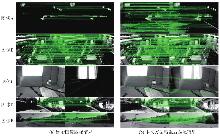
Fig. 8
Comparison of feature matching results before and after enhancement"
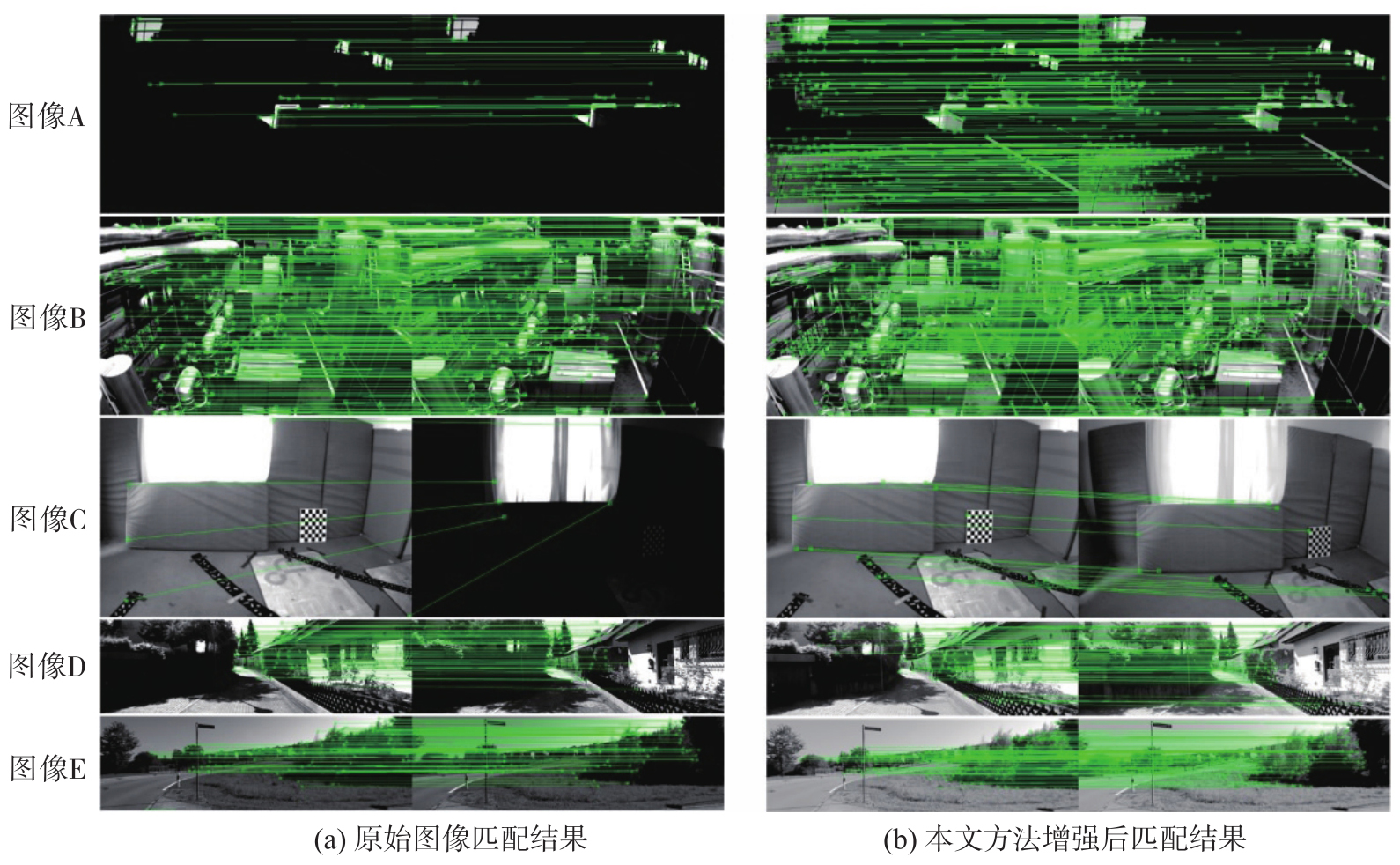
Tab. 7
The feature matching results before and after enhancement"
| 方法 | 匹配数量 | 匹配成功率/(%) | ||||||||
|---|---|---|---|---|---|---|---|---|---|---|
| 图像A | 图像B | 图像C | 图像D | 图像E | 图像A | 图像B | 图像C | 图像D | 图像E | |
| 原始图像 | 41 | 285 | 35 | 247 | 247 | 78.0 | 97.9 | 14.3 | 25.5 | 40.9 |
| CLAHE | 71 | 286 | 79 | 251 | 246 | 77.5 | 96.9 | 5.6 | 17.9 | 38.2 |
| MSRCR | 275 | 274 | 40 | 270 | 248 | 41.5 | 96.0 | 12.5 | 24.4 | 30.6 |
| Zero-DCE | 229 | 287 | 61 | 263 | 254 | 47.6 | 97.2 | 9.8 | 22.8 | 42.1 |
| Zero-DCE++ | 253 | 287 | 48 | 258 | 254 | 49.4 | 98.3 | 10.4 | 20.2 | 46.1 |
| CIDNet | 252 | 271 | 50 | 269 | 248 | 78.2 | 97.0 | 10.0 | 22.3 | 46.8 |
| 本文方法 | 279 | 289 | 85 | 272 | 258 | 86.4 | 99.3 | 18.8 | 31.2 | 48.8 |
Tab. 8
The comparison results of different modules"
| VINS-Fusion | LE曲线 | IE曲线 | 固定迭代 | 自适应迭代 | 匹配特征点平均数量 | 平均耗时/ms | ||||
|---|---|---|---|---|---|---|---|---|---|---|
| MH_04_difficult | room1 | 00 | MH_04_difficult | room1 | 00 | |||||
| √ | × | × | × | × | 196 | 75 | 212 | 1.0 | 1.0 | 1.5 |
| √ | √ | × | √ | × | 221 | 115 | 223 | 8.3 | 9.0 | 15.3 |
| √ | √ | × | × | √ | 231 | 117 | 225 | 7.8 | 8.6 | 12.5 |
| √ | × | √ | √ | × | 231 | 131 | 226 | 10.2 | 12.5 | 18.8 |
| √ | × | √ | × | √ | 234 | 152 | 227 | 9.7 | 10.4 | 15.8 |
Tab. 9
The characteristics of selected EuRoC sequences"
| 序列名称 | 长度/m | 特点 |
|---|---|---|
| V1_03_difficult | 78.982 | 室内环境,平台运动剧烈,光照变化明显,包含无纹理区域 |
| V2_03_difficult | 86.128 | 室内环境,平台运动剧烈,光照变化明显,包含无纹理区域,图像序列存在丢帧问题 |
| MH_04_difficult | 91.747 | 大型工业环境,存在光照变化,管道多,平台经过一段极端黑暗 |
| MH_05_difficult | 97.593 | 的区域 |
Tab. 10
The characteristics of selected TUM-VI sequences"
| 序列名称 | 长度/m | 特点 |
|---|---|---|
| room1 | 146.790 | 室内环境,平台运动剧烈,存在长时间绕圈行为,光照变化明显,包含无纹理区域,鱼眼相机视野范围广 |
| room2 | 141.598 | |
| room3 | 135.522 | |
| room4 | 68.698 |
Tab. 11
The characteristics of selected KITTI sequences"
| 序列名称 | 长度/m | 特点 |
|---|---|---|
| 00 | 3 724.187 | 住宅区场景,平台高速运动,转弯速度快,相机帧率低,视野内存在运动车辆和行人,光照分布不均,存在大量墙面反光、路面反光、镜头眩光和车窗玻璃反射光的强逆光场景 |
| 02 | 5 067.233 | |
| 03 | 560.888 | |
| 09 | 1 705.051 |
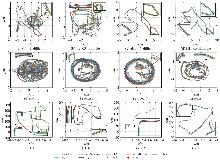
Fig. 9
Comparison of trajectories between the proposed method and other methods"

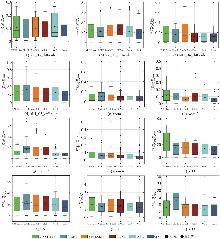
Fig. 10
Comparison of error distribution between the proposed method and other methods"

Tab. 12
The ATE comparison of different datasets"
| 数据集 | 序列名称 | RMSE/m | |||||
|---|---|---|---|---|---|---|---|
| VINS-Fusion | CLAHE | Zero-DCE++ | CIDNet | Our-8 | Our-it | ||
| EuRoC | V1_03_difficult | 0.137 | 0.118 | 0.126 | 0.107 | 0.144 | 0.101 |
| V2_03_difficult | 0.293 | 0.255 | 0.300 | 0.294 | 0.259 | 0.228 | |
| MH_04_difficult | 0.244 | 0.209 | 0.282 | 0.165 | 0.157 | 0.146 | |
| MH_05_difficult | 0.343 | 0.409 | 0.302 | 0.295 | 0.317 | 0.238 | |
| TUM-VI | room1 | 0.117 | 0.140 | 0.112 | 0.092 | 0.085 | 0.086 |
| room2 | 0.141 | 0.122 | 0.071 | 0.117 | 0.103 | 0.066 | |
| room3 | 0.127 | 0.194 | 0.231 | 0.178 | 0.092 | 0.083 | |
| room4 | 0.081 | 0.088 | 0.072 | 0.064 | 0.066 | 0.051 | |
| KITTI | 00 | 29.214 | 17.082 | 18.494 | 15.739 | 15.546 | 13.261 |
| 02 | 25.777 | 29.256 | 27.202 | 25.873 | 22.630 | 19.916 | |
| 03 | 1.806 | 1.471 | 1.657 | 1.641 | 1.515 | 1.376 | |
| 09 | 9.224 | 14.643 | 8.644 | 8.880 | 7.769 | 7.753 | |
| [1] |
陈锐志, 王磊, 李德仁, 等. 导航与遥感技术融合综述[J]. 测绘学报, 2019, 48(12): 1507-1522. DOI: .
doi: 10.11947/j.AGCS.2019.20190446 |
|
Chen Ruizhi, Wang Lei, Li Deren, et al. A survey on the fusion of the navigation and the remote sensing techniques[J]. Acta Geodaetica et Cartographica Sinica, 2019, 48(12): 1507-1522. DOI: .
doi: 10.11947/j.AGCS.2019.20190446 |
|
| [2] |
王晨捷, 罗斌, 李成源, 等. 无人机视觉SLAM协同建图与导航[J]. 测绘学报, 2020, 49(6): 767-776. DOI: .
doi: 10.11947/j.AGCS.2020.20190145 |
|
Wang Chenjie, Luo Bin, Li Chengyuan, et al. The collaborative mapping and navigation based on visual SLAM in UAV platform[J]. Acta Geodaetica et Cartographica Sinica, 2020, 49(6): 767-776. DOI: .
doi: 10.11947/j.AGCS.2020.20190145 |
|
| [3] | Yuan Zikang, Lang Fengtian, Xu Tianle, et al. SR-LIO: LiDAR-inertial odometry with sweep reconstruction[C]//Proceedings of 2024 IEEE/RSJ International Conference on Intelligent Robots and Systems (IROS), 2024: 7862-7869. |
| [4] |
张继贤, 刘飞. 视觉SLAM环境感知技术现状与智能化测绘应用展望[J]. 测绘学报, 2023, 52(10): 1617-1630. DOI: .
doi: 10.11947/j.AGCS.2023.20220240 |
|
Zhang Jixian, Liu Fei. Review of visual SLAM environment perception technology and intelligent surveying and mapping application[J]. Acta Geodaetica et Cartographica Sinica, 2023, 52(10): 1617-1630. DOI: .
doi: 10.11947/j.AGCS.2023.20220240 |
|
| [5] | Pan Youqi, Zhou Wugen, Cao Yingdian, et al. Adaptive VIO: deep visual-inertial odometry with online continual learning[C]//Proceedings of 2024 IEEE/CVF Conference on Computer Vision and Pattern Recognition, 2024: 18019-18028. |
| [6] | Peng Xiongfeng, Liu Zhihua, Li Weiming, et al. DVI-SLAM: a dual visual inertial SLAM network[C]//Proceedings of 2024 IEEE International Conference on Robotics and Automation, 2024: 12020-12026. |
| [7] | Xu Kuan, Hao Yuefan, Yuan Shenghai, et al. AirSLAM: an efficient and illumination-robust point-line visual SLAM system[J]. IEEE Transactions on Robotics, 2025, 41: 1673-1692. |
| [8] | Hana F M, Maulida I D. Analysis of contrast limited adaptive histogram equalization (CLAHE) parameters on finger knuckle print identification[J]. Journal of Physics: Conference Series, 2021, 1764(1): 012049. |
| [9] | Jobson D J, Rahman Z, Woodell G A. A multiscale retinex for bridging the gap between color images and the human observation of scenes[J]. IEEE Transactions on Image Processing, 1997, 6(7): 965-976. |
| [10] | Jobson D J. Retinex processing for automatic image enhancement[J]. Journal of Electronic Imaging, 2004, 13(1): 100. |
| [11] | Petro A B, Sbert C, Morel J M. Multiscale retinex[J]. Image Processing on Line, 2014, 4: 71-88. |
| [12] | 李艳, 张科, 李明辉. 微光场景下基于改进自适应Retinex的视觉SLAM算法[J]. 计算机工程与应用, 2026, 62(6): 391-400. |
| Li Yan, Zhang Ke, Li Minghui. Visual SLAM algorithm based on improved adaptive Retinex in low-light scenarios[J]. Computer Engineering and Applications, 2026, 62(6): 391-400. | |
| [13] | 李雪强, 李建胜, 王安成, 等. 低光照条件下基于图像增强的视觉惯性组合导航方法[J]. 测绘科学技术学报, 2025, 41(1): 21-26. |
| Li Xueqiang, Li Jiansheng, Wang Ancheng, et al. Visual-inertial integrated navigation method based on image enhancement under low illumination conditions[J]. Journal of Geomatics Science and Technology, 2025, 41(1): 21-26. | |
| [14] |
蔺小虎, 杨鑫, 姚顽强, 等. 面向复杂地下空间的多源传感器数据动态加权融合SLAM方法[J]. 测绘学报, 2025, 54(3): 523-535. DOI: .
doi: 10.11947/j.AGCS.2025.20230586 |
|
Lin Xiaohu, Yang Xin, Yao Wanqiang, et al. A dynamic weighted fusion SLAM method using multi-source sensor data in complex underground spaces[J]. Acta Geodaetica et Cartographica Sinica, 2025, 54(3): 523-535. DOI: .
doi: 10.11947/j.AGCS.2025.20230586 |
|
| [15] | 王纪武, 万伟鹏, 尚学强, 等. 基于图像增强和自适应阈值的语义视觉SLAM系统[J]. 计算机集成制造系统, 2024, 30(12): 4217-4232. |
| Wang Jiwu, Wan Weipeng, Shang Xueqiang, et al. Semantic visual SLAM system based on image enhancement and adaptive thresholding[J]. Computer Integrated Manufacturing Systems, 2024, 30(12): 4217-4232. | |
| [16] | Chen Gang, Du Guoqiang, Yang Chenguang, et al. An underwater visual SLAM system with adaptive image enhancement[J]. Ocean Engineering, 2025, 326: 120896. |
| [17] | Wei Chen, Wang Wenjing, Yang Wenhan, et al. Deep retinex decomposition for low-light enhancement[PP/OL]. arXiv (2018-08-14) [2026-03-15]. https://doi.org/10.48550/arXiv.1808.04560. |
| [18] | Guo Chunle, Li Chongyi, Guo Jichang, et al. Zero-reference deep curve estimation for low-light image enhancement[C]//Proceedings of 2020 IEEE/CVF Conference on Computer Vision and Pattern Recognition, 2020: 1777-1786. |
| [19] | Shi Yiqi, Liu Duo, Zhang Liguo, et al. ZERO-IG: zero-shot illumination-guided joint denoising and adaptive enhancement for low-light images[C]//Proceedings of 2024 IEEE/CVF Conference on Computer Vision and Pattern Recognition, 2024: 3015-3024. |
| [20] | Yan Qingsen, Feng Yixu, Zhang Cheng, et al. HVI: a new color space for low-light image enhancement[C]//Proceedings of 2025 IEEE/CVF Conference on Computer Vision and Pattern Recognition, 2025: 5678-5687. |
| [21] | Li Yiyu, Xu Ke, Hancke G P, et al. Color shift estimation-and-correction for image enhancement[C]//Proceedings of 2024 IEEE/CVF Conference on Computer Vision and Pattern Recognition, 2024: 25389-25398. |
| [22] | 江松, 崔智翔, 代碧波, 等. 暗环境适应性的基于SLAM的煤矿井下机器人定位方法[J]. 煤炭科学技术, 2025, 53(5): 349-361. |
| Jiang Song, Cui Zhixiang, Dai Bibo, et al. SLAM-based localization method of coal mine underground robot with adaptability to dark illumination environment[J]. Coal Science and Technology, 2025, 53(5): 349-361. | |
| [23] | Jiang Kuosheng, Zhu Chengbing, Yang Jinbao. Research on low-light environment SLAM system via retinex enhancement and deep feature optimization[J]. IEEE Sensors Journal, 2025, 25(15): 29992-30004. |
| [24] | Liu Yanjie, Wu Heng, Zhang Weiwu, et al. Low-light enhancement visual SLAM via deep deformable power curve estimation[J]. IEEE Sensors Journal, 2025, 25(10): 17404-17412. |
| [25] | Qin Tong, Cao Shaozu, Pan Jie, et al. A general optimization-based framework for global pose estimation with multiple sensors[PP/OL]. arXiv (2019-01-11) [2026-03-15]. https://doi.org/10.48550/arXiv.1901.03642. |
| [26] | Li Chongyi, Guo Chunle, Loy C C. Learning to enhance low-light image via zero-reference deep curve estimation[J]. IEEE Transactions on Pattern Analysis and Machine Intelligence, 2022, 44(8): 4225-4238. |
| [27] | Cai Jianrui, Gu Shuhang, Zhang Lei. Learning a deep single image contrast enhancer from multi-exposure images[J]. IEEE Transactions on Image Processing, 2018, 27(4): 2049-2062. |
| [28] | Hai Jiang, Xuan Zhu, Yang Ren, et al. R2RNet: low-light image enhancement via real-low to real-normal network[J]. Journal of Visual Communication and Image Representation, 2023, 90: 103712. |
| [29] | Zhang Ru, Zhu Feng, Liu Jianyi, et al. Depth-wise separable convolutions and multi-level pooling for an efficient spatial CNN-based steganalysis[J]. IEEE Transactions on Information Forensics and Security, 2020, 15: 1138-1150. |
| [30] | Baker S, Matthews I. Lucas-kanade 20 years on: a unifying framework[J]. International Journal of Computer Vision, 2004, 56(3): 221-255. |
| [31] | Burri M, Nikolic J, Gohl P, et al. The EuRoC micro aerial vehicle datasets[J]. The International Journal of Robotics Research, 2016, 35(10): 1157-1163. |
| [32] | Geiger A, Lenz P, Stiller C, et al. Vision meets robotics: the KITTI dataset[J]. International Journal of Robotics Research, 2013, 32(11): 1231-1237. |
| [33] | Schubert D, Goll T, Demmel N, et al. The TUM VI benchmark for evaluating visual-inertial odometry[C]//Proceedings of 2018 IEEE/RSJ International Conference on Intelligent Robots and Systems, 2018: 1680-1687. |
| [34] | Hadjivelichkov D, Ægidius S, Modugno V, et al. Task-critical part alignment improves imitation of object interactions[C]//Proceedings of 2025 IEEE International Conference on Advanced Robotics, 2025: 329-334. |
| [35] | Qin Tong, Li Peiliang, Shen Shaojie. VINS-mono: a robust and versatile monocular visual-inertial state estimator[J]. IEEE Transactions on Robotics, 2018, 34(4): 1004-1020. |
| [1] | He Li, Kejie Chen, Wenfeng Cui, Haishan Chai, Rongxin Fang, Chaoyong Peng, Li Sun. Rapid magnitude estimation based on BDS-3 PPP-B2b coseismic displacement and deep learning: a case study of the 2025 Tingri Mw 7.1 and Mandalay Mw 7.7 earthquakes [J]. Acta Geodaetica et Cartographica Sinica, 2026, 55(7): 1171-1182. |
| [2] | Xi Zhao, Qiangqiang Yuan, Jiadan Xu. A sample generation and enhancement method for side-scan sonar targets in complex marine environments [J]. Acta Geodaetica et Cartographica Sinica, 2026, 55(7): 1229-1239. |
| [3] | Shuo LIU, Haili SUN, Ruofei ZHONG. A tunnel water leakage detection method based on multi-scale edge information fusion [J]. Acta Geodaetica et Cartographica Sinica, 2026, 55(6): 1116-1127. |
| [4] | Tiandong SHI, Ling ZHAO, Wenhao ZHAO, Ji QI, Hao CUI, Chengli PENG, Xinchang ZHANG. Controllable generation of high-resolution optical remote sensing image explicitly guided by spatio-temporal information [J]. Acta Geodaetica et Cartographica Sinica, 2026, 55(5): 894-908. |
| [5] | Jiayao WANG, Lin CHEN, Shiyuan CHENG, Lijun WANG, Siqi XIONG. Artificial intelligence empowering the digital-intelligent transformation of cartographic science [J]. Acta Geodaetica et Cartographica Sinica, 2026, 55(3): 381-389. |
| [6] | Xiaomin LU, Zhiyi ZHANG, Haowen YAN, Yi HE, Xiaoning SU. A recognition method for building group pattern integrating deep graph infomax and multilayer perceptron [J]. Acta Geodaetica et Cartographica Sinica, 2026, 55(3): 425-438. |
| [7] | Shunping JI, Jin LIU, Jian GAO, Jianya GONG. An intelligent 3D reconstruction framework via deep learning based multi-view image matching [J]. Acta Geodaetica et Cartographica Sinica, 2025, 54(9): 1633-1646. |
| [8] | Jixian ZHANG, Haiyan GU, Huan NI, Haitao LI, Yi YANG, Shaopeng DING, Songman SUI. Deep learning methods for remote sensing intelligent change detection: evolution and development [J]. Acta Geodaetica et Cartographica Sinica, 2025, 54(8): 1347-1370. |
| [9] | Shuai FANG, Jiaen LIU, Jing ZHANG. Spatio-temporal fusion algorithm based on adaptive reference feature incorporation and multi-scale feature aggregation [J]. Acta Geodaetica et Cartographica Sinica, 2025, 54(8): 1476-1488. |
| [10] | Nina MENG, Fengmei LI, Xiaodong ZHOU. Data and cognition dual-driven building group generalization results and scale consistency assessment [J]. Acta Geodaetica et Cartographica Sinica, 2025, 54(7): 1318-1331. |
| [11] | Yaqing WANG, Zhonghui WANG. River network automated selection method based on heterogeneous graph convolutional networks [J]. Acta Geodaetica et Cartographica Sinica, 2025, 54(7): 1332-1345. |
| [12] | Xiaoya AN, Weiru GUO, Pengxin ZHANG, Xinxin LI, Lei SHI. Ship trajectories clustering method considering similarity in geometric position and mobility features [J]. Acta Geodaetica et Cartographica Sinica, 2025, 54(6): 1107-1121. |
| [13] | Chao WANG, Tianyu CHEN, Tong ZHANG, Tanvir AHMED, Liqiang JI, Tao XIE, Jiajun YANG, Shuai WANG. Multi-sensor optical remote sensing images change detection based on global differential enhancement module and balance penalty loss [J]. Acta Geodaetica et Cartographica Sinica, 2025, 54(5): 873-887. |
| [14] | Qingli LUO, Xueyan LI, Guoman HUANG, Honghui CHEN, Minglong XUE, Jian LI. AOSN: alpha optimal structure network for height estimation from a single SAR image in mountain areas [J]. Acta Geodaetica et Cartographica Sinica, 2025, 54(5): 888-898. |
| [15] | Xiaohu LIN, Xin YANG, Wanqiang YAO, Hongwei MA, Bolin MA, Xiongwei MA. A dynamic weighted fusion SLAM method using multi-source sensor data in complex underground spaces [J]. Acta Geodaetica et Cartographica Sinica, 2025, 54(3): 523-535. |
| Viewed | ||||||
|
Full text |
|
|||||
|
Abstract |
|
|||||
