

Acta Geodaetica et Cartographica Sinica ›› 2026, Vol. 55 ›› Issue (8): 1343-1356.doi: 10.11947/j.AGCS.2026.20250297
• Advanced Technologies in Imaging Geodesy and Innovative Applications in Smart Disaster Prevention • Previous Articles
Tengfeng Tang1( ), Renyuan Liu1, Chang Liu1, Yangang Zhao2, Dan Pan3, Yuanxin Ye1()
Received:2025-07-24
Revised:2025-12-05
Published:2026-09-09
Contact:
Yuanxin Ye
E-mail:ttf@my.swjtu.edu.cn;yeyuanxin@home.swjtu.edu.cn
About author:Tang Tengfeng (2000—), male, PhD candidate, majors in multi-source remote sensing image matching. E-mail: ttf@my.swjtu.edu.cn
Supported by:CLC Number:
Tengfeng Tang, Renyuan Liu, Chang Liu, Yangang Zhao, Dan Pan, Yuanxin Ye. Multi-modal image matching based on modality reconstruction and feature perturbation learning[J]. Acta Geodaetica et Cartographica Sinica, 2026, 55(8): 1343-1356.
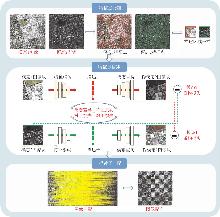
Fig. 1
Multi-modal image matching framework based on modality reconstruction and feature perturbation learning"
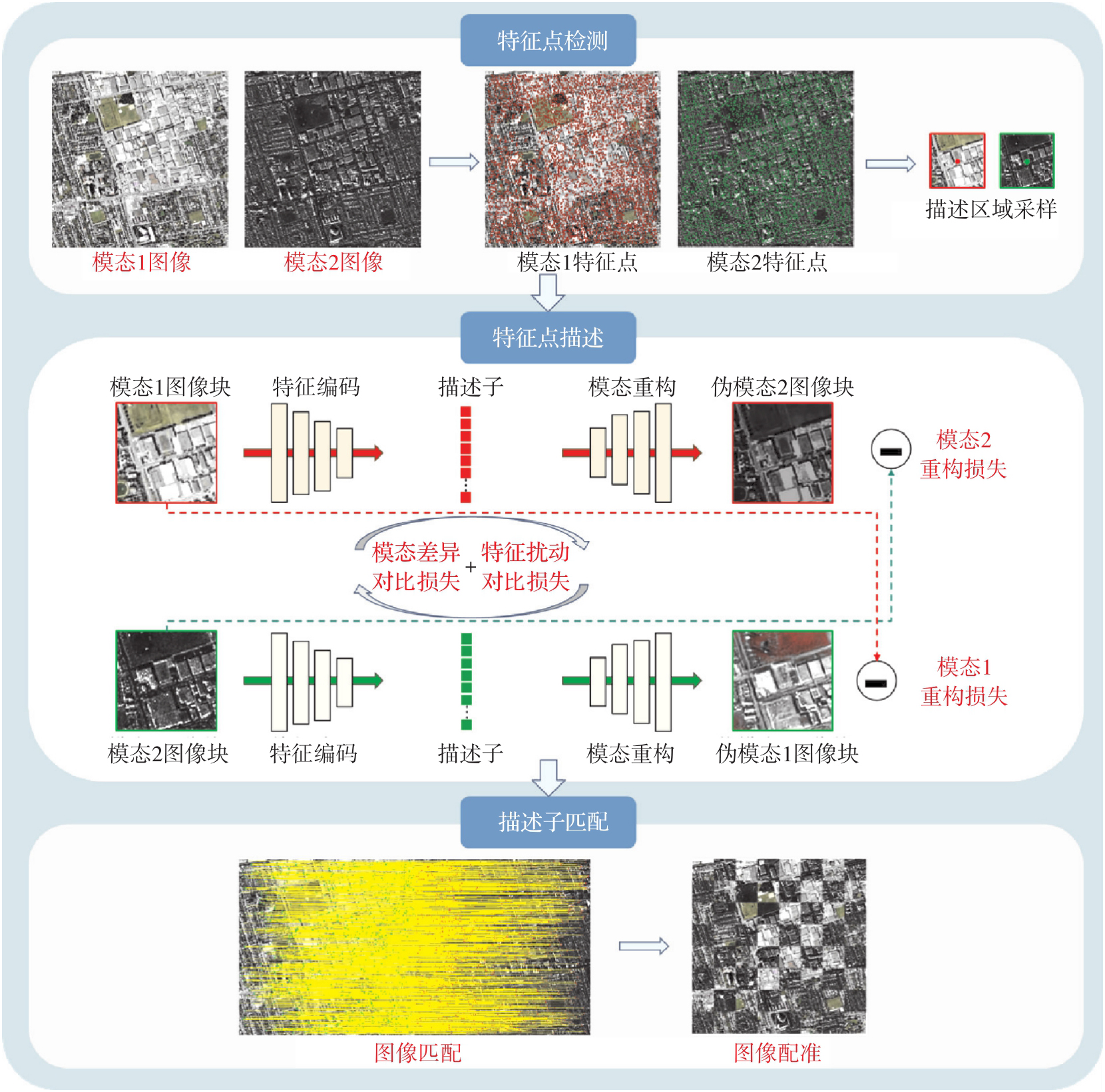
Fig. 2
The network structure of local region common feature extraction and modality reconstruction"
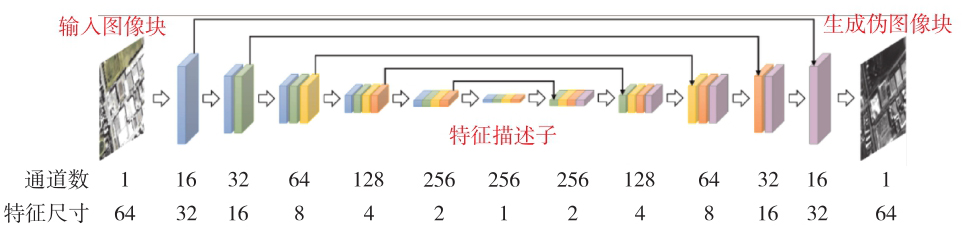
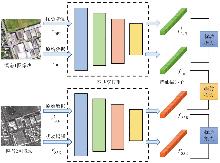
Fig. 3
The training process of feature encoder"

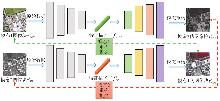
Fig. 4
The training process of feature decoder"
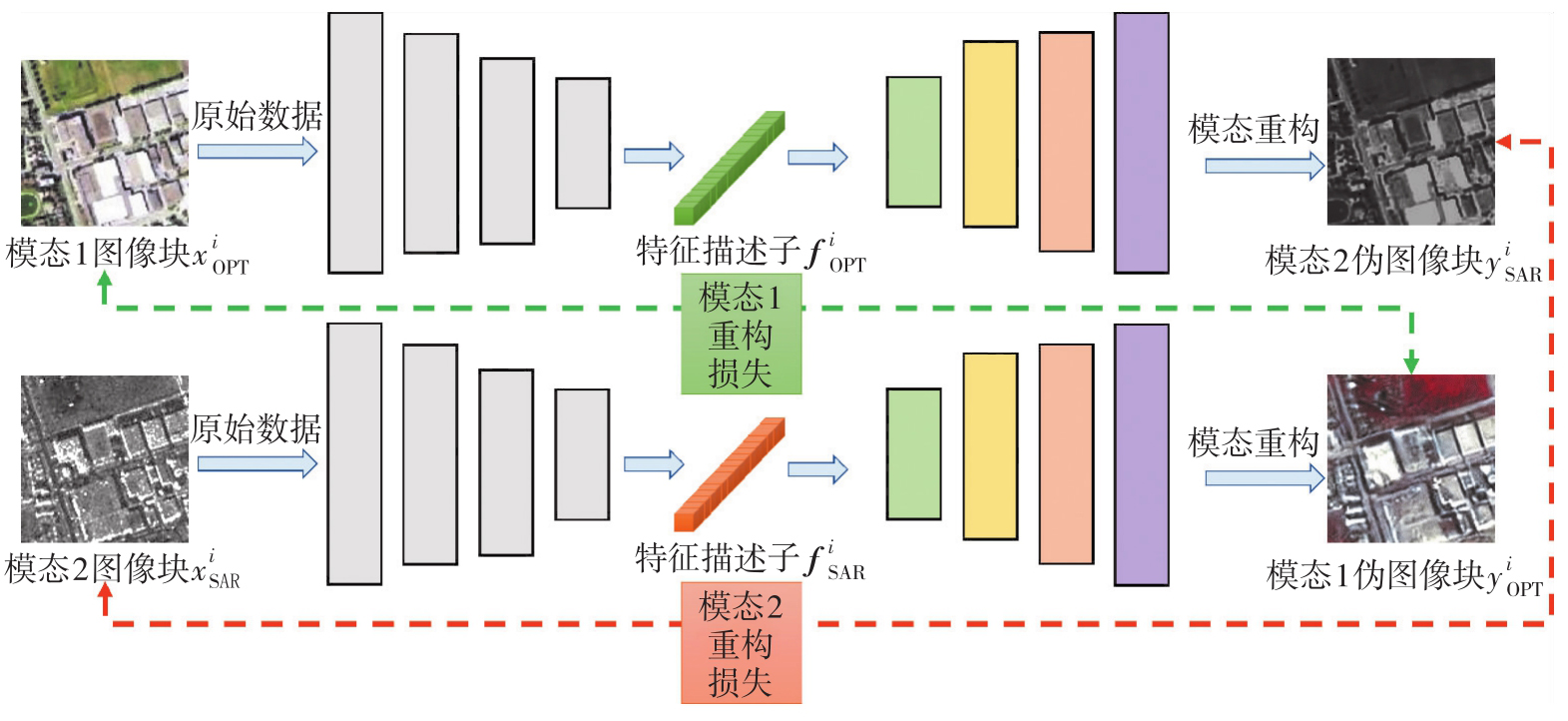
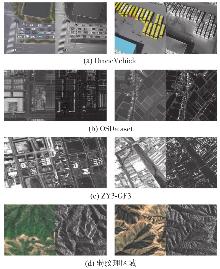
Fig. 5
Partial dataset images"
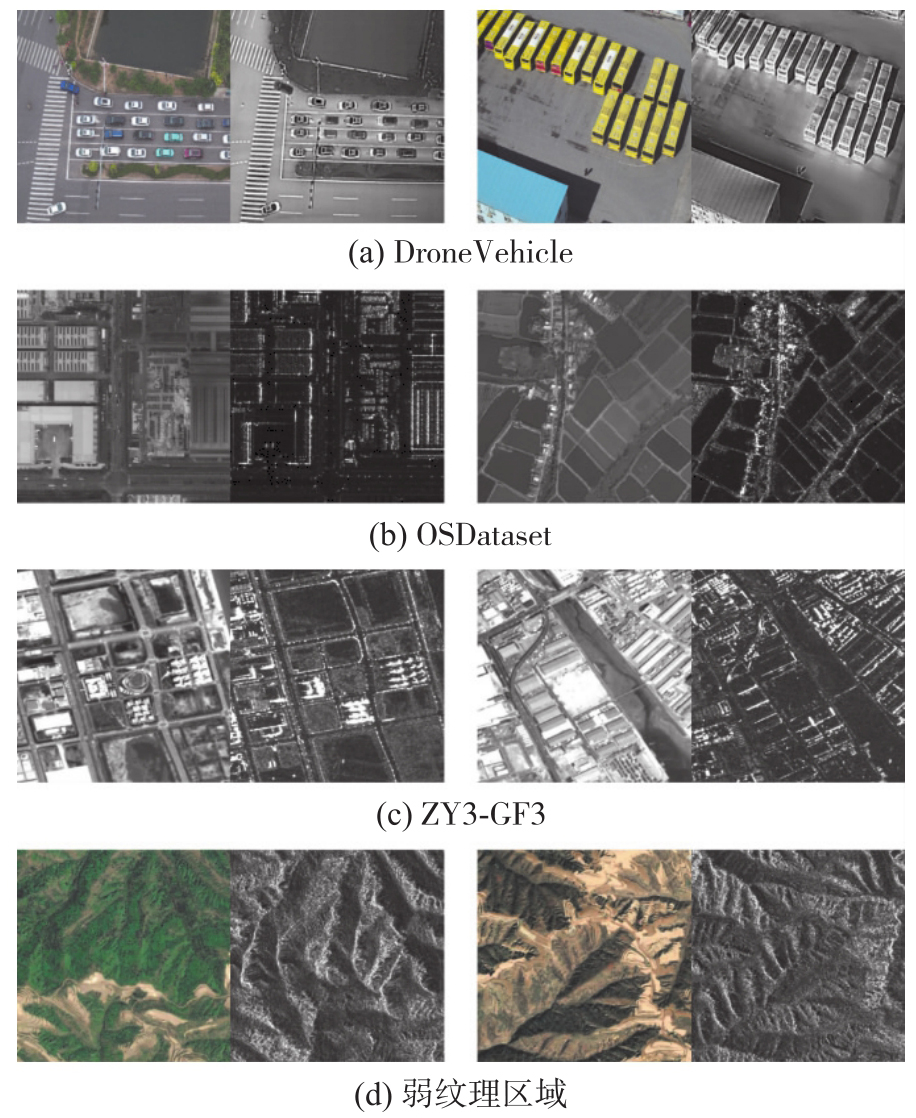
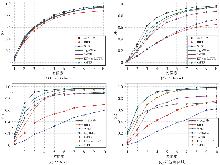
Fig. 6
Success rates under different thresholds"

Tab. 1
Image matching evaluation on DroneVehicle dataset"
| 方法 | RMSE/像素 | AUC/(%) | ||
|---|---|---|---|---|
| 3像素 | 5像素 | 10像素 | ||
| 本文方法 | 1.82 | 28.42 | 45.87 | 68.39 |
| RIFT | 2.51 | 24.22 | 40.83 | 62.33 |
| WSSF | 2.02 | 25.63 | 43.61 | 66.04 |
| LightGlue | 2.12 | 25.30 | 42.78 | 65.55 |
| LoFTR | 1.97 | 25.75 | 43.19 | 65.63 |
| EfficientLoFTR | 2.14 | 24.86 | 42.32 | 65.15 |
| XoFTR | 1.93 | 26.16 | 43.70 | 66.14 |
Tab. 2
Image matching evaluation on OSDataset"
| 方法 | RMSE/像素 | AUC/(%) | ||
|---|---|---|---|---|
| 3像素 | 5像素 | 10像素 | ||
| 本文方法 | 1.86 | 22.17 | 43.49 | 68.08 |
| RIFT | 5.54 | 8.14 | 18.14 | 37.48 |
| WSSF | 4.68 | 8.37 | 18.51 | 39.93 |
| LightGlue | 2.42 | 18.87 | 38.00 | 63.55 |
| LoFTR | 3.17 | 14.62 | 30.96 | 55.74 |
| EfficientLoFTR | 2.63 | 13.25 | 31.86 | 59.61 |
| XoFTR | 2.44 | 14.81 | 34.65 | 61.54 |
Tab. 3
Image matching evaluation on ZY3-GF3 dataset"
| 方法 | RMSE/像素 | AUC/(%) | ||
|---|---|---|---|---|
| 3像素 | 5像素 | 10像素 | ||
| 本文方法 | 1.59 | 45.18 | 64.21 | 80.26 |
| RIFT | 6.45 | 15.39 | 27.79 | 45.43 |
| WSSF | 8.26 | 6.03 | 13.62 | 30.74 |
| LightGlue | 3.22 | 35.53 | 53.57 | 70.49 |
| LoFTR | 3.34 | 30.57 | 49.45 | 68.64 |
| EfficientLoFTR | 2.92 | 24.54 | 45.87 | 69.49 |
| XoFTR | 2.12 | 40.64 | 59.28 | 77.26 |
Tab. 4
Image matching evaluation on the weak texture region"
| 方法 | RMSE/像素 | AUC/(%) | ||
|---|---|---|---|---|
| 3像素 | 5像素 | 10像素 | ||
| 本文方法 | 1.34 | 41.89 | 60.91 | 78.82 |
| RIFT | 6.31 | 12.39 | 24.33 | 45.21 |
| WSSF | 8.97 | 4.37 | 11.87 | 29.92 |
| LightGlue | 3.11 | 32.44 | 44.97 | 57.81 |
| LoFTR | 4.34 | 19.79 | 38.45 | 59.81 |
| EfficientLoFTR | 1.98 | 27.63 | 48.72 | 71.50 |
| XoFTR | 1.63 | 41.27 | 60.22 | 77.70 |
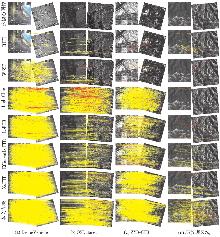
Fig. 7
Visualization of matching results by different methods"
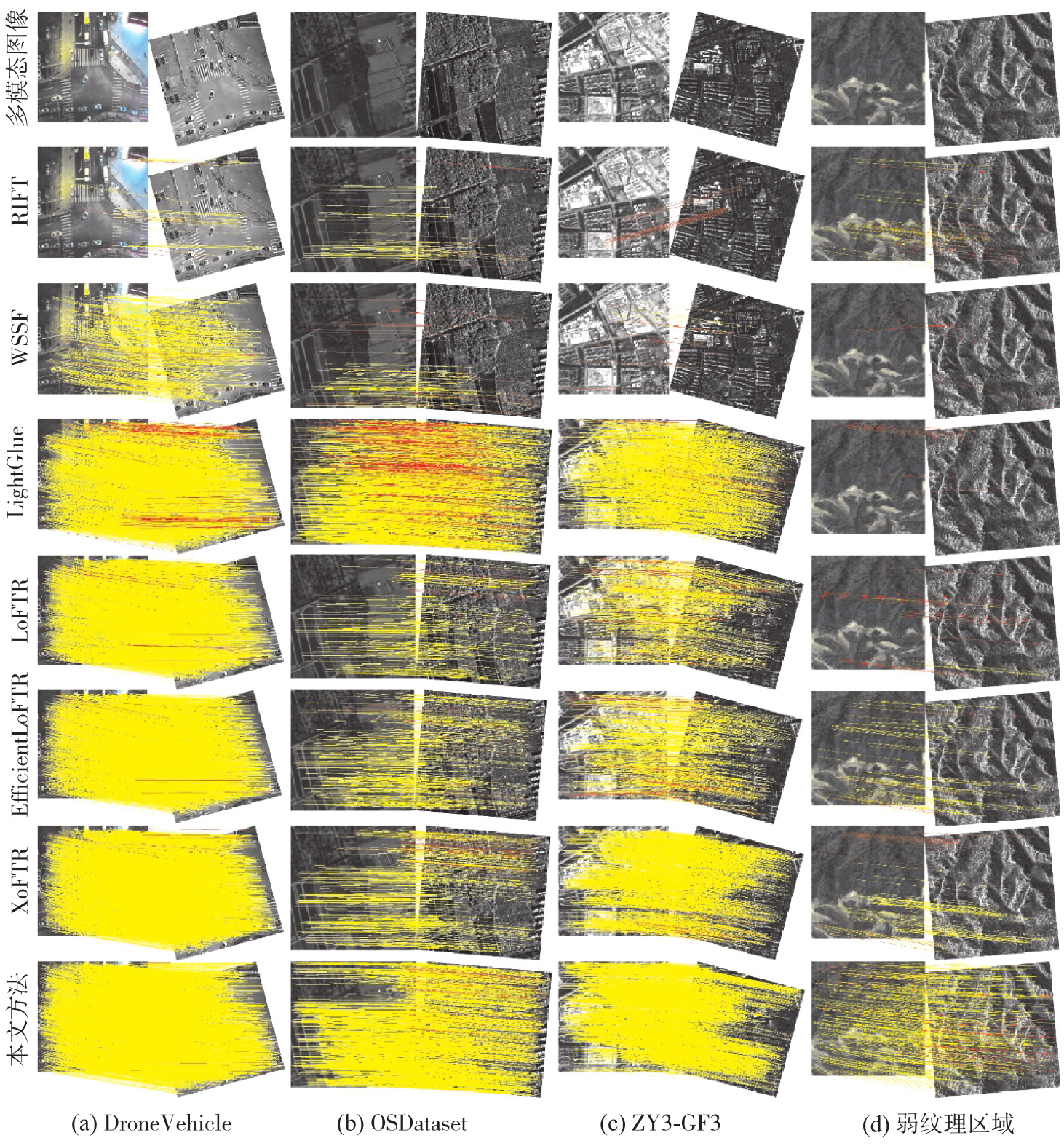
Fig. 8
Registration RMSE under different angles"
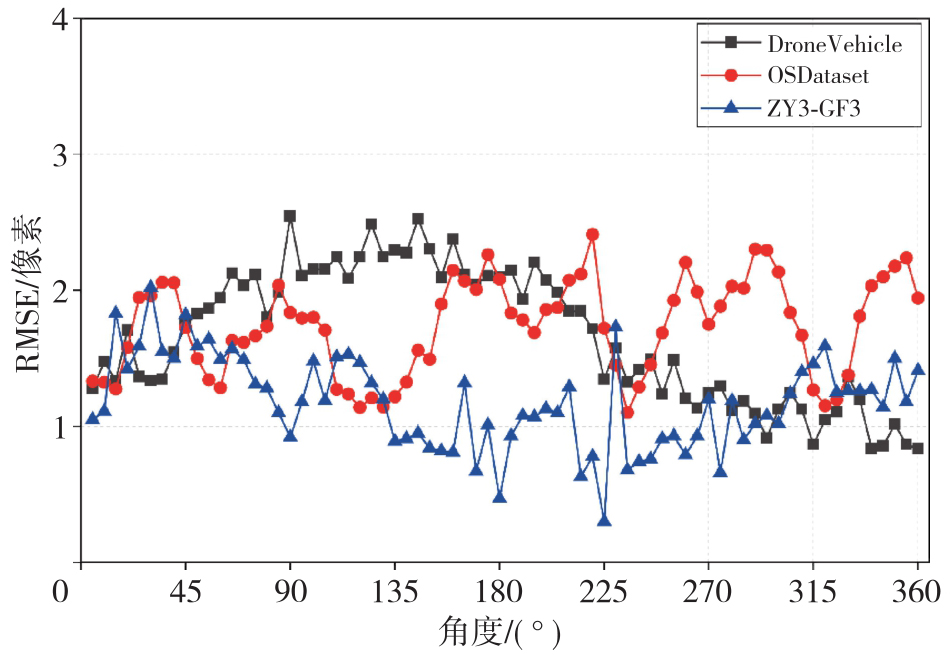
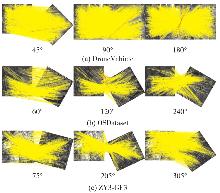
Fig. 9
Visualization of matching by different rotational angles"

Tab. 5
Ablation experiment on OSDataset"
| 消融方案 | 描述 | RMSE/像素 | AUC/(%) | ||
|---|---|---|---|---|---|
| 3像素 | 5像素 | 10像素 | |||
| 1 | Baseline | 2.47 | 19.03 | 40.87 | 63.24 |
| 2 | Baseline+特征扰动 | 2.15 | 22.41 | 41.37 | 65.34 |
| 3 | Baseline+模态重构 | 1.93 | 22.80 | 42.33 | 66.80 |
| 4 | 本文方法 | 1.86 | 22.17 | 43.49 | 68.08 |
Tab. 6
Hyperparameter analysis on OSDataset"
| 局部区域尺寸/像素 | RMSE/像素 | AUC/(%) | ||
|---|---|---|---|---|
| 3像素 | 5像素 | 10像素 | ||
| 64 | 8.59 | 5.43 | 11.89 | 20.74 |
| 96 | 3.22 | 20.01 | 36.41 | 56.05 |
| 128 | 2.35 | 20.56 | 40.47 | 64.89 |
| 160 | 1.86 | 22.17 | 43.49 | 68.08 |
| 192 | 2.03 | 19.42 | 41.34 | 67.38 |
| 224 | 2.17 | 18.79 | 39.95 | 66.60 |
Tab. 7
Average time of the matching process for a pair of images"
| 方法 | 耗时/s |
|---|---|
| RIFT | 3.823 5 |
| WSSF | 13.945 4 |
| LightGlue | 0.342 5 |
| LoFTR | 0.326 9 |
| E-LoFTR | 0.248 7 |
| XoFTR | 0.607 3 |
| 本文方法 | 1.102 7 |
| [1] | 朱柏, 叶沅鑫. 多模态遥感图像配准方法研究综述[J]. 中国图象图形学报, 2024, 29(8): 2137-2161. |
| Zhu Bai, Ye Yuanxin. Multimodal remote sensing image registration: a survey[J]. Journal of Image and Graphics, 2024, 29(8): 2137-2161. | |
| [2] |
眭海刚, 刘畅, 干哲, 等. 多模态遥感图像匹配方法综述[J]. 测绘学报, 2022, 51(9): 1848-1861. DOI: .
doi: 10.11947/j.AGCS.2022.20220126 |
|
Sui Haigang, Liu Chang, Gan Zhe, et al. Overview of multi-modal remote sensing image matching methods[J]. Acta Geodaetica et Cartographica Sinica, 2022, 51(9): 1848-1861. DOI: .
doi: 10.11947/j.AGCS.2022.20220126 |
|
| [3] | Li Liangzhi, Han Ling, Ye Yuanxin, et al. Deep learning in remote sensing image matching: a survey[J]. ISPRS Journal of Photogrammetry and Remote Sensing, 2025, 225: 88-112. |
| [4] | 唐霖峰, 张浩, 徐涵, 等. 基于深度学习的图像融合方法综述[J]. 中国图象图形学报, 2023, 28(1): 3-36. |
| Tang Linfeng, Zhang Hao, Xu Han, et al. Deep learning-based image fusion: a survey[J]. Journal of Image and Graphics, 2023, 28(1): 3-36. | |
| [5] | Ye Yuanxin, Wang Mengmeng, Zhou Liang, et al. Adjacent-level feature cross-fusion with 3D CNN for remote sensing image change detection[J]. IEEE Transactions on Geoscience and Remote Sensing, 2023, 61: 5618214. |
| [6] |
蔺小虎, 杨鑫, 姚顽强, 等. 面向复杂地下空间的多源传感器数据动态加权融合SLAM方法[J]. 测绘学报, 2025, 54(3): 523-535. DOI: .
doi: 10.11947/j.AGCS.2025.20230586 |
|
Lin Xiaohu, Yang Xin, Yao Wanqiang, et al. A dynamic weighted fusion SLAM method using multi-source sensor data in complex underground spaces[J]. Acta Geodaetica et Cartographica Sinica, 2025, 54(3): 523-535. DOI: .
doi: 10.11947/j.AGCS.2025.20230586 |
|
| [7] | Emery W J, Baldwin D, Matthews D. Maximum cross correlation automatic satellite image navigation and attitude corrections for open-ocean image navigation[J]. IEEE Transactions on Geoscience and Remote Sensing, 2003, 41(1): 33-42. |
| [8] | Suri S, Reinartz P. Mutual-information-based registration of TerraSAR-X and Ikonos imagery in urban areas[J]. IEEE Transactions on Geoscience and Remote Sensing, 2010, 48(2): 939-949. |
| [9] | Ye Y X, Bruzzone L, Shan J, et al. Fast and robust matching for multimodal remote sensing image registration[J]. IEEE Transactions on Geoscience and Remote Sensing, 2019, 57(11): 9059-9070. |
| [10] |
樊仲藜, 张力, 王庆栋, 等. SAR影像和光学影像梯度方向加权的快速匹配方法[J]. 测绘学报, 2021, 50(10): 1390-1403. DOI: .
doi: 10.11947/j.AGCS.2021.20200587 |
|
Fan Zhongli, Zhang Li, Wang Qingdong, et al. A fast matching method of SAR and optical images using angular weighted orientated gradients[J]. Acta Geodaetica et Cartographica Sinica, 2021, 50(10): 1390-1403. DOI: .
doi: 10.11947/j.AGCS.2021.20200587 |
|
| [11] |
南轲, 齐华, 叶沅鑫. 深度卷积特征表达的多模态遥感影像模板匹配方法[J]. 测绘学报, 2019, 48(6): 727-736. DOI: .
doi: 10.11947/j.AGCS.2019.20180432 |
|
Nan Ke, Qi Hua, Ye Yuanxin. A template matching method of multimodal remote sensing images based on deep convolutional feature representation[J]. Acta Geodaetica et Cartographica Sinica, 2019, 48(6): 727-736. DOI: .
doi: 10.11947/j.AGCS.2019.20180432 |
|
| [12] | Yang Chao, Gong Guoqing, Liu Chang, et al. RMSO-ConvNeXt: a lightweight CNN network for robust SAR and optical image matching under strong noise interference[J]. IEEE Transactions on Geoscience and Remote Sensing, 2025, 63: 5208013. |
| [13] | Zhou Liang, Ye Yuanxin, Tang Tengfeng, et al. Robust matching for SAR and optical images using multiscale convolutional gradient features[J]. IEEE Geoscience and Remote Sensing Letters, 2022, 19: 4017605. |
| [14] | 李加元. 鲁棒性遥感影像特征匹配关键问题研究[D]. 武汉: 武汉大学, 2018. |
| Li Jiayuan. Research on key techniques of robust remote sensing image feature matching[D]. Wuhan: Wuhan University, 2018. | |
| [15] | Lowe D G. Distinctive image features from scale-invariant keypoints[J]. International Journal of Computer Vision, 2004, 60(2): 91-110. |
| [16] | Li Jiayuan, Hu Qingwu, Ai Mingyao. RIFT: multi-modal image matching based on radiation-variation insensitive feature transform[J]. IEEE Transactions on Image Processing, 2020, 29: 3296-3310. |
| [17] | Wan Genyi, Ye Zhen, Xu Yusheng, et al. Multimodal remote sensing image matching based on weighted structure saliency feature[J]. IEEE Transactions on Geoscience and Remote Sensing, 2024, 62: 4700816. |
| [18] | Mishchuk A, Mishkin D, Radenovic F, et al. Working hard to know your neighbor's margins: local descriptor learning loss[C]//Proceedings of the 31st Annual Conference on Neural Information Processing Systems. Long Beach: NIPS Foundation, 2017: 4827-4838. |
| [19] | Tian Yurun, Barroso-Laguna A, Ng T, et al. HyNet: learning local descriptor with hybrid similarity measure and triplet loss[C]//Proceedings of the 34th Conference on Neural Information Processing Systems. [S.l.]: NIPS Foundation, 2020. |
| [20] | Detone D, Malisiewicz T, Rabinovich A. SuperPoint: self-supervised interest point detection and description[C]//Proceedings of 2018 IEEE/CVF Conference on Computer Vision and Pattern Recognition Workshops. Salt Lake City: IEEE, 2018: 337-349. |
| [21] | Dusmanu M, Rocco I, Pajdla T, et al. D2-Net: a trainable CNN for joint description and detection of local features[C]//Proceedings of 2019 IEEE/CVF Conference on Computer Vision and Pattern Recognition. Long Beach: IEEE, 2019: 8084-8093. |
| [22] |
蓝朝桢, 卢万杰, 于君明, 等. 异源遥感影像特征匹配的深度学习算法[J]. 测绘学报, 2021, 50(2): 189-202. DOI: .
doi: 10.11947/j.AGCS.2021.20200048 |
|
Lan Chaozhen, Lu Wanjie, Yu Junming, et al. Deep learning algorithm for feature matching of cross modality remote sensing images[J]. Acta Geodaetica et Cartographica Sinica, 2021, 50(2): 189-202. DOI: .
doi: 10.11947/j.AGCS.2021.20200048 |
|
| [23] | Sarlin P E, Detone D, Malisiewicz T, et al. SuperGlue: learning feature matching with graph neural networks[C]//Proceedings of 2020 IEEE/CVF Conference on Computer Vision and Pattern Recognition. Seattle: IEEE, 2020: 4937-4946. |
| [24] | Lindenberger P, Sarlin P, Pollefeys M. LightGlue: local feature matching at light speed[C]//Proceedings of 2023 IEEE/CVF International Conference on Computer Vision. Paris: IEEE, 2023: 17581-17592. |
| [25] | Sun Jiaming, Shen Zehong, Wang Yuang, et al. LoFTR: detector-free local feature matching with Transformers[C]//Proceedings of 2021 IEEE/CVF Conference on Computer Vision and Pattern Recognition. Nashville: IEEE, 2021: 8918-8927. |
| [26] | Wang Yifan, He Xingyi, Peng Sida, et al. Efficient LoFTR: semi-dense local feature matching with sparse-like speed[C]//Proceedings of 2024 IEEE/CVF Conference on Computer Vision and Pattern Recognition. Seattle: IEEE, 2024: 21666-21675. |
| [27] | Tuzcuoğlu Ö, Köksal A, Sofu B, et al. XoFTR: cross-modal feature matching transformer[C]//Proceedings of 2024 IEEE/CVF Conference on Computer Vision and Pattern Recognition Workshops. Seattle: IEEE, 2024: 4275-4286. |
| [28] | Edstedt J, Sun Qiyu, Bökman G, et al. RoMa: robust dense feature matching[C]//Proceedings of 2024 IEEE/CVF Conference on Computer Vision and Pattern Recognition. Seattle: IEEE, 2024: 19790-19800. |
| [29] | Ren Jiangwei, Jiang Xingyu, Li Zizhuo, et al. MINIMA: modality invariant image matching[C]//Proceedings of 2025 IEEE/CVF Conference on Computer Vision and Pattern Recognition. Tennessee: IEEE, 2025: 23059-23068. |
| [30] | Ronneberger O, Fischer P, Brox T. U-Net: convolutional networks for biomedical image segmentation[C]//Proceedings of the 18th International Conference on Medical Image Computing and Computer-Assisted Intervention. Cham: Springer, 2015: 234-241. |
| [31] | Sun Yiming, Cao Bing, Zhu Pengfei, et al. Drone-based RGB-infrared cross-modality vehicle detection via uncertainty-aware learning[J]. IEEE Transactions on Circuits and Systems for Video Technology, 2022, 32(10): 6700-6713. |
| [32] | Xiang Yuming, Tao Rongshu, Wang Feng, et al. Automatic registration of optical and SAR images via improved phase congruency model[J]. IEEE Journal of Selected Topics in Applied Earth Observations and Remote Sensing, 2020, 13: 5847-5861. |
| [33] | Chum O, Werner T, Matas J. Two-view geometry estimation unaffected by a dominant plane[C]//Proceedings of 2005 IEEE Computer Society Conference on Computer Vision and Pattern Recognition. San Diego: IEEE, 2005: 772-779. |
| [1] | He Li, Kejie Chen, Wenfeng Cui, Haishan Chai, Rongxin Fang, Chaoyong Peng, Li Sun. Rapid magnitude estimation based on BDS-3 PPP-B2b coseismic displacement and deep learning: a case study of the 2025 Tingri Mw 7.1 and Mandalay Mw 7.7 earthquakes [J]. Acta Geodaetica et Cartographica Sinica, 2026, 55(7): 1171-1182. |
| [2] | Xi Zhao, Qiangqiang Yuan, Jiadan Xu. A sample generation and enhancement method for side-scan sonar targets in complex marine environments [J]. Acta Geodaetica et Cartographica Sinica, 2026, 55(7): 1229-1239. |
| [3] | Lubing Zeng, Jiansheng Li, Ancheng Wang, Zidi Yang, Yuning Gao, Jiajie Zhang. A visual SLAM method fusing lightweight illumination enhancement network in complex illumination environments [J]. Acta Geodaetica et Cartographica Sinica, 2026, 55(7): 1278-1292. |
| [4] | Tiandong SHI, Ling ZHAO, Wenhao ZHAO, Ji QI, Hao CUI, Chengli PENG, Xinchang ZHANG. Controllable generation of high-resolution optical remote sensing image explicitly guided by spatio-temporal information [J]. Acta Geodaetica et Cartographica Sinica, 2026, 55(5): 894-908. |
| [5] | Peng LI, Jiahan ZHANG, Zhihan WANG, Houjie WANG, Zhenhong LI. A review of intertidal topography reconstruction methods: current status, challenges and trends [J]. Acta Geodaetica et Cartographica Sinica, 2026, 55(4): 571-587. |
| [6] | Jiayao WANG, Lin CHEN, Shiyuan CHENG, Lijun WANG, Siqi XIONG. Artificial intelligence empowering the digital-intelligent transformation of cartographic science [J]. Acta Geodaetica et Cartographica Sinica, 2026, 55(3): 381-389. |
| [7] | Xiaomin LU, Zhiyi ZHANG, Haowen YAN, Yi HE, Xiaoning SU. A recognition method for building group pattern integrating deep graph infomax and multilayer perceptron [J]. Acta Geodaetica et Cartographica Sinica, 2026, 55(3): 425-438. |
| [8] | Shunping JI, Jin LIU, Jian GAO, Jianya GONG. An intelligent 3D reconstruction framework via deep learning based multi-view image matching [J]. Acta Geodaetica et Cartographica Sinica, 2025, 54(9): 1633-1646. |
| [9] | Jixian ZHANG, Haiyan GU, Huan NI, Haitao LI, Yi YANG, Shaopeng DING, Songman SUI. Deep learning methods for remote sensing intelligent change detection: evolution and development [J]. Acta Geodaetica et Cartographica Sinica, 2025, 54(8): 1347-1370. |
| [10] | Shuai FANG, Jiaen LIU, Jing ZHANG. Spatio-temporal fusion algorithm based on adaptive reference feature incorporation and multi-scale feature aggregation [J]. Acta Geodaetica et Cartographica Sinica, 2025, 54(8): 1476-1488. |
| [11] | Nina MENG, Fengmei LI, Xiaodong ZHOU. Data and cognition dual-driven building group generalization results and scale consistency assessment [J]. Acta Geodaetica et Cartographica Sinica, 2025, 54(7): 1318-1331. |
| [12] | Yaqing WANG, Zhonghui WANG. River network automated selection method based on heterogeneous graph convolutional networks [J]. Acta Geodaetica et Cartographica Sinica, 2025, 54(7): 1332-1345. |
| [13] | Xiaoya AN, Weiru GUO, Pengxin ZHANG, Xinxin LI, Lei SHI. Ship trajectories clustering method considering similarity in geometric position and mobility features [J]. Acta Geodaetica et Cartographica Sinica, 2025, 54(6): 1107-1121. |
| [14] | Chao WANG, Tianyu CHEN, Tong ZHANG, Tanvir AHMED, Liqiang JI, Tao XIE, Jiajun YANG, Shuai WANG. Multi-sensor optical remote sensing images change detection based on global differential enhancement module and balance penalty loss [J]. Acta Geodaetica et Cartographica Sinica, 2025, 54(5): 873-887. |
| [15] | Qingli LUO, Xueyan LI, Guoman HUANG, Honghui CHEN, Minglong XUE, Jian LI. AOSN: alpha optimal structure network for height estimation from a single SAR image in mountain areas [J]. Acta Geodaetica et Cartographica Sinica, 2025, 54(5): 888-898. |
| Viewed | ||||||
|
Full text |
|
|||||
|
Abstract |
|
|||||
