

Acta Geodaetica et Cartographica Sinica ›› 2026, Vol. 55 ›› Issue (7): 1171-1182.doi: 10.11947/j.AGCS.2026.20260112
• Frontiers in AI-Driven Geodesy and Satellite Gravity Inversion • Previous Articles
He Li1( ), Kejie Chen1(), Wenfeng Cui1, Haishan Chai1, Rongxin Fang2, Chaoyong Peng3, Li Sun4
Received:2026-03-27
Revised:2026-05-07
Published:2026-08-18
Contact:
Kejie Chen
E-mail:lihe12100@gmail.com;chenkj@sustech.edu.cn
About author:Li He (2003—), male, postgraduate, majors in real-time magnitude estimation of large earthquakes based on deep learning. E-mail: lihe12100@gmail.com
Supported by:CLC Number:
He Li, Kejie Chen, Wenfeng Cui, Haishan Chai, Rongxin Fang, Chaoyong Peng, Li Sun. Rapid magnitude estimation based on BDS-3 PPP-B2b coseismic displacement and deep learning: a case study of the 2025 Tingri Mw 7.1 and Mandalay Mw 7.7 earthquakes[J]. Acta Geodaetica et Cartographica Sinica, 2026, 55(7): 1171-1182.
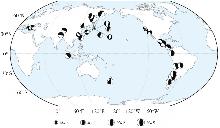
Fig. 1
Distribution and focal mechanisms of 29 strong earthquake events"
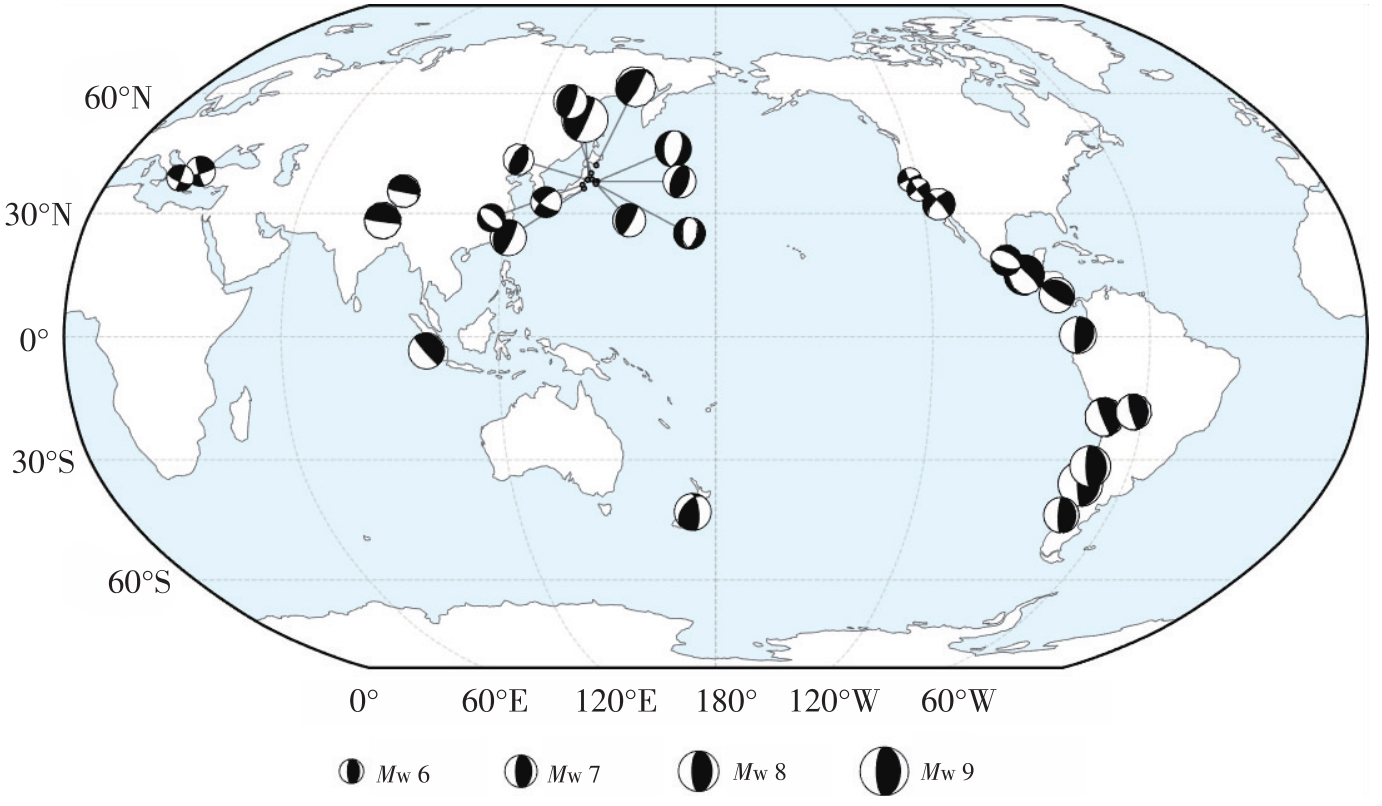
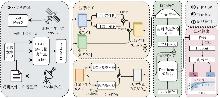
Fig. 2
Framework of the CTS model spatiotemporal prediction network integrated with real-time GNSS processing"

Tab. 1
Regression coefficients of three empirical PGD-Mw scaling laws used for comparison"
| 回归系数 | 文献[ | 文献[ | 文献[ |
|---|---|---|---|
| A | -6.687 | -5.919 | -4.434 |
| B | 1.5 | 1.009 | 1.047 |
| C | -0.214 | -0.145 | -0.138 |
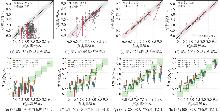
Fig. 3
Comparison of real-time magnitude prediction performance between CTS model and empirical PGD-Mw scaling laws on the test dataset"
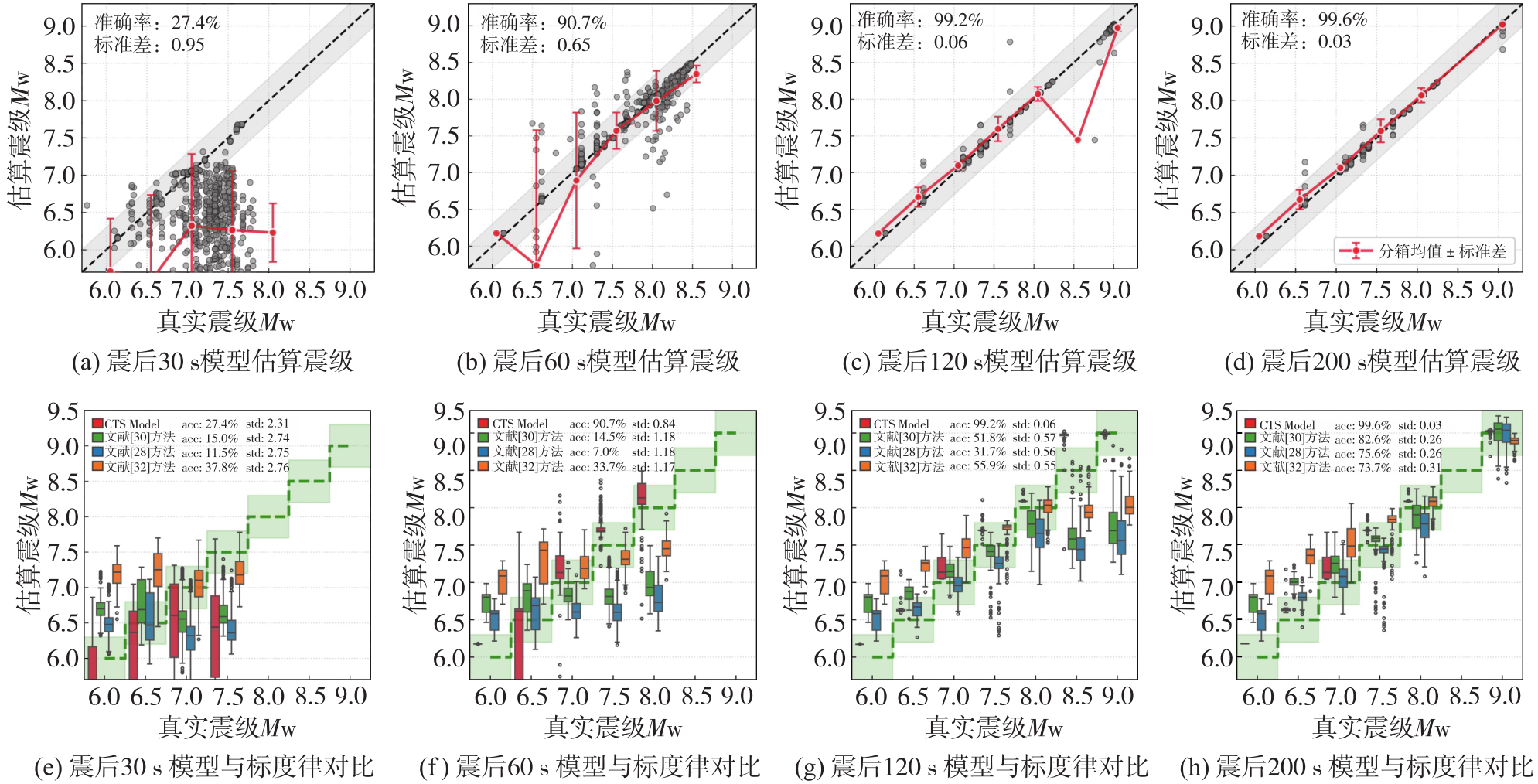
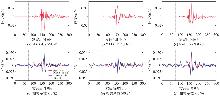
Fig. 4
Comparison of strong-motion and high-rate GNSS waveforms"

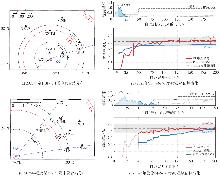
Fig. 5
Epicenter and station distribution and time-series analysis of real-time magnitude warning performance for the 2025 Tingri Mw 7.1 and Mandalay Mw 7.7 earthquakes"
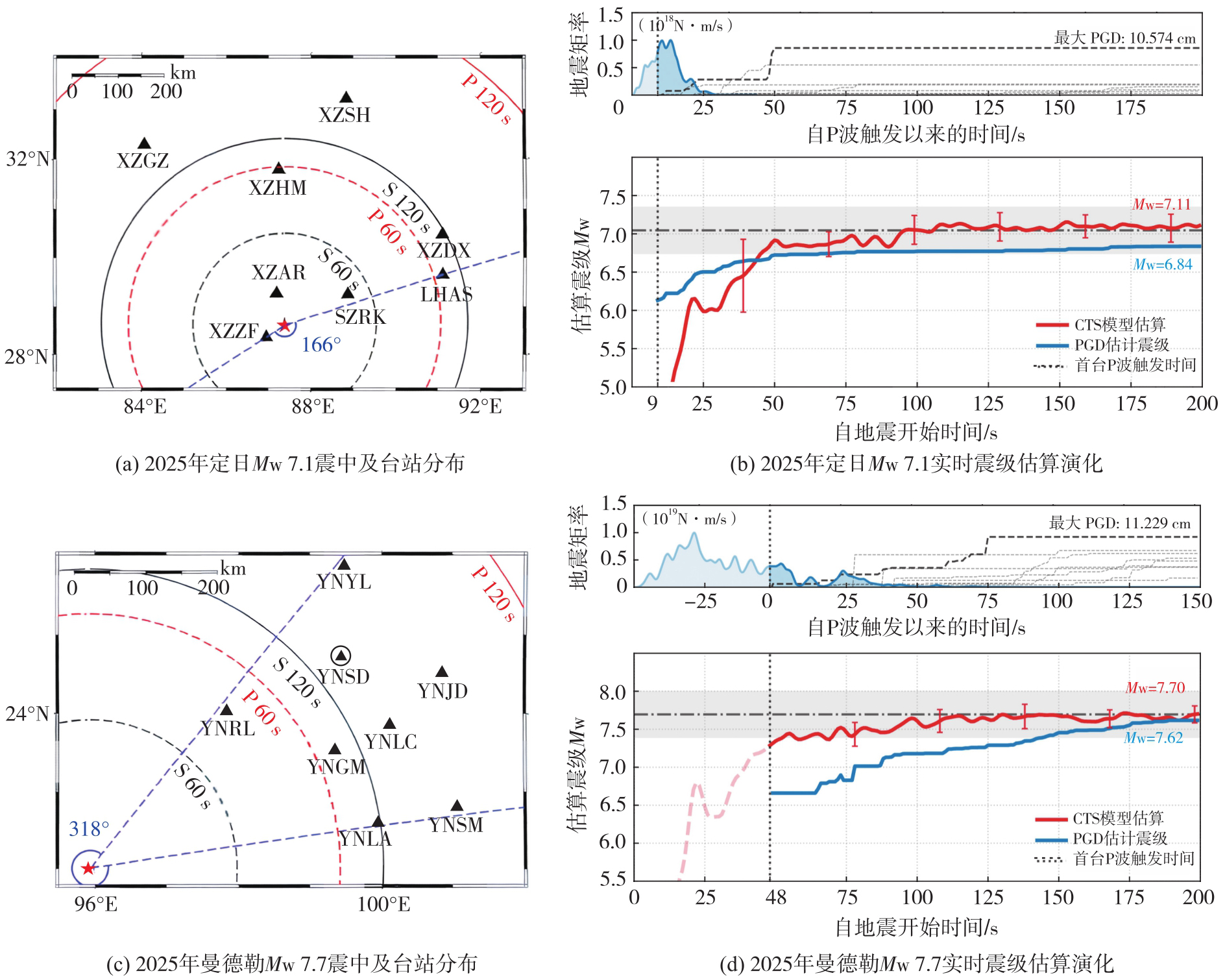
Fig. 6
Evaluation of real-time magnitude estimation performance of WUM and PPP-B2b products based on different seismic events"
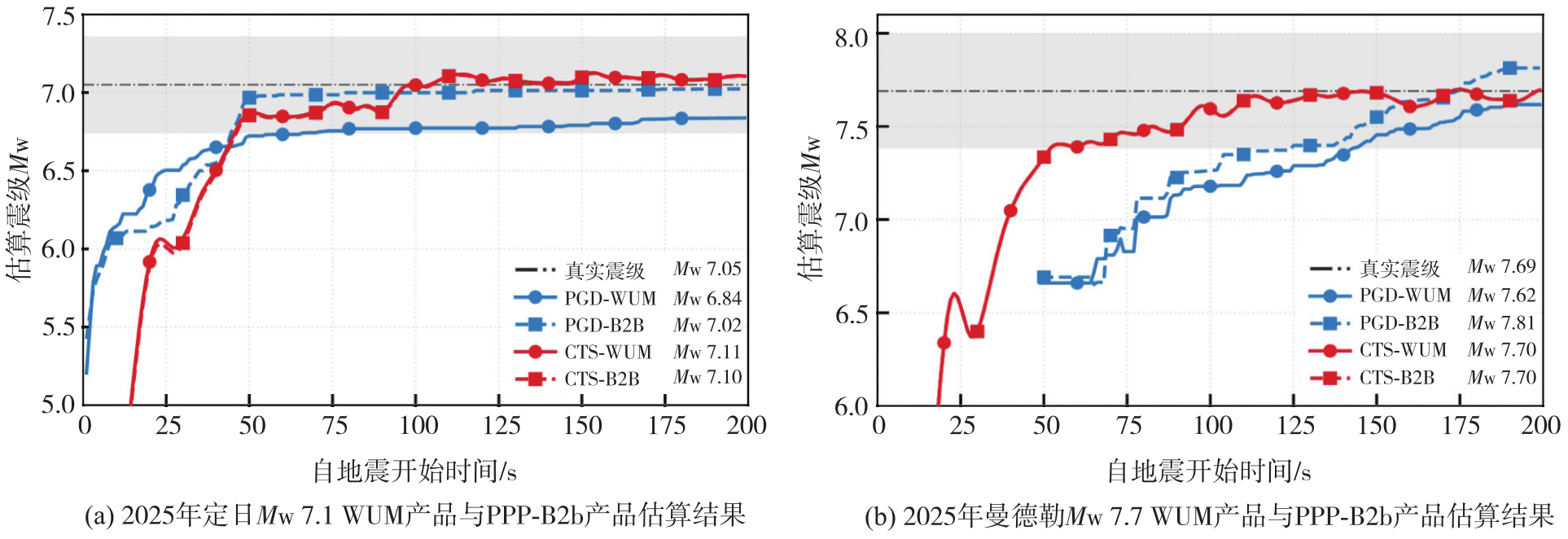
Fig. 7
Impact of station network density on magnitude estimation performance"

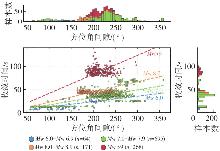
Fig. 8
Relationship between station distribution and convergence time for different magnitudes"
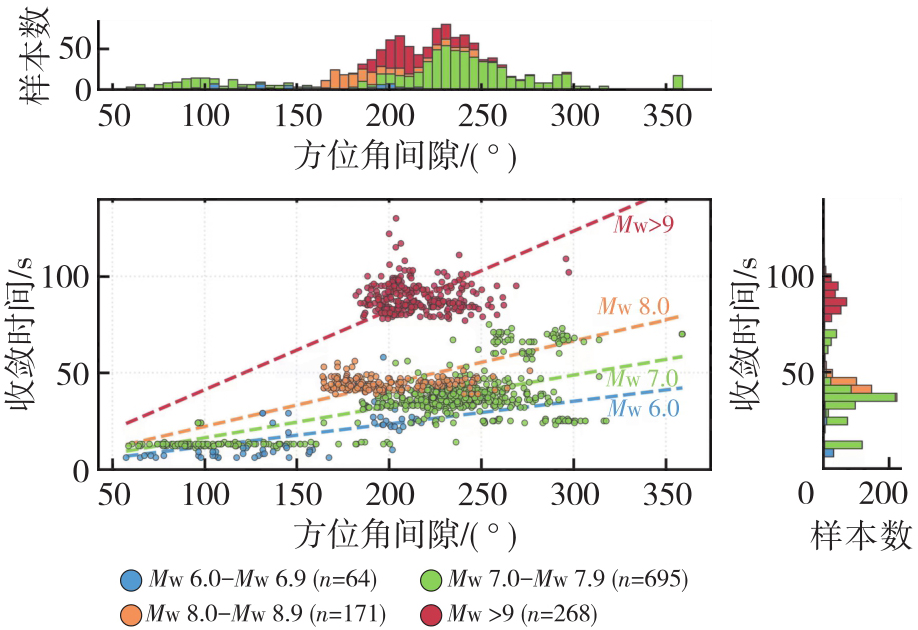
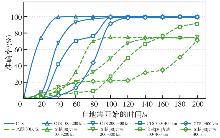
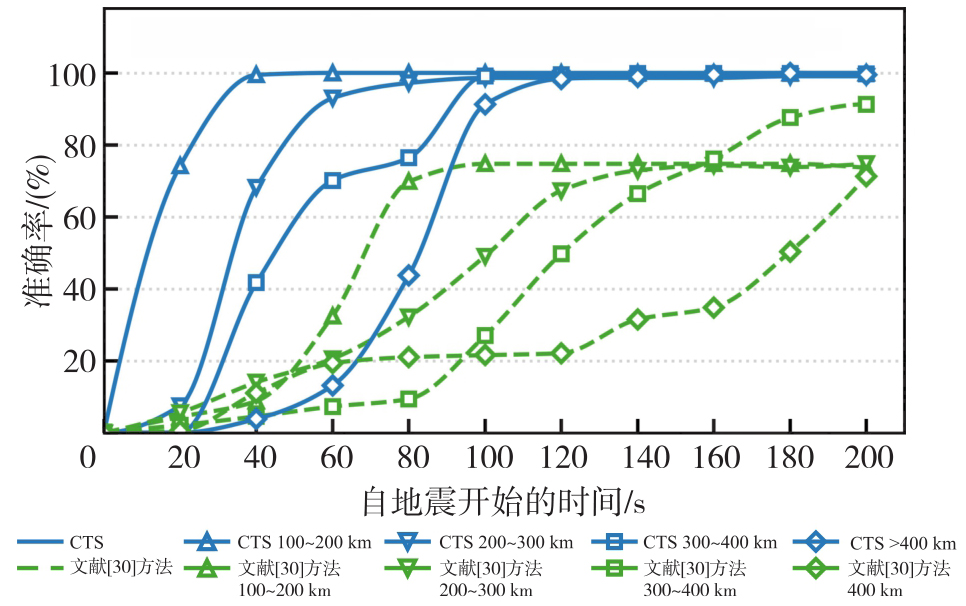
Fig. 9
Evaluation of magnitude estimation performance under different epicentral distances and lead times"
| [1] | Allen R M, Brown H, Hellweg M, et al. Real-time earthquake detection and hazard assessment by ElarmS across California[J]. Geophysical Research Letters, 2009, 36(5): L00B08. |
| [2] | 孙丽. 地震预警的新发展:新型传感器网络的应用[J]. 地球与行星物理论评(中英文), 2023, 54(1): 105-107. |
| Sun Li. The new development of EEW: the application of new sensor networks[J]. Reviews of Geophysics and Planetary Physics, 2023, 54(1): 105-107. | |
| [3] | Melgar D, Bock Y, Sanchez D, et al. On robust and reliable automated baseline corrections for strong motion seismology[J]. Journal of Geophysical Research: Solid Earth, 2013, 118(3): 1177-1187. |
| [4] | Meier M A, Heaton T, Clinton J. Evidence for universal earthquake rupture initiation behavior[J]. Geophysical Research Letters, 2016, 43(15): 7991-7996. |
| [5] | Hoshiba M, Iwakiri K, Hayashimoto N, et al. Outline of the 2011 off the Pacific coast of Tohoku Earthquake (Mw 9.0): earthquake early warning and observed seismic intensity[J]. Earth, Planets and Space, 2011, 63(7): 547-551. |
| [6] | Marcou S, Lux A I, Akimov A, et al. Exploring end-to-end earthquake early warning performance in large earthquakes using the February 2023 Kahramanmara ş, Türkiye sequence[J]. Scientific Reports, 2026, 16: 327. |
| [7] | 陈克杰, 柴海山, 李佳峰, 等. GNSS海啸预警:地表形变监测与电离层扰动探测[J]. 中国科学(地球科学), 2026, 56(3): 928-942. |
| Chen Kejie, Chai Haishan, Li Jiafeng, et al. An overview of GNSS for tsunami early warning: From lithosphere to ionosphere[J]. Scientia Sinica (Terrae), 2026, 56(3): 928-942. | |
| [8] | Bock Y, Melgar D, Crowell B W. Real-time strong-motion broadband displacements from collocated GPS and accelerometers[J]. Bulletin of the Seismological Society of America, 2011, 101(6): 2904-2925. |
| [9] | Chen Kejie, Ge Maorong, Babeyko Andrey, et al. Retrieving real-time co-seismic displacements using GPS/GLONASS: a preliminary report from the September 2015Mw 8.3 Illapel earthquake in Chile[J]. Geophysical Journal International, 2016, 206(2): 941-953. |
| [10] | Zumberge J F, Heflin M B, Jefferson D C, et al. Precise point positioning for the efficient and robust analysis of GPS data from large networks[J]. Journal of Geophysical Research: Solid Earth, 1997, 102(B3): 5005-5017. |
| [11] |
张小红, 李星星, 李盼. GNSS精密单点定位技术及应用进展[J]. 测绘学报, 2017, 46(10): 1399-1407. DOI: .
doi: 10.11947/j.AGCS.2017.20170327 |
|
Zhang Xiaohong, Li Xingxing, Li Pan. Review of GNSS PPP and its application[J]. Acta Geodaetica et Cartographica Sinica, 2017, 46(10): 1399-1407. DOI: .
doi: 10.11947/j.AGCS.2017.20170327 |
|
| [12] | 柴海山, 陈克杰, 魏国光, 等. 北斗三号与超高频GNSS同震形变监测:以2021年青海玛多Mw 7.4地震为例[J]. 武汉大学学报(信息科学版), 2022, 47(6): 946-954. |
| Chai Haishan, Chen Kejie, Wei Guoguang, et al. Coseismic deformation monitoring using BDS-3 and ultra-high rate GNSS: a case study of the 2021 Maduo Mw 7.4 earthquake[J]. Geomatics and Information Science of Wuhan University, 2022, 47(6): 946-954. | |
| [13] | Chen Kejie, Chai Haishan, Li Jiafeng, et al. An overview of GNSS for tsunami early warning: from lithosphere to ionosphere[J]. Science China Earth Sciences, 2026, 69(3): 898-912. |
| [14] | 中国卫星导航系统管理办公室. 北斗卫星导航系统空间信号接口控制文件:精密单点定位服务信号(PPP-B2b)(1.0版)[S]. 北京: 中国卫星导航系统管理办公室, 2020. |
| China Satellite Navigation Office. BeiDou navigation satellite system signal in space interface control document: precise point positioning service signal (PPP-B2b)(V1.0)[S]. Beijing: China Satellite Navigation Office, 2020. | |
| [15] | Fang Rongxin, Lü Huanghui, Hu Zhigang, et al. GPS/BDS precise point positioning with B2b products for high-rate seismogeodesy: application to the 2021Mw 7.4 Maduo earthquake[J]. Geophysical Journal International, 2022, 231(3): 2079-2090. |
| [16] | Mousavi S M, Beroza G C. Deep-learning seismology[J]. Science, 2022, 377(6607): eabm4470. |
| [17] | LeCun Y, Bengio Y, Hinton G. Deep learning[J]. Nature, 2015, 521(7553): 436-444. |
| [18] | Meier M A, Ross Z E, Ramachandran A, et al. Reliable real-time seismic signal/noise discrimination with machine learning[J]. Journal of Geophysical Research: Solid Earth, 2019, 124(1): 788-800. |
| [19] | Zhu Weiqiang, Beroza G C. PhaseNet: a deep-neural-network-based seismic arrival time picking method[J]. Geophysical Journal International, 2019, 216(1): 261-273. |
| [20] | Perol T, Gharbi M, Denolle M. Convolutional neural network for earthquake detection and location[J]. Science Advances, 2018, 4(2): e1700578. |
| [21] | Kuang Wenhuan, Yuan Congcong, Zhang Jie. Real-time determination of earthquake focal mechanism via deep learning[J]. Nature Communications, 2021, 12: 1432. |
| [22] | Mousavi S M, Beroza G C. A machine-learning approach for earthquake magnitude estimation[J]. Geophysical Research Letters, 2020, 47(1): e2019GL085976. |
| [23] | Taroni M, Spassiani I, Laskin N, et al. How many strong earthquakes will there be tomorrow?[J]. Frontiers in Applied Mathematics and Statistics, 2023, 9: 1152476. |
| [24] | Frankel A, Wirth E, Marafi N, et al. Broadband synthetic seismograms for Magnitude 9 earthquakes on the cascadia megathrust based on 3D simulations and stochastic synthetics, part 1: methodology and overall results[J]. Bulletin of the Seismological Society of America, 2018, 108(5A): 2347-2369. |
| [25] | Lin J T, Melgar D, Thomas A M, et al. Early warning for great earthquakes from characterization of crustal deformation patterns with deep learning[J]. Journal of Geophysical Research: Solid Earth, 2021, 126(10): e2021JB022703. |
| [26] | Cui Wenfeng, Chen Kejie, Wei Guoguang, et al. Simultaneous magnitude and slip distribution characterization from high-rate GNSS using deep learning: case studies of the 2021Mw 7.4 Maduo and 2023 Turkey doublet events[J]. Geophysical Journal International, 2024, 238(1): 91-108. |
| [27] | Quinteros-Cartaya C, Quintero-Arenas J, Padilla-Lafarga A, et al. A deep learning pipeline for large earthquake analysis using high-rate global navigation satellite system data[J]. Earth Science Informatics, 2025, 18(4): 516. |
| [28] | Ruhl C J, Melgar D, Geng Jianghui, et al. A global database of strong-motion displacement GNSS recordings and an example application to PGD scaling[J]. Seismological Research Letters, 2019, 90(1): 271-279. |
| [29] | 肖懿思, 方荣新, 李瑜, 等. 利用高频GNSS观测研究2025年西藏定日Ms 6.8地震地表形变及预警震级[J]. 武汉大学学报(信息科学版), 2025, 50(11): 2176-2186. |
| Xiao Yisi, Fang Rongxin, Li Yu, et al. Surface displacement and early warning magnitude of the 2025 Dingri, Xizang Ms 6.8 earthquake using high-rate GNSS observations[J]. Geomatics and Information Science of Wuhan University, 2025, 50(11): 2176-2186. | |
| [30] | Melgar D, Crowell B W, Geng Jianghui, et al. Earthquake magnitude calculation without saturation from the scaling of peak ground displacement[J]. Geophysical Research Letters, 2015, 42(13): 5197-5205. |
| [31] | Laske G, Masters G, Ma Z, et al. Update on CRUST1.0: a 1-degree global model of Earth's crust[C]//Proceedings of 2013 Geophysical Research Abstracts. Munich: European Geosciences Union, 2013, 15: EGU2013-2658. |
| [32] | Crowell B W, Melgar D, Bock Y, et al. Earthquake magnitude scaling using seismogeodetic data[J]. Geophysical Research Letters, 2013, 40(23): 6089-6094. |
| [33] | Jiang Weiping, Zhao Qile, Li Min, et al. The progress of IGS analysis center at Wuhan University[J]. Journal of Geodesy and Geoinformation Science, 2023, 6(3): 46-57. |
| [1] | Tiandong SHI, Ling ZHAO, Wenhao ZHAO, Ji QI, Hao CUI, Chengli PENG, Xinchang ZHANG. Controllable generation of high-resolution optical remote sensing image explicitly guided by spatio-temporal information [J]. Acta Geodaetica et Cartographica Sinica, 2026, 55(5): 894-908. |
| [2] | Jiayao WANG, Lin CHEN, Shiyuan CHENG, Lijun WANG, Siqi XIONG. Artificial intelligence empowering the digital-intelligent transformation of cartographic science [J]. Acta Geodaetica et Cartographica Sinica, 2026, 55(3): 381-389. |
| [3] | Xiaomin LU, Zhiyi ZHANG, Haowen YAN, Yi HE, Xiaoning SU. A recognition method for building group pattern integrating deep graph infomax and multilayer perceptron [J]. Acta Geodaetica et Cartographica Sinica, 2026, 55(3): 425-438. |
| [4] | Shunping JI, Jin LIU, Jian GAO, Jianya GONG. An intelligent 3D reconstruction framework via deep learning based multi-view image matching [J]. Acta Geodaetica et Cartographica Sinica, 2025, 54(9): 1633-1646. |
| [5] | Jixian ZHANG, Haiyan GU, Huan NI, Haitao LI, Yi YANG, Shaopeng DING, Songman SUI. Deep learning methods for remote sensing intelligent change detection: evolution and development [J]. Acta Geodaetica et Cartographica Sinica, 2025, 54(8): 1347-1370. |
| [6] | Shuai FANG, Jiaen LIU, Jing ZHANG. Spatio-temporal fusion algorithm based on adaptive reference feature incorporation and multi-scale feature aggregation [J]. Acta Geodaetica et Cartographica Sinica, 2025, 54(8): 1476-1488. |
| [7] | Nina MENG, Fengmei LI, Xiaodong ZHOU. Data and cognition dual-driven building group generalization results and scale consistency assessment [J]. Acta Geodaetica et Cartographica Sinica, 2025, 54(7): 1318-1331. |
| [8] | Yaqing WANG, Zhonghui WANG. River network automated selection method based on heterogeneous graph convolutional networks [J]. Acta Geodaetica et Cartographica Sinica, 2025, 54(7): 1332-1345. |
| [9] | Xiaoya AN, Weiru GUO, Pengxin ZHANG, Xinxin LI, Lei SHI. Ship trajectories clustering method considering similarity in geometric position and mobility features [J]. Acta Geodaetica et Cartographica Sinica, 2025, 54(6): 1107-1121. |
| [10] | Chao WANG, Tianyu CHEN, Tong ZHANG, Tanvir AHMED, Liqiang JI, Tao XIE, Jiajun YANG, Shuai WANG. Multi-sensor optical remote sensing images change detection based on global differential enhancement module and balance penalty loss [J]. Acta Geodaetica et Cartographica Sinica, 2025, 54(5): 873-887. |
| [11] | Qingli LUO, Xueyan LI, Guoman HUANG, Honghui CHEN, Minglong XUE, Jian LI. AOSN: alpha optimal structure network for height estimation from a single SAR image in mountain areas [J]. Acta Geodaetica et Cartographica Sinica, 2025, 54(5): 888-898. |
| [12] | Wei TU, Xiangyuan CHI, Tianhong ZHAO, Jian YANG, Shiping ZHU, Deli CHEN. Multi-view spatio-temporal graph convolutional networks model for urban drainage networks flow prediction [J]. Acta Geodaetica et Cartographica Sinica, 2025, 54(2): 334-344. |
| [13] | Zhili ZHANG, Huiwei JIANG, Xiangyun HU. A minimal-interaction framework for accurate and batch extraction of geospatial objects from remote sensing imagery [J]. Acta Geodaetica et Cartographica Sinica, 2025, 54(10): 1863-1876. |
| [14] | Zhenghua ZHANG, Guoliang CHEN. A lightweight rotation-invariant network for LiDAR-based place recognition [J]. Acta Geodaetica et Cartographica Sinica, 2025, 54(1): 90-103. |
| [15] | Yan SHI, Da WANG, Min DENG, Xuexi YANG. Spatio-temporal anomaly detection: connotation transformation and implementation path from data-driven to knowledge-driven modeling [J]. Acta Geodaetica et Cartographica Sinica, 2024, 53(8): 1493-1504. |
| Viewed | ||||||
|
Full text |
|
|||||
|
Abstract |
|
|||||
