

Acta Geodaetica et Cartographica Sinica ›› 2025, Vol. 54 ›› Issue (7): 1265-1279.doi: 10.11947/j.AGCS.2025.20240247
• Photogrammetry and Remote Sensing • Previous Articles Next Articles
Yakun XIE1,2( ), Yaoji ZHAO1, Jiaxing TU1, Ruifeng XIA1, Dejun FENG1, Suning LIU1, Hongyu CHEN1, Jun ZHU1()
Received:2024-06-19
Revised:2025-06-06
Online:2025-08-18
Published:2025-08-18
Contact:
Jun ZHU
E-mail:yakunxie@163.com;zhujun@swjtu.edu.cn
About author:XIE Yakun (1991—), male, PhD, associate professor, majors in intelligent information perception and digital twin modeling. E-mail: yakunxie@163.com
Supported by:CLC Number:
Yakun XIE, Yaoji ZHAO, Jiaxing TU, Ruifeng XIA, Dejun FENG, Suning LIU, Hongyu CHEN, Jun ZHU. Edge and global features integrated network for salient object detection in optical remote sensing images[J]. Acta Geodaetica et Cartographica Sinica, 2025, 54(7): 1265-1279.

Fig. 1
Overall framework"


Fig. 2
Edge feature enhancement module structure"


Fig. 3
Global context enhancement module structure"


Fig. 4
Some representative samples of three datasets"

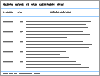
Tab. 1
Quantitative comparison results on the ORSSD dataset"
| 方法 |  ↓ ↓ | Sα↑ | Fβ↑ |
|---|---|---|---|
| DSG | 0.102 4 | 0.718 6 | 0.609 0 |
| RCNN | 0.127 7 | 0.684 9 | 0.559 1 |
| CorrNet | 0.009 8 | 0.938 0 | 0.912 9 |
| EMFINet | 0.010 9 | 0.936 6 | 0.900 2 |
| ERPNet | 0.013 5 | 0.925 4 | 0.897 4 |
| SeaNet | 0.010 5 | 0.926 0 | 0.894 2 |
| SRAL | 0.010 5 | 0.930 5 | 0.916 7 |
| AESINet | 0.008 5 | 0.945 5 | 0.916 0 |
| 本文方法 | 0.007 2 | 0.951 2 | 0.948 1 |

Fig. 5
PR and F-measure curves on ORSSD dataset"


Fig. 6
Qualitative analysis on ORSSD dataset"

Tab. 2
Quantitative comparison results on the EORSSD dataset"
| 方法 |  ↓ ↓ | Sα↑ | Fβ↑ |
|---|---|---|---|
| DSG | 0.125 0 | 0.642 3 | 0.523 3 |
| RCNN | 0.164 7 | 0.601 1 | 0.401 8 |
| CorrNet | 0.008 3 | 0.928 9 | 0.877 8 |
| EMFINet | 0.008 4 | 0.929 0 | 0.872 0 |
| ERPNet | 0.008 2 | 0.921 0 | 0.863 2 |
| SeaNet | 0.008 3 | 0.920 8 | 0.864 9 |
| SRAL | 0.006 7 | 0.923 4 | 0.896 4 |
| AESINet | 0.006 4 | 0.934 7 | 0.879 2 |
| 本文方法 | 0.005 4 | 0.937 7 | 0.919 6 |

Fig. 7
PR and F-measure curves on EORSSD dataset"


Fig. 8
Qualitative analysis on EORSSD dataset"

Tab. 3
Quantitative comparison results on the ORSI-4199 dataset"
| 方法 |  ↓ ↓ | Sα↑ | Fβ↑ |
|---|---|---|---|
| DSG | 0.129 4 | 0.697 1 | 0.627 0 |
| RCNN | 0.163 7 | 0.649 1 | 0.548 0 |
| CorrNet | 0.036 6 | 0.862 3 | 0.856 0 |
| EMFINet | 0.037 6 | 0.866 4 | 0.848 6 |
| ERPNet | 0.030 5 | 0.863 3 | 0.843 6 |
| SeaNet | 0.030 8 | 0.872 2 | 0.865 3 |
| SRAL | 0.032 1 | 0.873 5 | 0.857 6 |
| AESINet | 0.030 5 | 0.875 5 | 0.872 6 |
| 本文方法 | 0.027 0 | 0.889 4 | 0.876 9 |

Fig. 9
PR and F-measure curves on ORSI-4199 dataset"


Fig. 10
Qualitative analysis on ORSI-4199 dataset"

Tab. 4
Comparison of the accuracy"
| 方法 | ORSSD | EORSSD | ORSI4199 | ||||||
|---|---|---|---|---|---|---|---|---|---|
 ↓ ↓ | Sα↑ | Fβ↑ |  ↓ ↓ | Sα↑ | Fβ↑ |  ↓ ↓ | Sα↑ | Fβ↑ | |
| ASTT | 0.009 0 | 0.935 0 | 0.906 0 | 0.006 0 | 0.925 0 | 0.874 0 | 0.029 0 | 0.883 0 | 0.869 0 |
| BAFSNet | 0.007 9 | 0.938 5 | 0.913 6 | 0.006 0 | 0.928 6 | 0.870 8 | — | — | — |
| BANet | 0.009 7 | 0.943 2 | 0.920 5 | 0.008 9 | 0.929 2 | 0.905 5 | 0.031 4 | 0.876 7 | 0.857 6 |
| CIFNet | 0.008 4 | 0.944 5 | 0.918 3 | 0.006 1 | 0.934 2 | 0.884 3 | — | — | — |
| CRNet | 0.009 1 | 0.938 9 | 0.910 7 | 0.006 3 | 0.937 0 | 0.887 3 | 0.033 5 | 0.866 9 | 0.866 9 |
| IP2GRNet | 0.009 0 | 0.940 6 | — | 0.007 1 | 0.924 8 | — | — | — | — |
| PCDNet | 0.009 4 | 0.944 4 | 0.913 8 | 0.006 9 | 0.934 6 | 0.883 0 | — | — | — |
| GLGCNet | 0.007 1 | 0.948 8 | 0.923 6 | 0.005 5 | 0.937 5 | 0.892 4 | 0.027 4 | 0.883 9 | 0.880 8 |
| 本文方法 | 0.007 2 | 0.951 2 | 0.948 1 | 0.005 4 | 0.937 7 | 0.919 6 | 0.027 0 | 0.889 4 | 0.876 9 |

Fig. 11
Qualitative analysis of different attributes on ORSI-4199 dataset"

Tab. 5
Comparison of different attributes on ORSI-4199 dataset"
| 方法 | BSO | CS | CSO | ISO | LCS | MSO | NSO | OC | SSO | 均值 |
|---|---|---|---|---|---|---|---|---|---|---|
| CorrNet | 0.859 7 | 0.872 5 | 0.831 1 | 0.821 4 | 0.838 9 | 0.869 1 | 0.878 7 | 0.862 9 | 0.849 5 | 0.853 8 |
| EMFINet | 0.918 6 | 0.901 3 | 0.908 4 | 0.907 2 | 0.830 7 | 0.851 8 | 0.839 9 | 0.831 5 | 0.818 1 | 0.867 5 |
| ERPNet | 0.906 3 | 0.889 3 | 0.888 1 | 0.890 4 | 0.835 1 | 0.862 1 | 0.867 7 | 0.814 2 | 0.818 6 | 0.863 5 |
| SeaNet | 0.879 2 | 0.884 6 | 0.860 3 | 0.857 6 | 0.848 6 | 0.862 5 | 0.887 6 | 0.854 7 | 0.835 7 | 0.863 4 |
| AESINet | 0.912 8 | 0.907 6 | 0.910 2 | 0.904 4 | 0.847 9 | 0.874 5 | 0.884 7 | 0.850 6 | 0.852 5 | 0.882 8 |
| 本文方法 | 0.920 4 | 0.914 1 | 0.917 5 | 0.905 7 | 0.852 9 | 0.879 3 | 0.886 4 | 0.878 4 | 0.869 1 | 0.891 5 |
Tab. 6
Comparison of different attributes on ORSI-4199 dataset"
| 方法 | Param/MB | FLOPs/GB | FPS |
|---|---|---|---|
| CorrNet | 4.07 | 40.31 | 38.56 |
| SeaNet | 2.75 | 2.71 | 98.71 |
| EMFINet | 95.09 | 334.52 | 15.32 |
| ERPNet | 56.48 | 215.45 | 34.89 |
| AESINet | 51.57 | 39.19 | 9.11 |
| 本文方法 | 29.11 | 15.10 | 48.79 |
Tab. 7
The setting and accuracy evaluation results of ablation experiments"
| 试验 | Baseline | EE | GC | ORSI-4199 | |||
|---|---|---|---|---|---|---|---|
| ED | EH |  ↓ ↓ | Sα↑ | Fβ↑ | |||
| 试验1 | √ | 0.034 3 | 0.868 2 | 0.858 7 | |||
| 试验2 | √ | √ | √ | 0.031 9 | 0.872 5 | 0.863 6 | |
| 试验3 | √ | √ | 0.032 1 | 0.869 4 | 0.862 0 | ||
| 试验4 | √ | √ | √ | 0.030 8 | 0.880 8 | 0.872 6 | |
| 试验5 | √ | √ | √ | √ | 0.027 0 | 0.889 4 | 0.876 9 |

Fig. 12
Qualitative analysis of ablation experiments"


Fig. 13
The failure cases"

| [1] | ZHENG Jianwei, QUAN Yueqian, ZHENG Hang, et al. ORSI salient object detection via cross-scale interaction and enlarged receptive field[J]. IEEE Geoscience and Remote Sensing Letters, 2023, 20: 3249764. |
| [2] |
余东行, 徐青, 赵传, 等. 注意力引导特征融合与联合学习的遥感影像场景分类[J]. 测绘学报, 2023, 52(4): 624-637. DOI: .
doi: 10.11947/j.AGCS.2023.20210659 |
|
YU Donghang, XU Qing, ZHAO Chuan, et al. Attention-guided feature fusion and joint learning for remote sensing image scene classification[J]. Acta Geodaetica et Cartographica Sinica, 2023, 52(4): 624-637. DOI: .
doi: 10.11947/j.AGCS.2023.20210659 |
|
| [3] | 汪西莉, 梁正印, 刘涛. 基于特征注意力金字塔的遥感图像目标检测方法[J]. 遥感学报, 2023, 27(2): 492-501. |
| WANG Xili, LIANG Zhengyin, LIU Tao. Feature attention pyramid-based remote sensing image object detection method[J]. National Remote Sensing Bulletin, 2023, 27(2): 492-501. | |
| [4] | 梁烽, 张瑞祥, 柴英特, 等. 一种结合上下文与边缘注意力的SAR图像海陆分割深度网络方法[J]. 武汉大学学报(信息科学版), 2023, 48(8): 1286-1295. |
| LIANG Feng, ZHANG Ruixiang, CHAI Yingte, et al. A sea-land segmentation method for SAR images using context-aware and edge attention based CNNs[J]. Geomatics and Information Science of Wuhan University, 2023, 48(8): 1286-1295. | |
| [5] | 张艳邦, 张芬. 融合纹理和颜色特征的显著目标检测[J]. 计算机与数字工程, 2021, 49(9): 1793-1798, 1877. |
| ZHANG Yanbang, ZHANG Fen. Salient object detection based on texture and color features[J]. Computer & Digital Engineering, 2021, 49(9): 1793-1798, 1877. | |
| [6] | 邵凯旋, 童林, 吴帮吕, 等. 基于颜色差异计算的图像显著性检测算法研究[J]. 计算机与数字工程, 2022, 50(2): 394-398. |
| SHAO Kaixuan, TONG Lin, WU Banglü, et al. Research on image saliency detection algorithm based on color difference calculation[J]. Computer & Digital Engineering, 2022, 50(2): 394-398. | |
| [7] | ZHOU Li, YANG Zhaohui, ZHOU Zongtan, et al. Salient region detection using diffusion process on a two-layer sparse graph[J]. IEEE Transactions on Image Processing, 2017, 26(12): 5882-5894. |
| [8] | YUAN Yuchen, LI Changyang, KIM J, et al. Reversion correction and regularized random walk ranking for saliency detection[J]. IEEE Transactions on Image Processing, 2018, 27(3): 1311-1322. |
| [9] | 王震, 于万钧, 陈颖. 多尺度特征融合的RGB-D图像显著性目标检测[J]. 计算机工程与应用, 2024, 60(11): 242-250. |
| WANG Zhen, YU Wanjun, CHEN Ying. Multi-scale feature fusion saliency object detection based on RGB-D images[J]. Computer Engineering and Applications, 2024, 60(11): 242-250. | |
| [10] |
胡明洪, 李佳田, 姚彦吉, 等. 结合多路径的高分辨率遥感影像建筑物提取SER-UNet算法[J]. 测绘学报, 2023, 52(5): 808-817. DOI: .
doi: 10.11947/j.AGCS.2023.20210691 |
|
HU Minghong, LI Jiatian, YAO Yanji, et al. SER-UNet algorithm for building extraction from high-resolution remote sensing image combined with multipath[J]. Acta Geodaetica et Cartographica Sinica, 2023, 52(5): 808-817. DOI: .
doi: 10.11947/j.AGCS.2023.20210691 |
|
| [11] |
胡功明, 杨春成, 徐立, 等. 改进U-Net的遥感图像语义分割方法[J]. 测绘学报, 2023, 52(6): 980-989. DOI: .
doi: 10.11947/j.AGCS.2023.20210684 |
|
HU Gongming, YANG Chuncheng, XU Li, et al. Improved U-Net remote sensing image semantic segmentation method[J]. Acta Geodaetica et Cartographica Sinica, 2023, 52(6): 980-989. DOI: .
doi: 10.11947/j.AGCS.2023.20210684 |
|
| [12] | LI Chongyi, CONG Runmin, HOU Junhui, et al. Nested network with two-stream pyramid for salient object detection in optical remote sensing images[EB/OL]. [2024-11-12]. https://arxiv.org/abs/1906.08462v1. |
| [13] | ZHANG Qijian, CONG Runmin, LI Chongyi, et al. Dense attention fluid network for salient object detection in optical remote sensing images[J]. IEEE Transactions on Image Processing, 2021, 30: 1305-1317. |
| [14] | TU Zhengzheng, WANG Chao, LI Chenglong, et al. ORSI salient object detection via multiscale joint region and boundary model[J]. IEEE Transactions on Geoscience and Remote Sensing, 2022, 60: 3101359. |
| [15] | ZHENG Qingping, ZHENG Ling, BAI Yunpeng, et al. Boundary-aware network with two-stage partial decoders for salient object detection in remote sensing images[J]. IEEE Transactions on Geoscience and Remote Sensing, 2023, 61: 3260825. |
| [16] | 赵卫东, 王辉, 柳先辉. 边缘信息增强的显著性目标检测网络[J]. 同济大学学报(自然科学版), 2024, 52(2): 293-302. |
| ZHAO Weidong, WANG Hui, LIU Xianhui. Edge enhancing network for salient object detection[J]. Journal of Tongji University (Natural Science), 2024, 52(2): 293-302. | |
| [17] | 连远锋, 石旭, 江澄. 基于多模态遥感影像的边缘感知引导显著性检测[J]. 太赫兹科学与电子信息学报, 2023, 21(3): 360-370. |
| LIAN Yuanfeng, SHI Xu, JIANG Cheng. Edge aware guidance saliency detection based on multi-modal remote sensing image[J]. Journal of Terahertz Science and Electronic Information Technology, 2023, 21(3): 360-370. | |
| [18] | WANG Zhen, GUO Jianxin, ZHANG Chuanlei, et al. Multiscale feature enhancement network for salient object detection in optical remote sensing images[J]. IEEE Transactions on Geoscience and Remote Sensing, 2022, 60: 1-19. |
| [19] | GONG Aojun, NIE Junfei, NIU Chen, et al. Edge and skeleton guidance network for salient object detection in optical remote sensing images[J]. IEEE Transactions on Circuits and Systems for Video Technology, 2023, 33(12): 7109-7120. |
| [20] | ZHOU Xiaofei, SHEN Kunye, WENG Li, et al. Edge-guided recurrent positioning network for salient object detection in optical remote sensing images[J]. IEEE Transactions on Cybernetics, 2023, 53(1): 539-552. |
| [21] | 杨世伟, 王永雄, 兰博天. 多尺度Transformer与层次化边界引导的显著性目标检测[J]. 计算机应用研究, 2022, 39(12): 3820-3824, 3836. |
| YANG Shiwei, WANG Yongxiong, LAN Botian. Hierarchical boundary guided multi-scale Transformer for salient object detection[J]. Application Research of Computers, 2022, 39(12): 3820-3824, 3836. | |
| [22] | 叶协康, 马晨阳, 陈小伟, 等. 基于全局注意力的多尺度显著性检测网络[J]. 计算机应用与软件, 2022, 39(2): 167-173. |
| YE Xiekang, MA Chenyang, CHEN Xiaowei, et al. Global attention-based multi-scale salient object detection network[J]. Computer Applications and Software, 2022, 39(2): 167-173. | |
| [23] | LI Gongyang, BAI Zhen, LIU Zhi, et al. Salient object detection in optical remote sensing images driven by transformer[J]. IEEE Transactions on Image Processing, 2023, 32: 5257-5269. |
| [24] | BAI Zhen, LI Gongyang, LIU Zhi. Global-local-global context-aware network for salient object detection in optical remote sensing images[J]. ISPRS Journal of Photogrammetry and Remote Sensing, 2023, 198: 184-196. |
| [25] | WANG Wenhai, XIE Enze, LI Xiang, et al. PVT v2: improved baselines with pyramid vision transformer[J]. Computational Visual Media, 2022, 8(3): 415-424. |
| [26] | OUYANG Daliang, HE Su, ZHANG Guozhong, et al. Efficient multi-scale attention module with cross-spatial learning[C]//Proceedings of 2023 IEEE International Conference on Acoustics, Speech and Signal Processing. Rhodes Island: IEEE, 2023: 1-5. |
| [27] | PERAZZI F, KRAHENBUHL P, PRITCH Y, et al. Saliency filters: Contrast based filtering for salient region detection[C]//Proceedings of 2012 IEEE Conference on Computer Vision and Pattern Recognition. Providence: IEEE, 2012: 733-740. |
| [28] | FAN Dengping, CHENG Mingming, LIU Yun, et al. Structure-measure: a new way to evaluate foreground maps[C]//Proceedings of 2017 IEEE International Conference on Computer Vision. Venice: IEEE, 2017: 4558-4567. |
| [29] | ACHANTA R, HEMAMI S, ESTRADA F, et al. Frequency-tuned salient region detection[C]//Proceedings of 2009 IEEE Conference on Computer Vision and Pattern Recognition. Miami: IEEE, 2009: 1597-1604. |
| [30] | LI Gongyang, LIU Zhi, BAI Zhen, et al. Lightweight salient object detection in optical remote sensing images via feature correlation[J]. IEEE Transactions on Geoscience and Remote Sensing, 2022, 60: 1-12. |
| [31] | LI Gongyang, LIU Zhi, ZHANG Xinpeng, et al. Lightweight salient object detection in optical remote-sensing images via semantic matching and edge alignment[J]. IEEE Transactions on Geoscience and Remote Sensing, 2023, 61: 8049. |
| [32] | LIU Yanfeng, XIONG Zhitong, YUAN Yuan, et al. Distilling knowledge from super-resolution for efficient remote sensing salient object detection[J]. IEEE Transactions on Geoscience and Remote Sensing, 2023, 61: 3267271. |
| [33] | ZENG Xiangyu, XU Mingzhu, HU Yijun, et al. Adaptive edge-aware semantic interaction network for salient object detection in optical remote sensing images[J]. IEEE Transactions on Geoscience and Remote Sensing, 2023, 61: 6722. |
| [34] | GAO Lina, LIU Bing, FU Ping, et al. Adaptive spatial tokenization Transformer for salient object detection in optical remote sensing images[J]. IEEE Transactions on Geoscience and Remote Sensing, 2023, 61: 1-15. |
| [35] | GU Yubin, XU Honghui, QUAN Yueqian, et al. ORSI salient object detection via bidimensional attention and full-stage semantic guidance[J]. IEEE Transactions on Geoscience and Remote Sensing, 2023, 61: 3243769. |
| [36] | SUN Le, WANG Qing, CHEN Yuwen, et al. CRNet: channel-enhanced remodeling-based network for salient object detection in optical remote sensing images[J]. IEEE Transactions on Geoscience and Remote Sensing, 2023, 61: 1-14. |
| [37] | YANG Mo, LIU Ziyan, DONG Wen, et al. An important pick-and-pass gated refinement network for salient object detection in optical remote sensing images[J]. IEEE Journal of Selected Topics in Applied Earth Observations and Remote Sensing, 2023, 16: 6505-6516. |
| [38] | HUANG Kan, TIAN Chunwei, LIN C W. Progressive context-aware dynamic network for salient object detection in optical remote sensing images[J]. IEEE Transactions on Geoscience and Remote Sensing, 2023, 61: 3295992. |
| [1] | Shunping JI, Jin LIU, Jian GAO, Jianya GONG. An intelligent 3D reconstruction framework via deep learning based multi-view image matching [J]. Acta Geodaetica et Cartographica Sinica, 2025, 54(9): 1633-1646. |
| [2] | Zibo DONG, Jingxue WANG, Lijing BU, Lin FANG, Zhenghui XU. MAFNet: building extraction method from remote sensing images based on multi-scale atrous fusion network [J]. Acta Geodaetica et Cartographica Sinica, 2025, 54(6): 1094-1106. |
| [3] | Chao WANG, Tianyu CHEN, Tong ZHANG, Tanvir AHMED, Liqiang JI, Tao XIE, Jiajun YANG, Shuai WANG. Multi-sensor optical remote sensing images change detection based on global differential enhancement module and balance penalty loss [J]. Acta Geodaetica et Cartographica Sinica, 2025, 54(5): 873-887. |
| [4] | Zhaoyang HOU, Haowen YAN, Liming ZHANG, Rongjuan MA, Ruitao QU. Zero-watermark copyright protection method for remote sensing images based on coupled neural P system and blockchain [J]. Acta Geodaetica et Cartographica Sinica, 2025, 54(12): 2247-2261. |
| [5] | Liangxiong GONG, Xinghua LI, Yuanming CHENG, Xingyou ZHAO, Renping XIE, Honggen WANG. A lightweight remote sensing images change detection network utilizing spatio-temporal difference enhancement and adaptive feature fusion [J]. Acta Geodaetica et Cartographica Sinica, 2025, 54(1): 136-153. |
| [6] | Jialing LI, Ji QI, Weipeng LU, Chao TAO. Self-supervised learning based urban functional zone classification by integrating optical remote sensing image-OSM data [J]. Acta Geodaetica et Cartographica Sinica, 2025, 54(1): 154-164. |
| [7] | Zhiwei XIE, Shuaizhi ZHAI, Fengyuan ZHANG, Min CHEN, Lishuang SUN. Object-oriented high-resolution image classification using inductive graph neural networks [J]. Acta Geodaetica et Cartographica Sinica, 2024, 53(8): 1610-1623. |
| [8] | Daifeng PENG, Chenchen ZHAI, Dingwei ZHOU, Yongjun ZHANG, Haiyan GUAN, Yufu ZANG. High-resolution optical images change detection based on global information enhancement by pyramid semantic token [J]. Acta Geodaetica et Cartographica Sinica, 2024, 53(6): 1195-1211. |
| [9] | Haiyan GU, Yi YANG, Haitao LI, Lijian SUN, Shaopeng DING, Shiqi LIU. Dynamic construction of high-resolution remote sensing image sample datasets and intelligent interpretation applications [J]. Acta Geodaetica et Cartographica Sinica, 2024, 53(6): 1165-1179. |
| [10] | Jicheng WANG, Anmei GUO, Li SHEN, Tian LAN, Zhu XU, Zhilin LI. Multi-level contrastive learning for weakly supervised extraction of urban solid wastes dump from high-resolution remote sensing images [J]. Acta Geodaetica et Cartographica Sinica, 2024, 53(6): 1212-1223. |
| [11] | Shaopeng DING, Xiushan LU, Rufei LIU, Yi YANG, Haiyan GU, Haitao LI. Building change detection method combining object feature guidance and multiple attention mechanism [J]. Acta Geodaetica et Cartographica Sinica, 2024, 53(6): 1224-1235. |
| [12] | Shiyan PANG, Jingjing HAO, Zhiqi ZUO, Jingjing LAN, Xiangyun HU. A high-resolution remote sensing images change detection method via the integration of dense connections and self-attention mechanisms [J]. Acta Geodaetica et Cartographica Sinica, 2024, 53(12): 2244-2253. |
| [13] | JIANG Baode, HANG Wei, XU Shaofen, WU Yong. Multi-scale building instance refinement extraction from remote sensing images by fusing with decentralized adaptive attention mechanism [J]. Acta Geodaetica et Cartographica Sinica, 2023, 52(9): 1504-1514. |
| [14] | LIAN Renbao, ZHANG Zhenmin, LIAO Yipeng, ZOU Changzhong, HUANG Liqin. A quick road centreline extraction method from remote sensing images combining with geodesic distance field and curve smoothing [J]. Acta Geodaetica et Cartographica Sinica, 2023, 52(8): 1317-1329. |
| [15] | GU Xiaohu, LI Zhengjun, MIAO Jianhao, LI Xinghua, SHEN Huanfeng. Dual-channel parallel hybrid convolutional neural networks based classification method for high-resolution remote sensing image [J]. Acta Geodaetica et Cartographica Sinica, 2023, 52(5): 798-807. |
| Viewed | ||||||
|
Full text |
|
|||||
|
Abstract |
|
|||||
