

Acta Geodaetica et Cartographica Sinica ›› 2025, Vol. 54 ›› Issue (1): 136-153.doi: 10.11947/j.AGCS.2025.20240299
• Photogrammetry and Remote Sensing • Previous Articles Next Articles
Liangxiong GONG1( ), Xinghua LI2(), Yuanming CHENG3, Xingyou ZHAO1, Renping XIE4, Honggen WANG1
Received:2024-07-19
Revised:2024-12-12
Online:2025-02-17
Published:2025-02-17
Contact:
Xinghua LI
E-mail:1021386774@qq.com;lixinghua5540@whu.edu.cn
About author:GONG Liangxiong (1991—), male, master, senior engineer, majors in intelligent interpretation of remote sensing imagery. E-mail: 1021386774@qq.com
Supported by:CLC Number:
Liangxiong GONG, Xinghua LI, Yuanming CHENG, Xingyou ZHAO, Renping XIE, Honggen WANG. A lightweight remote sensing images change detection network utilizing spatio-temporal difference enhancement and adaptive feature fusion[J]. Acta Geodaetica et Cartographica Sinica, 2025, 54(1): 136-153.
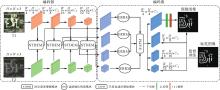
Fig. 1
Overall network architecture"
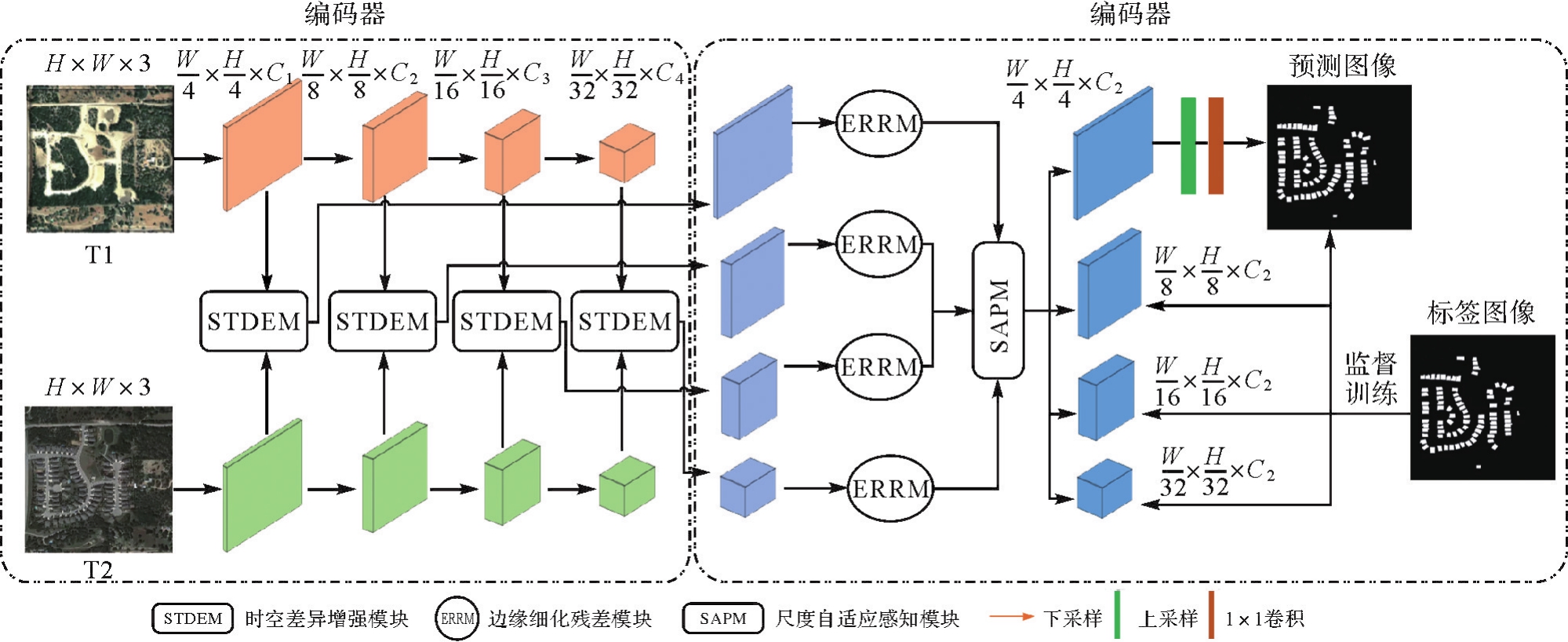
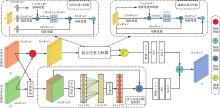
Fig. 2
Spatio-temporal difference enhancement module"

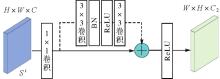
Fig. 3
Edge refinement residual module"
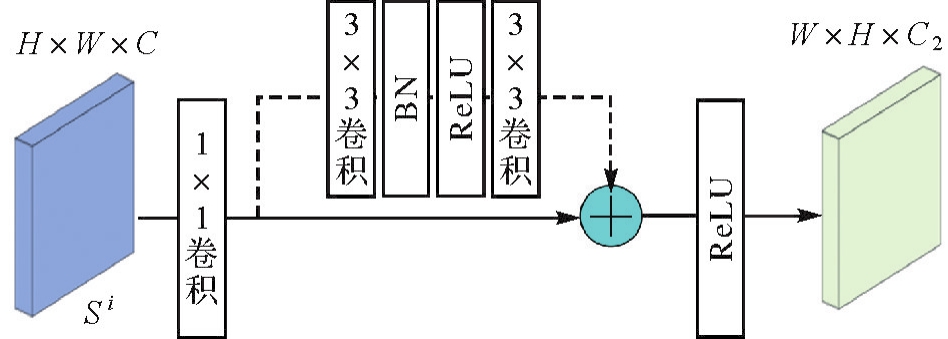
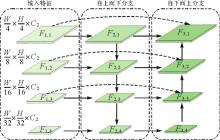
Fig. 4
Scale-adaptive perception module"

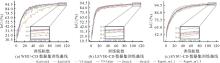
Fig. 5
Training comparison of different backbone networks on different datasets"

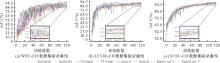
Fig. 6
Validation comparison of different backbone networks on different datasets"
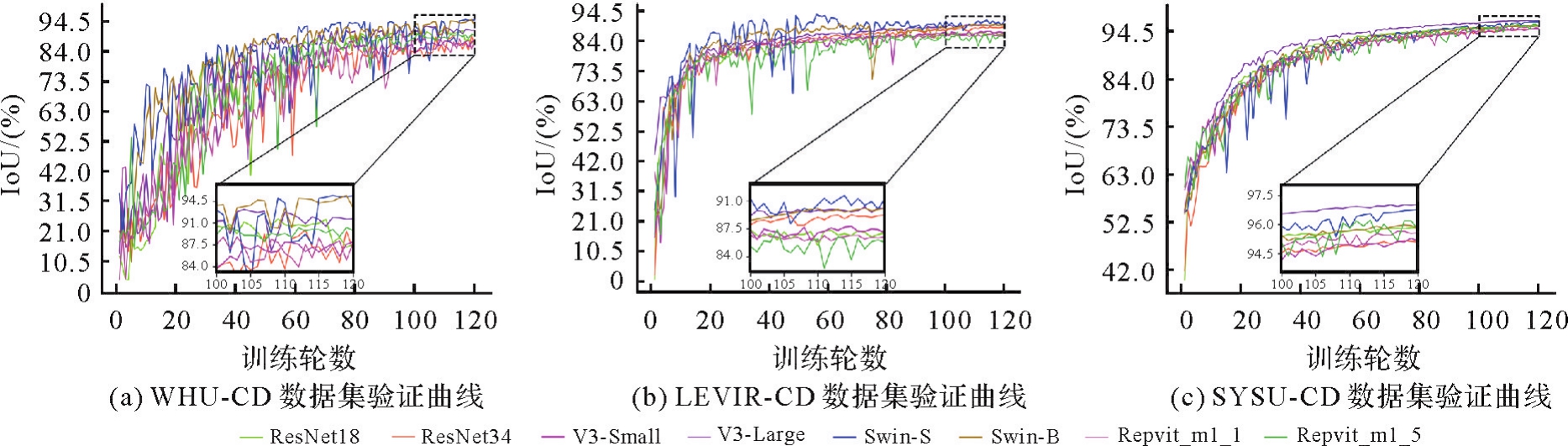
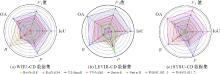
Fig. 7
Comparison of metrics for different backbone networks on different datasets"

Tab. 1
Comparison of metrics for different backbone networks on different datasets"
| 主干网络 | 主干网络复杂度嵌入后网络复杂度 | WHU-CD/(%) | LEVIR-CD/(%) | SYSU-CD/(%) | |||||||||
|---|---|---|---|---|---|---|---|---|---|---|---|---|---|
| 参数量/M | FLOPs/G | 参数量/M | FLOPs/G | IoU | F1值 | OA | IoU | F1值 | OA | IoU | F1值 | OA | |
| Res Net18 | 11.18 | 19.05 | 13.44 | 22.31 | 77.12 | 87.08 | 98.83 | 78.61 | 88.02 | 98.85 | 67.23 | 80.40 | 91.23 |
| Res Net34 | 21.28 | 38.43 | 23.55 | 41.69 | 72.08 | 83.78 | 98.49 | 79.53 | 88.60 | 98.89 | 66.69 | 80.01 | 91.21 |
| V3-Small | 1.14 | 1.35 | 1.73 | 2.71 | 78.34 | 87.86 | 98.92 | 76.93 | 86.96 | 98.75 | 65.92 | 79.46 | 90.99 |
| V3-Large | 3.41 | 5.79 | 5.67 | 9.05 | 80.59 | 89.25 | 99.05 | 81.23 | 89.65 | 98.96 | 69.46 | 81.97 | 91.78 |
| Swin-S | 48.76 | 89.13 | 32.51 | 51.28 | 83.04 | 90.73 | 99.22 | 82.96 | 91.07 | 99.11 | 68.27 | 81.14 | 91.48 |
| Swin-B | 86.64 | 158.3 | 95.52 | 167.01 | 80.50 | 89.20 | 99.04 | 81.39 | 89.74 | 98.97 | 65.48 | 79.14 | 90.52 |
| Repvit_m1_1 | 7.77 | 14.37 | 10.04 | 17.63 | 79.44 | 88.54 | 98.99 | 80.33 | 89.09 | 98.92 | 67.27 | 80.43 | 91.26 |
| Repvit_m1_5 | 13.62 | 24.43 | 15.88 | 27.69 | 75.54 | 86.06 | 98.77 | 78.22 | 87.78 | 98.83 | 64.70 | 78.57 | 90.69 |
Tab. 2
Comparison of indicators for different loss function combinations on different datasets"
| 损失函数 | WHU-CD | LEVIR-CD | SYSU-CD | SECOND | ||||||||
|---|---|---|---|---|---|---|---|---|---|---|---|---|
| IoU | F1值 | OA | IoU | F1值 | OA | IoU | F1值 | OA | IoU | F1值 | OA | |
| BCE loss+Dice loss | 78.88 | 88.19 | 98.93 | 80.74 | 89.35 | 98.95 | 69.55 | 82.04 | 91.79 | 58.38 | 73.72 | 94.69 |
| Focal loss+Dice loss | 80.59 | 89.25 | 99.05 | 81.23 | 89.65 | 98.96 | 69.46 | 81.97 | 91.78 | 58.93 | 74.16 | 94.67 |
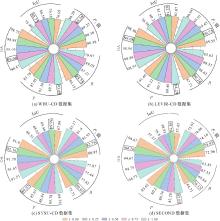
Fig. 8
Comparison of different balancing coefficients on different datasets"

Tab. 3
Comparison of indicators for different models on different datasets"
| 网络模型 | 网络复杂度 | WHU-CD/(%) | LEVIR-CD/(%) | SYSU-CD/(%) | SECOND/(%) | |||||||||
|---|---|---|---|---|---|---|---|---|---|---|---|---|---|---|
| 参数量/M | FLOPs/G | IoU | F1值 | OA | IoU | F1值 | OA | IoU | F1值 | OA | IoU | F1值 | OA | |
| Tiny-CD | 0.29 | 6.18 | 66.34 | 79.76 | 97.91 | 82.16 | 90.21 | 99.02 | 65.10 | 78.86 | 90.31 | 57.20 | 72.78 | 93.95 |
| RFANet | 2.86 | 12.65 | 73.28 | 84.58 | 98.52 | 81.11 | 89.57 | 98.95 | 65.61 | 79.24 | 90.53 | 56.51 | 72.22 | 94.39 |
| FC-Siam-diff | 1.35 | 18.91 | 64.05 | 78.09 | 97.73 | 73.41 | 84.66 | 98.49 | 65.35 | 79.04 | 90.79 | 50.42 | 67.04 | 93.44 |
| SNUNet | 12.03 | 219.33 | 71.59 | 83.45 | 98.40 | 81.33 | 89.49 | 98.96 | 65.64 | 79.25 | 90.71 | 55.04 | 71.00 | 94.00 |
| AMTNet | 16.45 | 58.85 | 72.93 | 84.35 | 98.56 | 79.29 | 88.45 | 98.84 | 60.89 | 75.69 | 88.91 | 51.08 | 67.62 | 93.65 |
| ChangeFormer | 29.75 | 84.73 | 70.05 | 82.39 | 98.28 | 79.80 | 88.76 | 98.87 | 63.90 | 77.97 | 89.40 | 51.10 | 67.64 | 93.20 |
| BIT | 11.47 | 105.24 | 72.49 | 84.11 | 98.45 | 80.62 | 89.27 | 98.92 | 63.72 | 77.30 | 89.18 | 56.79 | 72.44 | 94.45 |
| TFI-GR | 27.78 | 38.96 | 76.65 | 86.70 | 98.78 | 80.66 | 89.29 | 98.96 | 67.84 | 81.00 | 91.34 | 55.42 | 71.32 | 93.99 |
| CDNeXt | 39.42 | 64.33 | 76.53 | 86.53 | 98.73 | 80.77 | 89.36 | 98.94 | 67.14 | 80.34 | 91.16 | 56.50 | 72.20 | 94.29 |
| DMINet | 6.24 | 59.49 | 78.04 | 87.76 | 98.93 | 80.25 | 89.04 | 98.92 | 67.72 | 80.75 | 91.32 | 57.68 | 73.16 | 94.65 |
| SEAFNet | 5.67 | 9.05 | 80.77 | 89.36 | 99.06 | 82.74 | 90.73 | 99.08 | 70.64 | 82.76 | 92.16 | 59.79 | 74.83 | 94.76 |
Fig. 9
Visualization results of different models on the WHU-CD dataset"
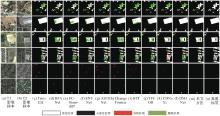
Fig. 10
Visualization results of different models on the LEVIR-CD dataset"
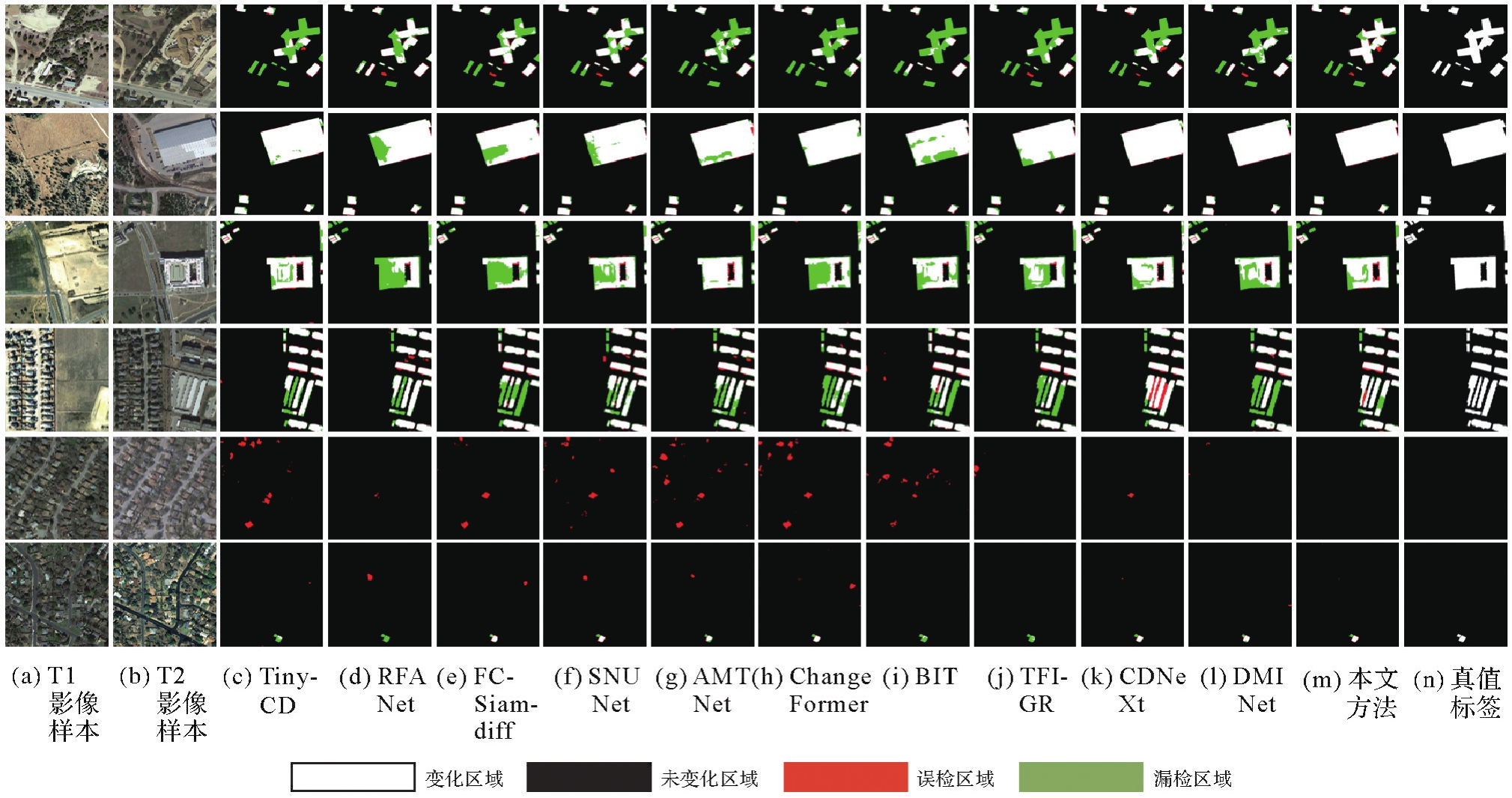
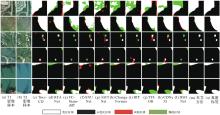
Fig. 11
Visualization results of different models on the SYSU-CD dataset"
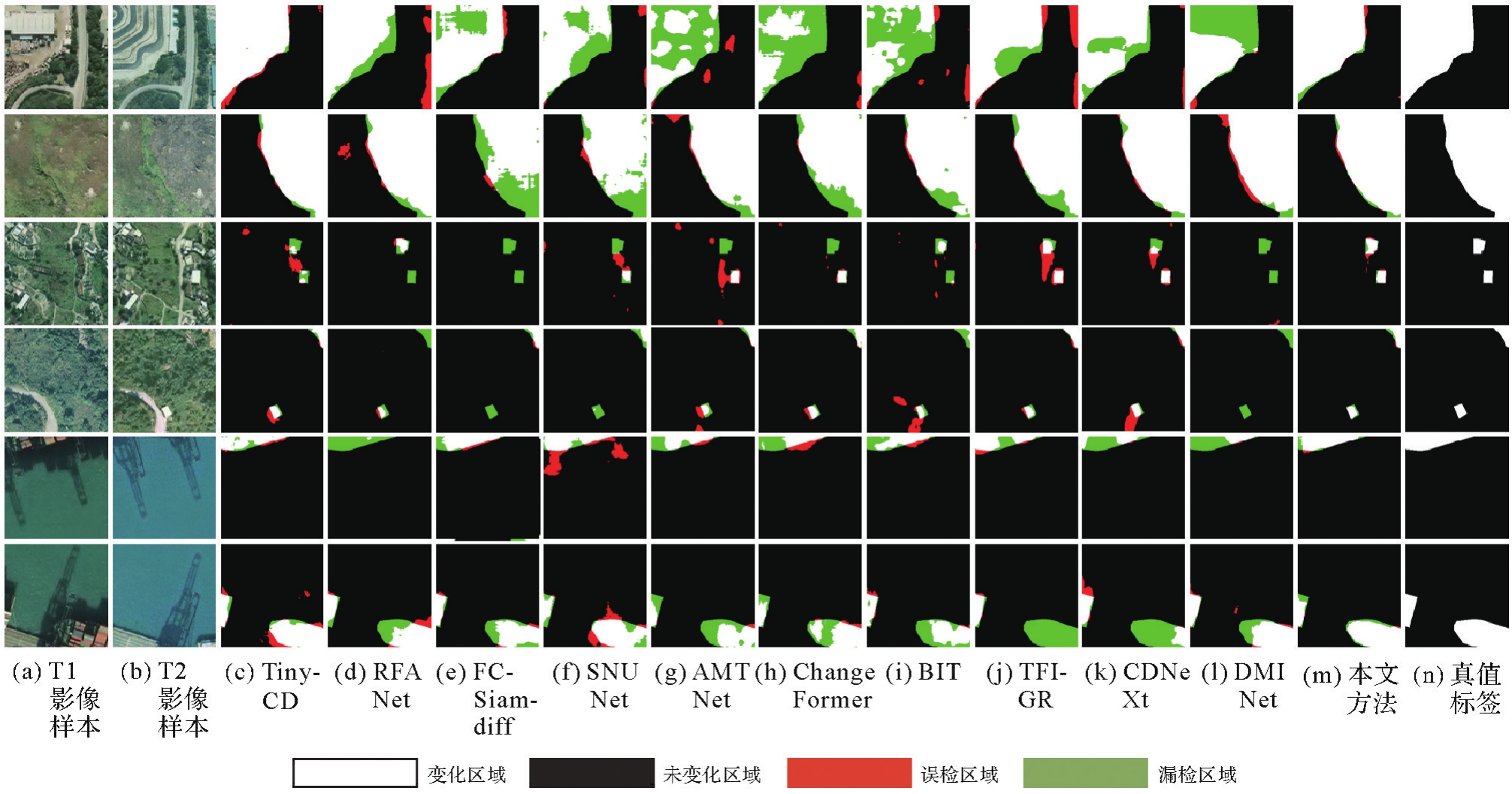
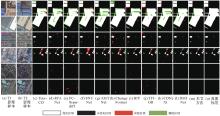
Fig. 12
Visualization results of different models on the SECOND dataset"
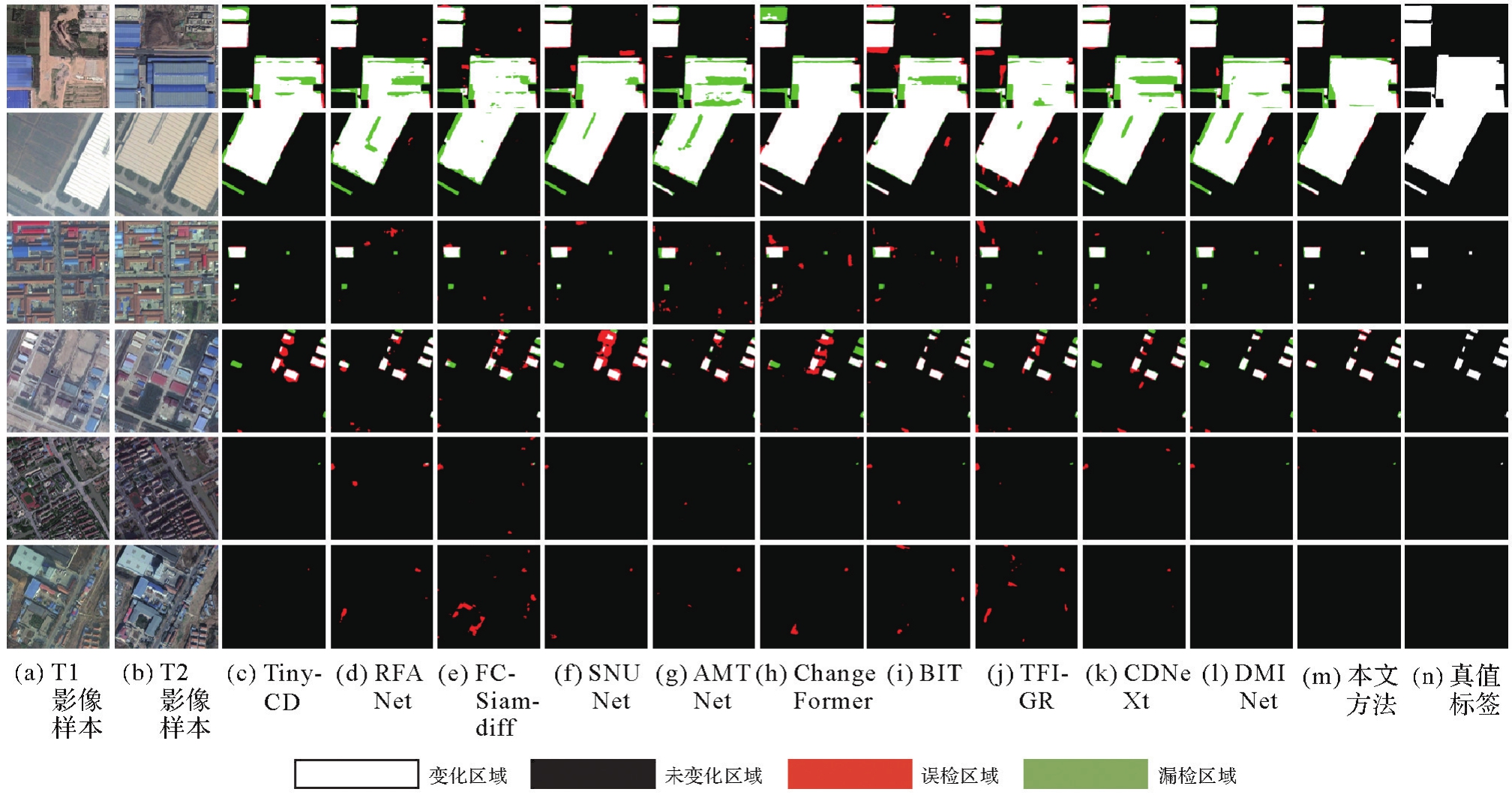
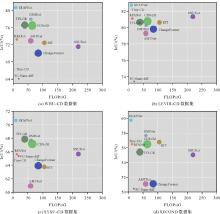
Fig. 13
Performance comparison of different models on different datasets"

Tab. 4
Results of ablation experiments on different datasets using different branches"
| 分支名称 | WHU-CD/(%) | LEVIR-CD/(%) | SYSU-CD/(%) | SECOND/(%) | 网络复杂度 | ||||||||||
|---|---|---|---|---|---|---|---|---|---|---|---|---|---|---|---|
| 分支1 | 分支2 | IoU | F1值 | OA | IoU | F1值 | OA | IoU | F1值 | OA | IoU | F1值 | OA | 参数量/M | FLOPs/G |
| × | × | 74.77 | 85.56 | 98.77 | 71.25 | 83.21 | 98.49 | 60.55 | 75.43 | 89.92 | 49.91 | 66.59 | 93.42 | 3.57 | 8.79 |
| × | √ | 76.35 | 86.59 | 98.76 | 73.58 | 84.78 | 98.59 | 64.69 | 78.56 | 90.67 | 50.83 | 67.40 | 93.82 | 3.55 | 8.77 |
| √ | × | 76.04 | 86.39 | 98.88 | 73.98 | 85.04 | 98.45 | 63.60 | 77.75 | 90.49 | 51.34 | 67.84 | 93.49 | 5.56 | 9.06 |
| √ | √ | 77.60 | 87.39 | 98.93 | 77.76 | 87.49 | 98.72 | 65.31 | 79.01 | 90.69 | 52.45 | 68.81 | 93.69 | 5.56 | 9.06 |
Tab. 5
Results of ablation experiments on different datasets using weighted parameters"
| 权重参数 | WHU-CD/(%) | LEVIR-CD/(%) | SYSU-CD/(%) | SECOND/(%) | 网络复杂度 | |||||||||
|---|---|---|---|---|---|---|---|---|---|---|---|---|---|---|
| IoU | F1值 | OA | IoU | F1值 | OA | IoU | F1值 | OA | IoU | F1值 | OA | 参数量/M | FLOPs/G | |
| × | 76.69 | 86.81 | 98.94 | 77.29 | 87.17 | 98.73 | 66.40 | 79.81 | 91.35 | 53.88 | 70.03 | 94.21 | 3.67 | 8.72 |
| √ | 77.29 | 87.19 | 98.90 | 77.78 | 87.52 | 98.74 | 66.88 | 80.15 | 91.31 | 54.61 | 70.64 | 94.28 | 3.67 | 8.72 |
Tab. 6
Results of ablation experiments on different datasets using different modules"
| 模块名称 | WHU-CD/(%) | LEVIR-CD/(%) | SYSU-CD/(%) | SECOND/(%) | 网络复杂度 | |||||||||||
|---|---|---|---|---|---|---|---|---|---|---|---|---|---|---|---|---|
| STDEM | ERRM | SAPM | IoU | F1值 | OA | IoU | F1值 | OA | IoU | F1值 | OA | IoU | F1值 | OA | 参数量/M | FLOPs/G |
| √ | √ | √ | 80.59 | 89.25 | 99.05 | 81.23 | 89.65 | 98.96 | 69.46 | 81.97 | 91.78 | 58.93 | 74.16 | 94.67 | 5.67 | 9.05 |
| × | √ | √ | 78.59 | 88.01 | 98.92 | 79.57 | 88.62 | 98.89 | 67.73 | 80.76 | 91.52 | 54.66 | 70.68 | 94.35 | 3.68 | 8.78 |
| √ | × | √ | 80.43 | 89.16 | 99.04 | 79.87 | 88.81 | 98.89 | 68.57 | 81.35 | 91.63 | 57.17 | 72.75 | 94.19 | 5.67 | 8.99 |
| √ | √ | × | 78.79 | 88.14 | 99.02 | 78.17 | 87.75 | 98.79 | 65.76 | 79.35 | 90.92 | 53.52 | 69.72 | 92.96 | 5.57 | 9.13 |
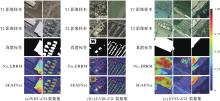
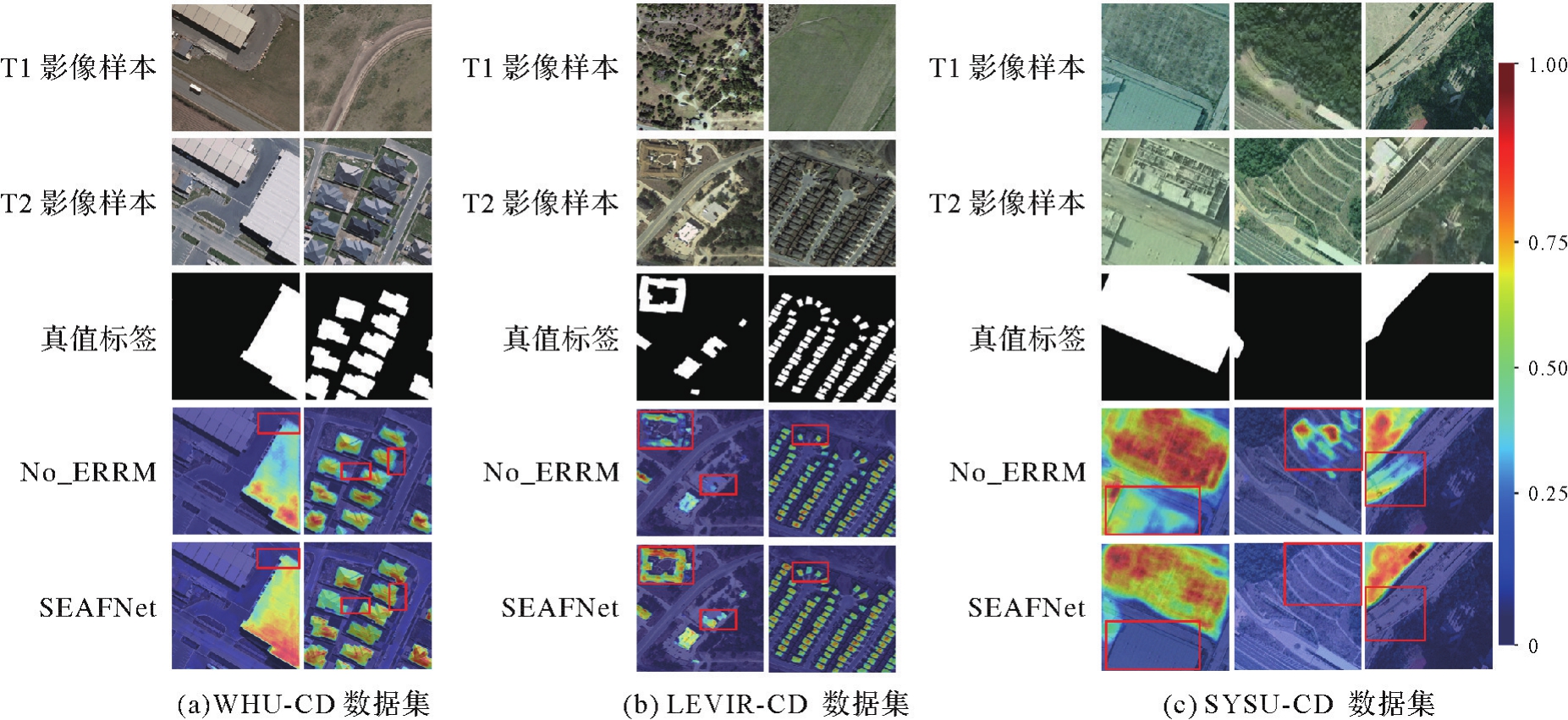
Fig. 14
Visualization of class heat maps for each module"
| [1] | 刘宣广, 李蒙蒙, 汪小钦, 等. 基于面向对象孪生神经网络的高分辨率遥感影像建筑物变化检测[J]. 遥感学报, 2024, 28(2): 437-454. |
| LIU Xuanguang, LI Mengmeng, WANG Xiaoqin, et al. Use of object-based siamese neural network to build change detection from very high resolution remote-sensing images[J]. National Remote Sensing Bulletin, 2024, 28(2): 437-454. | |
| [2] |
王超, 王帅, 陈晓, 等. 联合UNet++和多级差分模块的多源光学遥感影像对象级变化检测[J]. 测绘学报, 2023, 52(2): 283-296. DOI:.
doi: 10.11947/j.AGCS.2023.20220202 |
|
WANG Chao, WANG Shuai, CHEN Xiao, et al. Object-level change detection of multi-sensor optical remote sensing images combined with UNet++ and multi-level difference module[J]. Acta Geodaetica et Cartographica Sinica, 2023, 52(2): 283-296. DOI:.
doi: 10.11947/j.AGCS.2023.20220202 |
|
| [3] | 柳思聪, 都科丞, 郑永杰, 等. 人工智能时代的遥感变化检测技术:继承、发展与挑战[J]. 遥感学报, 2023, 27(9): 1975-1987. |
| LIU Sicong, DU Kecheng, ZHENG Yongjie, et al. Remote sensing change detection technology in the era of artificial intelligence: inheritance, development and challenges[J]. National Remote Sensing Bulletin, 2023, 27(9): 1975-1987. | |
| [4] | 徐炜, 王驿飞, 张艳, 等. 基于双边滤波和小目标抑制的异源遥感变化检测[J]. 电子测量技术, 2021, 44(17): 165-172. |
| XU Wei, WANG Yifei, ZHANG Yan, et al. Heterogeneous remote sensing image change detection based on bilateral filtering and small target suppression[J]. Electronic Measurement Technology, 2021, 44(17): 165-172. | |
| [5] | 邱云飞, 屈照阳, 方立. 结合差异增强的异源遥感影像变化检测网络[J]. 测绘科学, 2024, 49(1): 153-162. |
| QIU Yunfei, QU Zhaoyang, FANG Li. Change detection network for heterogeneous remote sensing images with differential augmentation[J]. Science of Surveying and Mapping, 2024, 49(1): 153-162. | |
| [6] | 张玉沙, 黄岩, 谭琨, 等. 基于多分类器集成和对象的城市典型地物要素变化检测——以ZY-3影像为例[J]. 地理与地理信息科学, 2018, 34(3): 54-60,130. |
| ZHANG Yusha, HUANG Yan, TAN Kun, et al. Change detection of urban typical features based on multi-classifier ensemble and objeets: taking ZY-3 as an example[J]. 2018, 34(3): 54-60,130. | |
| [7] | 张晗, 倪维平, 严卫东, 等. 利用分形和多尺度分析的中低分辨率SAR图像变化检测[J]. 武汉大学学报(信息科学版), 2016, 41(5): 642-648. |
| ZHANG Han, NI Weiping, YAN Weidong, et al. Mid and low resolution SAR image change detection based on fractal and multi-scale analysis[J]. Geomatics and Information Science of Wuhan University, 2016, 41(5): 642-648. | |
| [8] | 赵元昊, 孙根云, 张爱竹, 等. 基于典型相关分析的遥感影像非监督超像素级变化检测[J]. 遥感学报, 2024, 28(4): 1025-1040. |
| ZHAO Yuanhao, SUN Genyun, ZHANG Aizhu, et al. Unsupervised super pixel level change detection based on canonical correlation analysis[J]. National Remote Sensing Bulletin, 2024, 28(4): 1025-1040. | |
| [9] | ZHOU Zhenjin, MA Lei, FU Tengyun, et al. Change detection in coral reef environment using high-resolution images: comparison of object-based and pixel-based paradigms[J]. International Journal of Geo-Information, 2018, 7(11): 441. |
| [10] | 胡永月, 肖鹏峰, 冯学智, 等. 面向对象变化检测中多时相图像分割模式影响评价[J]. 南京大学学报(自然科学), 2015, 51(5): 1049-1057. |
| HU Yongyue, XIAO Pengfeng, FENG Xuezhi, et al. Evaluating the effectiveness of multi-temporal image segmentation on object-based change detection[J]. Journal of Nanjing University (Natural Sciences), 2015, 51(5): 1049-1057. | |
| [11] | 韩潇冰. 高分辨率遥感影像“像素-目标-场景”的深度理解方法研究[D]. 武汉: 武汉大学, 2020. |
| HAN Xiaobing. “Pixel-obiect-scene” level deep understanding for high spatial resolution remote sensing imagery[D]. Wuhan: Wuhan University, 2020. | |
| [12] | WU Chen, ZHANG Liangpei, DU Bo. Kernel slow feature analysis for scene change detection[J]. IEEE Transactions on Geoscience and Remote Sensing, 2017, 55(4): 2367-2384. |
| [13] | CHEN Jie, HUANG Haozhe, PENG Jian, et al. Contextual information-preserved architecture learning for remote sensing scene classification[J]. IEEE Transactions on Geoscience and Remote Sensing, 2022, 60: 1-14. |
| [14] | WANG Min, WANG Peidong. CFM-UNet: a joint CNN and transformer network via cross feature modulation for remote sensing images segmentation[J]. Journal of Geodesy and Geoinformation Science, 2023, 6(4): 40-47. |
| [15] | ZHU Qiqi, GUO Xi, DENG Weihuan, et al. Land-use/land-cover change detection based on a siamese global learning framework for high spatial resolution remote sensing imagery[J]. ISPRS Journal of Photogrammetry and Remote Sensing, 2022, 184: 63-78. |
| [16] | CHEN Zhanlong, LI Shuangjiang, XU Yongyang, et al. Correg-Yolov3: a method for dense buildings detection in high-resolution remote sensing images[J]. Journal of Geodesy and Geoinformation Science, 2023, 6(2): 51-61. |
| [17] | CODEGONI A, LOMBARDI G, FERRARI A. Tinycd: a (not so) deep learning model for change detection[J]. Neural Computing and Applications, 2023, 35(11): 8471-8486. |
| [18] | YANG Haiping, CHEN Yuanyuan, WU Wei, et al. A lightweight siamese neural network for building change detection using remote sensing images[J]. Remote Sensing, 2023, 15(4): 928. |
| [19] | YOU Zhihui, CHEN Sibao, WANG Jiaxin, et al. Robust feature aggregation network for lightweight and effective remote sensing image change detection[J]. ISPRS Journal of Photogrammetry and Remote Sensing, 2024, 215: 31-43. |
| [20] | HUANG Yanyuan, LI Xinghua, DU Zhengshun, et al. Spatiotemporal enhancement and interlevel fusion network for remote sensing images change detection[J]. IEEE Transactions on Geoscience and Remote Sensing, 2024, 62: 1-14. |
| [21] | BANDARA W G C, PATEL V M. A transformer-based siamese network for change detection[C]//Proceedings of 2022 IEEE International Geoscience and Remote Sensing Symposium. Malaysia: IEEE, 2022: 207-210. |
| [22] | ZHANG Cui, WANG Liejun, CHENG Shuli, et al. SwinSUNet: pure transformer network for remote sensing image change detection[J]. IEEE Transactions on Geoscience and Remote Sensing, 2022, 60: 1-13. |
| [23] | WANG Decheng, CHEN Xiangning, JIANG Mingyong, et al. ADS-Net: an attention-based deeply supervised network for remote sensing image change detection[J]. International Journal of Applied Earth Observation and Geoinformation, 2021, 101: 102348. |
| [24] | 张建兵, 严泽枭, 马淑芳. 用于遥感影像建筑物变化检测的多尺度交叉对偶注意力网络[J]. 地球信息科学学报, 2023, 25(12): 2487-2500. |
| ZHANG Jianbing, YAN Zexiao, MA Shufang. Multi-scale cross dual attention network for building change detection in remote sensing images[J]. Geo-Information Science, 2023, 25(12): 2487-2500. | |
| [25] | LI Qingyang, ZHONG Ruofei, DU Xin, et al. TransUNetCD: a hybrid transformer network for change detection in optical remote-sensing images[J]. IEEE Transactions on Geoscience and Remote Sensing, 2022, 60: 1-9. |
| [26] | LIANG Shike, HUA Zhen, LI Jinjiang. Enhanced self-attention network for remote sensing building change detection[J]. IEEE Journal of Selected Topics in Applied Earth Observations and Remote Sensing, 2023, 16: 4900-4915. |
| [27] | CHEN Hongruixuan, SONG Jian, HAN Chengxi, et al. ChangeMamba: remote sensing change detection with spatiotemporal state space model[J]. IEEE Transactions on Geoscience and Remote Sensing, 2024, 62: 1-20. |
| [28] | CAYE DAUDT R, LE SAUX B, BOULCH A. Fully convolutional siamese networks for change detection[C]//Proceedings of the 25th IEEE International Conference on Image Processing. Athens: IEEE, 2018: 4063-4067. |
| [29] | LI Shujun, HUO Lianzhi. Remote sensing image change detection based on fully convolutional network with pyramid attention[C]//Proceedings of 2021 IEEE International Geoscience and Remote Sensing Symposium. Brussels: IEEE, 2021: 4352-4355. |
| [30] |
姜明, 张新长, 孙颖, 等. 全尺度特征聚合的高分辨率遥感影像变化检测网络[J]. 测绘学报, 2023, 52(10): 1738-1748. DOI:.
doi: 10.11947/j.AGCS.2023.20220505 |
|
JIANG Ming, ZHANG Xinchang, SUN Ying, et al. Full-scale feature aggregation network for high-resolution remote sensing image change detection[J]. Acta Geodaetica et Cartographica Sinica, 2023, 52(10): 1738-1748. DOI:.
doi: 10.11947/j.AGCS.2023.20220505 |
|
| [31] | HE Kaiming, ZHANG Xiangyu, REN Shaoqing, et al. Deep residual learning for image recognition[C]//Proceedings of 2016 IEEE Conference on Computer Vision and Pattern Recognition. Las Vegas: IEEE, 2016: 770-778. |
| [32] | HOWARD A, SANDLER M, CHEN Bo, et al. Searching for MobileNetV3[C]//Proceedings of 2019 IEEE/CVF International Conference on Computer Vision. Seoul: IEEE, 2019: 1314-1324. |
| [33] | LIU Ze, LIN Yutong, CAO Yue, et al. Swin transformer: hierarchical vision transformer using shifted windows[C]//Proceedings of 2021 IEEE/CVF International Conference on Computer Vision. Montreal: IEEE, 2021: 9992-10002. |
| [34] | WANG Ao, CHEN Hui, Lin Zijia, et al. RepViT: revisiting mobile CNN from ViT perspective[C]//Proceedings of 2024 IEEE/CVF Conference on Computer Vision and Pattern Recognition. Seattle: IEEE, 2024: 15909-15920. |
| [35] | FU Jun, LIU Jing, JIANG Jie, et al. Scene segmentation with dual relation-aware attention network[J]. IEEE Transactions on Neural Networks and Learning Systems, 2021, 32(6): 2547-2560. |
| [36] | WANG Qilong, WU Banggu, ZHU Pengfei, et al. ECA-Net: efficient channel attention for deep convolutional neural networks[C]//Proceedings of 2020 IEEE/CVF Conference on Computer Vision and Pattern Recognition. Seattle: IEEE, 2020: 11531-11539. |
| [37] | LIN T Y, DOLLAR P, GIRSHICK R, et al. Feature pyramid networks for object detection[C]//Proceedings of 2017 IEEE Conference on Computer Vision and Pattern Recognition. Honolulu: IEEE, 2017: 936-944. |
| [38] | LIU Shu, QI Lu, QIN Haifang, et al. Path aggregation network for instance segmentation[C]//Proceedings of 2018 IEEE Conference on Computer Vision and Pattern Recognition. Salt Lake City: IEEE, 2018: 8759-8768. |
| [39] | JI Shunping, WEI Shiqing, LU Meng. Fully convolutional networks for multisource building extraction from an open aerial and satellite imagery data set[J]. IEEE Transactions on Geoscience and Remote Sensing, 2019, 57(1): 574-586. |
| [40] | CHEN Hao, SHI Zhenwei. A spatial-temporal attention-based method and a new dataset for remote sensing image change detection[J]. Remote Sensing, 2020, 12(10): 1662. |
| [41] | SHI Qian, LIU Mengxi, LI Shengchen, et al. A deeply supervised attention metric-based network and an open aerial image dataset for remote sensing change detection[J]. IEEE Transactions on Geoscience and Remote Sensing, 2022, 60: 1-16. |
| [42] | YANG Kunping, XIA Guisong, LIU Zicheng, et al. A symmetric siamese networks for semantic change detection in aerial images[J]. IEEE Transactions on Geoscience and Remote Sensing, 2022, 60: 1-18. |
| [43] | LIN T Y, GOYAL P, GIRSHICK R, et al. Focal loss for dense object detection[J]. IEEE Transactions on Pattern Analysis & AMP, Machine Intelligence, 2020, 42(2): 318-327. |
| [44] | SUDRE H C, LI W Q, TOM V, et al. Generalised dice overlap as a deep learning loss function for highly unbalanced segmentations[C]//Proceedings of 2017 Deep Learning in Medical Image Analysis and Multimodal Learning for Clinical Decision Support. Quebec City: Springer, 2017: 240-248. |
| [45] | FANG Sheng, LI Kaiyu, SHAO Jinyuan, et al. SNUNet-CD: a densely connected siamese network for change detection of VHR images[J]. IEEE Geoscience and Remote Sensing Letters, 2022, 19: 1-5. |
| [46] | CHEN Hao, QI Zipeng, SHI Zhenwei. Remote sensing image change detection with transformers[J]. IEEE Transactions on Geoscience and Remote Sensing, 2022, 60: 1-14. |
| [47] | LIU Wei, LIN Yiyuan, LIU Weijia, et al. An attention-based multiscale transformer network for remote sensing image change detection[J]. ISPRS Journal of Photogrammetry and Remote Sensing, 2023, 202: 599-609. |
| [48] | LI Zhenglai, TANG Chang, WANG Lizhe. Remote sensing change detection via temporal feature interaction and guided refinement[J]. IEEE Transactions on Geoscience and Remote Sensing, 2022, 60: 1-11. |
| [49] | FENG Yuchao, JIANG Jiawei, XU Honghui, et al. Change detection on remote sensing images using dual-branch multilevel intertemporal network[J]. IEEE Transactions on Geoscience and Remote Sensing, 2023, 61: 1-5. |
| [50] | WEI Jinjiang, SUN Kaimin, LI Wenzhuo, et al. Robust change detection for remote sensing images based on temporospatial interactive attention module[J]. ISPRS Journal of Photogrammetry and Remote Sensing, 2024, 128: 103767. |
| [1] | Lanxin WU, Jiangtao PENG, Weiwei SUN, Bing YANG. An Euler embedding and complementary feature modeling framework for hyperspectral change detection in coastal wetlands [J]. Acta Geodaetica et Cartographica Sinica, 2026, 55(4): 618-631. |
| [2] | Daifeng PENG, Xuelian LIU, Mengfei LU, Haiyan GUAN. Heterogeneous remote sensing image flood change detection based on multi-scale cross-modal feature fusion [J]. Acta Geodaetica et Cartographica Sinica, 2026, 55(2): 328-343. |
| [3] | Haopeng HU, Hangbin WU, Shihao ZHAN, Zaihao WEN, Chun LIU. Road pole-like object change detection supported by visual point cloud quality optimization [J]. Acta Geodaetica et Cartographica Sinica, 2026, 55(2): 344-358. |
| [4] | Zhuang SUN, Po LIU, Liang ZHAI, Yu HE, Zutao ZHANG. A self-supervised matching method for polygonal geographic entity based on a three-branch attention network [J]. Acta Geodaetica et Cartographica Sinica, 2026, 55(1): 169-180. |
| [5] | Shunping JI, Jin LIU, Jian GAO, Jianya GONG. An intelligent 3D reconstruction framework via deep learning based multi-view image matching [J]. Acta Geodaetica et Cartographica Sinica, 2025, 54(9): 1633-1646. |
| [6] | Jixian ZHANG, Haiyan GU, Huan NI, Haitao LI, Yi YANG, Shaopeng DING, Songman SUI. Deep learning methods for remote sensing intelligent change detection: evolution and development [J]. Acta Geodaetica et Cartographica Sinica, 2025, 54(8): 1347-1370. |
| [7] | Qing CHENG, Boxuan WANG, Hongyan ZHANG. DRformer: a progressive coupled multiscale CNN and condensed attention Transformer method for hyperspectral image super-resolution [J]. Acta Geodaetica et Cartographica Sinica, 2025, 54(7): 1230-1242. |
| [8] | Yakun XIE, Yaoji ZHAO, Jiaxing TU, Ruifeng XIA, Dejun FENG, Suning LIU, Hongyu CHEN, Jun ZHU. Edge and global features integrated network for salient object detection in optical remote sensing images [J]. Acta Geodaetica et Cartographica Sinica, 2025, 54(7): 1265-1279. |
| [9] | Zibo DONG, Jingxue WANG, Lijing BU, Lin FANG, Zhenghui XU. MAFNet: building extraction method from remote sensing images based on multi-scale atrous fusion network [J]. Acta Geodaetica et Cartographica Sinica, 2025, 54(6): 1094-1106. |
| [10] | Chao WANG, Tianyu CHEN, Tong ZHANG, Tanvir AHMED, Liqiang JI, Tao XIE, Jiajun YANG, Shuai WANG. Multi-sensor optical remote sensing images change detection based on global differential enhancement module and balance penalty loss [J]. Acta Geodaetica et Cartographica Sinica, 2025, 54(5): 873-887. |
| [11] | Yiming ZHAO, Kelin HU, Kelong TU, Yaxian QING, Chao YANG, Kunlun QI, Huayi WU. Multi-label scene classification method based on fusion of SAR and optical remote sensing images [J]. Acta Geodaetica et Cartographica Sinica, 2025, 54(5): 911-923. |
| [12] | Yupeng GU, Wanke LIU, Xiaohong ZHANG, Jie HU, Shujie HU, Weihao LEI, Kai ZHENG. Neural network-based GNSS stochastic model generation method by fisheye images [J]. Acta Geodaetica et Cartographica Sinica, 2025, 54(12): 2206-2218. |
| [13] | Zhaoyang HOU, Haowen YAN, Liming ZHANG, Rongjuan MA, Ruitao QU. Zero-watermark copyright protection method for remote sensing images based on coupled neural P system and blockchain [J]. Acta Geodaetica et Cartographica Sinica, 2025, 54(12): 2247-2261. |
| [14] | Xiong PAN, Zixuan ZHAO, Chang PING, Lihong JIN, Lilong LIU. Ionospheric TEC prediction incorporating semi-parametric and rule-learning [J]. Acta Geodaetica et Cartographica Sinica, 2025, 54(10): 1741-1756. |
| [15] | Yanjun WANG, Xuchao TANG, Cheng WANG, Hengfan CAI. Urban and rural road surface extraction network based on road topological correlation features [J]. Acta Geodaetica et Cartographica Sinica, 2025, 54(1): 75-89. |
| Viewed | ||||||
|
Full text |
|
|||||
|
Abstract |
|
|||||
