

Acta Geodaetica et Cartographica Sinica ›› 2025, Vol. 54 ›› Issue (7): 1206-1214.doi: 10.11947/j.AGCS.2025.20240406
• Geodesy and Navigation • Previous Articles Next Articles
Huiwen HU1,2( ), Cong SHEN1,2, Lintao LIU1(), Guocheng WANG1
Received:2024-10-11
Revised:2025-06-20
Online:2025-08-18
Published:2025-08-18
Contact:
Lintao LIU
E-mail:huhuiwen@apm.ac.cn;llt@asch.whigg.ac.cn
About author:HU Huiwen (1997—), male, PhD, majors in time delay estimation, array signal processing, and microphone array orientation. E-mail: huhuiwen@apm.ac.cn
Supported by:CLC Number:
Huiwen HU, Cong SHEN, Lintao LIU, Guocheng WANG. Pearson correlation coefficient time delay estimation applied in acoustic orientation[J]. Acta Geodaetica et Cartographica Sinica, 2025, 54(7): 1206-1214.
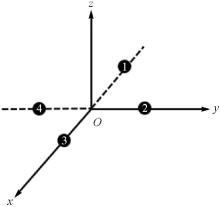
Fig. 1
Four-element array"

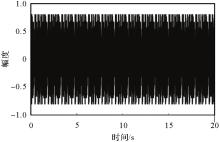
Fig. 2
Target signal"
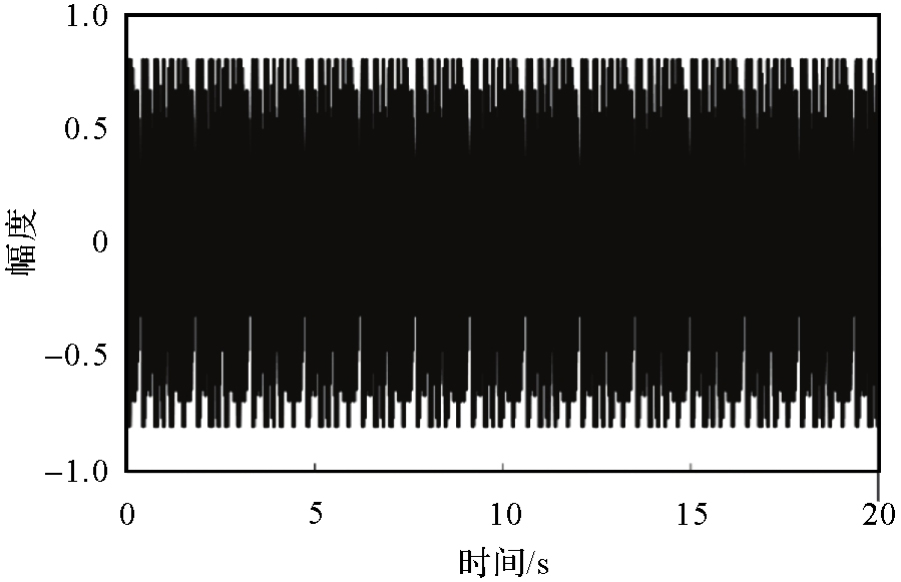
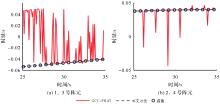
Fig. 3
Time delay estimated by different methods and true time delay between two array elements"

Tab. 1
TDE statistics"
| 阵元序号 | 异常值个数的比例/(%) | 去异常值后均方根误差/(°) | ||
|---|---|---|---|---|
| GCC-PHAT | 本文方法 | GCC-PHAT | 本文方法 | |
| 1、2 | 14.00 | 0.00 | 1.5×10⁻⁴ | 1.1×10⁻⁵ |
| 1、3 | 48.00 | 0.00 | 2.2×10⁻⁴ | 2.9×10⁻⁴ |
| 1、4 | 0.00 | 0.00 | 2.1×10⁻⁵ | 1.5×10⁻⁵ |
| 2、3 | 3.00 | 0.00 | 1.6×10⁻⁵ | 1.3×10⁻⁵ |
| 2、4 | 8.00 | 0.00 | 7.7×10⁻⁵ | 7.8×10⁻⁶ |
| 3、4 | 15.00 | 0.00 | 1.0×10⁻⁵ | 1.0×10⁻⁵ |
Tab. 2
Statistics about orientating target"
| 目标方向 | 方法 | 定向方程组有解的比例/(%) | 异常值个数的比例/(%) | 去异常值后均方根误差/(°) |
|---|---|---|---|---|
| 俯仰角 | GCC-PHAT | 71.00 | 28.17 | 0.54 |
| 本文方法 | 100.00 | 0.00 | 0.13 | |
| 方位角 | GCC-PHAT | 71.00 | 21.13 | 0.85 |
| 本文方法 | 100.00 | 0.00 | 0.10 |
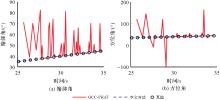
Fig. 4
Target direction"

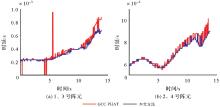
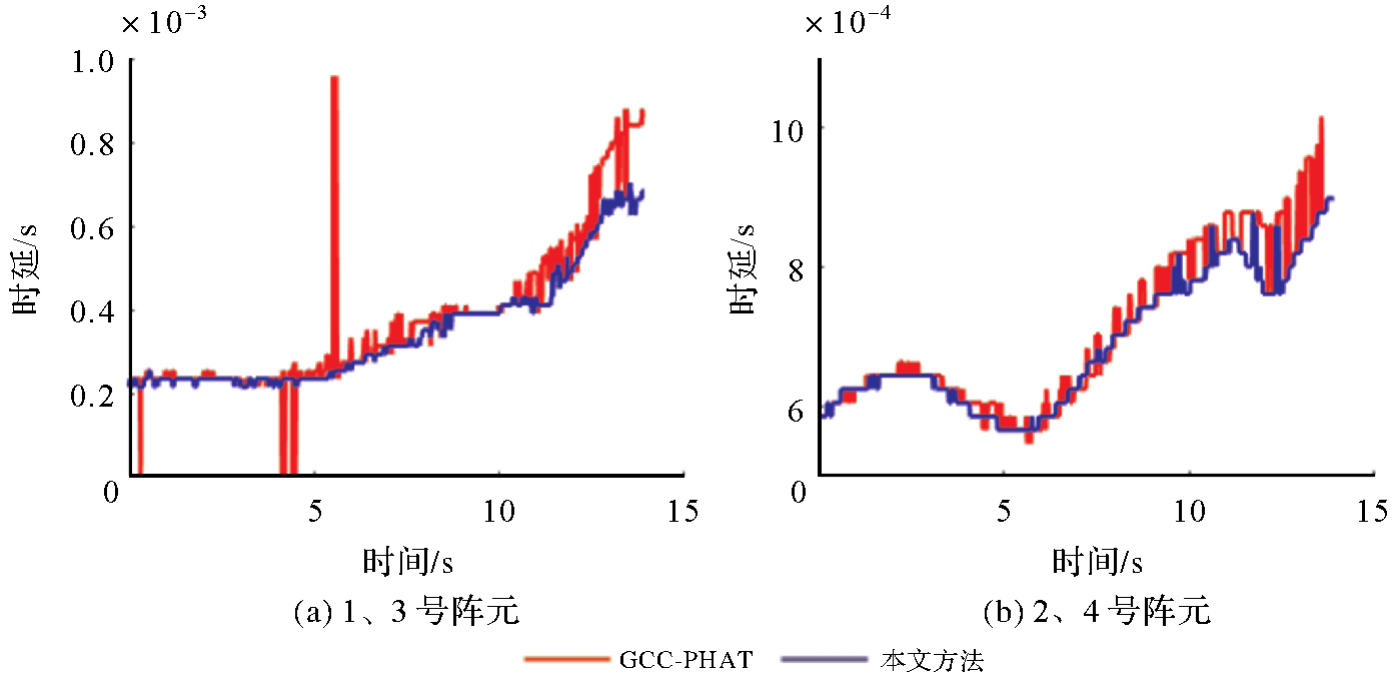
Fig. 5
Time delay estimated by GCC-PHAT and the proposed method between two array elements"
Tab. 3
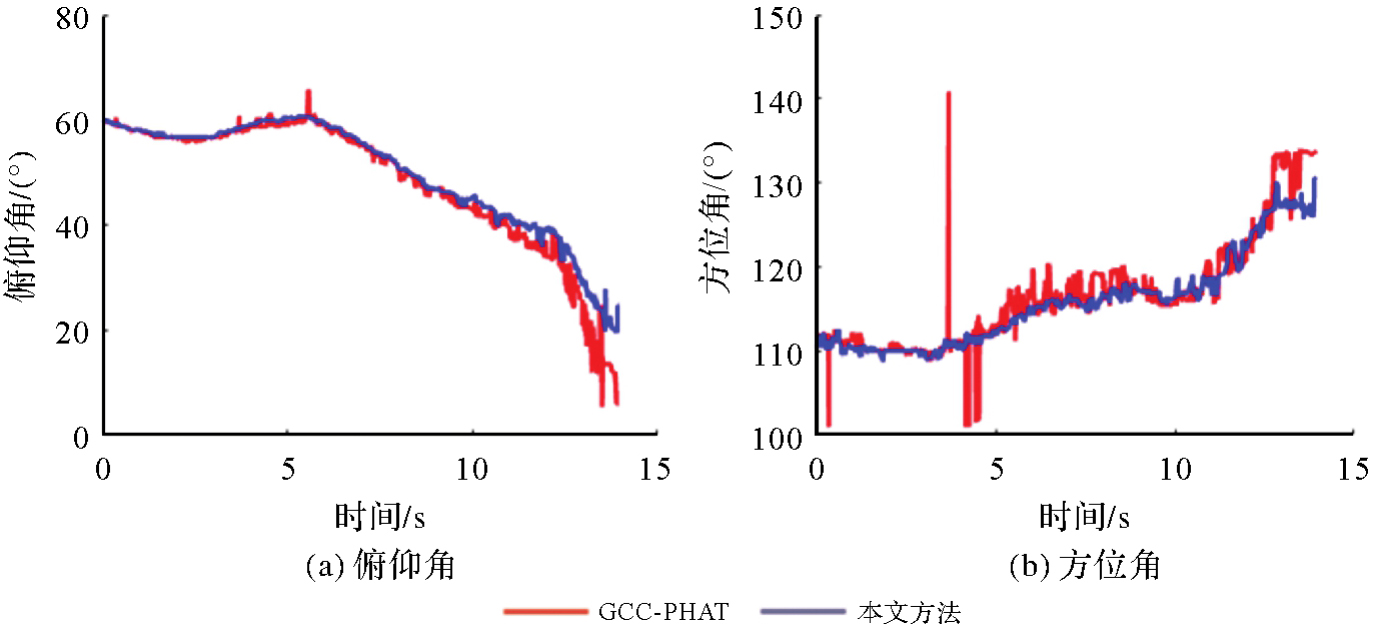
Statistics about orientating drone"
| 方法 | 定向方程组有解的比例 | 在俯仰角稳定性上占优比例 | 在方位角稳定性上占优比例 |
|---|---|---|---|
| GCC-PHAT | 98.22 | 35.67 | 39.89 |
| 本文方法 | 100.00 | 64.33 | 60.11 |
Fig. 6
Drone direction"
| [1] | LI Fu, VACCARO R J. Unified analysis for DOA estimation algorithms in array signal processing[J]. Signal Processing, 1991, 25(2): 147-169. |
| [2] | LIAO Bin, MADANAYAKE A, AGATHOKLIS P. Array signal processing and systems[J]. Multidimensional Systems and Signal Processing, 2018, 29(2): 467-473. |
| [3] | 蒋德军, 胡涛. 时延估计技术及其在多途环境中的应用[J]. 声学学报, 2001, 26(1): 34-40. |
| JIANG Dejun, HU Tao. Time-delay estimation and its application in multipath environment[J]. Acta Acustica, 2001, 26(1): 34-40. | |
| [4] | DA ROSA ZANATTA M, LÓPES DE MENDONÇA F L, ANTREICH F, et al. Tensor-based time-delay estimation for second and third generation global positioning system[J]. Digital Signal Processing, 2019, 92: 1-19. |
| [5] | AZARIA M, HERTZ D. Time delay estimation by generalized cross correlation methods[J]. IEEE Transactions on Acoustics, Speech, and Signal Processing, 1984, 32(2): 280-285. |
| [6] | 张传义, 卢晓. 基于广义互功率谱相位法的声源定位技术[J]. 东北大学学报(自然科学版), 2018, 39(8): 1075-1079. |
| ZHANG Chuanyi, LU Xiao. Sound source localization technology based on generalized cross-power spectrum phase[J]. Journal of Northeastern University (Natural Science), 2018, 39(8): 1075-1079. | |
| [7] | GAO Y, BRENNAN M J, JOSEPH P F. A comparison of time delay estimators for the detection of leak noise signals in plastic water distribution pipes[J]. Journal of Sound and Vibration, 2006, 292(3-5): 552-570. |
| [8] | ZHANG Cheng, SHEN Shihui, HUANG Hai, et al. Estimation of the vehicle speed using cross-correlation algorithms and MEMS wireless sensors[J]. Sensors, 2021, 21(5): 1721. |
| [9] | COBOS M, ANTONACCI F, COMANDUCCI L, et al. Frequency-sliding generalized cross-correlation: a sub-band time delay estimation approach[J]. IEEE/ACM Transactions on Audio, Speech, and Language Processing, 2020, 28: 1270-1281. |
| [10] | 李皖婷, 李登峰, 张修靖, 等. 指数形式的二次相关GCC-PHAT-β时延估计算法[J]. 科学技术与工程, 2022, 22(33): 14779-14785. |
| LI Wanting, LI Dengfeng, ZHANG Xiujing, et al. Exponential quadratic correlation GCC-PHAT-β delay estimation algorithm[J]. Science Technology and Engineering, 2022, 22(33): 14779-14785. | |
| [11] | 梁宇, 马良, 纳霞, 等. 基于广义互相关算法的时延估计[J]. 计算机科学, 2011, 38(): 454-456. |
| LIANG Yu, MA Liang, NA Xia, et al. Research of time delay estimation based on GCC algorithm[J]. Computer Science, 2011, 38(): 454-456. | |
| [12] | 邢毓华, 郑琦. 广义互相关在混沌扩频时延估计中的研究与应用[J]. 激光与光电子学进展, 2021, 58(23): 1907001. |
| XING Yuhua, ZHENG Qi. Research and application of generalized cross correlation in chaotic spread spectrum time delay estimation[J]. Laser & Optoelectronics Progress, 2021, 58(23): 1907001. | |
| [13] | NIKIAS C L, PAN R. Time delay estimation in unknown Gaussian spatially correlated noise[J]. IEEE Transactions on Acoustics, Speech, and Signal Processing, 1988, 36(11): 1706-1714. |
| [14] | TUGNAIT J K. Time delay estimation with unknown spatially correlated Gaussian noise[C]//Proceedings of 1991 International Conference on Acoustics, Speech, and Signal Processing. Toronto: IEEE, 1991: 1265-1268. |
| [15] | LIU Qing, HAN Shuangwang, MA Xiaoshu. Research of time delay estimation based on higher order statistics[J]. Applied Mechanics and Materials, 2014, 530-531. |
| [16] | ARULAMPALAM M S, MASKELL S, GORDON N, et al. A tutorial on particle filters for online nonlinear/non-Gaussian Bayesian tracking[J]. IEEE Transactions on Signal Processing, 2002, 50(2): 174-188. |
| [17] | HAYES E E, THORP S, MANDEL K S, et al. Gaussn: Bayesian time-delay estimation for strongly lensed supernovae[J]. Monthly Notices of the Royal Astronomical Society, 2024, 530(4): 3942-3963. |
| [18] | CHAN K L, WANG Zhuoru, DING Aijun, et al. MAX-DOAS and OMI measurements of tropospheric NO2 and HCHO over Eastern China[J]. Journal of Geodesy and Geoinformation Science, 2020, 3(4): 1-13. |
| [19] | REN Dong, WANG Yong, WANG Guocheng, et al. Rising trends of global precipitable water vapor and its correlation with flood frequency[J]. Geodesy and Geodynamics, 2023, 14(4): 355-367. |
| [20] | RUSAKOV D A. A misadventure of the correlation coefficient[J]. Trends in Neurosciences, 2023, 46(2): 94-96. |
| [21] | CHEN Kai, CHEN Li, XIAO Jiaqi, et al. Speckle reduction in digital holography with non-local means filter based on the Pearson correlation coefficient and Butterworth filter[J]. Optics Letters, 2022, 47(2): 397-400. |
| [22] | 路晓妹, 寇文珍, 段渭军. 基于EMD分解重构的互相关时延估计方法[J]. 测控技术, 2013, 32(7): 45-48, 56. |
| LU Xiaomei, KOU Wenzhen, DUAN Weijun. Cross-correlation delay estimation method based on EMD decomposition and reconstruction algorithm[J]. Measurement & Control Technology, 2013, 32(7): 45-48, 56. | |
| [23] | CHEN Lai, KANG Chaogui, YANG Chao. Understanding citizens' emotion states under the urban livability environment through social media data: a case study of Wuhan[J]. Journal of Geodesy and Geoinformation Science, 2022, 5(2): 49-59. |
| [24] |
张春森, 张萌萌, 郭丙轩. 影像信息驱动的三角网格模型优化方法[J]. 测绘学报, 2018, 47(7): 959-967. DOI: .
doi: 10.11947/j.AGCS.2018.20170733 |
|
ZHANG Chunsen, ZHANG Mengmeng, GUO Bingxuan. Refinement of the 3D mesh model driven by the image information[J]. Acta Geodaetica et Cartographica Sinica, 2018, 47(7): 959-967. DOI: .
doi: 10.11947/j.AGCS.2018.20170733 |
|
| [25] | 王兆瑞, 张杰. 一种基于小波变换的波达方向估计方法[J]. 测绘学报, 2011, 40(): 111-114. |
| WANG Zhaorui, ZHANG Jie. A method of DOA estimation based on wavelet transform[J]. Acta Geodaetica et Cartographica Sinica, 2011, 40(): 111-114. | |
| [26] | YANG Xu, XING Hongyan, YAN Yan. A data complementary method for sound source localization based on four-element microphone array groups[J]. Measurement Science and Technology, 2021, 32(9): 095015. |
| [27] | LI Yang, ZOU Xihua, LIU Puyu, et al. Four-element array for GNSS attitude determination using IRLS: an improved rounding of long-short baseline approach[J]. IEEE Transactions on Vehicular Technology, 2020, 69(5): 4920-4934. |
| [1] | Chengcheng ZHU, Zhen LI, Jinyun GUO, Maosheng ZHOU, Wanqiu LI. Improved latitude difference method for calculating crossover point position from wide-swath measurement data [J]. Acta Geodaetica et Cartographica Sinica, 2026, 55(4): 673-683. |
| [2] | Xiaolei YANG, Yun XIAO, Liqing YANG, Xiaodong HONG, Enze GUO, Han WANG. Improved baseline method for time-variable gravity field recovery [J]. Acta Geodaetica et Cartographica Sinica, 2026, 55(4): 708-720. |
| [3] | Yang LI, Haijun HUANG, Sulan LIU, Xiaohui WU, Qi LIU, Qipei PANG, Yunlong WU. Century-scale projection of terrestrial water storage anomaly and drought risk in the Poyang Lake Basin using a CMIP6-driven Transformer-GRU model [J]. Acta Geodaetica et Cartographica Sinica, 2026, 55(4): 721-738. |
| [4] | Xiansheng YANG. Research on high-available visible light intelligent positioning technology [J]. Acta Geodaetica et Cartographica Sinica, 2026, 55(4): 753-753. |
| [5] | Jijun GENG. Research on pedestrian indoor and outdoor positioning based on smartphone multi-sensor fusion [J]. Acta Geodaetica et Cartographica Sinica, 2026, 55(4): 754-754. |
| [6] | Hongyang MA. Tropospheric corrections augmented PPP-AR: theory, methods and the application in aviation navigation [J]. Acta Geodaetica et Cartographica Sinica, 2026, 55(4): 756-756. |
| [7] | Hang LIU. Research on low-latitude ionospheric scintillation monitoring and forecasting methods using ground-based GNSS and space-borne GNSS-R observations [J]. Acta Geodaetica et Cartographica Sinica, 2026, 55(4): 758-758. |
| [8] | Haifeng LIU. Study on the spatiotemporal distribution of sporadic E layers based on GNSS radio occultation [J]. Acta Geodaetica et Cartographica Sinica, 2026, 55(4): 759-759. |
| [9] | Jiayao WANG, Lin CHEN, Shiyuan CHENG, Lijun WANG, Siqi XIONG. Artificial intelligence empowering the digital-intelligent transformation of cartographic science [J]. Acta Geodaetica et Cartographica Sinica, 2026, 55(3): 381-389. |
| [10] | Tangting WU, Xinyu LUO, Liguo LU, Zhanke LIU, Nengfang CHAO. Assessment of water resource changes and drought characteristics in the Shaanxi, Gansu and Ningxia region based on GNSS and GRACE/GRACE-FO [J]. Acta Geodaetica et Cartographica Sinica, 2026, 55(3): 439-450. |
| [11] | Zhongmin MA, Shuangcheng ZHANG, Xin ZHOU, Qi LIU, Ning LIU, Hengli WANG. A flood monitoring method using FY-3 GNSS-R accounting for surface reflectivity uncertainty: a case study of the August 2 Guangdong rainstorm disaster [J]. Acta Geodaetica et Cartographica Sinica, 2026, 55(3): 451-464. |
| [12] | Rui ZHOU, Feng ZHU, Xiaohong ZHANG. Camera-IMU extrinsic calibration based on prior poses and motion planning [J]. Acta Geodaetica et Cartographica Sinica, 2026, 55(3): 465-476. |
| [13] | Jingxuan LIU, Xuexi LIU, Kefei ZHANG, Chao YANG, Suqin WU, Shouqing ZHU, Fudong GUO. A prediction method for LOD based on combined LSTM and WLS [J]. Acta Geodaetica et Cartographica Sinica, 2026, 55(3): 477-489. |
| [14] | Wentao HOU, Yun XIAO, Jie CAO, Yukang WANG, Chunting CAO, Han WANG. A downscaling method for gravity satellite derived groundwater storage changes based on a feature-weighted CatBoost model [J]. Acta Geodaetica et Cartographica Sinica, 2026, 55(3): 490-501. |
| [15] | Lei XU. Study on the theory and method of fine modeling of GNSS regional ionosphere [J]. Acta Geodaetica et Cartographica Sinica, 2026, 55(3): 565-565. |
| Viewed | ||||||
|
Full text |
|
|||||
|
Abstract |
|
|||||
