

Acta Geodaetica et Cartographica Sinica ›› 2025, Vol. 54 ›› Issue (6): 995-1008.doi: 10.11947/j.AGCS.2025.20240202
• Geodesy and Navigation • Previous Articles Next Articles
Yang SHEN1,2( ), Guangyun LI1(), Mingjian CHEN1, Linyang LI1, Xingyu SHI1, Wei CAI3, Weifeng HAO2,4
Received:2024-05-10
Revised:2025-04-14
Online:2025-07-14
Published:2025-07-14
Contact:
Guangyun LI
E-mail:yangshen0701@163.com;guangyun_li_chxy@163.com
About author:SHEN Yang (2000—), male, PhD candidate, majors in GNSS ionosphere modeling. E-mail: yangshen0701@163.com
Supported by:CLC Number:
Yang SHEN, Guangyun LI, Mingjian CHEN, Linyang LI, Xingyu SHI, Wei CAI, Weifeng HAO. Assessment of GNSS ionosphere models based on FY-3 TEC in polar regions[J]. Acta Geodaetica et Cartographica Sinica, 2025, 54(6): 995-1008.
Tab. 1
Comparison of Klobuchar, NeQuickG and BDGIM models"
| 电离层模型 | Klobuchar | NeQuickG | BDGIM |
|---|---|---|---|
| 算法 | 余弦函数+常值 | Chapman | 球谐函数 |
| 是否单层 | 2D | 3D | 2D |
| 投影函数 | Klobuchar | 无 | 余弦函数 |
| 参数个数 | 8 | 3 | 9 |
| 更新周期 | 2~7 d | 24 h | 2 h |
| 改正比例/(%) | 50 | 70 | 75 |
Tab. 2
The corresponding relationship between F10.7 index and solar activity level"
| F10.7/sfu | 太阳活动水平 |
|---|---|
| [60,80] | 极低 |
| (80,100] | 低 |
| (100,150] | 中等 |
| (150,200] | 高 |
| (200,300] | 极高 |
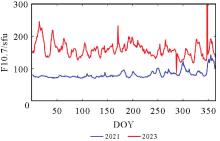
Fig. 1
Time series of solar activity index F10.7 in 2021 and 2023"

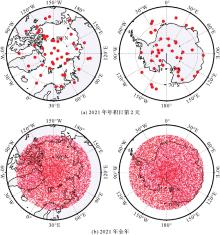
Fig. 2
The distribution of FY-3 D in the Arctic (left) and Antarctic (right) at sampling points"

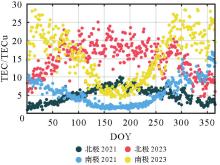
Fig. 3
Fengyun satellite TEC value in the Arctic and Antarctic region in 2021 and 2023 change with day of year"
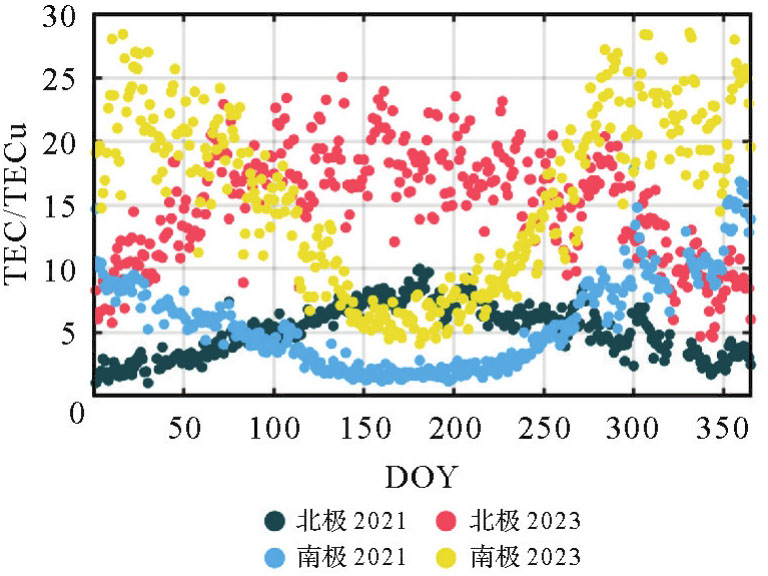
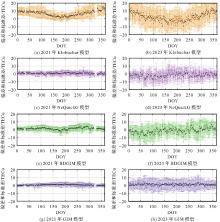
Fig. 4
The deviation and standard deviation between the calculated value of the model and Fengyun satellite TEC value in the Arctic region in 2021 and 2023 change with day of year"

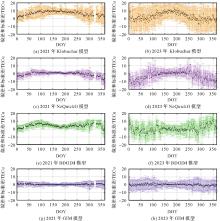
Fig. 5
The deviation and standard deviation between the calculated value of the model and Fengyun satellite TEC value in the Antarctic region in 2021 and 2023 change with day of year"

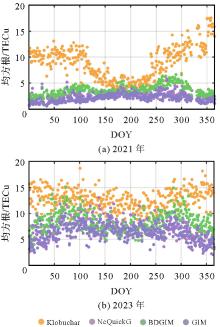
Fig. 6
RMS between the calculated value of the model and Fengyun satellite TEC value in the Arctic region in 2021 and 2023 change with day of year"

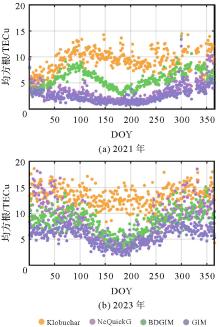
Fig. 7
RMS between the calculated value of the model and Fengyun satellite TEC value in the Antarctic region in 2021 and 2023 change with day of year"

Tab. 3
Comparison of model-based TEC with Fengyun satellite TEC in the Arctic and Antarctic in 2021 and 2023"
| 区域 | 模型 | 2021年 | 2023年 | ||||||
|---|---|---|---|---|---|---|---|---|---|
| 偏差/TECu | 标准差/TECu | RMS/TECu | 百分比/(%) | 偏差/TECu | 标准差/TECu | RMS/TECu | 百分比/(%) | ||
| 北极 | Klobuchar | 6.98 | 6.39 | 9.46 | 24.45 | 2.02 | 12.69 | 12.84 | 45.40 |
| NequickG | 0.66 | 2.58 | 2.66 | 60.71 | -1.68 | 7.17 | 7.36 | 64.62 | |
| BDGIM | 1.54 | 3.44 | 3.77 | 45.57 | -0.96 | 8.57 | 8.62 | 55.28 | |
| GIM | 0.61 | 2.20 | 2.28 | 65.79 | 1.01 | 6.53 | 6.61 | 65.49 | |
| 南极 | Klobuchar | 6.65 | 6.82 | 9.53 | 24.32 | 2.94 | 13.06 | 13.38 | 39.20 |
| NequickG | -0.49 | 3.83 | 3.86 | 53.44 | -2.63 | 8.70 | 9.09 | 56.47 | |
| BDGIM | 4.30 | 4.18 | 5.99 | 26.78 | 0.54 | 8.59 | 8.61 | 51.82 | |
| GIM | 0.24 | 2.79 | 2.80 | 62.93 | -0.08 | 5.90 | 5.90 | 67.05 | |
Tab. 4
The results of comparison between model-based TEC and Fengyun satellite TEC"
| 模型 | 偏差/TECu | 标准差/TECu | RMS/TECu | 百分比/(%) |
|---|---|---|---|---|
| Klobuchar | 4.65 | 9.74 | 11.30 | 33.34 |
| NequickG | -1.04 | 5.57 | 5.74 | 58.81 |
| BDGIM | 1.35 | 6.19 | 6.75 | 44.87 |
| GIM | 0.44 | 4.36 | 4.40 | 65.32 |
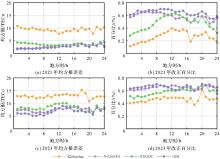
Fig. 8
The RMS values and percentages of model corrections in the Arctic in 2021 and 2023 vary with local time"
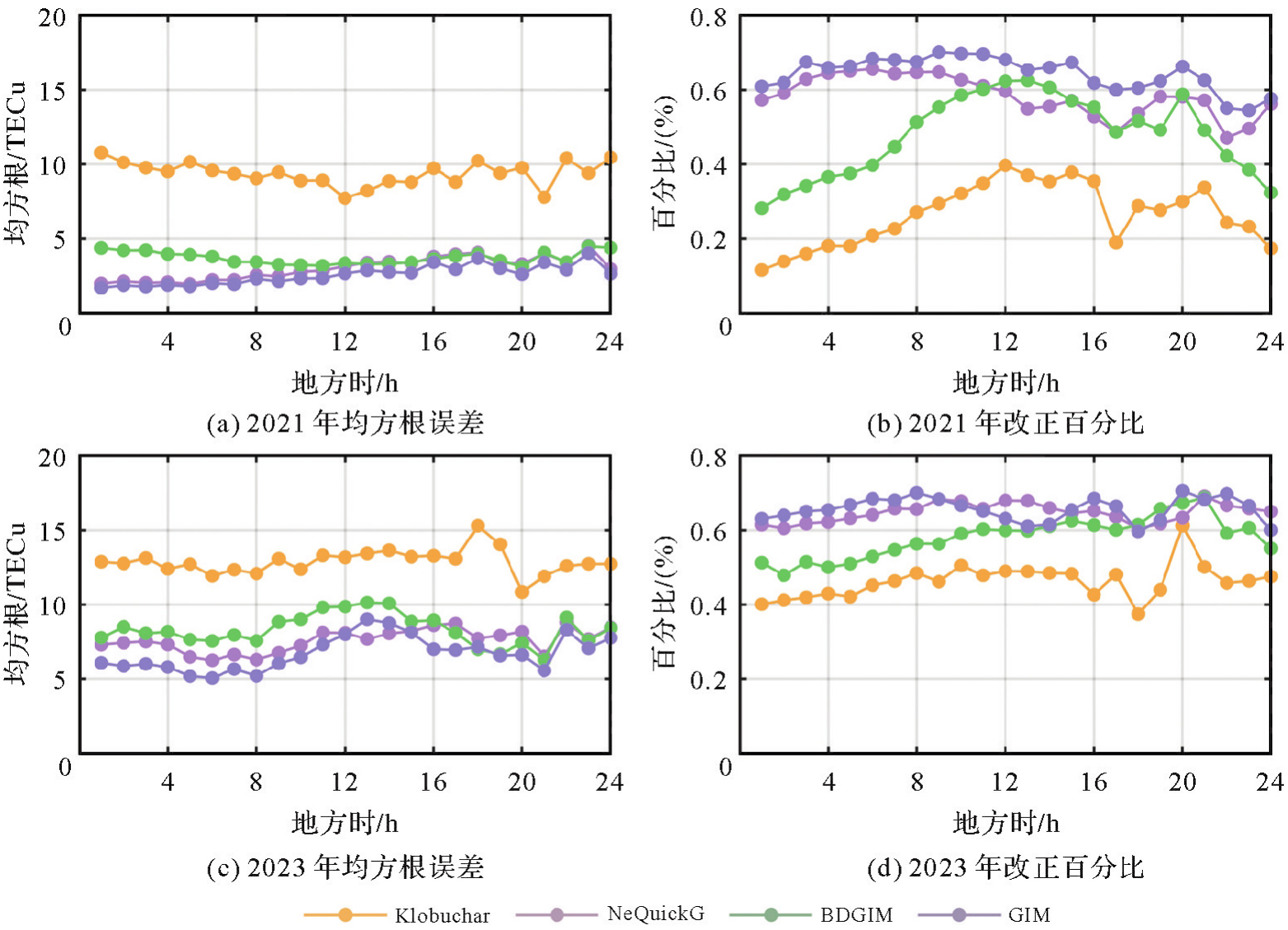
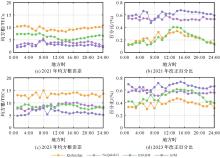
Fig. 9
The RMS values and percentages of model corrections in the Antarctic in 2021 and 2023 vary with local time"

Fig. 10
The RMS values and percentages of model corrections in the Arctic in 2021 and 2023 vary with latitude"


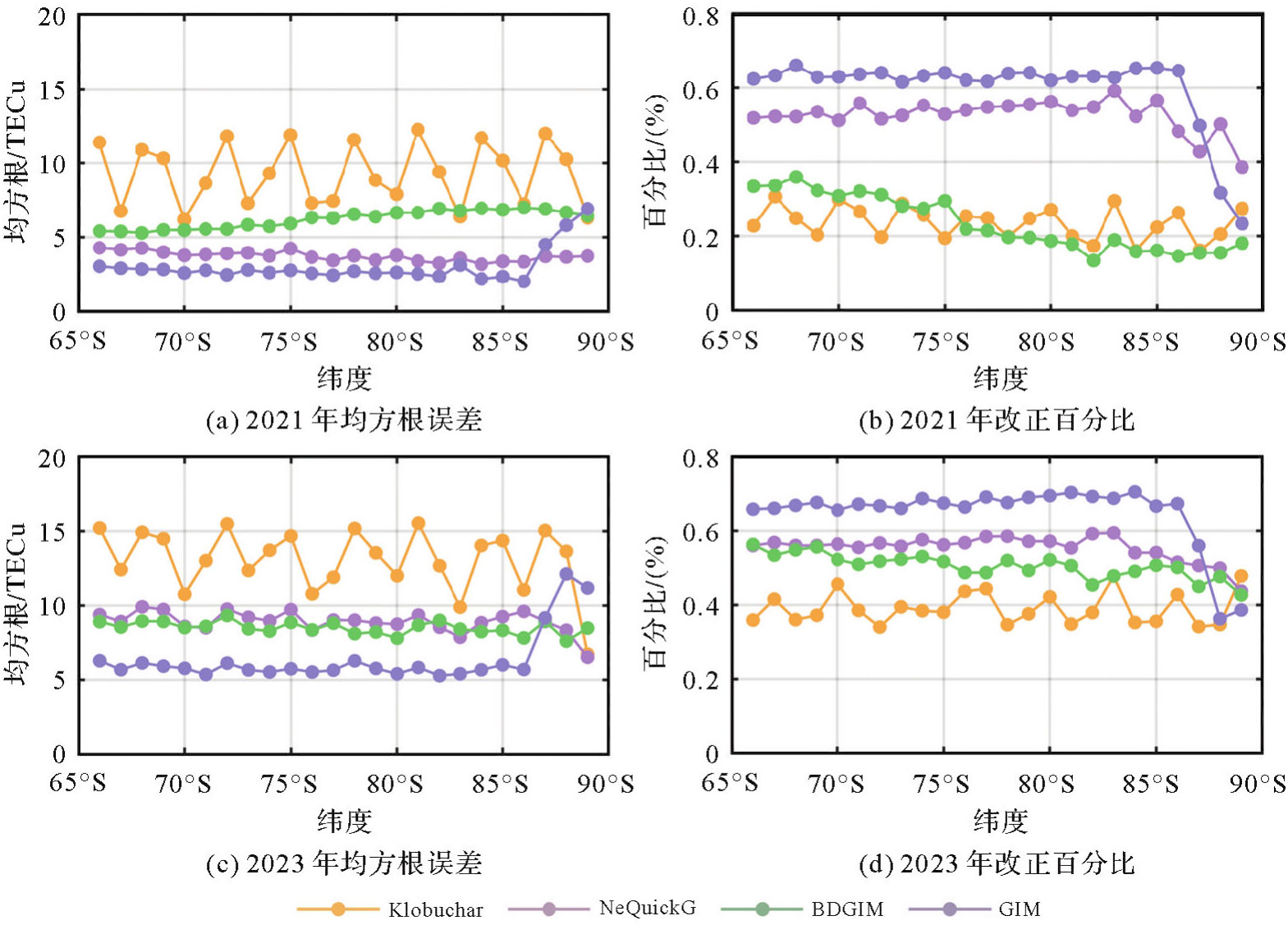
Fig. 11
The RMS values and percentages of model corrections in the Antarctic in 2021 and 2023 vary with latitude"
| [1] | LI Zishen, WANG Ningbo, LIU Ang, et al. Progress of geodesy related ionosphere from Chinese scientists in the period of 2019—2023[J]. Journal of Geodesy and Geoinformation Science, 2023, 6(3): 115-123. |
| [2] |
袁运斌, 霍星亮, 张宝成. 近年来我国GNSS电离层延迟精确建模及修正研究进展[J]. 测绘学报, 2017, 46(10): 1364-1378. DOI: .
doi: 10.11947/j.AGCS.2017.20170349 |
|
YUAN Yunbin, HUO Xingliang, ZHANG Baocheng. Research progress of precise models and correction for GNSS ionospheric delay in China over recent years[J]. Acta Geodaetica et Cartographica Sinica, 2017, 46(10): 1364-1378. DOI: .
doi: 10.11947/j.AGCS.2017.20170349 |
|
| [3] | KLOBUCHAR J A. Ionospheric effects on GPS[J]. GPS World, 1991, 2(4): 48-51. |
| [4] | KLOBUCHAR J A. Ionospheric time-delay algorithm for single-frequency GPS users[J]. IEEE Transactions on Aerospace Electronic Systems, 1987, 23: 325-331. |
| [5] |
王斐, 吴晓莉, 周田, 等. 不同Klobuchar模型参数的性能比较[J]. 测绘学报, 2014, 43(11): 1151-1157. DOI: .
doi: 10.13485/j.cnki.11-2089.2014.0176 |
|
WANG Fei, WU Xiaoli, ZHOU Tian, et al. Performance comparison between different Klobuchar model parameters[J]. Acta Geodaetica et Cartographica Sinica, 2014, 43(11): 1151-1157. DOI: .
doi: 10.13485/j.cnki.11-2089.2014.0176 |
|
| [6] |
王宁波, 袁运斌, 李子申, 等. 不同NeQuick电离层模型参数的应用精度分析[J]. 测绘学报, 2017, 46(4): 421-429. DOI: .
doi: 10.11947/j.AGCS.2017.20160400 |
|
WANG Ningbo, YUAN Yunbin, LI Zishen, et al. Performance analysis of different NeQuick ionospheric model parameters[J]. Acta Geodaetica et Cartographica Sinica, 2017, 46(4): 421-429. DOI: .
doi: 10.11947/j.AGCS.2017.20160400 |
|
| [7] | WU Xiaoli, ZHOU Jianhua, TANG Bo, et al. Evaluation of COMPASS ionospheric grid[J]. GPS Solutions, 2014, 18(4): 639-649. |
| [8] |
袁运斌, 李敏, 霍星亮, 等. 北斗三号全球导航卫星系统全球广播电离层延迟修正模型(BDGIM)应用性能评估[J]. 测绘学报, 2021, 50(4): 436-447. DOI: .
doi: 10.11947/j.AGCS.2021.20200421 |
|
YUAN Yunbin, LI Min, HUO Xingliang, et al. Research on performance of BeiDou global broadcast ionospheric delay correction model (BDGIM) of BDS-3[J]. Acta Geodaetica et Cartographica Sinica, 2021, 50(4): 436-447. DOI: .
doi: 10.11947/j.AGCS.2021.20200421 |
|
| [9] | 杨元喜, 徐君毅. 北斗在极区导航定位性能分析[J]. 武汉大学学报(信息科学版), 2016, 41(1): 15-20. |
| YANG Yuanxi, XU Junyi. Navigation performance of BeiDou in polar area[J]. Geomatics and Information Science of Wuhan University, 2016, 41(1): 15-20. | |
| [10] | LIU Jingbin, CHEN Ruizhi, AN Jiachun, et al. Spherical cap harmonic analysis of the Arctic ionospheric TEC for one solar cycle[J]. Journal of Geophysical Research: Space Physics, 2014, 119(1): 601-619. |
| [11] | 中国卫星导航系统管理办公室. 北斗卫星导航系统空间信号接口控制文件公开服务信号B1C(1.0版)[EB/OL]. [2005-04-08]. http://www.beidou.gov.cn/xt/gfxz/index_2.html. |
| China Satellite Navigation Office. BeiDou navigation satellite system signal in space interface control document open service signal BlC (version 1.0)[EB/OL]. [2025-04-08]. http://www.beidou.gov.cn/xt/gfxz/index_2.html. | |
| [12] | European Commission. European GNSS (Galileo) open service ionospheric correction algorithm for Galileo single frequency users[EB/OL]. [2025-04-08]. https://galileognss.eu/wp-content/uploads/docs/Ionospheric-Correction-Algorithm-for-Galileo-Single-Frequency-Users.pdf. |
| [13] |
郭树人, 蔡洪亮, 孟轶男, 等. 北斗三号导航定位技术体制与服务性能[J]. 测绘学报, 2019, 48(7): 810-821. DOI: .
doi: 10.11947/j.AGCS.2019.20190091 |
|
GUO Shuren, CAI Hongliang, MENG Yinan, et al. BDS-3 RNSS technical characteristics and service performance[J]. Acta Geodaetica et Cartographica Sinica, 2019, 48(7): 810-821. DOI:
doi: 10.11947/j.AGCS.2019.20190091 |
|
| [14] | 王泽民, 毕通, 孙伟, 等. GNSS广播电离层模型在极区的改正效果分析[J]. 极地研究, 2016, 28(2): 235-242. |
| WANG Zemin, BI Tong, SUN Wei, et al. Analysis of global navigation satellite system broadcast ionospheric model correction in polar regions[J]. Chinese Journal of Polar Research, 2016, 28(2): 235-242. | |
| [15] | 鲍任杰, 唐成盼, 胡小工, 等. 北斗广播电离层模型精度评估研究[J/OL]. 北京航空航天大学学报, 2023: 1-14. [2023-12-07]. https://link.cnki.net/doi/10.13700/j.bh.1001-5965.2023.0588. |
| BAO Renjie, TANG Chengpan, HU Xiaogong, et al. Study on the accuracy evaluation of BeiDou broadcast ionospheric model[J/OL]. Journal of Beijing University of Aeronautics and Astronautics, 2023: 1-14. [2023-12-07]. https://link.cnki.net/doi/10.13700/j.bh.1001-5965.2023.0588. | |
| [16] | TIAN Yu, LI Shuhui, SHEN Hang, et al. Comparative analysis of BDGIM, NeQuick-G, and Klobuchar ionospheric broadcast models[J]. Astrophysics and Space Science, 2022, 367(8): 78. |
| [17] | ZHANG Qiang, LIU Xuanzuo, LIU Zhuoya, et al. Performance evaluation of BDS-3 ionospheric delay correction models (BDSK and BDGIM): first year for full operational capability of global service[J]. Advances in Space Research, 2022, 70(3): 687-698. |
| [18] | JIANG Hu, LIU Jingbin, WANG Zemin, et al. Assessment of spatial and temporal TEC variations derived from ionospheric models over the polar regions[J]. Journal of Geodesy, 2019, 93(4): 455-471. |
| [19] | WANG Ningbo, LI Zishen, YUAN Yunbin, et al. BeiDou global ionospheric delay correction model (BDGIM): performance analysis during different levels of solar conditions[J]. GPS Solutions, 2021, 25(3): 97. |
| [20] | BHOWMIK P, NANDY D. Prediction of the strength and timing of sunspot cycle 25 reveal decadal-scale space environmental conditions[J]. Nature Communications, 2018, 9(1): 5209. |
| [21] | TSAGOURI I, BELEHAKI A, THEMENS D R, et al. Ionosphere variability I: advances in observational, monitoring and detection capabilities[J]. Advances in Space Research, 2023. |
| [22] | 霍星亮. 基于GNSS的电离层形态监测与延迟模型研究[D]. 武汉: 中国科学院测量与地球物理研究所, 2008. |
| HUO Xingliang. Research on GNSS-based ionospheric morphology monitoring and delay model[D]. Wuhan: Institute of Geodesy and Geophysics, Chinese Academy of Sciences, 2008. | |
| [23] | BI Tong, AN Jiachun, YANG Jian, et al. A modified Klobuchar model for single-frequency GNSS users over the polar region[J]. Advances in Space Research, 2017, 59(3): 833-842. |
| [24] | DI GIOVANNI G, RADICELLA S M. An analytical model of the electron density profile in the ionosphere[J]. Advances in Space Research, 1990, 10(11): 27-30. |
| [25] | 周仁宇, 胡志刚, 苏牡丹, 等. 北斗全球系统广播电离层模型性能初步评估[J]. 武汉大学学报(信息科学版), 2019, 44(10): 1457-1464. |
| ZHOU Renyu, HU Zhigang, SU Mudan, et al. Preliminary performance evaluation of BeiDou global ionospheric delay correction model[J]. Geomatics and Information Science of Wuhan University, 2019, 44(10): 1457-1464. | |
| [26] | YUAN Yunbin, WANG Ningbo, LI Zishen, et al. The BeiDou global broadcast ionospheric delay correction model (BDGIM) and its preliminary performance evaluation results[J]. Navigation, 2019, 66(1): 55-69. |
| [27] | HERNÁNDEZ-PAJARES M, JUAN J M, SANZ J, et al. The IGS VTEC maps: a reliable source of ionospheric information since 1998[J]. Journal of Geodesy, 2009, 83(3): 263-275. |
| [28] | LIU Ang, WANG Ningbo, LI Zishen, et al. Validation of CAS's final global ionospheric maps during different geomagnetic activities from 2015 to 2017[J]. Results in Physics, 2018, 10: 481-486. |
| [29] | HO S P, ANTHES R A, AO C O, et al. The COSMIC/FORMOSAT-3 radio occultation mission after 12 years: accomplishments, remaining challenges, and potential impacts of COSMIC-2[J]. Bulletin of the American Meteorological Society, 2020, 101(7): E1107-E1136. |
| [30] | YUE Xinan, SCHREINER W S, HUNT D C, et al. Quantitative evaluation of the low Earth orbit satellite based slant total electron content determination[J]. Space Weather, 2011, 9(9): 2405-2410. |
| [31] | XU Jiujing, WANG Qing, KE Fuyang, et al. Analysis of ionospheric parameters retrieved from Feng-Yun 3C and COSMIC radio occultation[J]. Advances in Space Research, 2021, 68(1): 214-224. |
| [1] | Jinwei BU, Shuhui LIU, Shunshuang XU, Tongsu XIANG, Qiulan WANG, Chaoying JI, Xiaoqing ZUO. Construction of an empirical model for estimating the global wave period of spaceborne GNSS-R [J]. Acta Geodaetica et Cartographica Sinica, 2026, 55(4): 684-697. |
| [2] | Tangting WU, Xinyu LUO, Liguo LU, Zhanke LIU, Nengfang CHAO. Assessment of water resource changes and drought characteristics in the Shaanxi, Gansu and Ningxia region based on GNSS and GRACE/GRACE-FO [J]. Acta Geodaetica et Cartographica Sinica, 2026, 55(3): 439-450. |
| [3] | Zhongmin MA, Shuangcheng ZHANG, Xin ZHOU, Qi LIU, Ning LIU, Hengli WANG. A flood monitoring method using FY-3 GNSS-R accounting for surface reflectivity uncertainty: a case study of the August 2 Guangdong rainstorm disaster [J]. Acta Geodaetica et Cartographica Sinica, 2026, 55(3): 451-464. |
| [4] | Qingyun YAN, Zixuan GUO, Yuanjin PAN, Yan JIA, Shuanggen JIN. Quantitative driving factors and zoning patterns of GNSS-R land surface reflectivity spatial heterogeneity [J]. Acta Geodaetica et Cartographica Sinica, 2026, 55(2): 315-327. |
| [5] | Qingzhi ZHAO, Duoduo JIANG, Yibin YAO, Zhi MA, Yongjie MA, Haojie LI, Ruirui XUE. An adaptive method for selecting the optimal GNSS satellite signal for water vapor tomography [J]. Acta Geodaetica et Cartographica Sinica, 2026, 55(1): 25-35. |
| [6] | Deying YU, Houpu LI, Yi LIU, Shuguang WU, Deyan LI, Mingchao LI, Wenkui LI, Shaofeng BIAN. A DBSCAN-based RAIM algorithm for multiple gross error identification [J]. Acta Geodaetica et Cartographica Sinica, 2026, 55(1): 59-72. |
| [7] | Dongliang CHENG, Lingqiu CHEN, Zhiyong HUANG, Shubo QIAO, Dandan WANG, Yaming YAN. Performance evaluation of COATS-based multi-mode and multi-frequency iGNSS-R altimetry [J]. Acta Geodaetica et Cartographica Sinica, 2026, 55(1): 73-89. |
| [8] | Yarong LUO, Wentao LU, Chi GUO, Jingnan LIU. Left-handed symmetry equivariant filtering model and algorithm for GNSS/INS integrated navigation [J]. Acta Geodaetica et Cartographica Sinica, 2025, 54(8): 1389-1403. |
| [9] | Yangyi CHEN, Kai ZHENG, Xiaohong ZHANG, Mingkui WU, Pengxu WANG, Wenju FU, Kezhong LIU. GPS/Galileo/BDS overlapping frequencies multipath error analysis and modeling [J]. Acta Geodaetica et Cartographica Sinica, 2025, 54(8): 1427-1438. |
| [10] | Jianzhang LI, Haowen YAN, Weifang YANG, Xiaoning SU. GNSS pseudo trigonometric leveling method [J]. Acta Geodaetica et Cartographica Sinica, 2025, 54(7): 1170-1177. |
| [11] | Qingzhi ZHAO, Lulu CHANG, Yibin YAO, Haojie LI. A method for constructing a hydrological drought index integrated with GNSS and meteorological data [J]. Acta Geodaetica et Cartographica Sinica, 2025, 54(7): 1192-1205. |
| [12] | Qianxin WANG, Chao HU, Tong CHENG. A method for satellite ultra-rapid orbit and clock offset estimation based on the prior information of the GNSS clock parameters [J]. Acta Geodaetica et Cartographica Sinica, 2025, 54(6): 982-994. |
| [13] | Shunqiang HU, Kejie CHEN, Xiaoxing HE, Hai ZHU, Tan WANG. The impact of environmental loading on nonlinear variations of 3D coordinate time series of GNSS stations in Sichuan and Yunnan region [J]. Acta Geodaetica et Cartographica Sinica, 2025, 54(5): 805-818. |
| [14] | Wentao YANG, Fei GUO, Xiaohong ZHANG, Zhiyu ZHANG, Yifan ZHU, Zheng LI, Ziheng WU. Soil moisture and freeze-thaw map using GNSS reflectometer and SMAP radiometer for Qinghai-Xizang Plateau [J]. Acta Geodaetica et Cartographica Sinica, 2025, 54(4): 725-735. |
| [15] | Qingzhi ZHAO, Duoduo JIANG, Hongwu GUO, Zufeng LI, Chen LIU, Yibin YAO. A general method for determining the key parameters of GNSS water vapor tomography modeling [J]. Acta Geodaetica et Cartographica Sinica, 2025, 54(3): 410-421. |
| Viewed | ||||||
|
Full text |
|
|||||
|
Abstract |
|
|||||
