

Acta Geodaetica et Cartographica Sinica ›› 2025, Vol. 54 ›› Issue (1): 75-89.doi: 10.11947/j.AGCS.2025.20240124
• Photogrammetry and Remote Sensing • Previous Articles Next Articles
Yanjun WANG1,2( ), Xuchao TANG1,2, Cheng WANG3, Hengfan CAI1,2
Received:2024-04-01
Revised:2024-12-11
Online:2025-02-17
Published:2025-02-17
About author:WANG Yanjun (1984—), male, PhD, professor, majors in multi-source remote sensing data intelligent processing. E-mail: wongyanjun@163.com
Supported by:CLC Number:
Yanjun WANG, Xuchao TANG, Cheng WANG, Hengfan CAI. Urban and rural road surface extraction network based on road topological correlation features[J]. Acta Geodaetica et Cartographica Sinica, 2025, 54(1): 75-89.
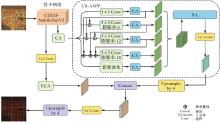
Fig. 1
Network framework structure of CAS-DeepNet"
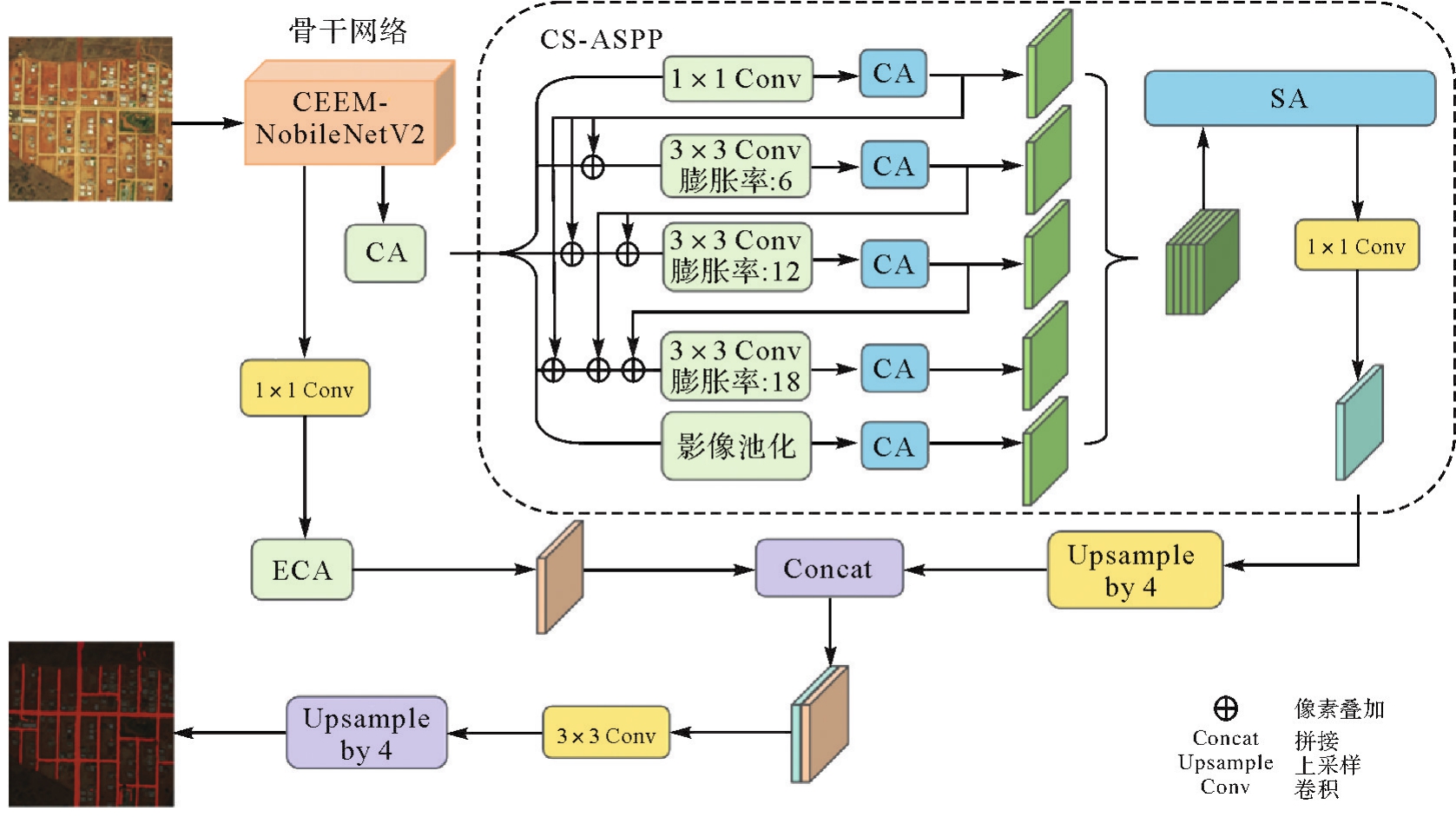
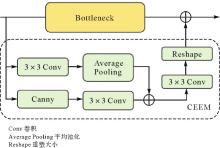
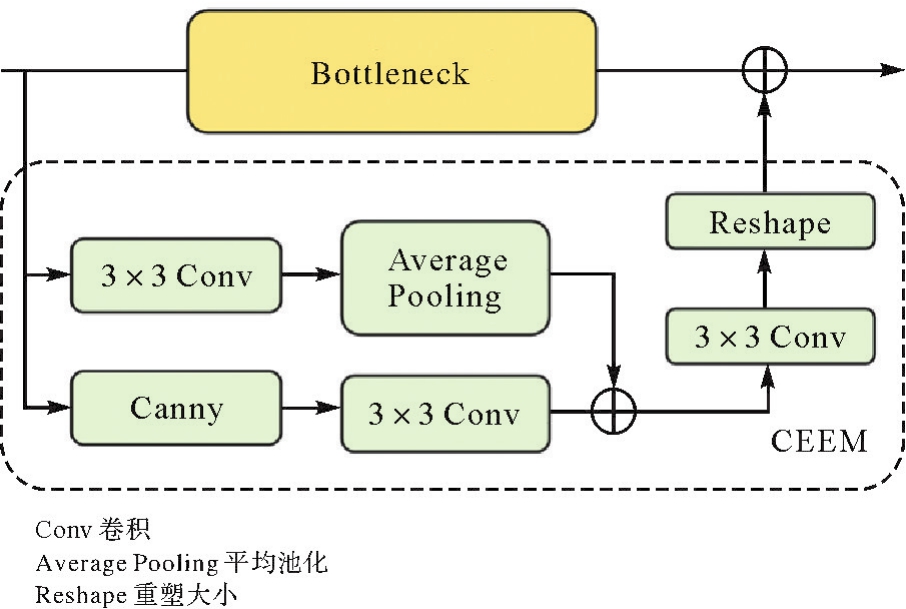
Fig. 2
Structure of CEEM"
Tab. 1
The backbone network structure of MobileNetV2"
| Input | Operator | t | c | n | s |
|---|---|---|---|---|---|
| 512×512×3 | Conv2d | — | 32 | 1 | 2 |
| 256×256×32 | Bottleneck | 1 | 16 | 1 | 1 |
| 256×256×16 | Bottleneck | 6 | 24 | 2 | 2 |
| 128×128×24 | Bottleneck | 6 | 32 | 3 | 2 |
| 64×64×32 | Bottleneck | 6 | 64 | 4 | 2 |
| 32×32×64 | Bottleneck | 6 | 96 | 3 | 1 |
| 32×32×96 | Bottleneck | 6 | 160 | 3 | 1 |
| 32×32×160 | Bottleneck | 6 | 320 | 1 | 1 |
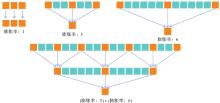
Fig. 3
Receptive field in one-dimensional state"
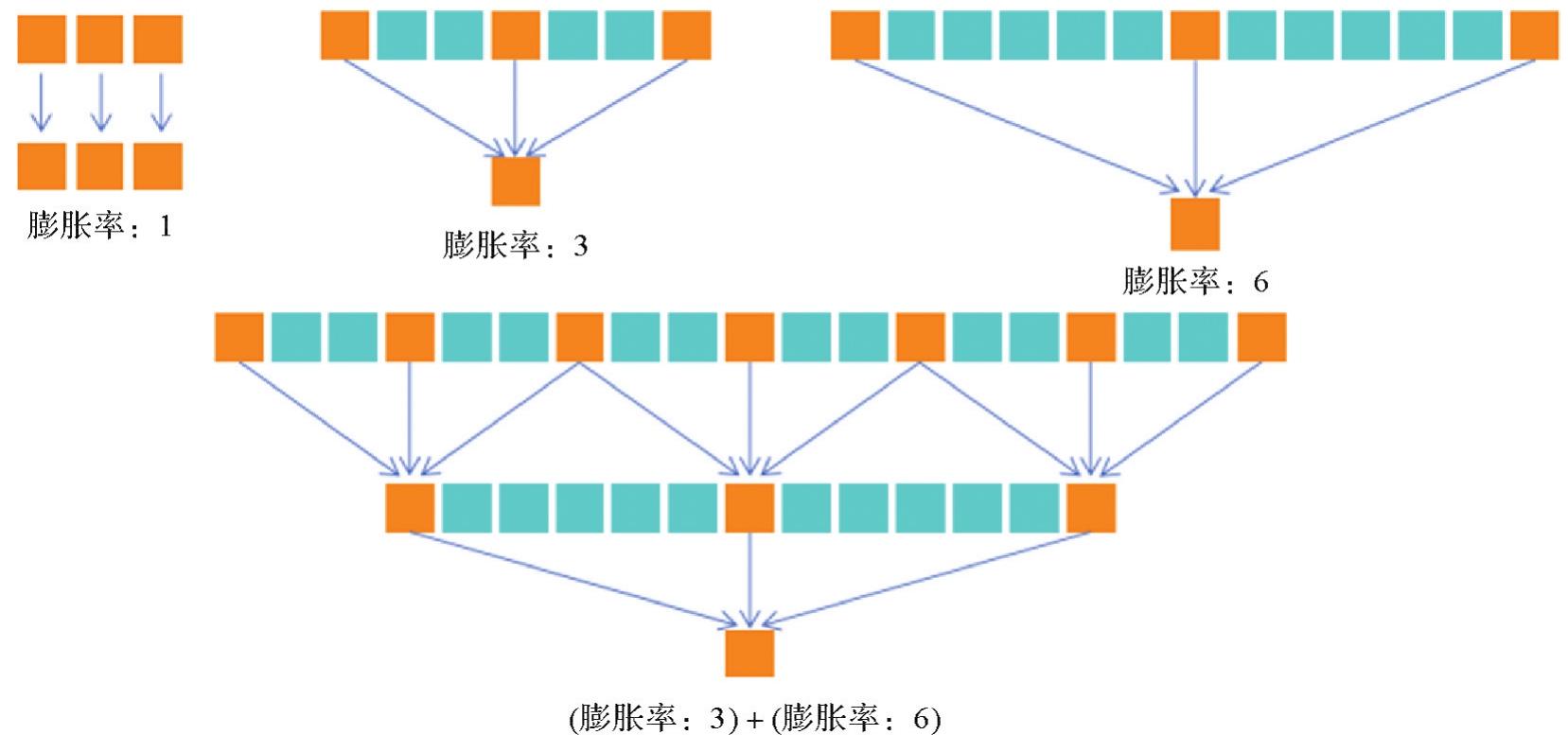
Fig. 4
The utilization times of pixels in 2D state with different expansion rate"

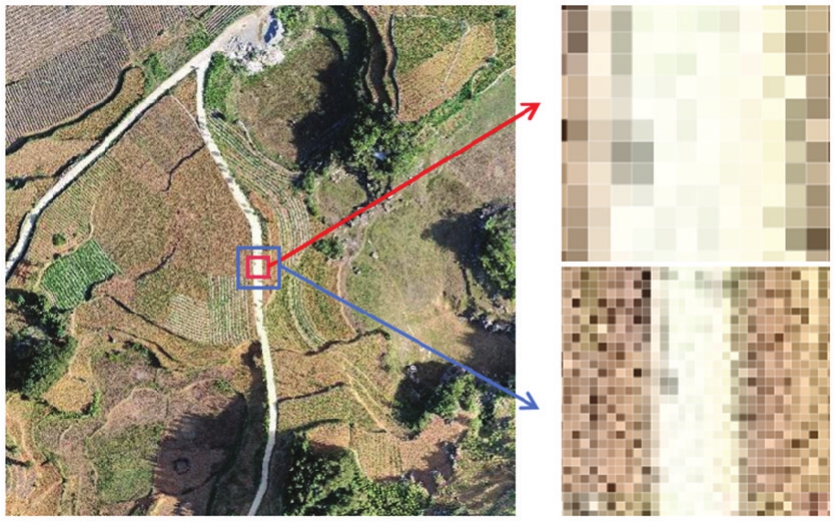
Fig. 5
Different receptive field regions of road image (top right) and their feature (bottom right)"
Tab. 2
Comparison of results of different models in CHN6-CUG dataset and DeepGlobe dataset"
| 数据集 | 模型 | Pre | Rec | F1 | OA | IoU |
|---|---|---|---|---|---|---|
| U-Net++ | 0.706 7 | 0.746 2 | 0.725 9 | 0.952 7 | 0.569 8 | |
| D-LinkNet | 0.747 5 | 0.837 2 | 0.789 8 | 0.969 1 | 0.652 6 | |
| RoadNet | 0.760 5 | 0.795 1 | 0.777 4 | 0.967 8 | 0.635 9 | |
| CHN6-CUG | DeepLabV3+ | 0.738 8 | 0.810 0 | 0.772 8 | 0.960 5 | 0.629 7 |
| ACNet | 0.786 7 | 0.843 4 | 0.814 1 | 0.963 6 | 0.684 1 | |
| SDUNet | 0.812 6 | 0.757 2 | 0.783 9 | 0.970 4 | 0.692 7 | |
| CAS-DeepNet | 0.781 2 | 0.860 5 | 0.818 9 | 0.974 4 | 0.693 4 | |
| U-Net++ | 0.657 5 | 0.723 6 | 0.688 9 | 0.972 3 | 0.525 5 | |
| D-LinkNet | 0.669 1 | 0.759 3 | 0.711 3 | 0.971 8 | 0.552 0 | |
| RoadNet | 0.661 3 | 0.745 6 | 0.700 9 | 0.972 0 | 0.539 5 | |
| DeepGlobe | DeepLabV3+ | 0.726 9 | 0.738 3 | 0.732 5 | 0.967 0 | 0.578 0 |
| ACNet | 0.743 3 | 0.772 7 | 0.757 7 | 0.970 3 | 0.589 7 | |
| SDUNet | 0.774 4 | 0.752 8 | 0.763 4 | 0.969 8 | 0.605 8 | |
| CAS-DeepNet | 0.743 5 | 0.789 2 | 0.765 6 | 0.976 4 | 0.578 0 |
Tab. 3
Comparison of computational efficiency of different models"
| 模型 | Params | MACs | Time/s |
|---|---|---|---|
| U-Net++ | 37.65×10⁶ | 186.43×10⁹ | 1.23 |
| D-LinkNet | 72.63×10⁶ | 133.23×10⁹ | 1.48 |
| RoadNet | 65.35×10⁶ | 167.46×10⁹ | 1.57 |
| DeepLabV3+ | 71.42×10⁶ | 233.45×10⁹ | 1.82 |
| ACNet | 47.39×10⁶ | 192.36×10⁹ | 1.69 |
| SDUNet | 76.63×10⁶ | 265.67×10⁹ | 1.73 |
| CAS-DeepNet | 68.34×10⁶ | 243.82×10⁹ | 1.71 |
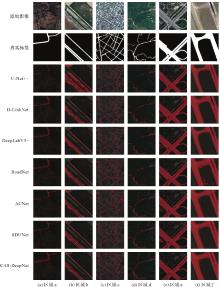
Fig. 6
Experimental results of different methods on CHN6-CUG dataset"

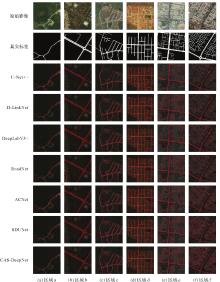
Fig. 7
Experimental results of different methods on DeepGlobe dataset"

Tab. 4
Ablation experiments on the CHN6-CUG dataset"
| 试验 | CEEM | CA | ECA | CS-ASPP | Mob-DeepLabV3+ | DeepLabV3+ | Pre | Rec | F1 | OA | IoU |
|---|---|---|---|---|---|---|---|---|---|---|---|
| 1 | √ | √ | 0.748 2 | 0.773 1 | 0.760 4 | 0.964 5 | 0.613 3 | ||||
| 2 | √ | √ | √ | 0.754 9 | 0.794 6 | 0.794 5 | 0.955 4 | 0.619 7 | |||
| 3 | √ | √ | 0.761 1 | 0.769 3 | 0.765 2 | 0.957 1 | 0.619 8 | ||||
| 4 | √ | √ | √ | √ | √ | 0.781 2 | 0.860 5 | 0.818 9 | 0.974 4 | 0.693 4 | |
| 5 | √ | 0.711 0 | 0.769 4 | 0.739 0 | 0.961 1 | 0.586 1 | |||||
| 6 | √ | 0.738 8 | 0.810 0 | 0.772 8 | 0.960 5 | 0.629 7 |
Tab. 5
Results of ablation experiments of CEEM constructed with different operators on the CHN6-CUG dataset"
| 模型 | Pre | Rec | F1 | OA | IoU |
|---|---|---|---|---|---|
| Prewitt+Mob-DeepLabV3+ | 0.739 8 | 0.732 3 | 0.736 0 | 0.957 6 | 0.582 4 |
| Laplacian+Mob-DeepLabV3+ | 0.744 2 | 0.740 8 | 0.742 5 | 0.961 0 | 0.590 5 |
| Robert+Mob-DeepLabV3+ | 0.745 8 | 0.760 9 | 0.753 2 | 0.958 0 | 0.604 2 |
| Sobel+Mob-DeepLabV3+ | 0.747 1 | 0.768 7 | 0.757 7 | 0.957 5 | 0.610 0 |
| Canny+Mob-DeepLabV3+ | 0.748 2 | 0.773 1 | 0.760 4 | 0.964 5 | 0.613 3 |
Tab. 6
Urban and suburban road test results on Massachusetts road dataset"
| 类别 | Pre | Rec | F1 | OA | IoU |
|---|---|---|---|---|---|
| 城市 | 0.813 4 | 0.793 4 | 0.808 1 | 0.978 4 | 0.738 7 |
| 郊区 | 0.803 5 | 0.807 2 | 0.805 3 | 0.969 8 | 0.724 6 |
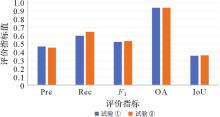
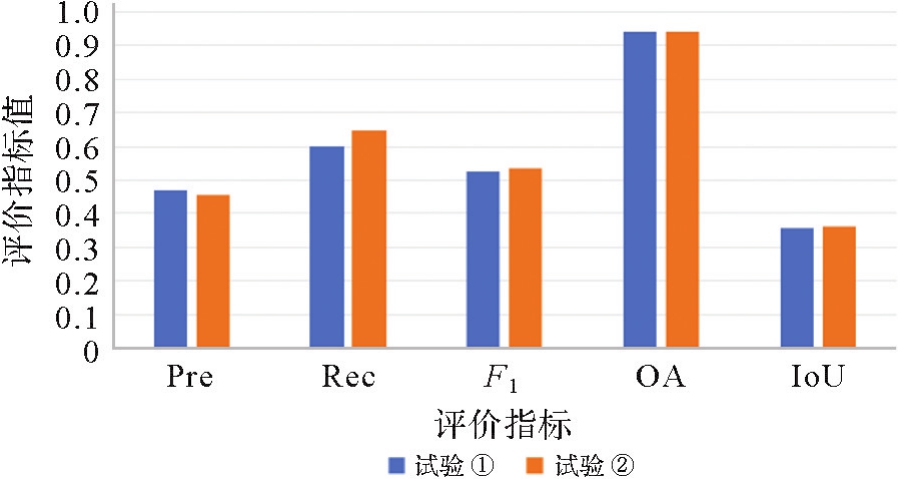
Fig. 8
Experimental results of the portability of CAS-DeepNet model in this study"
| [1] | WANG Weixing, YANG Nan, ZHANG Yi, et al. A review of road extraction from remote sensing images[J]. Journal of Traffic and Transportation Engineering (English Edition), 2016, 3(3): 271-282. |
| [2] | CHEN Ziyi, DENG Liai, LUO Yuhua, et al. Road extraction in remote sensing data: a survey[J]. International Journal of Applied Earth Observation and Geoinformation, 2022, 112: 102833. |
| [3] | 罗巍, 王东亮. 利用角度纹理特征提取高分辨率遥感影像中城市主干道路[J]. 中国图象图形学报, 2017, 22(11): 1584-1591. |
| LUO Wei, WANG Dongliang. Method using the angle texture feature to extract urban trunk road information from high-resolution remote sensing images[J]. Journal of Image and Graphics, 2017, 22(11): 1584-1591. | |
| [4] | 戴激光, 杜阳, 方鑫鑫, 等. 多特征约束的高分辨率光学遥感影像道路提取[J]. 遥感学报, 2018, 22(5): 777-791. |
| DAI Jiguang, DU Yang, FANG Xinxin, et al. Road extraction method for high resolution optical remote sensing images with multiple feature constraints[J]. Journal of Remote Sensing, 2018, 22(5): 777-791. | |
| [5] | 林鹏, 阮仁宗, 王玉强, 等. 一种基于面向对象的城镇道路自动提取方法研究[J]. 地理与地理信息科学, 2016, 32(1): 49-54. |
| LIN Peng, RUAN Renzong, WANG Yuqiang, et al. Research on extraction of road based on object oriented in an urban context[J]. Geography and Geo-Information Science, 2016, 32(1): 49-54. | |
| [6] |
连仁包, 张振敏, 廖一鹏, 等. 结合测地距离场与曲线平滑的遥感图像道路中心线快速提取[J]. 测绘学报, 2023, 52(8): 1317-1329. DOI:.
doi: 10.11947/j.AGCS.2023.20220002 |
|
LIAN Renbao, ZHANG Zhenmin, LIAO Yipeng, et al. A quick road centreline extraction method from remote sensing images combining with geodesic distance field and curve smoothing[J]. Acta Geodaetica et Cartographica Sinica, 2023, 52(8): 1317-1329. DOI:.
doi: 10.11947/j.AGCS.2023.20220002 |
|
| [7] |
曹云刚, 王志盼, 慎利, 等. 像元与对象特征融合的高分辨率遥感影像道路中心线提取[J]. 测绘学报, 2016, 45(10): 1231-1240. DOI:.
doi: 10.11947/j.AGCS.2016.20160158 |
|
CAO Yungang, WANG Zhipan, SHEN Li, et al. Fusion of pixel-based and object-based features for road centerline extraction from high-resolution satellite imagery[J]. Acta Geodaetica et Cartographica Sinica, 2016, 45(10): 1231-1240. DOI:.
doi: 10.11947/j.AGCS.2016.20160158 |
|
| [8] | ZANG Yu, WANG Cheng, YU Yao, et al. Joint enhancing filtering for road network extraction[J]. IEEE Transactions on Geoscience and Remote Sensing, 2017, 55(3): 1511-1525. |
| [9] | HE Hao, WANG Shuyang, WANG Shicheng, et al. A road extraction method for remote sensing image based on encoder-decoder network[J]. Journal of Geodesy and Geoinformation Science, 2020, 3(2): 16-25. |
| [10] | ABDOLLAHI A, PRADHAN B, ALAMRI A. SC-RoadDeepNet: a new shape and connectivity-preserving road extraction deep learning-based network from remote sensing data[J]. IEEE Transactions on Geoscience and Remote Sensing, 2022, 60: 3143855. |
| [11] | ALSHEHHI R, MARPU P R, WOON W L, et al. Simultaneous extraction of roads and buildings in remote sensing imagery with convolutional neural networks[J]. ISPRS Journal of Photogrammetry and Remote Sensing, 2017, 130: 139-149. |
| [12] | WANG Qi, GAO Junyu, YUAN Yuan. Embedding structured contour and location prior in siamesed fully convolutional networks for road detection[J]. IEEE Transactions on Intelligent Transportation Systems, 2018, 19(1): 230-241. |
| [13] |
林云浩, 王艳军, 李少春, 等. 一种耦合DeepLab与Transformer的农作物种植类型遥感精细分类方法[J]. 测绘学报, 2024, 53(2): 353-366.DOI:.
doi: 10.11947/j.AGCS.2024.20220692 |
|
LIN Yunhao, WANG Yanjun, LI Shaochun, et al. A coupled DeepLab and Transformer approach for fine classification of crop cultivation types in remote sensing[J]. Acta Geodaetica et Cartographica Sinica, 2024, 53(2): 353-366.DOI:.
doi: 10.11947/j.AGCS.2024.20220692 |
|
| [14] | SHELHAMER E, LONG J, DARRELL T. Fully convolutional networks for semantic segmentation[J]. IEEE Transactions on Pattern Analysis and Machine Intelligence, 2017, 39(4): 640-651. |
| [15] | RONNEBERGER O, FISCHER P, BROX T. U-Net: convolutional networks for biomedical image segmentation[EB/OL]. [2024-02-02]. https://arxiv.org/pdf/1505.04597. |
| [16] | BADRINARAYANAN V, KENDALL A, CIPOLLA R. SegNet: a deep convolutional encoder-decoder architecture for image segmentation[J]. IEEE Transactions on Pattern Analysis and Machine Intelligence, 2017, 39(12): 2481-2495. |
| [17] | HE Kaiming, ZHANG Xiangyu, REN Shaoqing, et al. Deep residual learning for image recognition[C]//Proceedings of 2016 IEEE Conference on Computer Vision and Pattern Recognition. Las Vegas: IEEE, 2016: 770-778. |
| [18] | ZHANG Zhengxin, LIU Qingjie, WANG Yunhong. Road extraction by deep residual U-Net[J]. IEEE Geoscience and Remote Sensing Letters, 2018, 15(5): 749-753. |
| [19] | ZHONG Z L, LI J, CUI W H, et al. Fully convolutional networks for building and road extraction: preliminary results[C]//Proceedings of 2016 IEEE International Geoscience and Remote Sensing Symposium. Beijing: IEEE, 2016: 1591-1694. |
| [20] | LU Xiaoyan, ZHONG Yanfei, ZHENG Zhuo, et al. GAMSNet: globally aware road detection network with multi-scale residual learning[J]. ISPRS Journal of Photogrammetry and Remote Sensing, 2021, 175: 340-352. |
| [21] | MEI Jie, LI Roujing, GAO Wang, et al. CoANet: connectivity attention network for road extraction from satellite imagery[J]. IEEE Transactions on Image Processing, 2021, 30: 8540-8552. |
| [22] | CHENG Guangliang, WANG Ying, XU Shibiao, et al. Automatic road detection and centerline extraction via cascaded end-to-end convolutional neural network[J]. IEEE Transactions on Geoscience and Remote Sensing, 2017, 55(6): 3322-3337. |
| [23] | YANG Xiaofei, LI Xutao, YE Yunming, et al. Road detection and centerline extraction via deep recurrent convolutional neural network U-Net[J]. IEEE Transactions on Geoscience and Remote Sensing, 2019, 57(9): 7209-7220. |
| [24] | JING Ran, GONG Zhaoning, ZHU Wending, et al. Island road centerline extraction based on a multiscale united feature[J]. IEEE Journal of Selected Topics in Applied Earth Observations and Remote Sensing, 2018, 11: 3940-3953. |
| [25] | XU Zhenhua, SUN Yuxiang, LIU Ming. iCurb: imitation learning-based detection of road curbs using aerial images for autonomous driving[J]. IEEE Robotics and Automation Letters, 2021, 6(2): 1097-1104. |
| [26] | ZHOU Linying, ZHOU Zhou, NING Hang. Road detection based on edge feature with GAC model in aerial image[J]. International Journal of Pattern Recognition and Artificial Intelligence, 2021, 35(14): 81-93. |
| [27] | LIANG J, HOMAYOUNFAR N, MA W C, et al. Convolutional recurrent network for road boundary extraction[C]//Proceedings of 2019 IEEE/CVF Conference on Computer Vision and Pattern Recognition. Long Beach: IEEE, 2019. |
| [28] | SHAO Zhenfeng, ZHOU Zifan, HUANG Xiao, et al. MRENet: simultaneous extraction of road surface and road centerline in complex urban scenes from very high-resolution images[J]. Remote Sensing, 2021, 13(2): 239. |
| [29] | WEI Yao, ZHANG Kai, JI Shunping. Simultaneous road surface and centerline extraction from large-scale remote sensing images using CNN-based segmentation and tracing[J]. IEEE Transactions on Geoscience and Remote Sensing, 2020, 58(12): 8919-8931. |
| [30] | LIU Ruyi, MIAO Qiguang, SONG Jianfeng, et al. Multiscale road centerlines extraction from high-resolution aerial imagery[J]. Neurocomputing, 2019, 329: 384-396. |
| [31] | CHEN L C, ZHU Y K, PAPANDREOU G, et al. Encoder-decoder with atrous separable convolution for semantic image segmentation[C]//Proceedings of 2018 Computer Vision European Conference. Cham: Springer, 2018: 833-851. |
| [32] | CHOLLET F. Xception: deep learning with depthwise separable convolutions[C]//Proceedings of 2017 IEEE Conference on Computer Vision and Pattern Recognition. Honolulu: IEEE, 2017: 1800-1807. |
| [33] | CANNY J. Acomputational approach to edge detection[J]. IEEE Transactions on Pattern Analysis and Machine Intelligence, 1986, PAMI-8(6): 679-698. |
| [34] | SANDLER M, HOWARD A, ZHU Menglong, et al. MobileNetV2: inverted residuals and linear bottlenecks[C]//Proceedings of 2018 IEEE/CVF Conference on Computer Vision and Pattern Recognition. Salt Lake City: IEEE, 2018: 4510-4520. |
| [35] | CHEN L C, PAPANDREOU G, KOKKINOS I, et al. DeepLab: semantic image segmentation with deep convolutional nets, atrous convolution, and fully connected CRFs[J]. IEEE Transactions on Pattern Analysis and Machine Intelligence, 2018, 40(4): 834-848. |
| [36] | HUANG Gao, LIU Zhuang, VAN DER MAATEN L, et al. Densely connected convolutional networks[C]//Proceedings of 2017 IEEE Conference on Computer Vision and Pattern Recognition. Honolulu: IEEE, 2017: 2261-2269. |
| [37] | HOU Qibin, ZHOU Daquan, FENG Jiashi. Coordinate attention for efficient mobile network design[C]//Proceedings of 2021 IEEE/CVF Conference on Computer Vision and Pattern Recognition. Nashville: IEEE, 2021: 13708-13717. |
| [38] | HU Jie, SHEN Li, SUN Gang. Squeeze-and-excitation networks[C]//Proceedings of 2018 IEEE/CVF Conference on Computer Vision and Pattern Recognition. Salt Lake City: IEEE, 2018: 7132-7141. |
| [39] | WOO S, PARK J, LEE J Y, et al. CBAM: convolutional block attention module[C]//Proceedings of 2018 Computer Vision European Conference. Cham: Springer, 2018: 3-19. |
| [40] | ZHANG Qinglong, YANG Yubin. SA-Net: shuffle attention for deep convolutional neural networks[C]//Proceedings of 2021 IEEE International Conference on Acoustics, Speech and Signal Processing. Toronto: IEEE, 2021: 2235-2239. |
| [41] | WANG Qilong, WU Banggu, ZHU Pengfei, et al. ECA-Net: efficient channel attention for deep convolutional neural networks[C]//Proceedings of 2020 IEEE/CVF Conference on Computer Vision and Pattern Recognition. Seattle: IEEE, 2020: 11531-11539. |
| [42] | ZHU Qiqi, ZHANG Yanan, WANG Lizeng, et al. A global context-aware and batch-independent Network for road extraction from VHR satellite imagery[J]. ISPRS Journal of Photogrammetry and Remote Sensing, 2021, 175: 353-365. |
| [43] | DEMIR I, KOPERSKI K, LINDENBAUM D, et al. DeepGlobe 2018: a challenge to parse the earth through satellite images[C]//Proceedings of 2018 IEEE/CVF Conference on Computer Vision and Pattern Recognition Workshops. Salt Lake City: IEEE, 2018. |
| [44] | ZHOU Zongwei, SIDDIQUEE M M R, TAJBAKHSH N, et al. UNet++: redesigning skip connections to exploit multiscale features in image segmentation[J]. IEEE Transactions on Medical Imaging, 2020, 39(6): 1856-1867. |
| [45] | ZHOU Lichen, ZHANG Chuang, WU Ming. D-LinkNet: linkNet with pretrained encoder and dilated convolution for high resolution satellite imagery road extraction[C]//Proceedings of 2018 IEEE/CVF Conference on Computer Vision and Pattern Recognition Workshops. Salt Lake City: IEEE, 2018: 192-1924. |
| [46] | LIU Yahui, YAO Jian, LU Xiaohu, et al. RoadNet: learning to comprehensively analyze road networks in complex urban scenes from high-resolution remotely sensed images[J]. IEEE Transactions on Geoscience and Remote Sensing, 2019, 57(4): 2043-2056. |
| [47] | DING Xiaohan, GUO Yuchen, DING Guiguang, et al. ACNet: strengthening the kernel skeletons for powerful CNN via asymmetric convolution blocks[C]//Proceedings of 2019 IEEE/CVF International Conference on Computer Vision. Seoul: IEEE, 2019: 1911-1920. |
| [48] | YANG Mengxing, YUAN Yuan, LIU Ganchao. SDUNet: road extraction via spatial enhanced and densely connected UNet[J]. Pattern Recognition, 2022, 126: 108549. |
| [49] | PREWITT J M S. Object enhancement and extraction[J]. Picture Processing and Psychopictorics, 1970, 10: 75-149. |
| [50] | MARR D, HILDRETH E. Theory of edge detection[J]. Proceedings of the Royal Society of London Series B, Biological Sciences, 1980, 207(1167): 187-217. |
| [51] | ROBINSON G S. Edge detection by compass gradient masks[J]. Computer Graphics and Image Processing, 1977, 6(5): 492-501. |
| [1] | Zhuang SUN, Po LIU, Liang ZHAI, Yu HE, Zutao ZHANG. A self-supervised matching method for polygonal geographic entity based on a three-branch attention network [J]. Acta Geodaetica et Cartographica Sinica, 2026, 55(1): 169-180. |
| [2] | Qing CHENG, Boxuan WANG, Hongyan ZHANG. DRformer: a progressive coupled multiscale CNN and condensed attention Transformer method for hyperspectral image super-resolution [J]. Acta Geodaetica et Cartographica Sinica, 2025, 54(7): 1230-1242. |
| [3] | Yongyang XU, Jian WANG, Liang WU, Zhong XIE. Research on road extraction considering road boundaries and connectivity [J]. Acta Geodaetica et Cartographica Sinica, 2025, 54(7): 1254-1264. |
| [4] | Yiming ZHAO, Kelin HU, Kelong TU, Yaxian QING, Chao YANG, Kunlun QI, Huayi WU. Multi-label scene classification method based on fusion of SAR and optical remote sensing images [J]. Acta Geodaetica et Cartographica Sinica, 2025, 54(5): 911-923. |
| [5] | Yupeng GU, Wanke LIU, Xiaohong ZHANG, Jie HU, Shujie HU, Weihao LEI, Kai ZHENG. Neural network-based GNSS stochastic model generation method by fisheye images [J]. Acta Geodaetica et Cartographica Sinica, 2025, 54(12): 2206-2218. |
| [6] | Yungang CAO, Peng YANG, Jiangbo GONG, Gao ZHU, Xingyu SHEN. A road extraction method integrating spatial-relation enhancement and heterogeneous feature fusion [J]. Acta Geodaetica et Cartographica Sinica, 2025, 54(12): 2219-2232. |
| [7] | Xiong PAN, Zixuan ZHAO, Chang PING, Lihong JIN, Lilong LIU. Ionospheric TEC prediction incorporating semi-parametric and rule-learning [J]. Acta Geodaetica et Cartographica Sinica, 2025, 54(10): 1741-1756. |
| [8] | Liangxiong GONG, Xinghua LI, Yuanming CHENG, Xingyou ZHAO, Renping XIE, Honggen WANG. A lightweight remote sensing images change detection network utilizing spatio-temporal difference enhancement and adaptive feature fusion [J]. Acta Geodaetica et Cartographica Sinica, 2025, 54(1): 136-153. |
| [9] | Tao XU, Yuanwei YANG, Xianjun GAO, Zhiwei WANG, Yue PAN, Shaohua LI, Lei XU, Yanjun WANG, Bo LIU, Jing YU, Fengmin WU, Haoyu SUN. Integrated graph convolution and multi-scale features for the overhead catenary system point cloud semantic segmentation [J]. Acta Geodaetica et Cartographica Sinica, 2024, 53(8): 1624-1633. |
| [10] | Yanan JIANG, Linfeng ZHENG, Qiang XU, Minggao TANG, Xing ZHU. Step-like displacement prediction of landslides guided by deformation mechanism [J]. Acta Geodaetica et Cartographica Sinica, 2024, 53(6): 1128-1139. |
| [11] | Daifeng PENG, Chenchen ZHAI, Dingwei ZHOU, Yongjun ZHANG, Haiyan GUAN, Yufu ZANG. High-resolution optical images change detection based on global information enhancement by pyramid semantic token [J]. Acta Geodaetica et Cartographica Sinica, 2024, 53(6): 1195-1211. |
| [12] | Shaopeng DING, Xiushan LU, Rufei LIU, Yi YANG, Haiyan GU, Haitao LI. Building change detection method combining object feature guidance and multiple attention mechanism [J]. Acta Geodaetica et Cartographica Sinica, 2024, 53(6): 1224-1235. |
| [13] | Changqi JI, Zhaojie GUO, Haili SUN, Ruofei ZHONG. Location and rapid detection method of water leakage in subway tunnels based on mobile laser scanning [J]. Acta Geodaetica et Cartographica Sinica, 2024, 53(6): 1236-1250. |
| [14] | Genyun SUN, Chao SUN, Aizhu ZHANG. Road extraction networks fusing multiscale and edge features [J]. Acta Geodaetica et Cartographica Sinica, 2024, 53(12): 2233-2243. |
| [15] | JIANG Baode, HANG Wei, XU Shaofen, WU Yong. Multi-scale building instance refinement extraction from remote sensing images by fusing with decentralized adaptive attention mechanism [J]. Acta Geodaetica et Cartographica Sinica, 2023, 52(9): 1504-1514. |
| Viewed | ||||||
|
Full text |
|
|||||
|
Abstract |
|
|||||
