

Acta Geodaetica et Cartographica Sinica ›› 2025, Vol. 54 ›› Issue (5): 873-887.doi: 10.11947/j.AGCS.2025.20240300
• Photogrammetry and Remote Sensing • Previous Articles Next Articles
Chao WANG1( ), Tianyu CHEN1, Tong ZHANG1, Tanvir AHMED1, Liqiang JI1, Tao XIE2(), Jiajun YANG1, Shuai WANG1
Received:2024-07-22
Revised:2025-03-20
Online:2025-06-23
Published:2025-06-23
Contact:
Tao XIE
E-mail:chaowang@nuist.edu.cn;xietao@nuist.edu.cn
About author:WANG Chao (1984—), male, PhD, associate professor, majors in high-resolution remote sensing image processing. E-mail: chaowang@nuist.edu.cn
Supported by:CLC Number:
Chao WANG, Tianyu CHEN, Tong ZHANG, Tanvir AHMED, Liqiang JI, Tao XIE, Jiajun YANG, Shuai WANG. Multi-sensor optical remote sensing images change detection based on global differential enhancement module and balance penalty loss[J]. Acta Geodaetica et Cartographica Sinica, 2025, 54(5): 873-887.
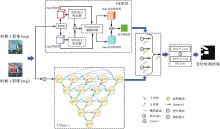
Fig. 1
Overall structure of GB-UNet++"
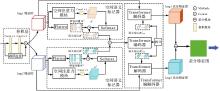
Fig. 2
Structure of GDEM"
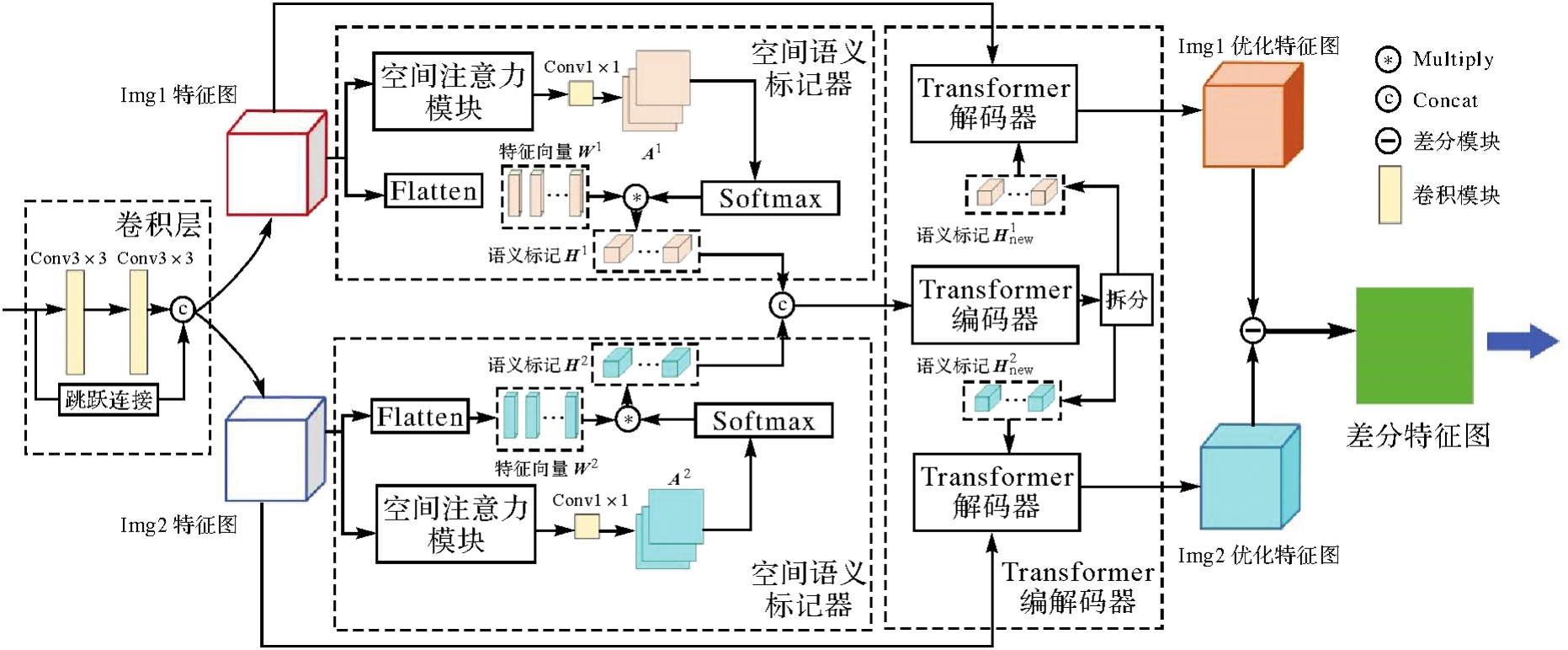
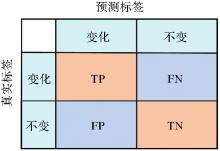
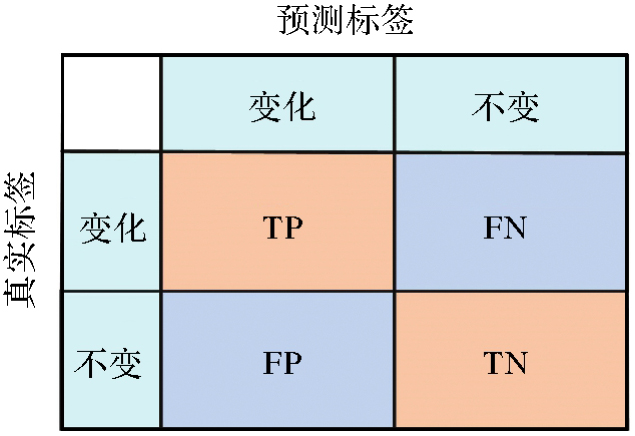
Fig. 3
Confusion matrix"
Tab. 1
Parameters of experimental datasets"
| 数据集 | 数据来源 | 空间分辨率/m | 样本尺寸/像素 | 时间跨度 |
|---|---|---|---|---|
| BCDD | 航拍图像 | 0.2 | 256×256 | 2012—2016年 |
| DSIFN | 在线地图服务平台 | 2 | 256×256 | 2001—2019年 |
| GZCD | 在线地图服务平台 | 0.55 | 256×256 | 2010—2019年 |
| YCCD | GF-1、GF-2 | 2 | 128×128 | 2018—2020年 |
| NJCD | World View-Ⅱ、航拍图像 | 2 | 128×128 | 2011—2013年 |
| GYCD | GF-1、GF-2 | 2 | 128×128 | 2015—2020年 |
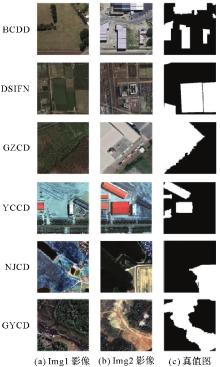
Fig. 4
Representative samples"
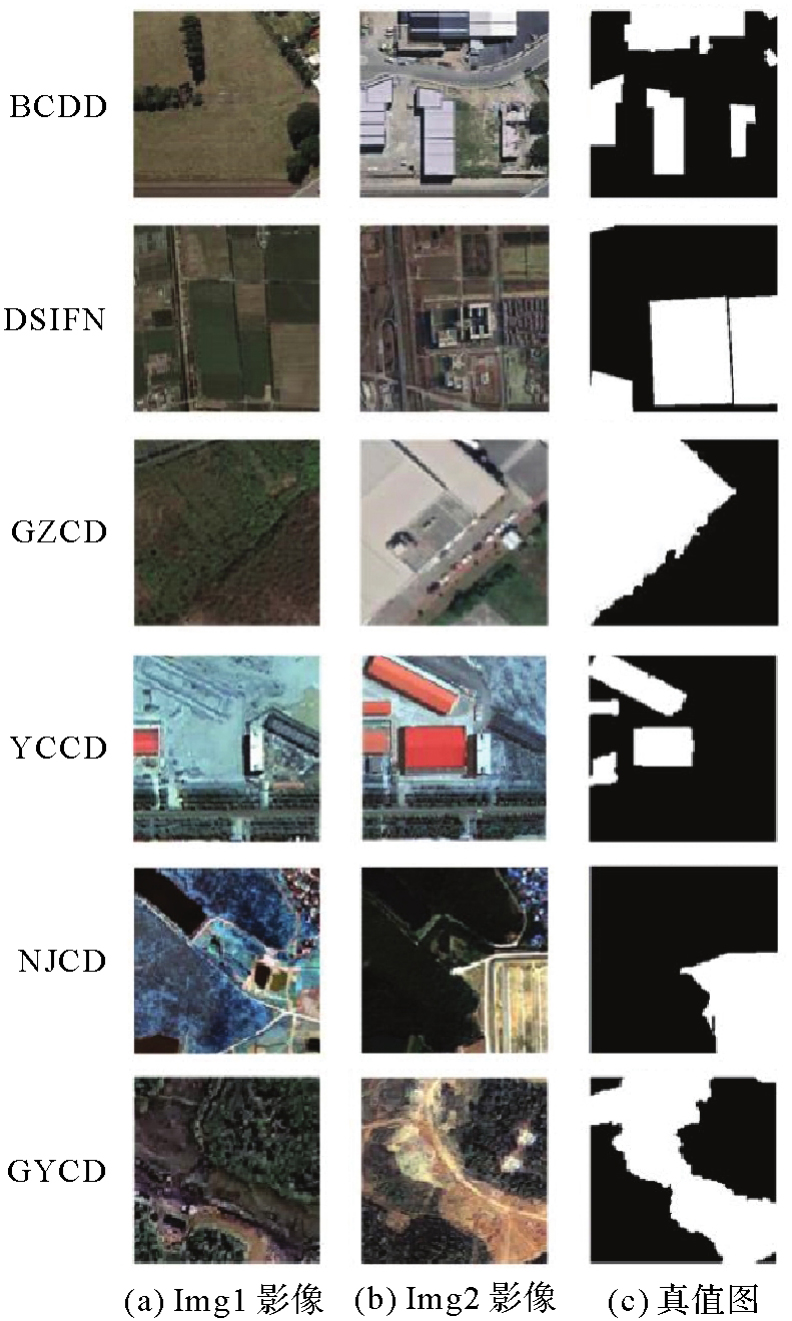
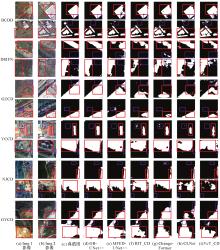
Fig. 5
Experimental results of different networks"

Tab. 2
Quantitative evaluation of prediction results of different methods"
| 数据集 | 方法 | P/(%) | R/(%) | PRD/(%) | F1值/(%) | OA/(%) | Kappa系数 |
|---|---|---|---|---|---|---|---|
| BCDD | Vc T_CD | 79.55 | 86.42 | 6.87 | 82.46 | 98.86 | 0.817 2 |
| BIT_CD | 76.55 | 85.39 | 8.84 | 80.74 | 98.73 | 0.806 1 | |
| ChangeFormer | 64.97 | 77.29 | 12.32 | 70.60 | 98.23 | 0.696 9 | |
| CLNet | 74.95 | 80.61 | 5.66 | 77.67 | 98.59 | 0.769 4 | |
| MFED-UNet++ | 81.01 | 84.63 | 3.62 | 82.77 | 98.89 | 0.822 1 | |
| GB-UNet++ | 83.24 | 86.54 | 3.30 | 84.86 | 99.02 | 0.843 5 | |
| Vc T_CD | 68.15 | 67.54 | 0.61 | 67.84 | 88.18 | 0.638 8 | |
| BIT_CD | 64.05 | 69.69 | 5.64 | 66.75 | 87.88 | 0.608 5 | |
| DSIFN | ChangeFormer | 63.27 | 65.18 | 1.91 | 64.21 | 86.89 | 0.609 3 |
| CLNet | 75.13 | 55.62 | 19.51 | 63.92 | 80.05 | 0.547 9 | |
| MFED-UNet++ | 55.39 | 78.28 | 22.89 | 64.88 | 88.15 | 0.612 2 | |
| GB-UNet++ | 68.83 | 69.15 | 0.32 | 68.99 | 88.24 | 0.666 2 | |
| Vc T_CD | 70.10 | 74.53 | 4.43 | 72.24 | 93.94 | 0.688 5 | |
| BIT_CD | 47.58 | 84.02 | 36.44 | 60.75 | 93.08 | 0.572 8 | |
| GZCD | ChangeFormer | 46.51 | 87.71 | 41.20 | 60.78 | 93.25 | 0.574 7 |
| CLNet | 42.70 | 95.60 | 52.90 | 59.03 | 93.33 | 0.559 8 | |
| MFED-UNet++ | 73.10 | 77.47 | 4.37 | 75.22 | 94.10 | 0.721 9 | |
| GB-UNet++ | 75.41 | 86.12 | 10.71 | 80.41 | 95.87 | 0.781 2 | |
| Vc T_CD | 52.95 | 63.63 | 10.68 | 57.80 | 95.60 | 0.554 6 | |
| BIT_CD | 51.22 | 63.81 | 12.59 | 56.82 | 95.59 | 0.555 5 | |
| YCCD | ChangeFormer | 53.07 | 52.80 | 0.27 | 52.94 | 94.54 | 0.500 4 |
| CLNet | 49.81 | 63.76 | 13.95 | 55.93 | 95.46 | 0.535 7 | |
| MFED-UNet++ | 55.51 | 65.41 | 9.90 | 60.06 | 95.73 | 0.578 2 | |
| GB-UNet++ | 57.31 | 65.75 | 8.44 | 61.24 | 95.77 | 0.585 4 | |
| Vc T_CD | 64.48 | 79.59 | 15.11 | 71.21 | 95.92 | 0.673 3 | |
| BIT_CD | 65.40 | 79.87 | 14.47 | 71.92 | 96.37 | 0.700 1 | |
| NJCD | ChangeFormer | 62.21 | 77.86 | 15.65 | 69.16 | 96.06 | 0.670 9 |
| CLNet | 64.74 | 78.53 | 13.79 | 70.97 | 96.24 | 0.689 8 | |
| MFED-UNet++ | 66.69 | 81.33 | 14.64 | 73.28 | 96.55 | 0.714 6 | |
| GB-UNet++ | 67.18 | 81.88 | 14.70 | 73.81 | 96.59 | 0.720 2 | |
| Vc T_CD | 65.47 | 72.39 | 6.92 | 68.79 | 91.74 | 0.658 6 | |
| BIT_CD | 54.18 | 66.66 | 12.48 | 59.78 | 89.85 | 0.540 5 | |
| GYCD | ChangeFormer | 57.51 | 65.98 | 8.47 | 61.46 | 89.96 | 0.557 2 |
| CLNet | 53.95 | 65.93 | 11.98 | 59.34 | 89.71 | 0.535 2 | |
| MFED-UNet++ | 68.66 | 71.60 | 2.94 | 70.09 | 91.85 | 0.653 8 | |
| GB-UNet++ | 68.85 | 72.53 | 3.68 | 70.62 | 92.04 | 0.661 1 |
Tab. 3
Analysis of the embedding effect of GDEM module"
| 数据集 | 基础网络 | GDEM | P/(%) | R/(%) | PRD/(%) | F1值/(%) | OA/(%) | Kappa系数 |
|---|---|---|---|---|---|---|---|---|
| BCDD | UNet++ | — | 65.91 | 63.89 | 2.02 | 64.89 | 97.66 | 0.636 1 |
| UNet++ | √ | 83.24 | 86.54 | 3.30 | 84.86 | 99.02 | 0.843 5 | |
| DSIFN | UNet++ | — | 70.57 | 56.71 | 13.86 | 62.89 | 85.47 | 0.539 9 |
| UNet++ | √ | 68.83 | 69.15 | 0.32 | 68.99 | 88.24 | 0.666 2 | |
| GZCD | UNet++ | — | 56.06 | 71.56 | 15.50 | 62.87 | 92.55 | 0.588 1 |
| UNet++ | √ | 75.41 | 86.12 | 10.71 | 80.41 | 95.87 | 0.781 2 | |
| YCCD | UNet++ | — | 50.77 | 51.93 | 1.16 | 51.35 | 94.43 | 0.483 9 |
| UNet++ | √ | 57.31 | 65.75 | 8.44 | 61.24 | 95.77 | 0.585 4 | |
| NJCD | UNet++ | — | 62.67 | 80.48 | 17.81 | 70.47 | 96.27 | 0.685 1 |
| UNet++ | √ | 67.18 | 81.88 | 14.70 | 73.81 | 96.59 | 0.720 2 | |
| GYCD | UNet++ | — | 57.89 | 66.99 | 9.10 | 62.11 | 90.16 | 0.564 9 |
| UNet++ | √ | 68.85 | 72.53 | 3.68 | 70.62 | 92.04 | 0.661 1 |
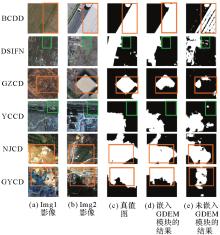
Fig. 6
Visualization results of the embedded GDEM"
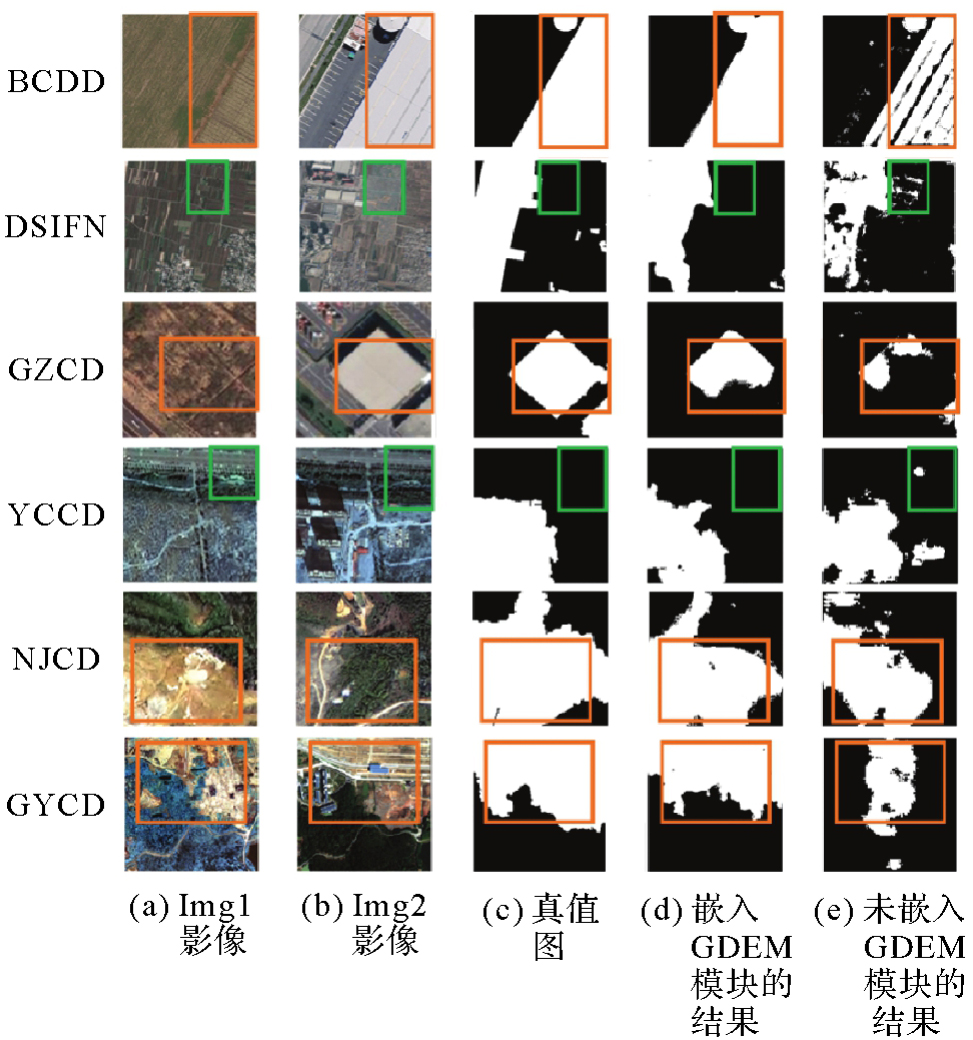
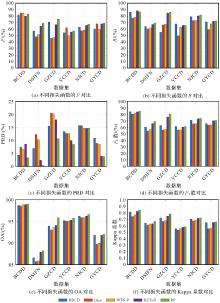
Fig. 7
Comparison of different loss functions based on GB-UNet++ framework"

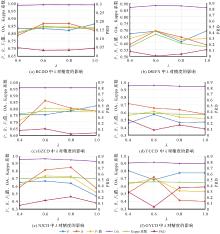
Fig. 8
Impact of λ on accuracy in BP Loss"
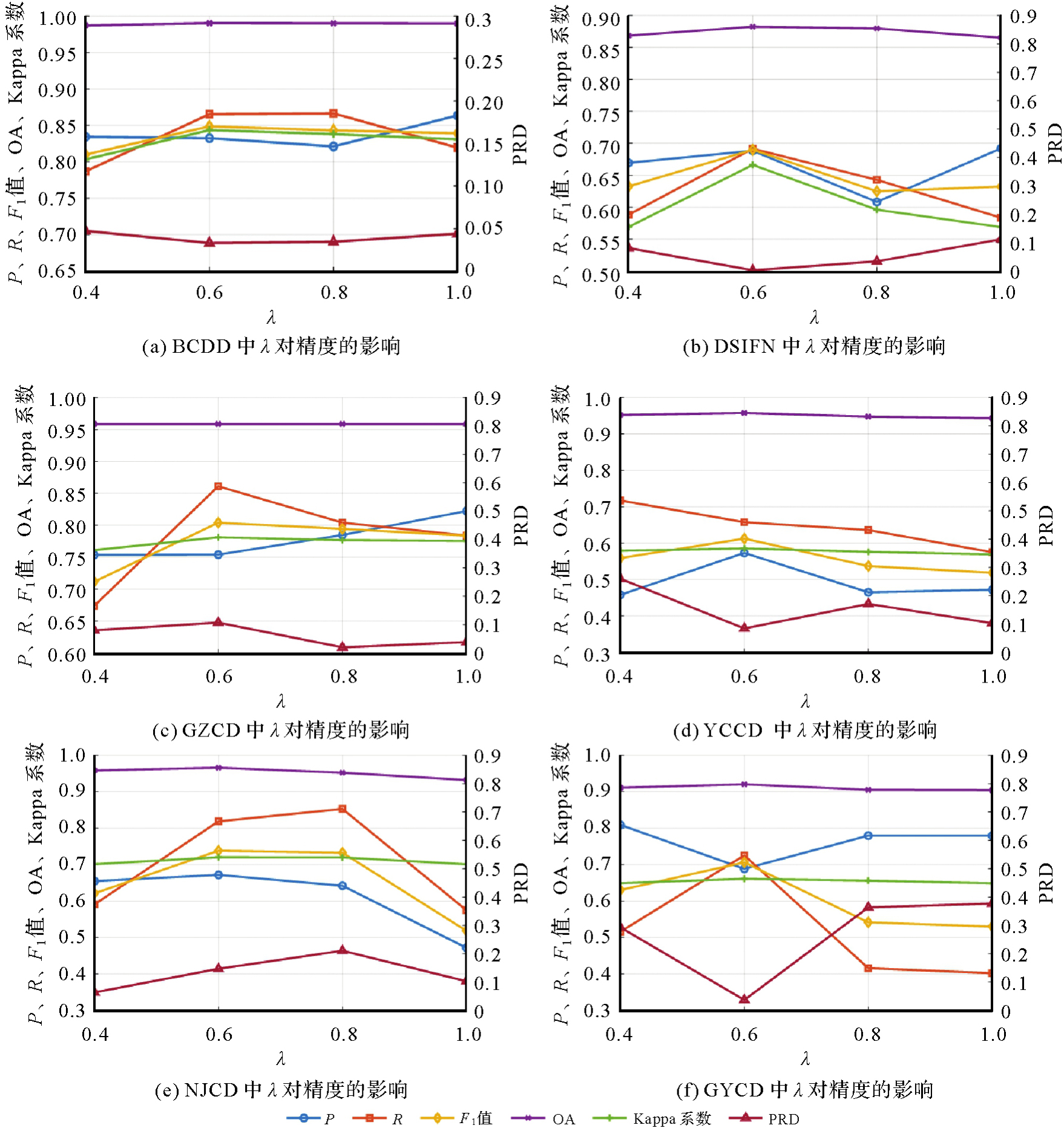
Fig. 9
Experimental results based on Transformer"
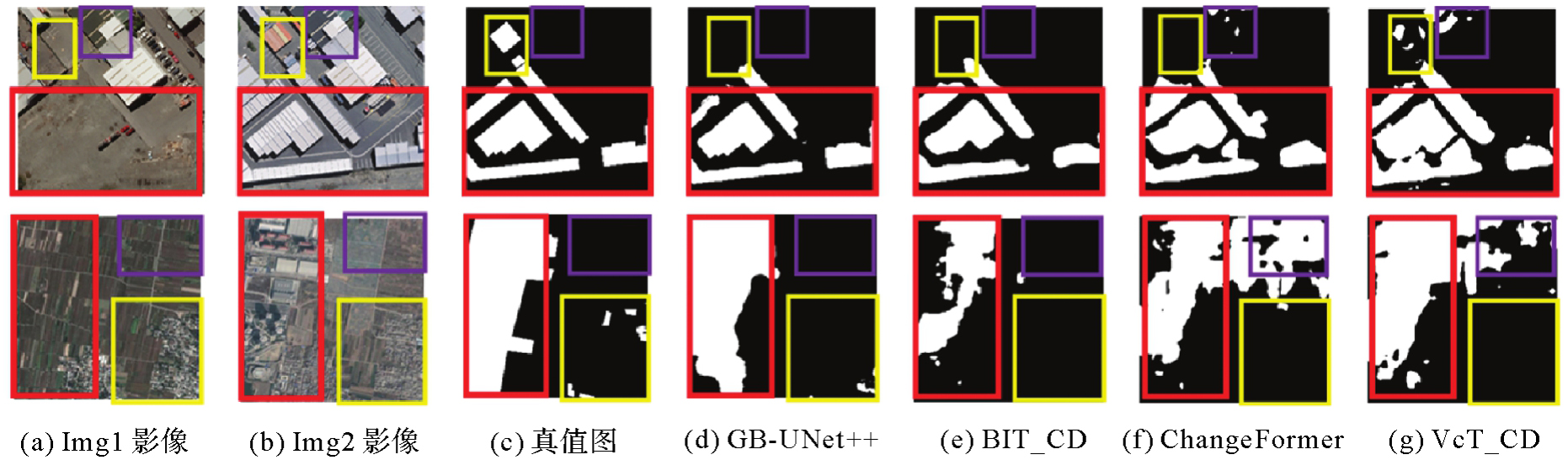
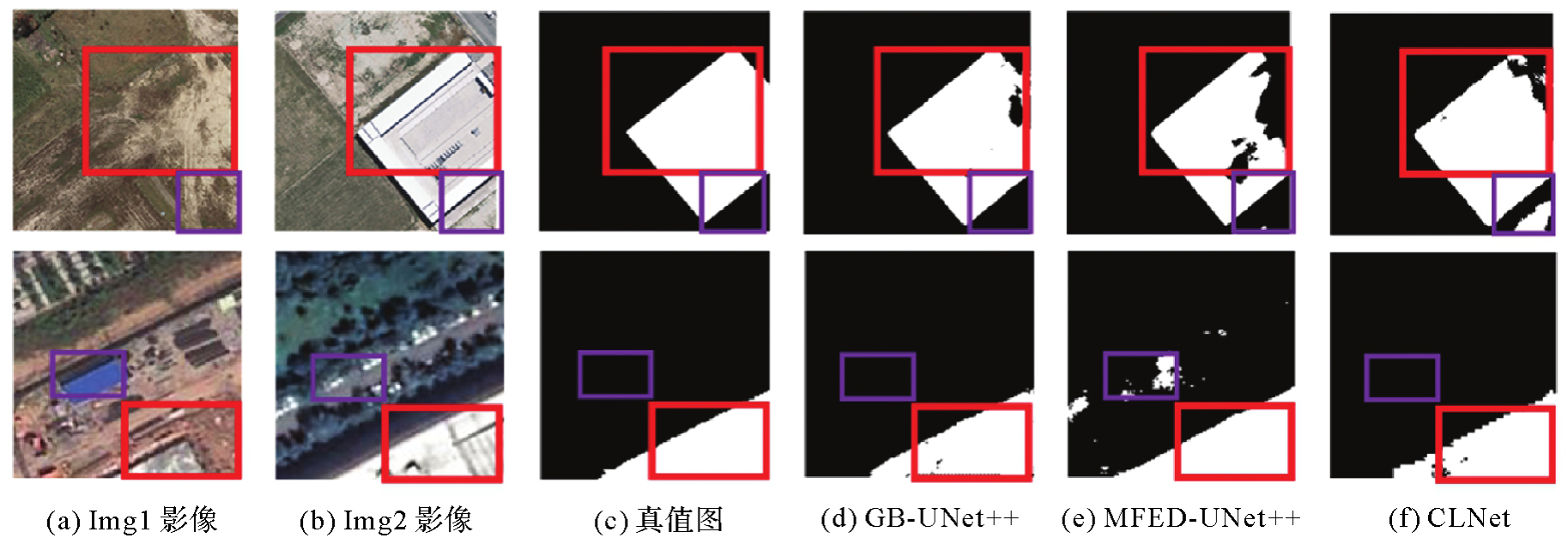
Fig. 10
Experimental results based on UNet"
| [1] |
黄亮. 多时相遥感影像变化检测技术研究[J]. 测绘学报, 2020, 49(6): 801. DOI: .
doi: 10.11947/j.AGCS.2020.20190236 |
|
HUANG Liang. Research on change detection technology in multi-temporal remote sensing images[J]. Acta Geodaetica et Cartographica Sinica, 2020, 49(6): 801. DOI: .
doi: 10.11947/j.AGCS.2020.20190236 |
|
| [2] |
宫金杞. 复杂城市场景的高分辨率遥感影像建筑物变化检测[J]. 测绘学报, 2023, 52(7): 1233. DOI: .
doi: 10.11947/j.AGCS.2023.20210728 |
|
GONG Jinqi. Building change detection in high-resolution remote sensing images of complex urban scenes[J]. Acta Geodaetica et Cartographica Sinica, 2023, 52(7): 1233. DOI: .
doi: 10.11947/j.AGCS.2023.20210728 |
|
| [3] |
姜明, 张新长, 孙颖, 等. 全尺度特征聚合的高分辨率遥感影像变化检测网络[J]. 测绘学报, 2023, 52(10): 1738-1748. DOI: .
doi: 10.11947/j.AGCS.2023.20220505 |
|
JIANG Ming, ZHANG Xinchang, SUN Ying, et al. Full-scale feature aggregation network for high-resolution remote sensing image change detection[J]. Acta Geodaetica et Cartographica Sinica, 2023, 52(10): 1738-1748. DOI: .
doi: 10.11947/j.AGCS.2023.20220505 |
|
| [4] | WU Haoran, GENG Jie, JIANG Wen. Multidomain constrained translation network for change detection in heterogeneous remote sensing images[J]. IEEE Transactions on Geoscience and Remote Sensing, 2024, 62: 3381196. |
| [5] | 许淑淑. 基于对象的多源数据变化检测的方法[J]. 测绘通报, 2020(): 122-126. |
| XU Shushu. Research on object based multisource data change detection method[J]. Bulletin of Surveying and Mapping, 2020 (): 122-126. | |
| [6] | CHEN Dong, WANG Yafei, SHEN Zhenyu, et al. Long time-series mapping and change detection of coastal zone land use based on Google Earth Engine and multi-source data fusion[J]. Remote Sensing, 2022, 14(1): 1. |
| [7] | 施向丰, 帅梅琴, 申劲松. 基于多时相遥感图像智能变化检测方法的研究[J]. 测绘通报, 2012(9): 23-25. |
| SHI Xiangfeng, SHUAI Meiqin, SHEN Jinsong. Study on the intelligent change detection methods on the basis of multi-temporal remotely sensed images[J]. Bulletin of Surveying and Mapping, 2012(9): 23-25. | |
| [8] | 韩星, 韩玲, 李良志, 等. 基于深度学习的高分辨率遥感图像建筑物变化检测[J]. 激光与光电子学进展, 2022, 59(10): 1001003. |
| HAN Xing, HAN Ling, LI Liangzhi, et al. Building change detection in high-resolution remote-sensing images based on deep learning[J]. Laser & Optoelectronics Progress, 2022, 59(10): 1001003. | |
| [9] | ZHANG Hongyan, LIN Manhui, YANG Guanyi, et al. ESCNet: an end-to-end superpixel-enhanced change detection network for very-high-resolution remote sensing images[J]. IEEE Transactions on Neural Networks and Learning Systems, 2021, 34(1): 28-42. |
| [10] | DONG Sijun, WANG Libo, DU Bo, et al. ChangeCLIP: remote sensing change detection with multimodal vision-language representation learning[J]. ISPRS Journal of Photogrammetry and Remote Sensing, 2024, 208: 53-69. |
| [11] | ZHENG Zhi, WAN Yi, ZHANG Yongjun, et al. CLNet: cross-layer convolutional neural network for change detection in optical remote sensing imagery[J]. ISPRS Journal of Photogrammetry and Remote Sensing, 2021, 175: 247-267. |
| [12] | 孙雯婷, 施文灶, 王磊, 等. 改进UNet++遥感影像建筑物变化检测[J]. 电脑知识与技术, 2022, 18(25): 20-25. |
| SUN Wenting, SHI Wenzao, WANG Lei, et al. Improved UNet++ for building change detection in remote sensing images[J]. Computer Knowledge and Technology, 2022, 18(25): 20-25. | |
| [13] | SU Linzhi, XIE Qiaoyun, ZHAO Fengjun, et al. Change detection for multispectral images using modified semantic segmentation network[J]. Journal of Applied Remote Sensing, 2022, 16: 014518. |
| [14] | ZHANG Xiuwei, YUE Yuanzeng, GAO Wenxiang, et al. DifUnet++: a satellite images change detection network based on UNet++ and differential pyramid[J]. IEEE Geoscience and Remote Sensing Letters, 2022, 19: 3049370. |
| [15] | FANG Sheng, LI Kaiyu, SHAO Jinyuan, et al. SNUNet-CD: a densely connected Siamese network for change detection of VHR images[J]. IEEE Geoscience and Remote Sensing Letters, 2022, 19: 3056416. |
| [16] | BAO Yintu, LIU Wei, GAO Ouyang, et al. E-Unet++: a semantic segmentation method for remote sensing images[C]//Proceedings of 2021 Advanced Information Management, Communicates, Electronic and Automation Control Conference. Chongqing: IEEE, 2021: 1858-1862. |
| [17] | LI Jian, LIU Kongyu, HU Yating, et al. Eres-UNet++: liver CT image segmentation based on high-efficiency channel attention and Res-UNet++[J]. Computers in Biology and Medicine, 2023, 158: 106501. |
| [18] | LI Zan, ZHANG Hong, LI Zhengzhen, et al. Residual-attention UNet++: a nested residual-attention U-Net for medical image segmentation[J]. Applied Sciences, 2022, 12(14): 7149. |
| [19] | 袁洲, 郭海涛, 卢俊, 等. 融合UNet++网络和注意力机制的高分辨率遥感影像变化检测算法[J]. 测绘科学技术学报, 2021, 38(2): 155-159. |
| YUAN Zhou, GUO Haitao, LU Jun, et al. Change detection algorithm for high-resolution remote sensing images by integrating UNet++ network and attention mechanism[J]. Journal of Geomatics Science and Technology, 2021, 38(2): 155-159. | |
| [20] | PENG Xueli, ZHONG Ruofei, LI Zhen, et al. Optical remote sensing image change detection based on attention mechanism and image difference[J]. IEEE Transactions on Geoscience and Remote Sensing, 2021, 59(9): 7296-7307. |
| [21] |
王超, 王帅, 陈晓, 等. 联合UNet++和多级差分模块的多源光学遥感影像对象级变化检测[J]. 测绘学报, 2023, 52(2): 283-296. DOI: .
doi: 10.11947/j.AGCS.2023.20220202 |
|
WANG Chao, WANG Shuai, CHEN Xiao, et al. Object-level change detection of multi-sensor optical remote sensing images combined with UNet++ and multi-level difference module[J]. Acta Geodaetica et Cartographica Sinica, 2023, 52(2): 283-296. DOI: .
doi: 10.11947/j.AGCS.2023.20220202 |
|
| [22] | SUN Bangyong, LIU Qinsen, YUAN Nianzeng, et al. Spectral token guidance transformer for multisource images change detection[J]. IEEE Journal of Selected Topics in Applied Earth Observations and Remote Sensing, 2023, 16: 2559-2572. |
| [23] | FU Yanping, LIU Yun. Contrastive Transformer based domain adaptation for multi-source cross-domain sentiment classification[J]. Knowledge-Based Systems, 2022, 245: 108649. |
| [24] | VASWANI A, SHAZEER N, PARMAR N, et al. Attention is all you need[J]. Advances in Neural Information Processing Systems, 2017, 30: 5998-6008. |
| [25] | YAN Tianyu, WAN Zifu, ZHANG Pingping. Fully Transformer network for change detection of remote sensing images[C]//Proceedings of 2022 Asian Conference on Computer Vision. Cham: Springer-Verlag, 2022: 75-92. |
| [26] | BANDARA W G C, PATEL V M. A Transformer-based siamese network for change detection[C]//Proceedings of 2022 IEEE International Geoscience and Remote Sensing Symposium. Kuala Lumpur: IEEE, 2022: 207-210. |
| [27] | JIANG Bo, WANG Zitian, WANG Xixi, et al. VcT: visual change Transformer for remote sensing image change detection[J]. IEEE Transactions on Geoscience and Remote Sensing, 2023, 61: 1-14. |
| [28] | YAN Tianyu, WAN Zifu, ZHANG Pingping, et al. TransY-Net: learning fully Transformer networks for change detection of remote sensing images[J]. IEEE Transactions on Geoscience and Remote Sensing, 2023, 61: 1-12. |
| [29] | CHEN Hao, QI Zipeng, SHI Zhenwei. Remote sensing image change detection with Transformers[J]. IEEE Transactions on Geoscience and Remote Sensing, 2022, 60: 1-14. |
| [30] | MAO Zan, TONG Xinyu, LUO Ze, et al. MFATNet: multi-scale feature aggregation via transformer for remote sensing image change detection[J]. Remote Sensing, 2022, 14(21): 5379. |
| [31] | JAFFARI R, HASHMANI M A, REYES-ALDASORO C C. A novel focal phi loss for power line segmentation with auxiliary classifier U-Net[J]. Sensors, 2021, 21(8): 2803. |
| [32] | JI Shunping, WEI Shiqing, LU Meng. Fully convolutional networks for multisource building extraction from an open aerial and satellite imagery data set[J]. IEEE Transactions on Geoscience and Remote Sensing, 2019, 57(1): 574-586. |
| [33] | ZHANG Chenxiao, YUE Peng, TAPETE D, et al. A deeply supervised image fusion network for change detection in high resolution bi-temporal remote sensing images[J]. ISPRS Journal of Photogrammetry and Remote Sensing, 2020, 166: 183-200. |
| [34] | PENG Daifeng, BRUZZONE L, ZHANG Yongjun, et al. SemiCDNet: a semisupervised convolutional neural network for change detection in high resolution remote-sensing images[J]. IEEE Transactions on Geoscience and Remote Sensing, 2021, 59(7): 5891-5906. |
| [35] | PENG Daifeng, ZHANG Yongjun, GUAN Haiyan. End-to-end change detection for high resolution satellite images using improved UNet++[J]. Remote Sensing, 2019, 11(11): 1382-1405. |
| [36] | MILLETARI F, NAVAB N, AHMADI S A. V-net: fully convolutional neural networks for volumetric medical image segmentation[C]//Proceedings of 2016 International Conference on 3D Vision. Stanford: IEEE, 2016: 565-571. |
| [37] | CHEN Jieneng, LU Yongyi, YU Qihang, et al. TransUNet: Transformers make strong encoders for medical image segmentation[EB/OL]. [2023-12-10]. https://arxiv.org/abs/2102.04306v1. |
| [38] | LI Qingyang, ZHONG Ruofei, DU Xin, et al. TransUNetCD: a hybrid Transformer network for change detection in optical remote-sensing images[J]. IEEE Transactions on Geoscience and Remote Sensing, 2022, 60: 3169479. |
| [39] | TIAN Juan, PENG Daifeng, GUAN Haiyan, et al. RACDNet: resolution- and alignment-aware change detection network for optical remote sensing imagery[J]. Remote Sensing, 2022, 14(18): 4527. |
| [40] | RAZA A, HUO Hong, FANG Tao. EUNet-CD: efficient UNet++ for change detection of very high-resolution remote sensing images[J]. IEEE Geoscience and Remote Sensing Letters, 2022, 19: 3144304. |
| [1] | Lanxin WU, Jiangtao PENG, Weiwei SUN, Bing YANG. An Euler embedding and complementary feature modeling framework for hyperspectral change detection in coastal wetlands [J]. Acta Geodaetica et Cartographica Sinica, 2026, 55(4): 618-631. |
| [2] | Yang LI, Haijun HUANG, Sulan LIU, Xiaohui WU, Qi LIU, Qipei PANG, Yunlong WU. Century-scale projection of terrestrial water storage anomaly and drought risk in the Poyang Lake Basin using a CMIP6-driven Transformer-GRU model [J]. Acta Geodaetica et Cartographica Sinica, 2026, 55(4): 721-738. |
| [3] | Jiayao WANG, Lin CHEN, Shiyuan CHENG, Lijun WANG, Siqi XIONG. Artificial intelligence empowering the digital-intelligent transformation of cartographic science [J]. Acta Geodaetica et Cartographica Sinica, 2026, 55(3): 381-389. |
| [4] | Xiaomin LU, Zhiyi ZHANG, Haowen YAN, Yi HE, Xiaoning SU. A recognition method for building group pattern integrating deep graph infomax and multilayer perceptron [J]. Acta Geodaetica et Cartographica Sinica, 2026, 55(3): 425-438. |
| [5] | Daifeng PENG, Xuelian LIU, Mengfei LU, Haiyan GUAN. Heterogeneous remote sensing image flood change detection based on multi-scale cross-modal feature fusion [J]. Acta Geodaetica et Cartographica Sinica, 2026, 55(2): 328-343. |
| [6] | Haopeng HU, Hangbin WU, Shihao ZHAN, Zaihao WEN, Chun LIU. Road pole-like object change detection supported by visual point cloud quality optimization [J]. Acta Geodaetica et Cartographica Sinica, 2026, 55(2): 344-358. |
| [7] | Pengcheng LIU, Xiaoqiang CHENG, Tianyuan XIAO, Min YANG, Tinghua AI. A Transformer model for building polygon simplification in map generalization [J]. Acta Geodaetica et Cartographica Sinica, 2026, 55(1): 124-137. |
| [8] | Shunping JI, Jin LIU, Jian GAO, Jianya GONG. An intelligent 3D reconstruction framework via deep learning based multi-view image matching [J]. Acta Geodaetica et Cartographica Sinica, 2025, 54(9): 1633-1646. |
| [9] | Jixian ZHANG, Haiyan GU, Huan NI, Haitao LI, Yi YANG, Shaopeng DING, Songman SUI. Deep learning methods for remote sensing intelligent change detection: evolution and development [J]. Acta Geodaetica et Cartographica Sinica, 2025, 54(8): 1347-1370. |
| [10] | Shuai FANG, Jiaen LIU, Jing ZHANG. Spatio-temporal fusion algorithm based on adaptive reference feature incorporation and multi-scale feature aggregation [J]. Acta Geodaetica et Cartographica Sinica, 2025, 54(8): 1476-1488. |
| [11] | Qing CHENG, Boxuan WANG, Hongyan ZHANG. DRformer: a progressive coupled multiscale CNN and condensed attention Transformer method for hyperspectral image super-resolution [J]. Acta Geodaetica et Cartographica Sinica, 2025, 54(7): 1230-1242. |
| [12] | Nina MENG, Fengmei LI, Xiaodong ZHOU. Data and cognition dual-driven building group generalization results and scale consistency assessment [J]. Acta Geodaetica et Cartographica Sinica, 2025, 54(7): 1318-1331. |
| [13] | Yaqing WANG, Zhonghui WANG. River network automated selection method based on heterogeneous graph convolutional networks [J]. Acta Geodaetica et Cartographica Sinica, 2025, 54(7): 1332-1345. |
| [14] | Xiaoya AN, Weiru GUO, Pengxin ZHANG, Xinxin LI, Lei SHI. Ship trajectories clustering method considering similarity in geometric position and mobility features [J]. Acta Geodaetica et Cartographica Sinica, 2025, 54(6): 1107-1121. |
| [15] | Qingli LUO, Xueyan LI, Guoman HUANG, Honghui CHEN, Minglong XUE, Jian LI. AOSN: alpha optimal structure network for height estimation from a single SAR image in mountain areas [J]. Acta Geodaetica et Cartographica Sinica, 2025, 54(5): 888-898. |
| Viewed | ||||||
|
Full text |
|
|||||
|
Abstract |
|
|||||
