

Acta Geodaetica et Cartographica Sinica ›› 2025, Vol. 54 ›› Issue (6): 982-994.doi: 10.11947/j.AGCS.2025.20240451
• Geodesy and Navigation • Previous Articles Next Articles
Qianxin WANG1( ), Chao HU2,3(), Tong CHENG1
Received:2024-11-05
Revised:2025-05-12
Online:2025-07-14
Published:2025-07-14
Contact:
Chao HU
E-mail:wqx@cumt.edu.cn;chaohu2014gnss@163.com
About author:WANG Qianxin (1980—), male, PhD, professor, majors in satellite geodesy data processing. E-mail: wqx@cumt.edu.cn
Supported by:CLC Number:
Qianxin WANG, Chao HU, Tong CHENG. A method for satellite ultra-rapid orbit and clock offset estimation based on the prior information of the GNSS clock parameters[J]. Acta Geodaetica et Cartographica Sinica, 2025, 54(6): 982-994.
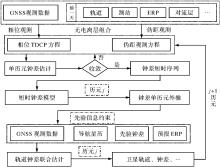
Fig. 1
Flowchart of GNSS ultra-rapid orbit and clock estimation based on the prior information of satellite clock offsets"

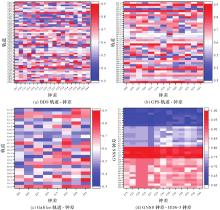
Fig. 2
The correlation distributions of ultra-rapid orbit and clock offset in analysis centre"

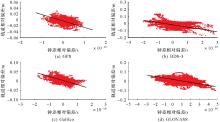
Fig. 3
The absolute relative errors distribution of satellites orbit and clock offsets"


Fig. 4
The relative residuals series of GNSS satellite orbit and clock offsets"

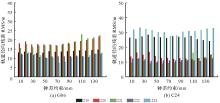
Fig. 5
The accuracy of orbit radial direction based on different constraints on the GNSS clock"

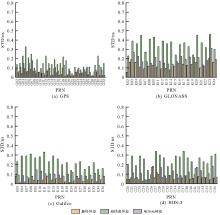
Fig. 6
Accuracies of GNSS clock offset based on final, ultra-rapid and epoch-wise schemes"

Tab. 1
The accuracy of GNSS clock offsets and the improvements of epoch-wise ultra-rapid clocks"
| 卫星系统 | 最终钟差/ns | 超快速钟差/ns | 单历元钟差/ns | 提升率/(%) |
|---|---|---|---|---|
| 铷钟(Rb) | 0.072 | 0.219 | 0.108 | 50.7 |
| 铯钟(Cs) | 0.058 | 0.110 | 0.076 | 30.9 |
| 氢钟(PHM) | 0.033 | 0.102 | 0.055 | 46.1 |
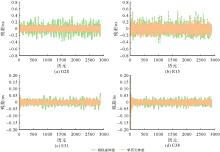
Fig. 7
Modelling residuals of GNSS clock based on ultra-rapid and epoch-wise solutions"

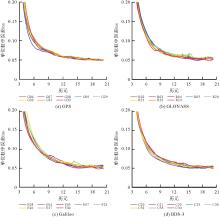
Fig. 8
The mean error series of epoch-wise estimated GNSS clock offset parameters"
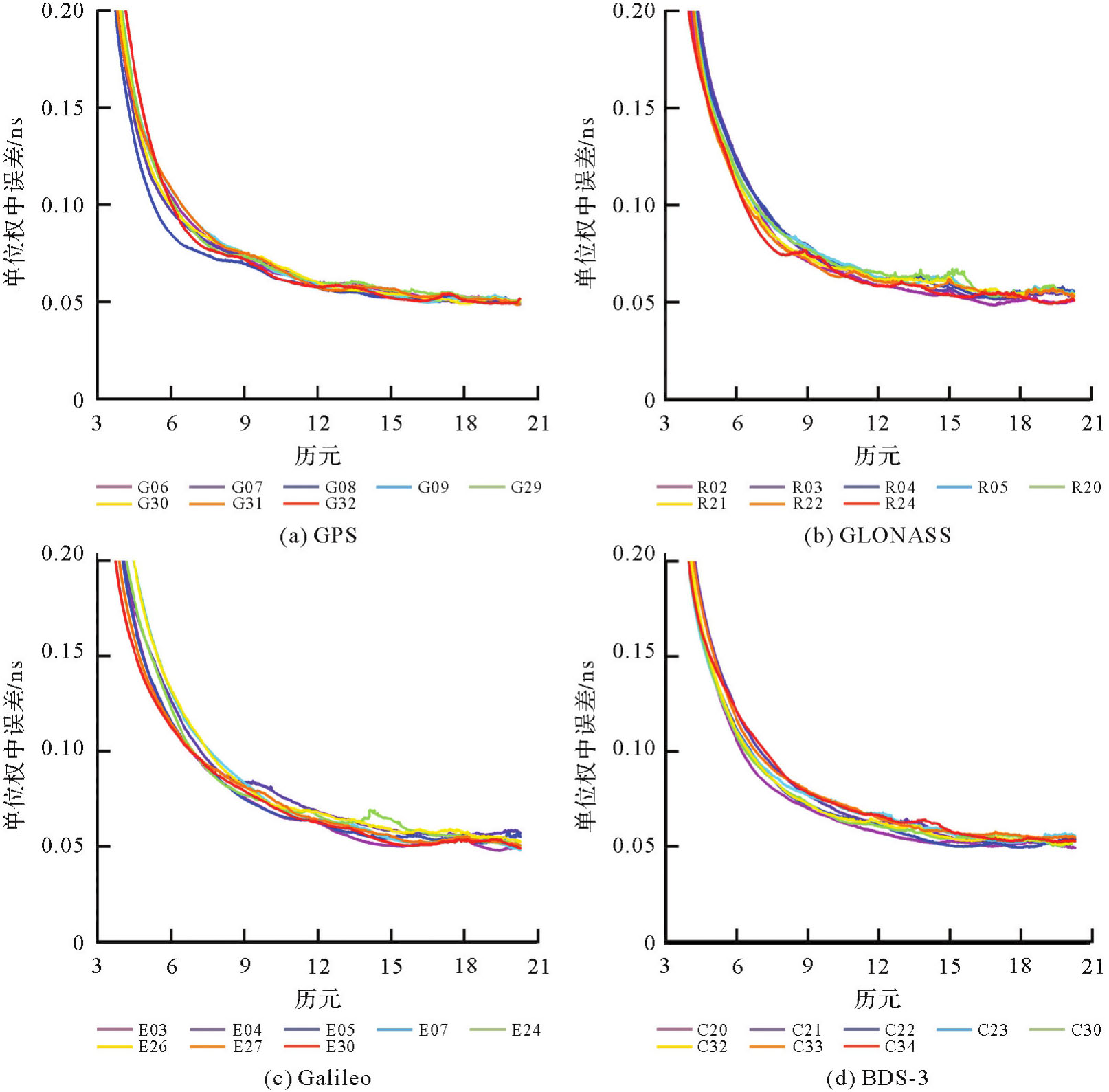

Fig. 9
The observation dimensions and time-consuming of GNSS satellite clock estimation"
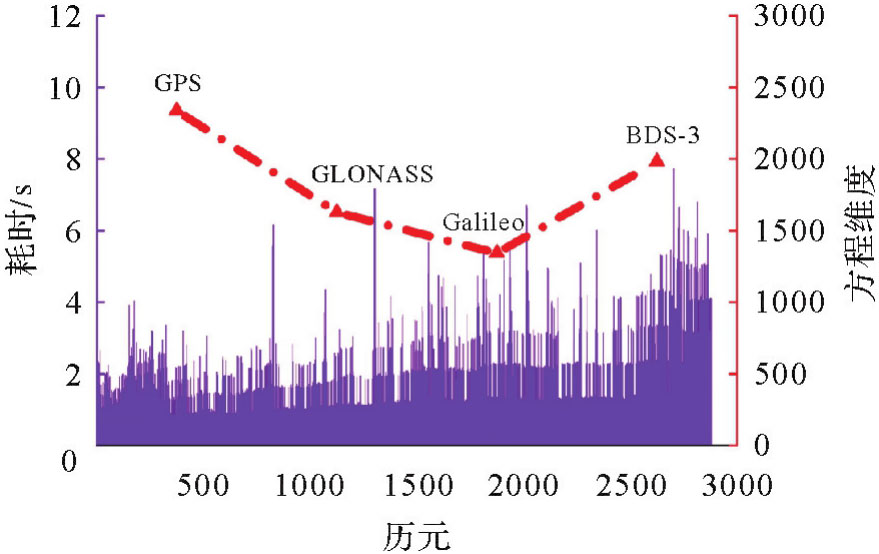
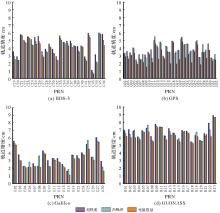
Fig. 10
The accuracy of the estimated ultra-rapid orbit based on different schemes on clock offsets"

Tab. 2
The accuracy of orbit radial direction and clock offset and its improvements based on the different schemes on different types of onboard clock parameters"
| 参数 | 钟类型 | 超快速/cm | 白噪声/cm | 先验信息/cm | 提升率/(%) |
|---|---|---|---|---|---|
| 轨道钟差 | GPS | 3.719 | 3.662 | 2.898 | 22.1 |
| GLONASS | 6.799 | 6.616 | 6.322 | 7.0 | |
| Galileo | 3.496 | 3.363 | 3.004 | 14.1 | |
| BDS-3 | 4.418 | 4.030 | 3.831 | 13.3 | |
| 铷钟(Rb) | 0.192 | 0.112 | 0.062 | 44.6 | |
| 铯钟(Cs) | 0.094 | 0.085 | 0.057 | 32.9 | |
| 氢钟(PHM) | 0.082 | 0.032 | 0.020 | 37.5 |
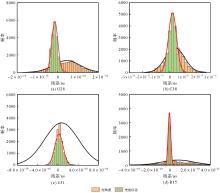
Fig. 11
The residuals distribution of GNSS clock offset modelling based on prior information and the ultra-rapid orbit determination solution"

Fig. 12
Time consumption and equation dimension of multi-system orbit clock difference single epoch solution"
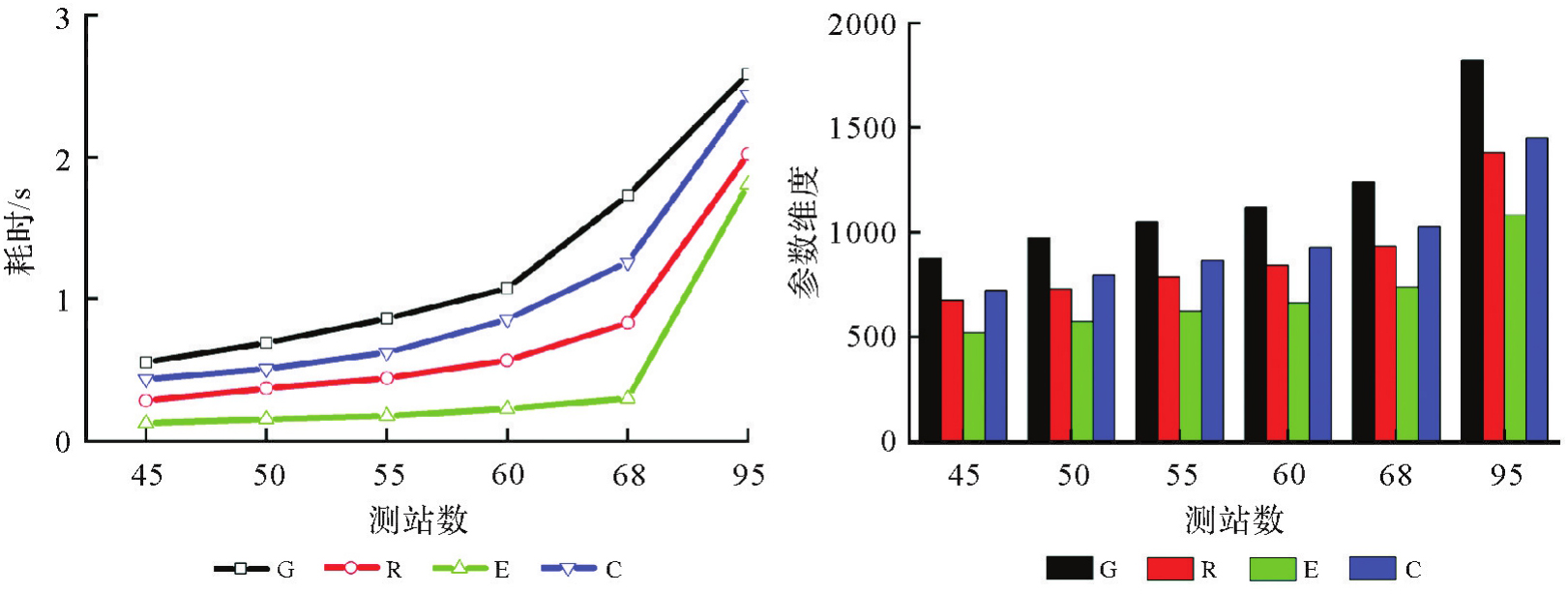
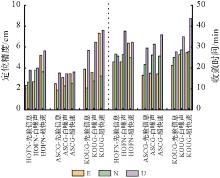
Fig. 13
The static PPP performances based on the ultra-rapid orbit and clock products with different schemes"

Tab. 3
The static PPP performances based on the ultra-rapid orbit and clock products with different schemes and its improvements"
| 方案 | 定位精度/cm | 收敛时间/min | ||||
|---|---|---|---|---|---|---|
| E | N | U | E | N | U | |
| 超快速 | 4.14 | 2.49 | 4.50 | 27.31 | 27.83 | 43.72 |
| 白噪声 | 5.29 | 3.45 | 6.37 | 26.33 | 28.61 | 34.94 |
| 先验信息 | 3.73 | 2.07 | 4.08 | 19.18 | 24.55 | 28.16 |
| 提升率 | 9.9% | 16.9% | 9.3% | 29.8% | 11.8% | 35.6% |
| [1] |
胡超, 王潜心. 顾及BDS-3星钟约束的GNSS超快速轨道钟差解算方法[J]. 测绘学报, 2024, 53(3): 413-424. DOI: .
doi: 10.11947/j.AGCS.2024.20240112 |
|
HU Chao, WANG Qianxin. GNSS ultra-rapid orbit and clock offset estimation method with the aid of the constraint of BDS-3 onboard clock[J]. Acta Geodaetica et Cartographica Sinica, 2024, 53(3): 413-424. DOI: .
doi: 10.11947/j.AGCS.2024.20240112 |
|
| [2] | LI Xingxing, WANG Qingyun, WU Jiaqi, et al. Multi-GNSS products and services at iGMAS Wuhan Innovation Application Center: strategy and evaluation[J]. Satellite Navigation, 2022, 3(1): 20. |
| [3] |
李星星, 张伟, 袁勇强, 等. GNSS卫星精密定轨综述:现状、挑战与机遇[J]. 测绘学报, 2022, 51(7): 1271-1293. DOI: .
doi: 10.11947/j.AGCS.2022.20220173 |
|
LI Xingxing, ZHANG Wei, YUAN Yongqiang, et al. Review of GNSS precise orbit determination: status, challenges, and opportunities[J]. Acta Geodaetica et Cartographica Sinica, 2022, 51(7): 1271-1293. DOI: .
doi: 10.11947/j.AGCS.2022.20220173 |
|
| [4] | GUO Jing, WANG Chen, CHEN Guo, et al. BDS-3 precise orbit and clock solution at Wuhan University: status and improvement[J]. Journal of Geodesy, 2023, 97(2): 15. |
| [5] | CHOI K, RAY J, GRIFFITHS J, et al. Evaluation of GPS orbit prediction strategies for the IGS ultra-rapid products[J]. GPS Solutions, 2011, 17(3): 403-412. |
| [6] |
胡超, 王潜心. 顾及BDS-3/GNSS星钟状态的超快速钟差参数估计模型[J]. 测绘学报, 2024, 53(12): 2268-2281. DOI: .
doi: 10.11947/j.AGCS.2024.20230168 |
|
HU Chao, WANG Qianxin. BDS-3/GNSS satellite ultra-rapid clock offsets estimation model with the aid of onboard clock states solution[J]. Acta Geodaetica et Cartographica Sinica, 2024, 53(12): 2268-2281. DOI: .
doi: 10.11947/j.AGCS.2024.20230168 |
|
| [7] |
陈康慷, 徐天河, 杨玉国, 等. iGMAS GNSS钟差产品综合与评估[J]. 测绘学报, 2016, 45(S2): 46-53. DOI: .
doi: 10.11947/j.AGCS.2016.F025 |
|
CHEN Kangkang, XU Tianhe, YANG Yuguo, et al. Combination and assessment of GNSS clock products from iGMAS analysis centers[J]. Acta Geodaeticaet et Cartographica Sinica, 2016, 45(S2): 46-53. DOI: .
doi: 10.11947/j.AGCS.2016.F025 |
|
| [8] | 杨元喜, 任夏, 贾小林, 等. 以北斗系统为核心的国家安全PNT体系发展趋势[J]. 中国科学:地球科学, 2023, 53(5): 917-927. |
| YANG Yuanxi, REN Xia, JIA Xiaolin, et al. Development trends of the national secure PNT system based on BDS[J]. Science China Earth Sciences, 2023, 53(5): 917-927. | |
| [9] | ZENG Ping, ZHANG Zhetao, WEN Yuanlan, et al. Properties of multi-GNSS uncalibrated phase delays with considering satellite systems, receiver types, and network scales[J]. Satellite Navigation, 2023, 4(1): 19. |
| [10] | 李博峰, 苗维凯, 陈广鄂. 多频多模GNSS高精度定位关键技术与挑战[J]. 武汉大学学报(信息科学版), 2023, 48(11): 1769-1783. |
| LI Bofeng, MIAO Weikai, CHEN Guang'e. Key technologies and challenges of multi-frequency and multi-GNSS high-precision positioning[J]. Geomatics and Information Science of Wuhan University, 2023, 48(11): 1769-1783. | |
| [11] | CAO Xinyun, KUANG Kaifa, GE Yulong, et al. An efficient method for undifferenced BDS-2/BDS-3 high-rate clock estimation[J]. GPS Solutions, 2022, 26(3): 66. |
| [12] | LI Xingxing, LI Yuhao, XIONG Yun, et al. An efficient strategy for multi-GNSS real-time clock estimation based on the undifferenced method[J]. GPS Solutions, 2022, 27(1): 23. |
| [13] | GE Maorong, CHEN Junping, DOUŠA J, et al. A computationally efficient approach for estimating high-rate satellite clock corrections in realtime[J]. GPS Solutions, 2012, 16(1): 9-17. |
| [14] | BLEWITT G. Fixed point theorems of GPS carrier phase ambiguity resolution and their application to massive network processing: ambizap[J]. Journal of Geophysical Research, 2008, 113, B12410. |
| [15] | FU Wenju, CHEN Ruizhi, CUI Yulu. A computationally efficient prior quality control approach for multi-GNSS real-time satellite clock estimation[J]. GPS Solutions, 2023, 27(4): 177. |
| [16] | GONG Xiaopeng, GU Shengfeng, LOU Yidong, et al. An efficient solution of real-time data processing for multi-GNSS network[J]. Journal of Geodesy, 2018, 92(7): 797-809. |
| [17] | MACIUK K, LEWISKA P. High-rate monitoring of satellite clocks using two methods of averaging time[J]. Remote Sensing, 2019, 11(23): 2754. |
| [18] | QING Yun, LOU Yidong, DAI Xiaolei, et al. Benefits of satellite clock modeling in BDS and Galileo orbit determination[J]. Advances in Space Research, 2017, 60(12): 2550-2560. |
| [19] |
袁运斌, 刘帅, 潭冰峰. 基于钟差解耦的GNSS精密单点定位模糊度固定模型及效果分析[J]. 测绘学报, 2022, 51(8): 1669-1679. DOI: .
doi: 10.11947/j.AGCS.2022.20210554 |
|
YUAN Yunbin, LIU Shuai, TAN Bingfeng. Modeling and effects analysis of GNSS precise point positioning ambiguity resolution based on the decoupled clock method[J]. Acta Geodaetica et Cartographica Sinica, 2022, 51(8): 1669-1679. DOI: .
doi: 10.11947/j.AGCS.2022.20210554 |
|
| [20] | WANG Kan, EL-MOWAFY A, YANG Xuhai. LEO satellite clock modeling and its benefits for LEO kinematic POD[J]. Remote Sensing, 2023, 15(12): 3149. |
| [21] |
曲伟菁, 黄勇, 徐君毅, 等. 星地SLR和星间链路的BDS-3卫星精密定轨[J]. 测绘学报, 2023, 52(9): 1437-1448. DOI: .
doi: 10.11947/j.AGCS.2023.20220558 |
|
QU Weijing, HUANG Yong, XU Junyi, et al. Precise orbit determination using satellite laser ranging and inter-satellite link observations for BDS-3 satellites[J]. Acta Geodaetica et Cartographica Sinica, 2023, 52(9): 1437-1448. DOI: .
doi: 10.11947/j.AGCS.2023.20220558 |
|
| [22] | FENG Baoxin, LI Haojun, DING Huimin, et al. Improved service method and its positioning performance of the Galileo satellite clock correction[J]. Advances in Space Research, 2023, 71(10): 4045-4054. |
| [23] | XUE Huijie, NIE Wenfeng, XU Tianhe, et al. Establishment of iGMAST based on spaceborne atomic clocks by optimizing Kalman plus weights algorithm[J]. Measurement, 2022, 203: 111998. |
| [24] |
杨宇飞, 杨元喜, 陈金平, 等. 北斗三号星座拟稳钟差测定及其预报[J]. 测绘学报, 2021, 50(12): 1728-1737. DOI: .
doi: 10.11947/j.AGCS.2021.20210084 |
|
YANG Yufei, YANG Yuanxi, CHEN Jinping, et al. Pseudo-stable constellation bias error of BDS-3 and its high-precision prediction[J]. Acta Geodaetica et Cartographica Sinica, 2021, 50(12): 1728-1737. DOI: .
doi: 10.11947/j.AGCS.2021.20210084 |
|
| [25] | YANG Yang, YUE Xiaokui, YUAN Jianping, et al. Enhancing the kinematic precise orbit determination of low earth orbiters using GPS receiver clock modelling[J]. Advances in Space Research, 2014, 54(9): 1901-1912. |
| [26] | PENG Yaquan, LOU Yidong, GONG Xiaopeng, et al. Real-time clock prediction of multi-GNSS satellites and its application in precise point positioning[J]. Advances in Space Research, 2019, 64(7): 1445-1454. |
| [27] | GU Shengfeng, MAO Feiyu, GONG Xiaopeng, et al. Improved short-term stability for real-time GNSS satellite clock estimation with clock model[J]. Journal of Geodesy, 2023, 97(6): 61. |
| [28] | LOU Yidong, DAI Xiaolei, GONG Xiaopeng, et al. A review of real-time multi-GNSS precise orbit determination based on the filter method[J]. Satellite Navigation, 2022, 3(1): 15. |
| [29] | DAI Xiaolei, LOU Yidong, DAI Zhiqiang, et al. Precise orbit determination for GNSS maneuvering satellite with the constraint of a predicted clock[J]. Remote Sensing, 2019, 11(16): 1949. |
| [30] | SHI Chuang, GUO Shiwei, GU Shengfeng, et al. Multi-GNSS satellite clock estimation constrained with oscillator noise model in the existence of data discontinuity[J]. Journal of Geodesy, 2019, 93(4): 515-528. |
| [31] | CHANG Guobin, XU Tianhe, YAO Yifei, et al. Ionospheric delay prediction based on online polynomial modeling for real-time cycle slip repair of undifferenced triple-frequency GNSS signals[J]. Measurement, 2019, 146: 289-297. |
| [32] | 陈俊平, 周建华, 严宇, 等. GNSS数据处理时空参数的相关性[J]. 武汉大学学报(信息科学版), 2017, 42(11): 1649-1657. |
| CHEN Junping, ZHOU Jianhua, YAN Yu, et al. Correlation of spatial and temporal parameters in GNSS data analysis[J]. Geomatics and Information Science of Wuhan University, 2017, 42(11): 1649-1657. | |
| [33] |
毛悦, 宋小勇, 张清华, 等. BDS-3卫星钟在轨性能评估与分析[J]. 测绘学报, 2023, 52(3): 349-356. DOI: .
doi: 10.11947/j.AGCS.2023.20220100 |
|
MAO Yue, SONG Xiaoyong, ZHANG Qinghua, et al. Performance evaluation and comparison of on-orbit satellite clocks for BDS-3[J]. Acta Geodaetica et Cartographica Sinica, 2023, 52(3): 349-356. DOI: .
doi: 10.11947/j.AGCS.2023.20220100 |
| [1] | Jinwei BU, Shuhui LIU, Shunshuang XU, Tongsu XIANG, Qiulan WANG, Chaoying JI, Xiaoqing ZUO. Construction of an empirical model for estimating the global wave period of spaceborne GNSS-R [J]. Acta Geodaetica et Cartographica Sinica, 2026, 55(4): 684-697. |
| [2] | Tangting WU, Xinyu LUO, Liguo LU, Zhanke LIU, Nengfang CHAO. Assessment of water resource changes and drought characteristics in the Shaanxi, Gansu and Ningxia region based on GNSS and GRACE/GRACE-FO [J]. Acta Geodaetica et Cartographica Sinica, 2026, 55(3): 439-450. |
| [3] | Zhongmin MA, Shuangcheng ZHANG, Xin ZHOU, Qi LIU, Ning LIU, Hengli WANG. A flood monitoring method using FY-3 GNSS-R accounting for surface reflectivity uncertainty: a case study of the August 2 Guangdong rainstorm disaster [J]. Acta Geodaetica et Cartographica Sinica, 2026, 55(3): 451-464. |
| [4] | Qingyun YAN, Zixuan GUO, Yuanjin PAN, Yan JIA, Shuanggen JIN. Quantitative driving factors and zoning patterns of GNSS-R land surface reflectivity spatial heterogeneity [J]. Acta Geodaetica et Cartographica Sinica, 2026, 55(2): 315-327. |
| [5] | Qingzhi ZHAO, Duoduo JIANG, Yibin YAO, Zhi MA, Yongjie MA, Haojie LI, Ruirui XUE. An adaptive method for selecting the optimal GNSS satellite signal for water vapor tomography [J]. Acta Geodaetica et Cartographica Sinica, 2026, 55(1): 25-35. |
| [6] | Deying YU, Houpu LI, Yi LIU, Shuguang WU, Deyan LI, Mingchao LI, Wenkui LI, Shaofeng BIAN. A DBSCAN-based RAIM algorithm for multiple gross error identification [J]. Acta Geodaetica et Cartographica Sinica, 2026, 55(1): 59-72. |
| [7] | Dongliang CHENG, Lingqiu CHEN, Zhiyong HUANG, Shubo QIAO, Dandan WANG, Yaming YAN. Performance evaluation of COATS-based multi-mode and multi-frequency iGNSS-R altimetry [J]. Acta Geodaetica et Cartographica Sinica, 2026, 55(1): 73-89. |
| [8] | Yarong LUO, Wentao LU, Chi GUO, Jingnan LIU. Left-handed symmetry equivariant filtering model and algorithm for GNSS/INS integrated navigation [J]. Acta Geodaetica et Cartographica Sinica, 2025, 54(8): 1389-1403. |
| [9] | Yangyi CHEN, Kai ZHENG, Xiaohong ZHANG, Mingkui WU, Pengxu WANG, Wenju FU, Kezhong LIU. GPS/Galileo/BDS overlapping frequencies multipath error analysis and modeling [J]. Acta Geodaetica et Cartographica Sinica, 2025, 54(8): 1427-1438. |
| [10] | Jianzhang LI, Haowen YAN, Weifang YANG, Xiaoning SU. GNSS pseudo trigonometric leveling method [J]. Acta Geodaetica et Cartographica Sinica, 2025, 54(7): 1170-1177. |
| [11] | Qingzhi ZHAO, Lulu CHANG, Yibin YAO, Haojie LI. A method for constructing a hydrological drought index integrated with GNSS and meteorological data [J]. Acta Geodaetica et Cartographica Sinica, 2025, 54(7): 1192-1205. |
| [12] | Yang SHEN, Guangyun LI, Mingjian CHEN, Linyang LI, Xingyu SHI, Wei CAI, Weifeng HAO. Assessment of GNSS ionosphere models based on FY-3 TEC in polar regions [J]. Acta Geodaetica et Cartographica Sinica, 2025, 54(6): 995-1008. |
| [13] | Shunqiang HU, Kejie CHEN, Xiaoxing HE, Hai ZHU, Tan WANG. The impact of environmental loading on nonlinear variations of 3D coordinate time series of GNSS stations in Sichuan and Yunnan region [J]. Acta Geodaetica et Cartographica Sinica, 2025, 54(5): 805-818. |
| [14] | Wentao YANG, Fei GUO, Xiaohong ZHANG, Zhiyu ZHANG, Yifan ZHU, Zheng LI, Ziheng WU. Soil moisture and freeze-thaw map using GNSS reflectometer and SMAP radiometer for Qinghai-Xizang Plateau [J]. Acta Geodaetica et Cartographica Sinica, 2025, 54(4): 725-735. |
| [15] | Qingzhi ZHAO, Duoduo JIANG, Hongwu GUO, Zufeng LI, Chen LIU, Yibin YAO. A general method for determining the key parameters of GNSS water vapor tomography modeling [J]. Acta Geodaetica et Cartographica Sinica, 2025, 54(3): 410-421. |
| Viewed | ||||||
|
Full text |
|
|||||
|
Abstract |
|
|||||
